The Billion-Dollar Handshake: How Licensing Is Reshaping the Automotive Industry

For decades, automotive competition revolved around horsepower, fuel efficiency, safety, manufacturing efficiency and brand loyalty. Today, however, the industry is experiencing a convergence of automotive engineering, telecommunications, semiconductors, cloud computing and artificial intelligence.
Modern vehicles are no longer isolated mechanical machines. They are sophisticated computing platforms capable of continuously exchanging data with cellular networks, cloud infrastructure, smartphones, satellites, charging stations and other vehicles.
This transformation reflects broader trends shaping innovation in the automotive industry, where connectivity, electrification and software-defined architectures are fundamentally redefining vehicle capabilities and competitive differentiation.
Today’s connected vehicles integrate technologies such as:
Each of these capabilities relies on patented technologies, many of which are protected by Standard Essential Patents (SEPs).
Unlike proprietary innovations, SEPs are unavoidable. Any company implementing standardized technologies such as LTE, 5G, Wi-Fi or V2X must obtain access to the underlying patents through licensing arrangements governed by Fair, Reasonable and Non-Discriminatory (FRAND) commitments. As a result, licensing has become a critical enabler of innovation, market access and risk management.
Must Read: For organizations navigating SEP licensing frameworks, FRAND commitments and royalty negotiations, our comprehensive guide on Everything You Need to Know About Patent Licensing provides additional insights into licensing fundamentals and commercial considerations.
The New Automotive IP Ecosystem
The rise of connected mobility has fundamentally altered the innovation ecosystem surrounding vehicles.
Historically, automotive companies primarily relied on internal engineering expertise and traditional supplier relationships. Today, innovation increasingly originates from a broader network of technology providers, standards contributors, semiconductor manufacturers, software developers and telecommunications companies.
As the boundaries between industries continue to blur, licensing agreements have become essential mechanisms for facilitating technology transfer and enabling interoperability across the mobility value chain.
Patent Pools and the Rise of Aggregated Licensing
As vehicles became increasingly connected, licensing complexity expanded dramatically.
A single connected vehicle may incorporate technologies related to cellular communication, Wi-Fi, Bluetooth, multimedia codecs, navigation, cloud services, OTA updates, V2X communication and advanced driver assistance systems. Each technology area may be protected by patents owned by dozens of different organizations.
Negotiating individual agreements with every patent owner quickly became commercially impractical.
Patent pools emerged as an effective solution to this challenge.
A patent pool enables multiple patent owners to aggregate relevant patents into a centralized licensing program, allowing implementers to obtain access through a single agreement rather than negotiating numerous bilateral licenses.
Must Read: Interested in how patent pools operate and why they have become increasingly important in standards-driven industries? Explore our detailed article on Patent Pools for a closer look at licensing structures, participant benefits and commercialization strategies.
Patent pools have become particularly important in addressing the growing complexity of patent thickets associated with standardized communication technologies and connected vehicle ecosystems.
Among the most prominent examples is Avanci, which has established itself as a leading platform for automotive cellular licensing. Through a single agreement, automakers gain access to thousands of SEPs covering 2G, 3G, 4G and 5G technologies contributed by companies including Qualcomm, Ericsson, Nokia, InterDigital, Huawei, Panasonic and others.
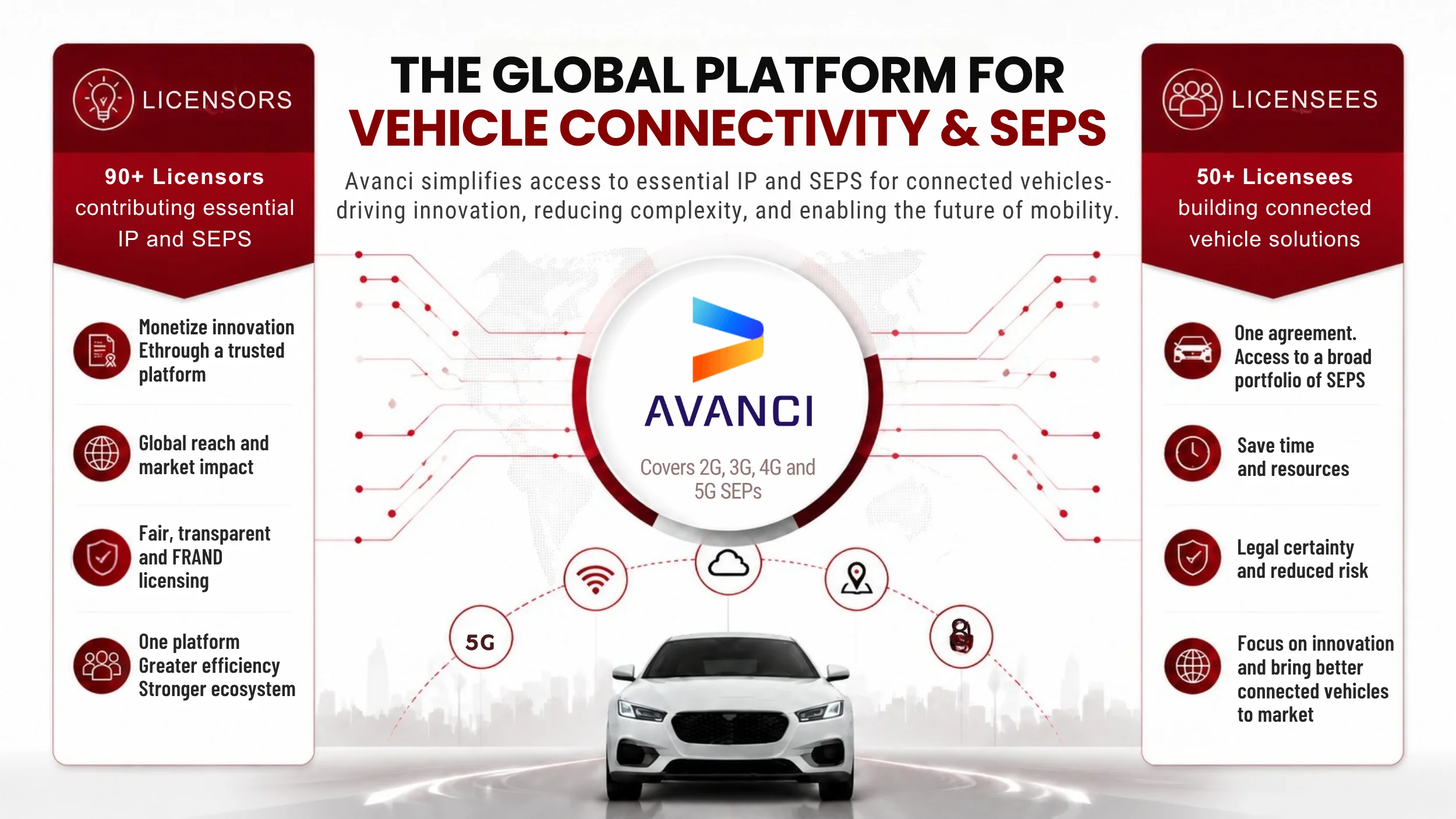
For organizations seeking a deeper understanding of patent pool structures and licensing models, patent pools continue to play a pivotal role in simplifying SEP access and reducing licensing friction.
From Litigation to Licensing: The Commercial Reality
Many of today’s most significant licensing agreements were preceded by litigation.
Over the past decade, the automotive industry has witnessed a growing number of disputes involving SEP holders and vehicle manufacturers as courts and regulators grappled with questions surrounding FRAND licensing, royalty calculations and licensing frameworks.
Notable examples include:
While these disputes often attract attention, they also reveal an important trend: the industry is increasingly moving toward negotiated licensing solutions rather than prolonged litigation.
Major automakers including Toyota, Honda, Nissan, Ford, BMW, Mercedes-Benz and Stellantis, Audi and Porsche have embraced licensing frameworks via Avanci that provide access to essential technologies while reducing commercial uncertainty.
The evolution from litigation to collaboration reflects a broader industry realization that licensing agreements often deliver greater value than extended legal battles.
The Economics of Connected Vehicle Licensing
At its core, patent licensing represents one of the most scalable business models in technology.
For innovators, licensing provides recurring royalty revenue that helps recover investments made in research, standards participation and technology development.
For automakers, licensing costs often represent only a small fraction of total vehicle value while enabling critical capabilities such as connectivity, navigation, remote diagnostics, infotainment and software-defined functionality.
The economics become particularly compelling when viewed at industry scale.
Licensing programs covering standardized communication technologies may generate only tens of dollars per connected vehicle yet when applied across millions of vehicles annually, they create multi-billion-dollar licensing markets.
This dynamic illustrates why both licensors and licensees increasingly view licensing as a strategic business function rather than a legal obligation.
Must Read: Licensing is not solely a risk mitigation tool. It can also accelerate innovation and unlock new revenue streams. Learn more about the strategic benefits of In-Licensing and Out-Licensing across technology-driven industries.
Emerging Challenges in Automotive Licensing
Despite significant progress, automotive licensing continues to face several challenges.
FRAND Interpretation: Differences in royalty valuation methodologies continue to generate disputes regarding what constitutes fair and reasonable compensation.
Licensing Level Debates: Questions surrounding component-level versus vehicle-level licensing remain areas of discussion across the industry.
Global Jurisdictional Differences: Licensing enforcement strategies and SEP jurisprudence vary significantly across jurisdictions, creating additional complexity for multinational organizations.
Increasing Patent Density: As connected vehicles integrate more technologies, the number of potentially relevant patents continues to grow, further increasing licensing complexity.
The Next Licensing Frontier: From Connectivity to Intelligence
While current automotive licensing discussions are largely centered around cellular communication technologies, the next wave of innovation is expected to expand licensing activity into entirely new domains.
Must Read: Many of the technologies expected to influence future automotive licensing strategies, including AI, autonomous systems, connected mobility and software-defined vehicles are discussed in our review of Innovative Technology Trends Driving the Automotive Industry.
As automotive technology trends continue to evolve, companies must prepare for a future in which intellectual property strategy extends far beyond wireless connectivity.
The organizations that proactively identify emerging licensing obligations and strategic partnership opportunities will be best positioned to lead the next generation of mobility innovation.
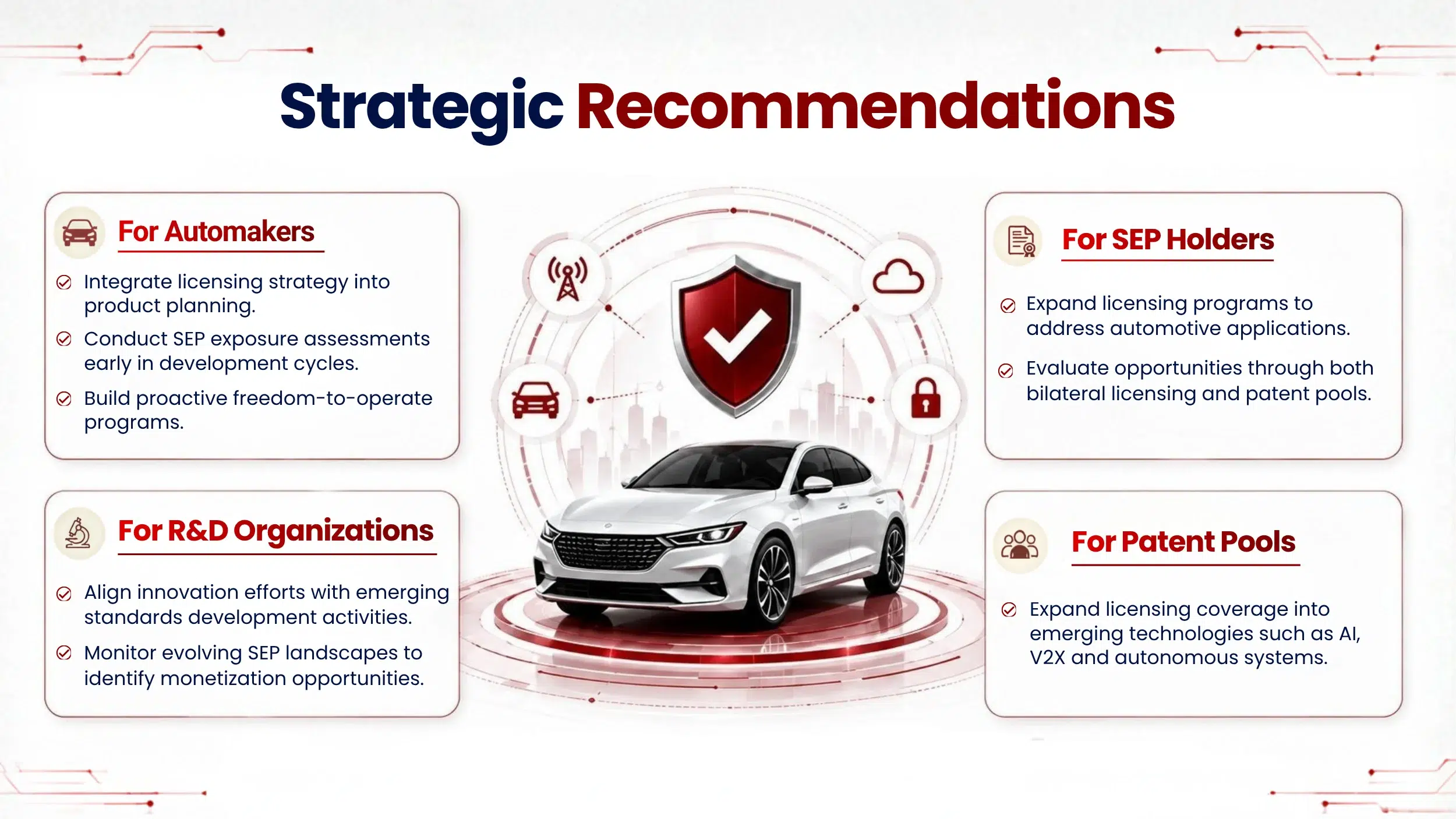
Key Strategic Recommendations
Conclusion: The Real Engine of Tomorrow’s Mobility
The automotive industry is no longer competing solely on engineering excellence.
As vehicles become increasingly connected, software-defined, electric and autonomous, access to essential technologies through strategic licensing has emerged as a critical competitive advantage.
The billion-dollar handshake represents far more than a legal agreement. It is a mechanism that enables innovation, supports interoperability, reduces commercial uncertainty and facilitates collaboration across industries.
For automakers, licensing provides access to technologies that power the next generation of mobility. For technology innovators, it creates pathways to monetize decades of research and development. For the broader ecosystem, it enables continued advancement toward a more connected and intelligent transportation future.
As mobility continues to evolve, the organizations that effectively leverage intellectual property, collaborative licensing frameworks and forward-looking innovation strategies will be best positioned to shape the future of the automotive industry.
Authored by: Amit Pundir
Connected vehicles rely on standardized communication technologies such as 4G LTE, 5G, Wi-Fi and Vehicle-to-Everything (V2X) communication. These technologies are protected by Standard Essential Patents (SEPs), making licensing a necessity for manufacturers that implement industry standards. Obtaining SEP licenses helps automotive companies reduce infringement risks, ensure freedom to operate and bring connected vehicles to market with greater legal certainty.
Patent pools simplify licensing by allowing multiple patent owners to aggregate their patents into a single licensing platform. Instead of negotiating individual agreements with numerous SEP holders, automakers can obtain access to relevant technologies through a single license. This reduces transaction costs, accelerates negotiations and minimizes licensing complexity across connected vehicle ecosystems.
The adoption of 5G and V2X technologies is significantly increasing the number of patented technologies integrated into modern vehicles. As automakers deploy advanced connectivity features, autonomous driving capabilities and real-time vehicle communication systems, the importance of SEP licensing continues to grow. This trend is expected to drive further collaboration between automotive manufacturers, telecom companies, and patent holders.
Some of the most significant challenges include determining FRAND royalty rates, navigating patent thickets, managing global licensing obligations, addressing component-level versus vehicle-level licensing debates and evaluating participation in patent pool programs. As vehicles become increasingly connected and software-defined, licensing complexity is expected to continue evolving.
Automotive companies can mitigate licensing risks by conducting SEP exposure assessments early in product development, performing Freedom-to-Operate (FTO) analyses, monitoring standards-related patent activity, engaging in proactive licensing negotiations and evaluating patent pool participation where appropriate. Integrating intellectual property strategy into product planning can help reduce legal uncertainty and support faster commercialization of connected vehicle technologies.
The Best Decisions Start With Better Intelligence.
Connect the dots across technology, markets, competition and innovation with research designed to support strategic decision-making.