The World Has Better Sunscreen. America Isn’t Allowed to Have It.
PAST (1999–2024)
The Freeze : The FDA approved its last new UV filter in 1999. While Europe and Asia built a library of 30+ modern, photostable filters, Americans were left with unstable avobenzone and zinc oxide’s white cast.
PRESENT (2025–2026)
The Crack: In December 2025, after a 20-year campaign by DSM-Firmenich, the FDA proposed approving bemotrizinol (BEMT), the first new US sunscreen filter in 26 years. Final approval expected June 2026.
FUTURE (2026–2030)
The Cascade: BEMT is only the beginning. Bisoctrizole, Mexoryl XL, and Uvinul-A Plus are next. The industry’s biggest innovation cycle in decades begins.
THE PROBLEM
Walk into a pharmacy in Paris, Seoul, or Tokyo and buy an SPF 50 sunscreen. Now do the same in Chicago. The numbers on the bottles are identical, the protection inside is not. Here is a fact that most consumers don’t know: The same La Roche-Posay Anthelios sunscreen sold in Paris contains completely different active ingredients from the one sold in New York. This is not a supply chain quirk. It is a direct consequence of how the United States regulates sunscreens. In the US, sunscreens are classified as over-the-counter (OTC) whereas in the EU, sunscreens are regulated as cosmetics and this five-letter difference created a 26-year innovation freeze that left Americans with weaker UV protection, less elegant formulas, and a growing grey market of consumers importing better sunscreens from abroad.
South Korea and Japan follow more innovation-friendly regulatory frameworks. South Korea classifies sunscreens as functional cosmetics, while Japan regulates them as cosmetics or quasi-drugs with a strong emphasis on UVA protection through the PA rating system. These regulatory approaches have enabled the development of advanced sunscreen formulations that are widely recognized for their superior UV protection, cosmetic elegance, and consumer appeal.
The consequence is not just cosmetic inconvenience. UVA radiation — the ‘ageing ray’, penetrates deeper into skin than UVB, driving collagen breakdown, hyperpigmentation, immune suppression, and melanoma risk. The limited range of approved UVA filters in the United States, coupled with a heavy reliance on the photo-unstable filter avobenzone, has restricted access to more advanced broad-spectrum photoprotection technologies. This regulatory gap is especially concerning in a country where skin cancer remains the most frequently diagnosed cancer, underscoring the importance of access to effective and photostable UVA protection.
THE SCIENCE GAP
To understand why the UV filter gap matters, it is important to first understand what constitutes effective UV protection. Ultraviolet radiation arrives in two relevant bands: UVB (280–315 nm), the burning ray that causes sunburn and surface skin cancer, and UVA (315–400 nm), the ageing ray that penetrates to the dermis and drives long-term photo-damage. An ideal sunscreen should deliver broad-spectrum protection against both UVA and UVB radiation, demonstrate high photostability under solar exposure, and exhibit low systemic absorption while maintaining a strong safety profile. This is precisely what modern filters like bemotrizinol achieve — and what the FDA’s approved palette struggles to deliver alone.
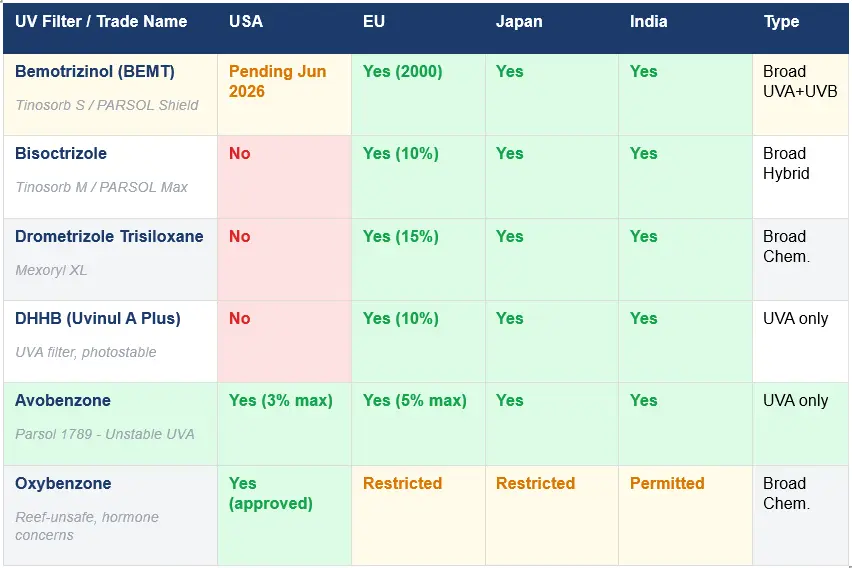
Avobenzone — the FDA’s only approved full-spectrum chemical UVA filter — is notoriously photo-unstable, can degrade upon prolonged exposure to sunlight, necessitating the use of complex stabilizing systems to maintain efficacy. In contrast, European formulators have access to advanced filters such as Bemotrizinol (BEMT), a highly photostable broad-spectrum UV filter that provides effective protection across both UVA and UVB wavelengths.
THE 26-YEAR ODYSSEY
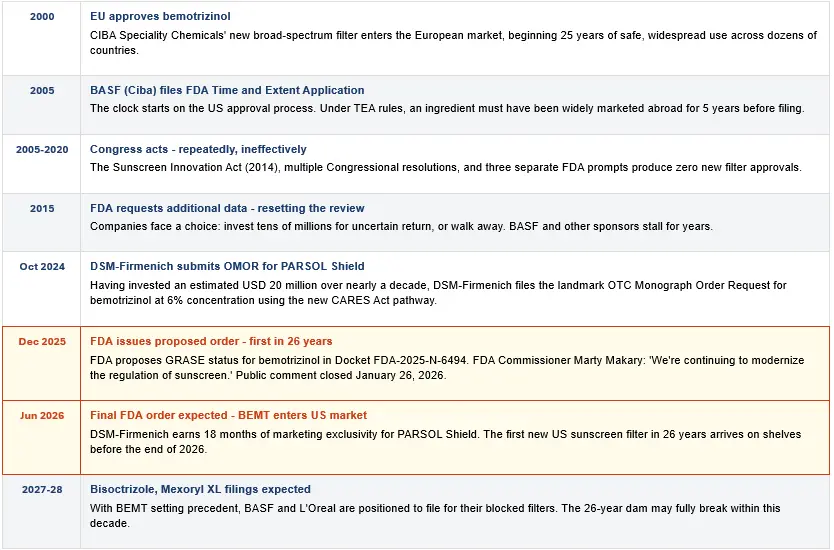
The story of how bemotrizinol finally reached the doorstep of US approval is one of the most instructive case studies in regulatory dysfunction in modern consumer safety history.
WHAT BEMT ACTUALLY DOES
The significance of Bemotrizinol (BEMT) for the U.S. sunscreen market cannot be overstated. With absorption peaks in both the UVB and UVA regions, BEMT provides broad-spectrum protection through a single highly photostable molecule, reducing reliance on complex stabilization systems. Its high molecular weight results in minimal skin penetration, aligning well with FDA safety expectations. In addition, BEMT is oil-soluble, highly formulation-compatible, and effective at relatively low concentrations, allowing formulators greater flexibility to incorporate antioxidants, sensorial enhancers, and skincare-active ingredients.
In practical terms, BEMT has been a key enabler of the lightweight, elegant sunscreen formulations that have become synonymous with European and Asian markets. Its introduction into the United States creates an opportunity for American formulators to develop products with improved protection, photostability, and consumer aesthetics that more closely align with global sunscreen innovation standards.
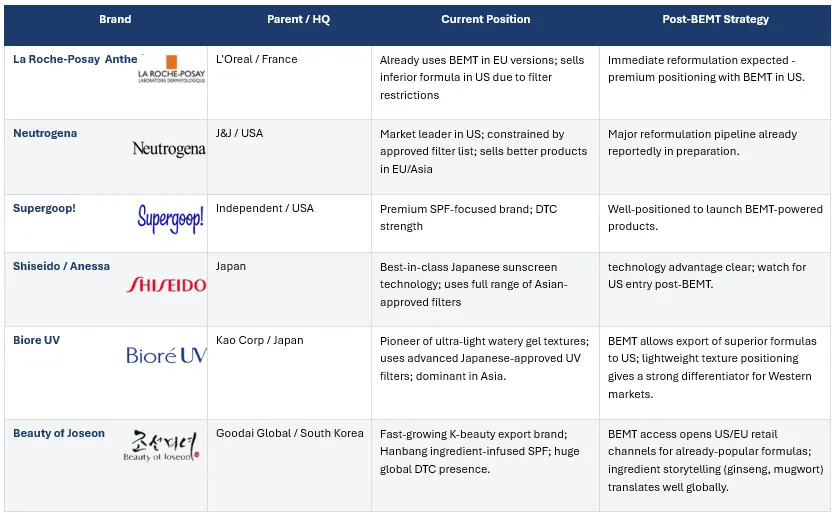
The approval of BEMT is expected to reshape competition in the U.S. sunscreen market. Brands such as La Roche-Posay, Neutrogena, and Supergoop! are well-positioned to rapidly reformulate and strengthen their premium sun care portfolios. Meanwhile, international leaders including Biore UV, Beauty of Joseon, and Anessa may gain new opportunities to introduce formulations closer to those already sold in Asia and Europe, increasing competitive pressure and accelerating innovation across the U.S. sunscreen category.
THE LOOPHOLE NOBODY SAW COMING
When regulations can’t keep up with science, the industry finds its own way around them. In the US sunscreen market, that way around has a name: SUNSCREEN DOPING — and it is far more widespread than most consumers realize. Sunscreen doping refers to the practice of incorporating UV-absorbing compounds into the *inactive ingredient* list of a formulation, bypassing the FDA’s requirement for approval as active sunscreen ingredients. Compounds such as butyloctyl salicylate and ethyl ferulate can enhance UV protection despite being classified as inactive ingredients. Their use highlights a regulatory grey area, raising concerns about transparency and oversight while underscoring the limitations of the current U.S. UV filter framework.
INNOVATIONS TRENDS RESHAPING SUNSCREEN INDUSTRY
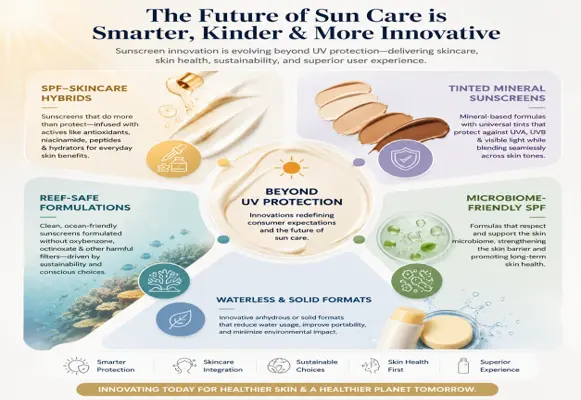
Sunscreen innovation is rapidly evolving beyond traditional UV protection. Key trends include SPF-skincare hybrids that combine sun protection with skincare benefits, tinted mineral sunscreens offering visible light protection and improved skin-tone compatibility, reef-safe formulations driven by sustainability concerns, microbiome-friendly SPF designed to support skin health, and waterless or solid formats that enhance portability while reducing environmental impact. Together, these innovations are redefining consumer expectations and shaping the future of sun care.
KEY TAKEAWAYS FOR BEAUTY BRANDS AND FORMULATORS
The BEMT First-Mover Window Is Narrow : DSM-Firmenich’s 18-month exclusivity means brands without supply agreements or active reformulation pipelines are already behind. Those who move now will own premium SPF positioning for the better part of two years.
K-Beauty Is Coming for the US Market: Biore UV and Beauty of Joseon have been locked out of the US by regulatory restrictions on their best UV filters. As barriers ease, these brands bring superior textures, advanced filter technology, and fierce consumer loyalty — directly into the mid-market SPF segment.
Consumer Education Is the New Brand Differentiator : The US–EU UV filter gap is already mainstream on social media. Brands that communicate transparently about their formulations and the science behind next-generation filters like BEMT will convert consumer awareness into measurable brand loyalty.
SPF Numbers Alone No Longer Win:High SPF is table stakes. Future market leaders will compete on comprehensive photoprotection — UVA depth, photostability, skin health integration, and environmental credentials — building a competitive advantage that a single number on a label never could.
Reformulation Is Not Optional: It Is Urgent Every brand still relying on avobenzone-based stabilizer systems is carrying formulation risk into a market that is about to change overnight. BEMT offers a photostable, elegant alternative. Brands that wait for competitors to move first will find themselves permanently playing catch-up.
Sustainability Will Separate the Leaders from the Laggards : Reef-safe bans on oxybenzone and octinoxate are expanding globally. Consumers, retailers, and regulators are aligning. Brands that embed environmental responsibility into their formulation strategy now — not as marketing language, but as genuine R&D commitment — will define the next era of sun care.
For 26 years, the regulatory gap between US sunscreen and the rest of the world has been a footnote in dermatology journals. In 2026, it becomes front-page business news. The brands, formulators, and markets that move fastest — armed with the science, the regulatory intelligence, and the right ingredient partnerships — will define sun protection for the next generation. The window is open. The question is who walks through it first.