Ratchet Wrench Patent Analysis | Prior Art Search Case Study

Is Patent Literature Alone Enough to Understand Ratchet Wrench Innovation?

A structured state-of-the-art investigation combined patent and non-patent intelligence to map emerging ratchet wrench technologies.

Type State-of-the-Art (SOA) Analysis
Industry Mechanical Tools
Published 27 July, 2026
ratchet wrench technology image

The Client's Challenge

Modern ratchet wrench designs continue to evolve through incremental mechanical improvements that enhance precision, durability, usability and operational efficiency. While many innovations are protected through patents, others become publicly known through technical publications, commercial product documentation, engineering demonstrations and industry resources.

The client sought a comprehensive State-of-the-Art (SOA) analysis that would consolidate these diverse sources into a unified view of current ratchet wrench technologies. Rather than limiting the investigation to patent literature, the objective was to identify and evaluate both patented and publicly disclosed engineering developments relevant to modern ratchet wrench design.

A broad investigation was necessary because individual references often describe only specific aspects of a mechanism or product. Developing a complete understanding of contemporary innovation therefore required systematically examining multiple technical sources while organizing the findings according to their underlying engineering principles.
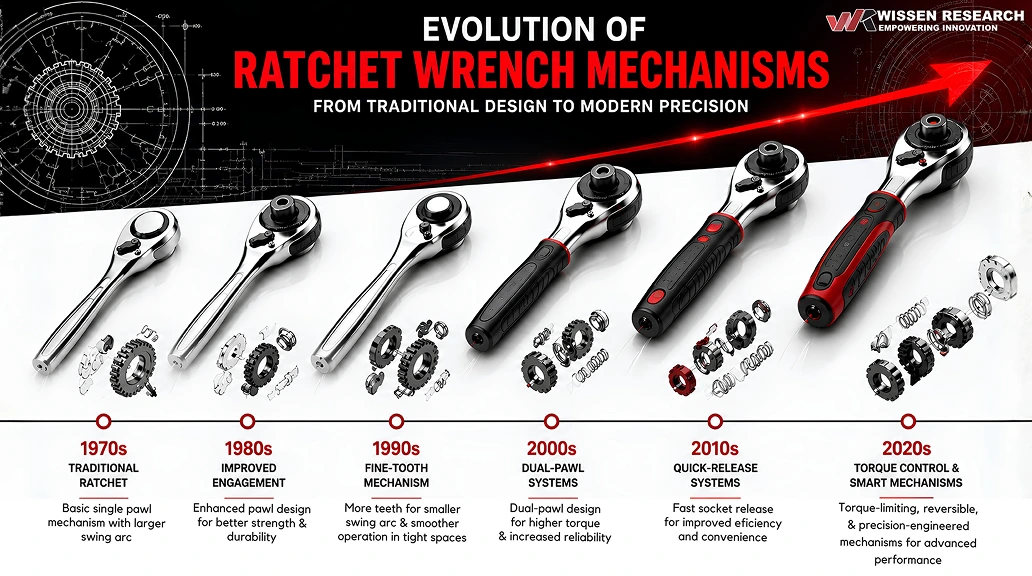
Evolution of ratchet wrench mechanisms chart

The investigation focused on identifying publicly available technical disclosures including:

    • Fine-tooth ratchet mechanisms for reduced swing angles.
    • Dual-pawl engagement systems designed to improve torque transmission and durability.
    • Quick-release socket retention mechanisms for faster operation.
    • Reversible ratcheting systems enabling efficient directional switching.
    • Torque-limiting mechanisms intended to improve fastening consistency and prevent over-tightening.
Objective icon
CLIENT’S OBJECTIVE

To identify innovations and understand how they collectively represent the current state of mechanical engineering within the ratchet wrench industry.

Clients come to us for answers.
They leave with opportunities they didn’t know existed.

Our experts help organizations uncover insights, opportunities and strategic directions that traditional approaches often miss.

Wissen Out-of-the-Box Approach:

Integrated Patent & Non-Patent Technology Intelligence

  • Recognizing the limitations of reviewing patents and technical literature independently, the investigation evolved beyond a conventional document-centric search strategy.
  • To establish a more comprehensive understanding of ratchet wrench innovation, the analysis expanded beyond identifying individual references and focused on constructing an integrated technology landscape. This required correlating patent disclosures with publicly available non-patent literature to capture engineering developments that were often distributed across different sources.
  • Rather than treating patents and non-patent publications as separate streams of information, both were evaluated together to understand how modern ratchet wrench technologies had progressed in design, functionality and practical implementation.

Our Methodology

Traditional Search Limitations
Client Requirement Analysis
Patent & Non-Patent Search Strategy
Iterative Search Refinement
Technology Intelligence Expansion
Technology Categorization
Traditional Search Limitations
  • Patent and non-patent information distributed across numerous sources
  • Different terminology describing similar engineering concepts
  • Technology trends difficult to identify from isolated references
  • Commercial product innovations often documented outside patent literature
  • Individual document review provided limited visibility into overall technology evolution
Client Requirement Analysis
  • Review client disclosure
  • Identify core engineering requirements
  • Define investigation scope
  • Establish primary technology themes
Patent & Non-Patent Search Strategy
  • Develop structured keyword combinations
  • Identify relevant IPC/CPC classifications
  • Execute searches across patent databases
  • Investigate complementary non-patent resources
Iterative Search Refinement
  • Screen retrieved references
  • Expand technical keywords
  • Refine classification searches
  • Improve search precision through iterative analysis
Technology Intelligence Expansion
  • Perform assignee-based investigations
  • Conduct citation analysis
  • Execute similarity searches
  • Identify related engineering developments
Technology Categorization
  • Organize references by functional mechanisms
  • Compare engineering approaches
  • Identify recurring innovation themes
  • Establish current technology landscape
Outcome

A structured State-of-the-Art landscape integrating patent and non-patent intelligence, providing a comprehensive understanding of contemporary ratchet wrench technologies and their underlying engineering evolution.

Technical Investigation Methodology

The investigation followed a systematic process designed to capture both patented innovations and publicly disclosed engineering developments across the ratchet wrench ecosystem.

Evolution of ratchet wrench mechanism Methodology

Technical Challenges Addressed Through Integrated Technology Intelligence

Challenge 1: Building a Complete View of Ratchet Wrench Innovation Across Dispersed Technical Sources

One of the primary challenges was developing a comprehensive understanding of current ratchet wrench technology when relevant engineering knowledge was distributed across patents, academic publications, manufacturer documentation, technical articles and publicly available demonstrations.

Solution

Rather than relying on isolated document review, the investigation adopted an integrated technology intelligence approach that combined patent and non-patent literature within a unified analysis framework.

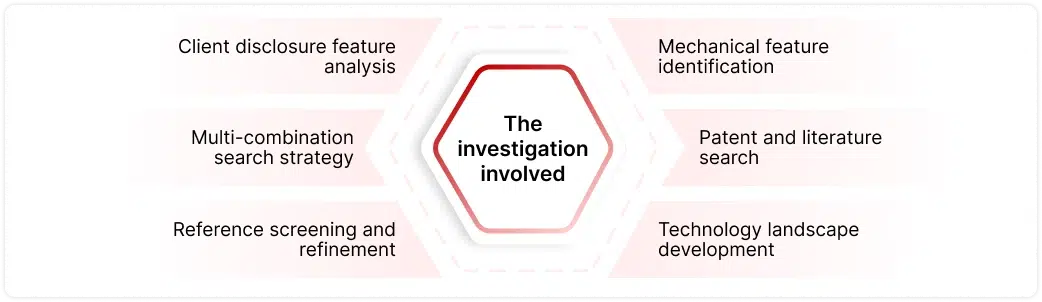
The investigation involved:
  • Reviewing patent and non-patent references in parallel.
  • Expanding search strategies through iterative keyword refinement.
  • Performing citation and similarity analysis to identify related developments.
  • Conducting assignee-based investigations.
Challenge 2: Distinguishing Meaningful Engineering Trends from Individual Design Variations

A second challenge involved identifying broader technology trends within a large collection of individual patents and technical disclosures. Many references described incremental improvements to ratchet wrench mechanisms. Evaluating each document independently made it difficult to determine which innovations represented recurring engineering directions and which reflected isolated product implementations.

Solution

To address this challenge, the investigation classified references according to their underlying mechanical functionality rather than their publication characteristics. Each relevant disclosure was evaluated based on its contribution to core engineering mechanisms before being grouped into technology categories representing common design objectives.

The investigation identified:
  • Fine-tooth ratchet mechanisms for reduced swing angles and improved accessibility.
  • Dual-pawl systems designed to improve torque transmission and operational durability.
  • Quick-release mechanisms enabling faster socket replacement.
  • Reversible ratcheting systems supporting efficient directional changes.
  • Torque-limiting mechanisms intended to improve fastening consistency.

Organizing the investigation around engineering functionality transformed a large volume of technical information into a structured technology landscape that more clearly illustrated the evolution of modern ratchet wrench design.

Results & Business Impact

The completed State-of-the-Art analysis provided a comprehensive overview of current ratchet wrench technologies by integrating patent intelligence with publicly available technical information.

Key Outcomes

    • Comprehensive investigation across patent and non-patent literature.
    • Identification of major engineering developments in modern ratchet wrench technology.
    • Technology categorization based on functional mechanical mechanisms.
    • Expanded investigation through keyword refinement, citation analysis, similarity searching, and assignee analysis.
    • Structured mapping of engineering trends supporting future technology assessment.
Strategic Business Impact

By integrating multiple sources of publicly available technical information, the investigation provided a broader perspective on ratchet wrench innovation in:

  • Understanding current engineering trends.
  • Benchmarking competing technology approaches.
  • Identifying areas of concentrated innovation.
  • Recognizing opportunities for future product differentiation.
  • Supporting research, development and technology planning activities.

The investigation demonstrated that combining patent intelligence with non-patent technical evidence produces a more complete understanding of engineering evolution across mature product categories.

Explore the Full Technology Landscape Before Building What’s Next

Our State-of-the-Art analyses deliver structured technology insights that support product development, competitive benchmarking and strategic planning.