
Invalidation Case Study: Ibrutinib - Wissen Research

Can Clinical Trial Records Become Prior Art for a Cancer Drug Patent Invalidation?

By integrating patent intelligence with clinical trial evidence, the investigation identified pre-priority disclosures relevant to the validity of a BTK inhibitor patent.

Case Study Type Patent Invalidation Search
Industry Pharmaceuticals
Publication Date 05 August, 2026
Ibrutinib a Cancer Drug Patent Invalidation image

The Client's Challenge

A client sought support in evaluating the validity of a pharmaceutical patent directed to a Bruton’s tyrosine kinase (BTK) inhibitor developed for the treatment of cancer. The patent claimed a specific chemical entity together with its therapeutic application and a dosage regimen intended for adult patients, making the claimed invention considerably narrower than earlier disclosures relating to BTK inhibition as a broader therapeutic class.

The objective of the investigation was to identify publicly available evidence predating the patent’s priority date that disclosed the claimed therapeutic approach, either explicitly or through technically supported prior art capable of challenging the patent’s novelty and non-obviousness. Achieving this objective required determining whether the critical technical disclosures existed within conventional patent literature or whether they were documented elsewhere within the broader pharmaceutical innovation ecosystem.
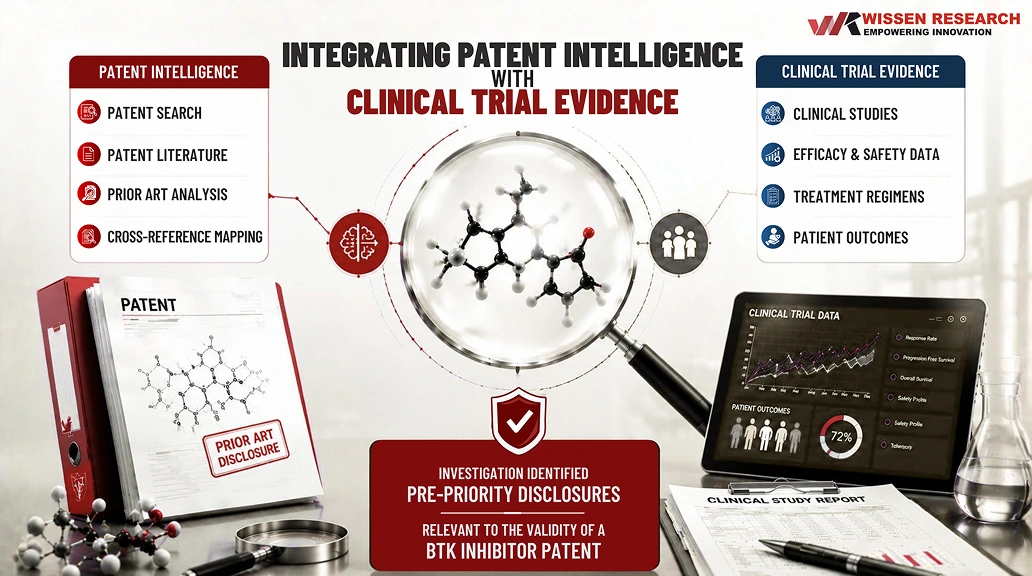
Patent intelligence clinical trial evidence

The investigation focused primarily on determining whether prior art disclosed:

    • A specific Bruton’s tyrosine kinase inhibitor for cancer treatment.
    • The claimed chemical structure corresponding to the patented compound.
    • Therapeutic administration for oncology indications.
    • Adult dosage within the claimed therapeutic range of approximately 40 mg to 100 mg per day.
    • Public availability of these disclosures before the patent’s effective priority date.
    • Evidence sufficient to support a robust patent validity assessment.
Objective icon
CLIENT’S OBJECTIVE

Identify prior art capable of challenging the novelty and inventive step of a patent covering a specific Bruton’s tyrosine kinase (BTK) inhibitor and its therapeutic dosage for cancer treatment.

Clients come to us for answers.
They leave with opportunities they didn’t know existed.

Our experts help organizations uncover insights, opportunities and strategic directions that traditional approaches often miss.

Wissen's Out-of-the-Box Approach:

From Conventional Prior Art to Clinical Development Intelligence

  • Recognizing the limitations of conventional patent and literature searching, the investigation expanded beyond traditional documentary prior art analysis.
  • To enable a more comprehensive assessment of publicly available prior art, the investigation incorporated evidence from the pharmaceutical innovation lifecycle, focusing on information that was:
  • Publicly available before the patent's priority date
  • Associated with organizations actively developing BTK inhibitors
  • Technically relevant to the claimed compound, therapeutic use and dosage regimen

Identifying Relevant Prior Art

  • A focused investigation was conducted to trace the development of Bruton’s tyrosine kinase (BTK) inhibitors across the pharmaceutical innovation landscape.

  • The expanded investigation ultimately identified a pre-priority clinical trial record describing Ibrutinib for the treatment of chronic lymphocytic leukemia (CLL).

  • For this investigation, the clinical trial record became the critical piece of evidence that conventional searches had failed to uncover.

Our Methodology

Traditional Search Limitations
Innovation Ecosystem Analysis
Clinical Development Intelligence
Traditional Search Limitations
  • Conventional patent and scientific literature searches identified fragmented disclosures.
  • Exact compound, Markush and dosage searches did not reveal a single anticipatory reference.
  • Traditional search methods provided limited support for a robust novelty challenge.
Innovation Ecosystem Analysis
  • Reviewed patent portfolios, patent families, and prosecution histories.
  • Investigated inventor publications, institutional research and scientific collaborations.
  • Performed backward citation analysis.
Clinical Development Intelligence
  • Expanded the investigation beyond patents into publicly available clinical development records.
  • Reviewed clinical trial registries, research publications, conference proceedings and related scientific disclosures.
  • Correlated therapeutic indications, dosage regimens and administration protocols with the claimed invention.
Outcome

A broader evidence-based investigation uncovered pre-priority technical disclosures that conventional pharmaceutical prior art searches had overlooked.

Technical Challenges Addressed

Challenge 1: Finding Prior Art Beyond Conventional Patent and Scientific Literature

One of the primary technical challenges was determining whether the claimed combination of the specific BTK inhibitor and its therapeutic dosage had already entered the public domain before the patent’s priority date.

Solution

The investigation expanded beyond conventional literature to analyze the broader innovation ecosystem surrounding BTK inhibitor development.

This included:
  • Analysis of leading organizations developing BTK inhibitor therapies.
  • Review of related patent portfolios.
  • Examination of inventor publications.
  • Patent family and backward citation analysis.
  • Investigation of publicly available clinical development activities.

The discovery demonstrated that important technical disclosures may become publicly available during clinical development, even when they are not comprehensively documented within conventional patent literature.

Challenge 2: Correlating Clinical Development Evidence with Patent Claims

Finding a clinical trial alone was not sufficient. The technical challenge was determining whether the publicly available clinical information was relevant to the patent claims under evaluation.

Solution

The identified clinical trial record was systematically compared against the independent patent claims.

The analysis evaluated whether the disclosed information addressed:
  • The therapeutic compound.
  • Cancer indication.
  • Adult dosage range.
  • Treatment protocol.
  • Timing of public disclosure relative to the patent’s priority date.

Each technical disclosure was independently assessed before being incorporated into the overall patent validity analysis.

Results & Business Impact

By expanding the investigation beyond traditional patent searching, the project uncovered publicly available evidence that conventional search methodologies had not identified.

Key Outcomes

    • Identified a pre-priority clinical trial describing the claimed therapeutic approach.
    • Expanded prior art coverage beyond patents and scientific literature.
    • Strengthened the technical foundation for evaluating patent validity.
    • Demonstrated the value of innovation ecosystem analysis in pharmaceutical investigations.
    • Improved confidence in the completeness of the prior art assessment.
    • Reduced the likelihood of overlooking publicly available technical disclosures.
Strategic Business Impact

This investigation illustrates how expanding prior art searches into adjacent evidence sources can provide a more comprehensive understanding of technology development and public disclosure. This broader investigative strategy offers several advantages:

  • More comprehensive prior art coverage.
  • Earlier identification of overlooked technical disclosures.
  • Stronger technical support for patent validity assessments.
  • Improved confidence in litigation and licensing decisions.
  • Better-informed intellectual property strategies.

This approach demonstrates that effective pharmaceutical patent investigations require a broader understanding of how innovation is documented throughout the drug development lifecycle.

Looking Beyond Conventional Prior Art Can Change the Outcome

Our team combines patent intelligence, scientific research and broader innovation ecosystem analysis to uncover technical evidence.