
Abaloparatide Patent Invalidity Search | Prior Art Mapping

Can Pharmaceutical Prior Art Mapping Reveal Overlooked Pathways to Challenge an Abaloparatide Patent?

A structured invalidity investigation connected fragmented peptide, formulation and analytical prior art to assess an abaloparatide patent’s validity.

Case Study Type Invalidity Search
Industry Pharmaceutical
Publication Date August 14, 2026
Drug patent Image

The Client’s Challenge

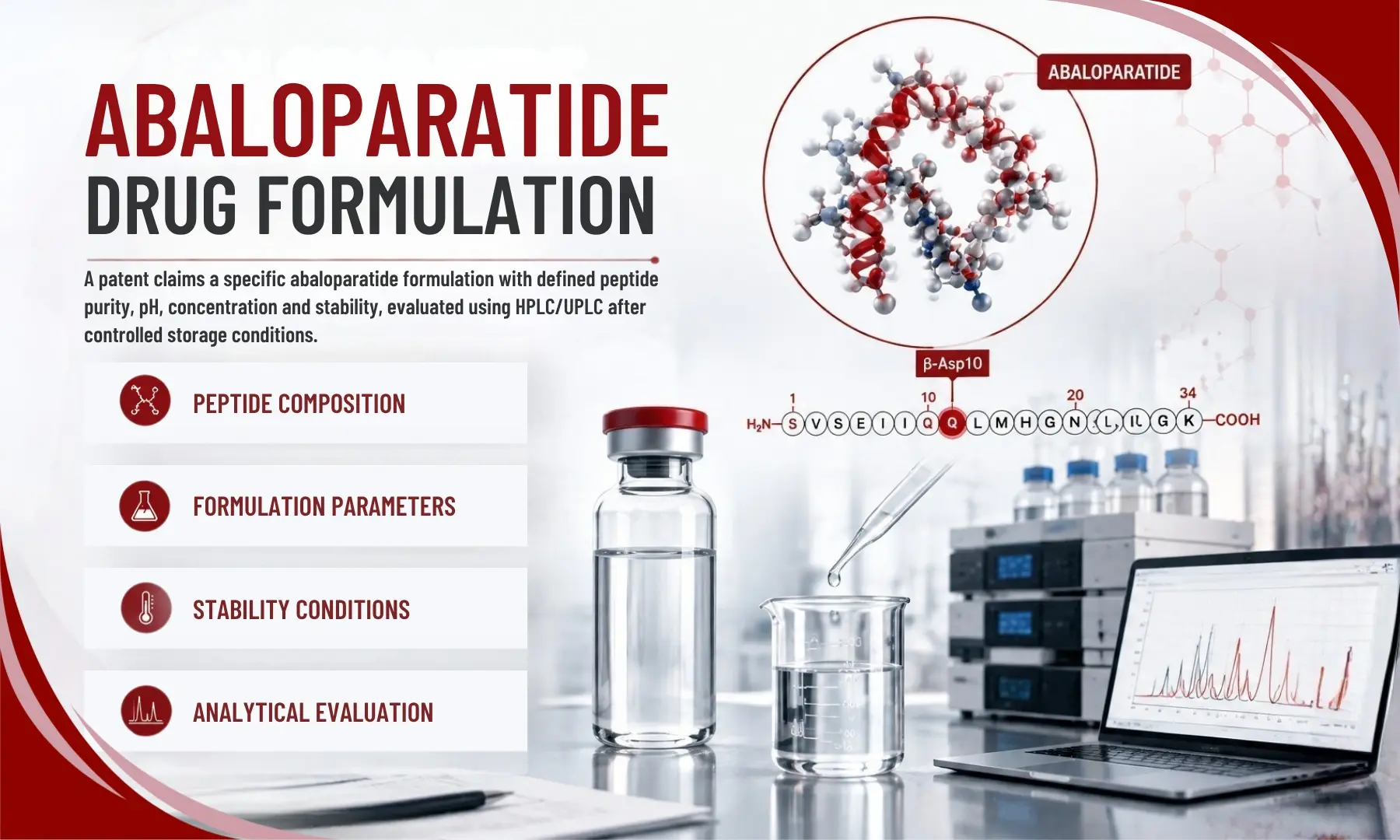
A client requested an invalidity search involving a patent related to an abaloparatide drug formulation. The claimed subject matter involved specific formulation characteristics, including the presence of beta-Asp10 related peptide content, defined pH conditions, concentration parameters and analytical evaluation using HPLC and/or UPLC methods after controlled storage conditions.

The investigation required determining whether the claimed elements represented previously disclosed technical knowledge or whether relevant teachings existed across earlier pharmaceutical and peptide research.
Abaloparatide drug formulation Image

The investigation focused on identifying disclosures related to:

    • Abaloparatide and related peptide analogs
    • Parathyroid hormone-related protein (PTHrP) derivatives
    • Beta-Asp10 formation and peptide modifications
    • Buffer-based pharmaceutical formulations
    • Stability assessment methodologies
    • HPLC/UPLC-based analytical detection approaches
Objective icon
CLIENT’S OBJECTIVE

Assess the validity of a patent related to an abaloparatide drug formulation by identifying prior art disclosures capable of challenging the claimed technical features.

Clients come to us for answers.
They leave with opportunities they didn’t know existed.

Our experts help organizations uncover insights, opportunities and strategic directions that traditional approaches often miss.

Wissen’s Out-of-the-Box Approach:

Expanding Beyond Direct Abaloparatide Disclosures

  • Recognizing the limitations of direct keyword-based searching, the investigation evolved from searching for identical disclosures toward identifying interconnected technical teachings across related pharmaceutical domains.
  • The strategy focused on understanding the technical foundation of the claimed invention rather than limiting the search to exact terminology. This involved examining:
  • Related peptide analog technologies
  • Parathyroid hormone-related protein (PTHrP) research
  • Pharmaceutical formulation approaches

Identifying Related Technical Pathways

A specialized search approach was developed to identify references beyond direct abaloparatide disclosures.

The investigation expanded into structurally and functionally related peptide technologies, including PTHrP analogs, parathyroid hormone-related peptides, peptide substitution strategies, aspartic acid modifications and formulation stabilization approaches.

Our Methodology

Patent Scope & Claim Analysis
Technical Feature Identification
Multi-Database Prior Art Search
Analog & Structure-Based Searching
Pharmaceutical Disclosure Analysis
Multi-Reference Claim Mapping
Invalidity Position Development
Patent Scope & Claim Analysis
  • Review patent claims and scope
  • Analyze prosecution history documents
  • Identify critical technical elements
Technical Feature Identification
  • Define peptide-related claim features
  • Identify formulation parameters
  • Determine analytical testing requirements
Multi-Database Prior Art Search
  • Search patent and scientific databases
  • Apply keyword and classification searches
  • Explore citation and similarity results
Analog & Structure-Based Searching
  • Search related PTHrP analogs
  • Explore peptide structural modifications
  • Conduct specialized STN searches
Pharmaceutical Disclosure Analysis
  • Examine formulation and stability teachings
  • Analyze peptide modification disclosures
  • Review HPLC and UPLC methods
Multi-Reference Claim Mapping
  • Map references against claim elements
  • Identify complementary technical disclosures
  • Correlate overlapping pharmaceutical teachings
Invalidity Position Development
  • Assess combined prior art teachings
  • Evaluate claim element coverage
  • Develop evidence-based invalidity position
Outcome

Nine relevant prior art references collectively disclosed key technical features, strengthening the assessment of potential vulnerabilities in the abaloparatide patent claims.

Technical Challenges Addressed Through Pharmaceutical Prior Art Analysis

Challenge 1: Identifying Prior Art for a Multi-Component Pharmaceutical Claim

The primary challenge was identifying prior art that disclosed the combination of technical elements associated with the abaloparatide formulation claims.

The claimed subject matter incorporated multiple parameters, including peptide composition, beta-Asp10 content, formulation characteristics, storage conditions, and analytical detection methods. However, these elements were not consistently disclosed together within a single prior art reference.

Solution

A claim-element-driven analysis was performed to deconstruct the claimed invention into individual technical components and evaluate each element against available prior art disclosures. The investigation identified multiple references that disclosed individual aspects of the claimed technology.

The analysis revealed:
  • PTHrP peptide disclosures
  • Abaloparatide analog modifications
  • Buffered formulation approaches
  • Peptide degradation analysis methods

These findings demonstrated that significant technical elements of the claimed invention were already represented within existing pharmaceutical literature.

Challenge 2: Establishing Relationships Between Fragmented Prior Art References

The identified prior art references disclosed different portions of the claimed invention. The challenge was determining whether these references could be technically correlated and whether their combined teachings addressed the claimed subject matter.

A simple collection of references was insufficient; the investigation required understanding the scientific relationship between each disclosure.

Solution

A structured reference-mapping approach was applied to evaluate the contribution of each prior art document.

The analysis:
  • Compared technical teachings
  • Identified overlapping concepts
  • Evaluated chemistry-formulation consistency
  • Assessed analytical method alignment

The investigation identified nine relevant references, with each contributing one or more technical aspects associated with the claimed invention.

Results & Business Impact

The investigation successfully identified nine technically relevant prior art references that collectively addressed significant aspects of the abaloparatide drug formulation claims.

Key Outcomes

  • Key outcome Icon

    Identified prior art covering peptide structures, formulation strategies, and analytical methods related to abaloparatide.

  • Key outcome Icon

    Established technical connections between previously fragmented pharmaceutical disclosures.

  • Key outcome Icon

    Mapped relevant references against key claim elements.

  • Key outcome Icon

    Identified potential weaknesses in the claimed combination of technical features.

  • Key outcome Icon

    Developed a stronger evidence foundation for invalidity assessment.

Strategic Business Impact

Pharmaceutical patent challenges often involve inventions that combine multiple established scientific concepts into a single claimed formulation. A conventional search approach focused only on identical disclosures may overlook important prior art relationships.

By combining:

  • Patent prosecution analysis
  • Pharmaceutical domain searching
  • Peptide chemistry investigation
  • Formulation analysis
  • Analytical method evaluation

The investigation provided a more comprehensive assessment of the patent landscape.

The investigation demonstrated the importance of connecting scientific disclosures across multiple research domains when evaluating complex pharmaceutical patents.

Need Support for Complex Pharmaceutical Patent Investigations?

Our experts help organizations uncover relevant prior art, evaluate claim vulnerabilities and develop evidence-based invalidity strategies.