
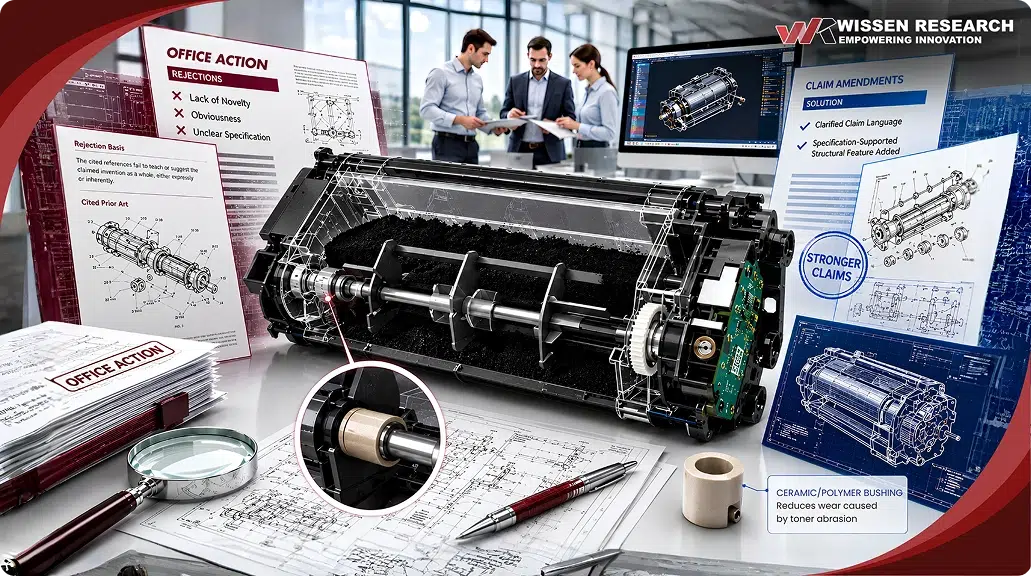
The client sought assistance in responding to an Office Action issued against a patent application directed to an image-forming apparatus, specifically a toner cartridge designed to monitor toner levels through a mechanically driven stirring mechanism. The patent application contained one independent claim and five dependent claims covering the structural configuration of the toner cartridge, the stirring mechanism, material selections for the hopper and stirring components and additional functional features integrated into the cartridge assembly. During examination, the patent examiner rejected the application on multiple statutory grounds. The combination of multiple rejection grounds created a complex prosecution scenario. The central challenge was therefore not merely to respond to the examiner’s objections, but to determine whether the application still contained patentable technical subject matter that had not yet been reflected in the claims.
The Client's Challenge
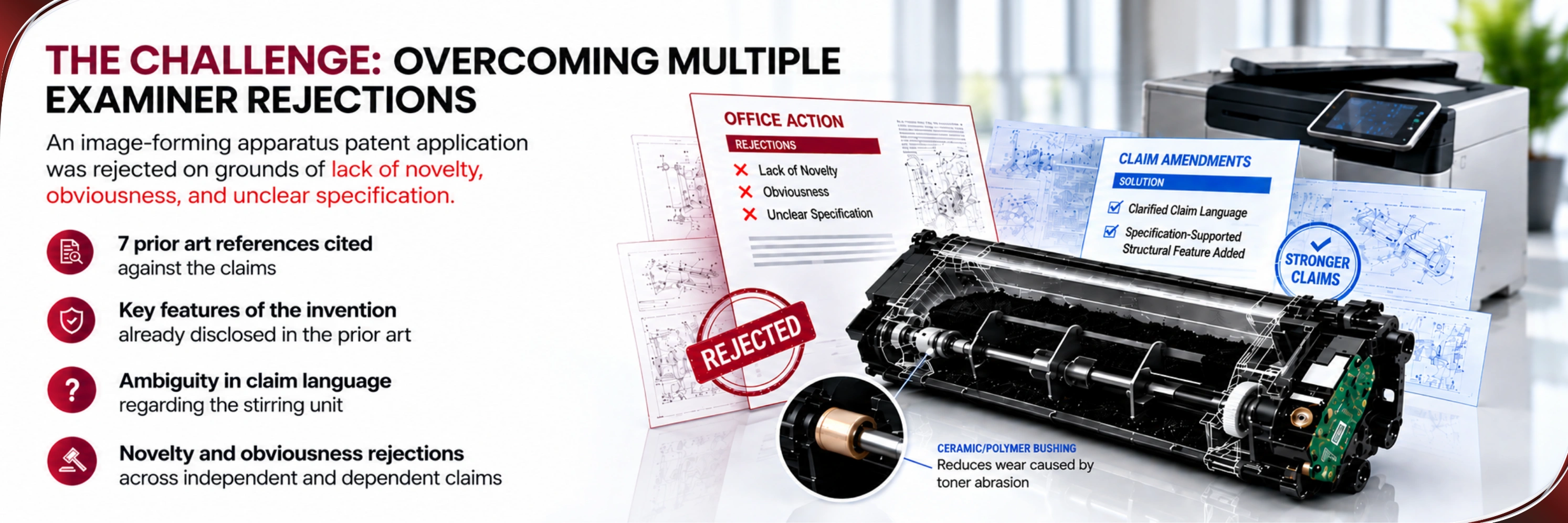
The examiner's analysis primarily focused on the following claimed features:
- A toner cartridge incorporating a stirring mechanism disposed within a toner hopper.
- Rotation of the stirring mechanism to facilitate toner-level detection.
- A detection unit configured to determine toner quantity through rotational movement of the stirring assembly.
- Material characteristics of the hopper and stirring components.
- Integration of a display within the toner hopper assembly.
- Structural relationships between the stirring mechanism and the toner detection system.

To develop a technically and legally supportable response capable of overcoming the examiner’s rejection while preserving commercially meaningful claim scope.
Evaluate each rejection issued by the examiner for technical and legal merit.
Traditional Office Action Response Approach
The analysis typically focuses on identifying claim elements that are absent from the cited prior art or demonstrating that the examiner’s combination of references is technically or legally unsupported.
Conventional Investigation Strategy
The objective is to determine whether existing claim language can be defended through legal argument or whether limited claim amendments are necessary to distinguish the invention.
Traditional Office Action Investigation Workflow

Office Action Review
- Examine statutory grounds for rejection.
- Identify claims affected by each rejection.
- Review examiner observations and cited passages.

Claim Interpretation
- Analyze independent and dependent claim scope.
- Interpret claim terminology in light of the specification.
- Identify ambiguous or unsupported claim language.

Prior Art Comparison
- Compare each claim limitation with the cited references.
- Evaluate novelty and obviousness on a feature-by-feature basis.
- Determine whether meaningful technical distinctions exist.

Specification Review
- Verify written-description support.
- Identify embodiments supporting possible amendments.
- Confirm compliance with prosecution requirements.
Response Strategy Development
- Draft arguments where distinctions exist.
- Recommend claim amendments where arguments alone are insufficient.
- Ensure amendments avoid introduction of new matter.
Outcome: Develop an Office Action response capable of overcoming the examiner’s objections while preserving the strongest defensible claim scope.
Although conventional prosecution methodologies provide a systematic framework for responding to office actions, they become significantly less effective when the examiner’s cited references collectively disclose nearly every claimed feature.

- The cited references extensively covered the structural features recited in the independent claim.
- Dependent claim limitations relating to component materials and integrated display elements were likewise disclosed within the cited art.
- The specification ambiguity surrounding the term "stirring unit" weakened the clarity of the independent claim.
- Relying solely on legal argument risked maintaining a claim scope that remained vulnerable to the cited references.
- Reviewing only the existing claims provided no viable pathway for overcoming both novelty and obviousness rejections.
Rather than attempting to defend claims already anticipated by the prior art, the analysis needed to determine whether the original specification contained additional technical disclosures capable of redefining the invention's patentable scope.
Wissen's Out-of-the-Box Approach:
Specification-Driven Claim Strategy
- Recognizing that conventional claim-by-claim arguments offered limited scope for overcoming the examiner’s rejections, the investigation evolved beyond defending the existing claim language.
- To develop a stronger and technically grounded prosecution strategy, the analysis expanded beyond the examiner’s cited references to examine the patent specification itself for overlooked technical features that could distinguish the invention.
Identifying a Specification-Supported Technical Distinction
-
A focused review was conducted across the application’s embodiments, drawings, structural configurations and detailed technical descriptions.
-
The initial analysis identified features such as split-type and detachable toner cartridges. However, these configurations were considered too general to provide a strong basis for distinguishing the claimed invention from the prior art.
-
This specification-driven approach provided a technically supported pathway to strengthen the independent claim while resolving the examiner’s concerns without introducing new matter.
Our Methodology
- Review examiner’s statutory rejections.
- Classify objections by clarity, novelty, and obviousness.
- Prioritize technical issues requiring resolution.
- Break independent claim into individual technical limitations.
- Interpret claim terminology using the specification.
- Identify ambiguous language.
- Compare each limitation against all cited references.
- Validate examiner mappings.
- Identify genuine technical distinctions.
- Assess dependent claims for incorporation into the independent claim.
- Determine whether additional limitations remain patentable.
- Eliminate features already disclosed in the cited art.
- Analyze embodiments, figures and implementation details.
- Search for unclaimed technical innovations.
- Evaluate engineering significance.
- Verify written-description support.
- Confirm absence from cited references.
- Assess technical contribution to the invention.
- Incorporate specification-supported feature.
- Resolve examiner objections.
- Preserve commercially meaningful claim scope.
Specification-Driven Claim Analysis Methodology
The investigation involved a structured technical review of the patent application to identify specification-supported features that could strengthen the claims against the examiner’s cited prior art.
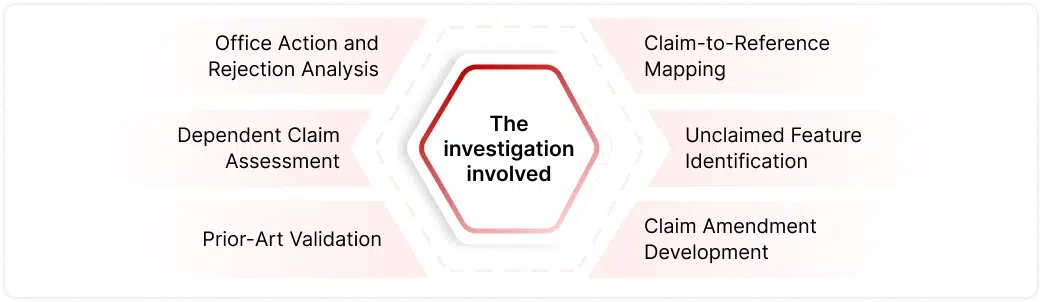
The specification-driven analysis identified a previously unclaimed ceramic or polymer bushing supporting the stirring shaft as a technically meaningful distinction.
The feature provided a specification-supported basis for amending the independent claim and strengthening the application’s position against the examiner’s novelty and obviousness rejections.
Evidence Collection & Validation
The investigation relied on multiple technical and legal evidence sources, including:
 The examiner's Office Action and rejection analysis.
The originally filed patent specification.
Patent claims and dependent claim hierarchy.
Application drawings and component illustrations.
Seven examiner-cited prior-art references.
The examiner's Office Action and rejection analysis.
The originally filed patent specification.
Patent claims and dependent claim hierarchy.
Application drawings and component illustrations.
Seven examiner-cited prior-art references.
Rather than relying on broad assertions of inventiveness, the prosecution strategy was grounded in verifiable engineering disclosure and a disciplined comparison with the prior art, strengthening the overall credibility of the proposed Office Action response.
Technical Challenges Addressed
The examiner had cited seven references against the application. Independent Claim 1 broadly covered a toner cartridge incorporating a stirring mechanism disposed within a toner hopper and a detection unit configured to determine toner level by rotating the stirring mechanism. Dependent Claims 2–6 introduced additional limitations relating to component materials and an integrated display.
The investigation needed to determine whether any of these claimed elements remained technically distinguishable over the cited art.
Rather than evaluating the references at a high level, the investigation decomposed the independent claim into individual technical components and assessed whether each element was explicitly or inherently disclosed.
- Toner cartridge architecture.
- Stirring mechanism configuration.
- Material selections.
- Auxiliary cartridge features.
This detailed comparison demonstrated that the cited references collectively disclosed substantially all of the technical features recited in both the independent and dependent claims.
Patent prosecution permits claim amendments only when they are fully supported by the original specification. Introducing features not originally disclosed would constitute impermissible new matter and could jeopardize the application.
The investigation therefore needed to determine whether the patent specification itself contained overlooked technical disclosures that were explicitly described in the original application while being technically meaningful and not disclosed in the examiner’s cited references.
A comprehensive specification review was undertaken to evaluate every embodiment, mechanical configuration, structural variation and implementation detail described in the application. The investigation continued by examining lower-level mechanical details associated with the toner stirring assembly.
- Explicit support within the original specification.
- Absence from the pending claims.
- Absence from the examiner’s cited references.
- Direct structural relationship to the claimed stirring assembly.
The recommended amendment revised the independent claim to specify that:“…the stirring frame is supported on a stirring shaft provided with a ceramic or polymer bushing.”
This amendment introduced a specific structural limitation that distinguished the claimed invention while remaining fully supported by the original disclosure.
Results & Business Impact
The investigation demonstrated that successfully responding to an Office Action is not always a matter of strengthening legal arguments. In this case, the decisive factor was identifying a technically significant feature that had been disclosed in the original specification but omitted from the claims.
Key Outcomes
-

Successfully resolved the examiner’s clarity objection by replacing ambiguous terminology with specification-supported claim language.
-
Performed a comprehensive technical assessment of all seven cited references against the independent and dependent claims.
-
Identified an overlooked structural feature disclosed in the original specification but absent from the pending claims.
-
Recommended a specification-supported amendment introducing a ceramic or polymer bushing supporting the stirring shaft.
-
Established a technically meaningful distinction over the cited prior art without introducing new matter.
-
Strengthened the patentability of the independent claim while preserving support for the dependent claims.
This investigation demonstrated how a structured review of the specification can uncover these overlooked innovations before prosecution options become limited.
- Reduced prosecution risk
- Avoided weak novelty arguments
- Preserved commercially meaningful claim scope
- Aligned claims with technical contribution
- Strengthened evidence-based prosecution strategy
For organizations managing active patent portfolios, this approach provides a practical framework for improving prosecution outcomes while minimizing unnecessary narrowing of claim scope.
Conclusion & Implications
The Office Action presented multiple challenges, including ambiguity in claim language, novelty concerns and obviousness rejections supported by seven prior-art references. Initial analysis confirmed that the cited art substantially overlapped with the claimed invention, leaving limited opportunity for successful prosecution through conventional argument alone. Rather than continuing to defend the existing claims, the investigation adopted a broader technical perspective by examining the patent specification for unclaimed innovations capable of distinguishing the invention. This approach identified a specific structural feature, a ceramic or polymer bushing supporting the stirring shaft that addressed a practical engineering problem associated with component wear and was neither claimed nor disclosed in the cited references. Incorporating this feature into the independent claim provided a technically supported amendment that resolved the examiner’s clarity concerns while strengthening the application’s novelty position. The project reinforces several broader lessons for patent prosecution: