
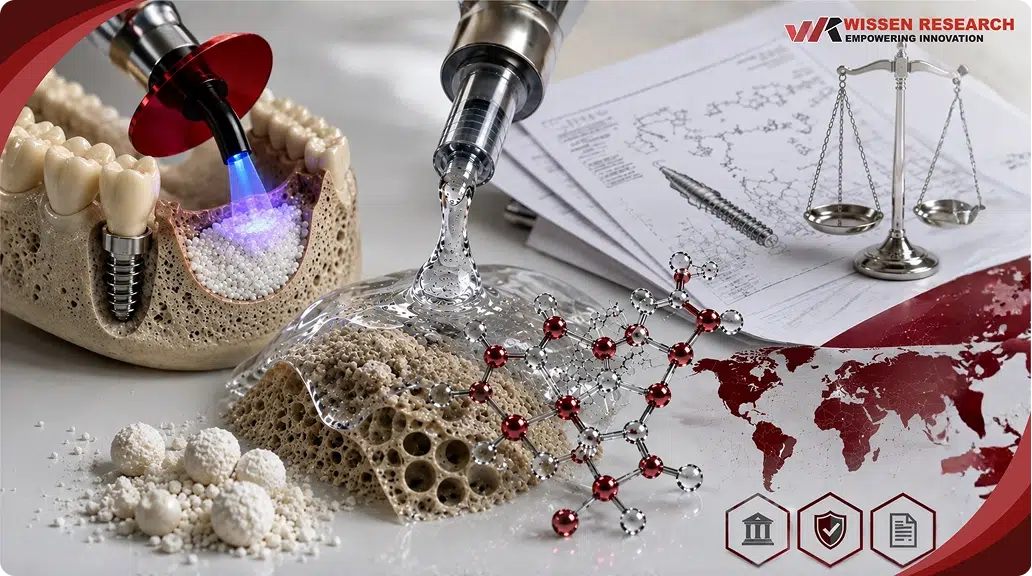
Bone Fixation FTO Search: Hidden Patent Risk Analysis

Could Building-Block Analysis Reveal Hidden FTO Risks in Bone Fixation Composition Material?

A photopolymerizable bone fixation FTO investigation uncovered hidden patent risks through feature-level claim analysis and strategic patent mapping.

Case Study Type Freedom-to-Operate (FTO) Search
Industry Medical Devices
Publication Date August 17, 2026
Bona fixation image

The Client's Challenge

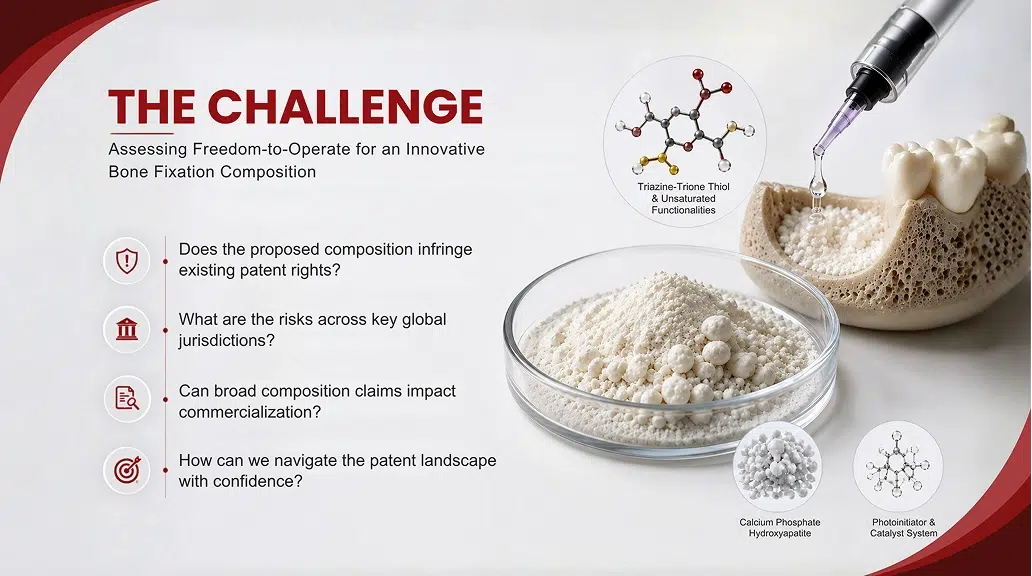
The client was preparing to commercialize a photopolymerizable resin-based composite designed for dental and bone fixation applications. Before advancing toward market launch, the client required a comprehensive Freedom-to-Operate (FTO) assessment to determine whether the proposed formulation could be manufactured and commercialized without infringing active third-party patents.

The assessment focused on jurisdictions representing key commercial markets and manufacturing interests, namely the United States, China, Germany and Japan. The challenge was determining whether any active patent broadly claimed the same combination of essential features present in the client’s product.
FTO for bone fixation composition

The following patent considerations guided the investigation:

    • Independent composition claims covering photopolymerizable resin systems.
    • Broad claims involving multifunctional thiol and ene chemistries.
    • Claims directed to triazine-trione-based crosslinking systems.
    • Resin compositions containing calcium phosphate or hydroxyapatite fillers.
    • Jurisdiction-specific patent families with active enforceable rights.
    • Claim language broad enough to satisfy the all-element rule without requiring additional limiting features.
Objective icon
CLIENT’S OBJECTIVE
  • Determine whether the client’s proposed bone fixation composition could be commercialized without infringing enforceable patent rights within the target jurisdictions.
  • Distinguish between high-risk, moderate-risk, and low-risk references based on claim scope.
  • Assess infringement risk across the United States, China, Germany and Japan.

Clients come to us for answers.
They leave with opportunities they didn’t know existed.

Our experts help organizations uncover insights, opportunities and strategic directions that traditional approaches often miss.

Wissen’s Out-of-the-Box Approach:

Feature-Level Claim Analysis for Hidden FTO Risks

  • Recognizing the limitations of conventional formulation-based searching, the investigation evolved beyond searching for patents that described the complete bone fixation composition.
  • The strategy shifted toward identifying broad patent claims covering the individual chemical building blocks and functional combinations of the proposed formulation. The investigation therefore expanded from formulation similarity to a claim-centric analysis focused on:
  • Individual Product Features
  • Chemical Building Blocks
  • Broad Independent Claims
  • Jurisdictional Patent Coverage
  • Competitor Patent Portfolios

Identifying Relevant Patent Risks

  • A focused technical and patent investigation was conducted around photopolymerizable resin systems used in dental restoration, bone fixation and related biomaterial applications.

  • The turning point came when the investigation prioritized broad independent claims satisfying the all-element rule, rather than simply ranking patents according to formulation similarity.

  • The result was a jurisdiction-specific FTO assessment identifying meaningful commercialization risks in the United States and Germany, while no comparable FTO restriction was identified in China and Japan based on the scope of the investigation.

Our Methodology

Product Feature Decomposition
Feature-Level Patent Searching
IPC/CPC Classification Integration
Competitor & Inventor Analysis
Citation & Similarity Analysis
Claim Scope Assessment
Jurisdictional Risk Assessment
Product Feature Decomposition
  • Extract essential product features
  • Identify key chemical components
  • Define functional ingredient combinations
Feature-Level Patent Searching
  • Search individual product features
  • Combine critical technical features
  • Target dental and bone applications
IPC/CPC Classification Integration
  • Identify relevant patent classifications
  • Combine classifications with keywords
  • Expand technical search coverage
Competitor & Inventor Analysis
  • Analyze competitor patent portfolios
  • Trace prolific technology inventors
  • Identify related patent families
Citation & Similarity Analysis
  • Analyze forward and backward citations
  • Identify related technical disclosures
  • Discover overlooked patent references
Claim Scope Assessment
  • Review broad independent claims
  • Map claims against product
  • Apply the all-element rule
Jurisdictional Risk Assessment
  • Verify active patent rights
  • Analyze target-country patent coverage
  • Categorize commercialization risks
Outcome

Identified high-risk patent claims covering the product’s essential features and mapped jurisdiction-specific FTO risks for commercialization.

Technical Challenges Addressed

Challenge 1

Determining Whether Broad Composition Claims Could Satisfy the All-Element Rule

One of the most significant challenges involved determining whether existing patents claimed the client’s formulation broadly enough to satisfy the all-element rule.

Solution

This analysis identified two patent families whose independent claims broadly encompassed the essential features of the formulation without introducing restrictive compositional limitations.

The analysis revealed
  • Broad Claims Aligned with Formulation
  • Essential Components Covered
  • Minimal Additional Claim Limitations
  • Strong Chemical Architecture Overlap
  • Two High-Risk Patent Families

Because these essential elements were already present within the client’s formulation, the identified patents represented substantially greater Freedom-to-Operate risks than other technically similar references containing additional mandatory claim limitations.

Challenge 2

Distinguishing High-Risk Patent Families from Technically Similar References

The investigation required a systematic method to distinguish patents posing genuine infringement concerns from those representing lower practical risk.

Solution

The analysis categorized references by commercialization risk, identifying two high-risk patent families with broad claim overlap and four moderate-risk references requiring additional limitations.

The analysis revealed
  • Broad claims increased risk
  • Additional limitations reduced risk
  • Jurisdictional analysis shaped assessment
  • Claim scope drove evaluation

This risk-based prioritization helped focus legal review and commercialization planning on patents most likely to affect market entry.

Results & Business Impact

The final investigation provided a comprehensive understanding of the patent risks associated with the client’s photopolymerizable bone fixation composition.

Key Outcomes

  • Key outcome Icon

    Identification of high-risk patent families with broad independent claims covering essential elements of the proposed formulation.

  • Key outcome Icon

    Detection of moderate-risk references containing additional claim limitations absent from the client’s composition.

  • Key outcome Icon

    Establishment of jurisdiction-specific FTO risks across the USA, Germany, China and Japan.

  • Key outcome Icon

    Claim-level mapping of product features against relevant patent disclosures to evaluate potential overlap.

  • Key outcome Icon

    Improved visibility into competitor patent activity within dental and bone fixation biomaterial technologies.

  • Key outcome Icon

    Evidence-based prioritization of patents requiring further legal review and strategic consideration.

Strategic Business Impact

By applying a claim-centric Freedom-to-Operate methodology, the investigation provided the client with actionable insights before commercial launch. The findings supported:

  • Early Infringement Risk Identification
  • High-Risk Claim Design-Around Opportunities
  • Improved Geographic Commercialization Planning
  • Reduced Biomaterial Patent Uncertainty

The investigation demonstrated that effective FTO analysis requires more than identifying similar formulations. By combining technical feature analysis, claim construction and jurisdictional evaluation, the project transformed a complex patent landscape into a focused risk assessment framework enabling the client to make strategic decisions regarding product development and market entry.

Need Support for Complex Biomaterial FTO Investigations?

Our team combines patent analysis, technical domain expertise, and structured claim evaluation to help organizations identify potential risks before they become commercial obstacles.