
Summarize this report with:



Executive Summary
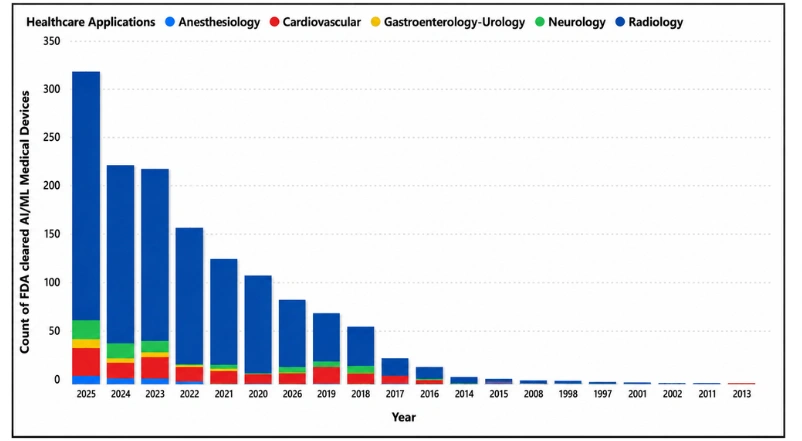
Artificial intelligence has completed its transition from an experimental medical technology to a structural feature of the global device industry. Since the FDA authorized the first AI/ML-enabled medical device in 1995, a cervical smear rescreening tool — the pace of clearances stayed nearly flat for two decades before accelerating sharply after 2016. By late the end of Q1 2026, the FDA’s AI-Enabled Medical Device List had grown to roughly 1524 entries, up from 1451 at the end of 2025 and 1250 the year before, with the agency authorizing 92 new AI-enabled devices in the first quarter of 2026 alone, a 28% jump from the previous quarter. AI’s share of all FDA 510(k) clearances rose from roughly 1 in 700 (0.14%) in 2019 to approximately 1 in 28 (3.57%) in 2025, a near 25-fold increase in relative share over six years. Hence, this is no longer a niche regulatory category, it is one of the fastest-growing segments of medical device approvals globally, and it is reshaping capital allocation, competitive strategy, and clinical workflow simultaneously.
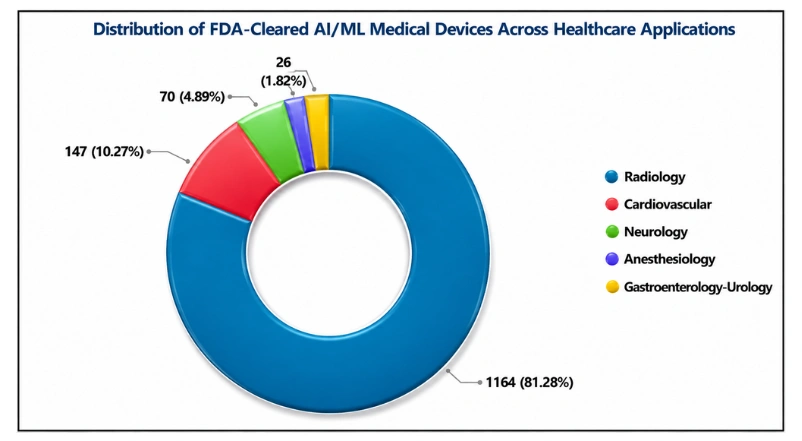
This growth is not evenly distributed. Five specialties account for the overwhelming majority of all AI/ML device authorizations: Radiology (1164), Cardiovascular (147), Neurology (70), Anesthesiology (26), and Gastroenterology-Urology (25). Together, these areas represent the clearest picture of where AI diagnostics has moved from research promise to clinical reality and where the next wave of growth is most likely to come from. Moreover, emerging technologies are expected to further accelerate the evolution of AI in healthcare. Quantum computing has the potential to increase the processing efficiency of AI-driven medical diagnostics by 10–20 times, while blockchain-based patient data management can enhance data security and reduce the risk of healthcare data breaches by more than 30%.
Generative AI is the clearest unresolved frontier. As of March 2026, no FDA-authorized device uses generative AI or is powered by a large language mode. South Korea issued the world’s first generative-AI medical device guideline in January 2025 and approved its first such device in April 2026 , and the FDA granted RecovryAI Breakthrough Device Designation for a patient-facing generative AI clinical application in March 2026 — the clearest domestic signal yet that a regulatory pathway for autonomous generative clinical AI is beginning to take shape.
-
• Radiology dominates AI device approvals, highlighting the widespread adoption of deep learning in image-based diagnostics.
-
• While radiology dominates AI device approvals, its growing maturity has created a highly competitive landscape; cardiology is witnessing faster growth as companies explore newer AI-driven diagnostic opportunities.
-
• The 510(k) pathway accounts for most AI device approvals, driven by its efficient clearance process for devices substantially equivalent to existing technologies.
-
• The regulatory “moat” is real & defensible. While most AI devices enter through the 510(k) pathway, companies achieving early De Novo authorization establish predicate devices, creating a structural advantage for future competitors.
-
• Foundation and multimodal models are the next capability jump, and are essentially unregulated so far.
-
• The FDA’s Breakthrough Device Designation for RecovryAI highlights the emergence of a regulatory pathway for autonomous generative AI in clinical care.
-
• Reimbursement, not accuracy, is the commercial unlock. Devices that clear the FDA but lack a payment pathway struggle to scale.
-
• Incumbents own distribution, startups own the algorithm. Incumbent MedTech companies hold a strong advantage through established hospital networks, regulatory expertise, and clinical workflow integration, while AI-native startups differentiate through advanced algorithms, specialized solutions, and rapid innovation.
Source: FDA
TECHNOLOGY LANDSCAPE
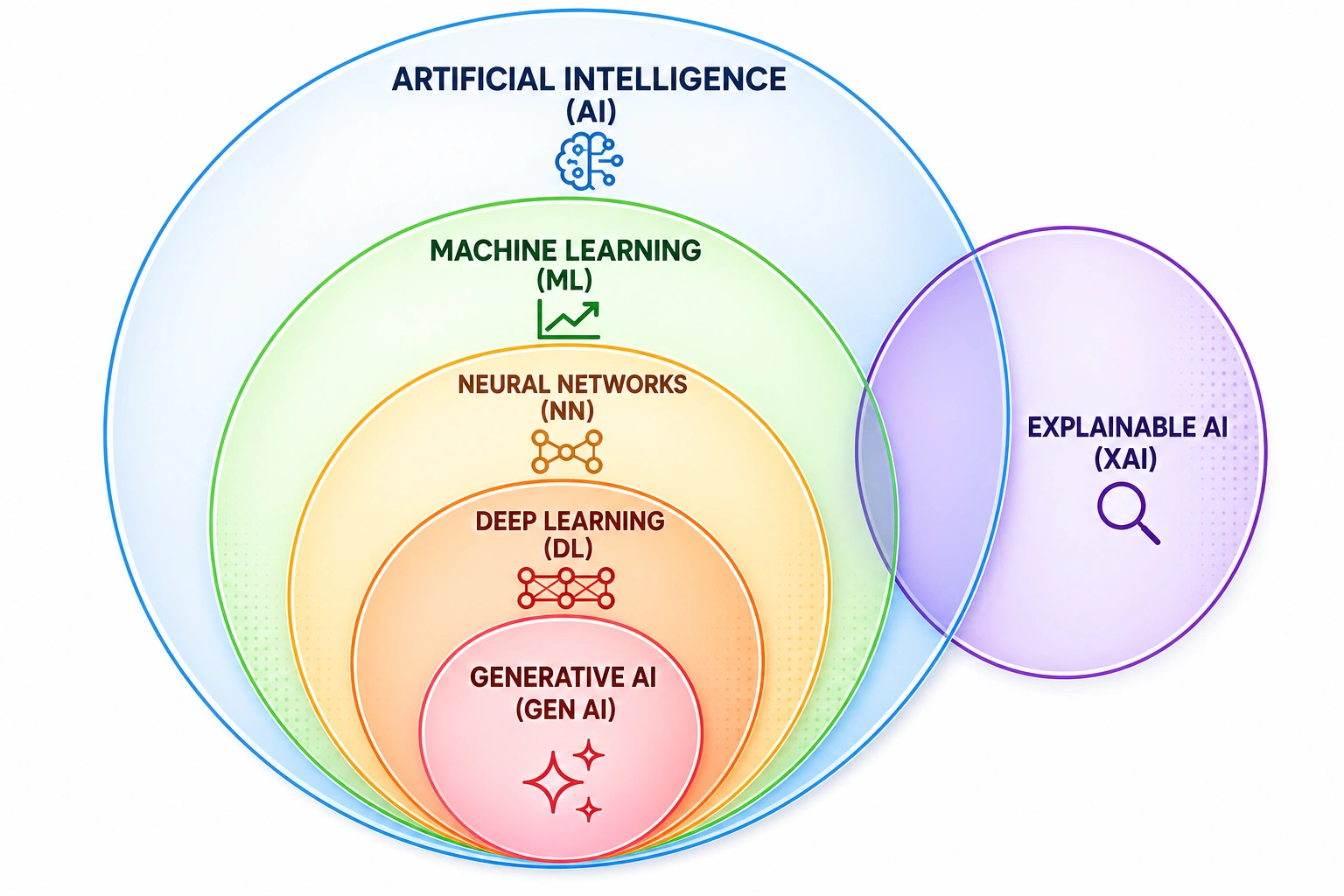 Artificial intelligence (AI) in medical devices integrates advanced algorithms and machine learning into healthcare technologies to enhance diagnosis, treatment, patient monitoring, and clinical decision-making. AI medical device technology is not a single category; it spans a spectrum defined by two variables — the clinical function (inform, drive, or diagnose/treat a decision) and the data modality (image, waveform, physiological signal, text, or multimodal combination). Machine learning (ML), a subset of artificial intelligence, focuses on developing algorithms that learn from data to make predictions and support decision-making. By analyzing complex medical data, AI-enabled devices can identify patterns, generate predictive insights, and improve the accuracy and efficiency of healthcare delivery. As AI continues to evolve, it is expected to play a pivotal role in shaping the future of intelligent healthcare.
Technology by Application Domain:
• AI-Powered Diagnostic Imaging: The dominant category by volume. Convolutional neural networks and, increasingly, transformer-based foundation models analyze CT, MRI, X-ray, ultrasound, and mammography studies for triage (flagging time-critical findings like intracranial hemorrhage or pulmonary embolism), detection (nodules, fractures), and quantification (organ volumes, plaque burden).
• Software as a Medical Device (SaMD): Cardiology. ECG waveform analysis, echocardiography interpretation, digital stethoscope auscultation, and CT-derived fractional flow reserve (FFR) simulation.
• Digital Pathology: Whole-slide image (WSI) analysis for cancer detection, grading, and biomarker prediction. Paige Prostate and Ibex Prostate Detect represent the clearest FDA-cleared examples; Paige’s collaboration with Microsoft produced what the company describes as the first million-slide foundation model for cancer.
• AI Wearables and Remote Patient Monitoring (RPM): Consumer and clinical-grade sensors — the Apple Watch ECG app, Dexcom continuous glucose monitors, and a fast-evolving category of “wellness vs. medical” wearables. The FDA’s January 2026 final guidance clarified that non-invasive blood pressure estimation features (as used by Whoop) can be classified as wellness features rather than medical claims when not diagnostically positioned.
• Surgical AI: Intuitive Surgical’s da Vinci ecosystem is integrating AI-driven capabilities across the surgical continuum i.e. automated tissue identification, real-time procedural insights, and workflow optimization.
• Prosthetics and Implants: Machine learning (ML), CT-based 3D modelling, and advanced sensor technologies enable intelligent prosthetics and adaptive implants that deliver personalized movement, real-time adaptation, and continuous patient monitoring.
• Generative AI in Medical Devices: The frontier category. As of March 2026, zero FDA-authorized devices use generative AI or LLMs; the closest domestic precedent is RecovryAI’s March 2026 Breakthrough Device Designation for a patient-facing generative application.
Table 1 illustrates the broad range of AI applications across various sectors and demonstrates how intelligent technologies are enhancing operational efficiency, improving accuracy, and enabling more personalized solutions.
Device | AI Technology | Applications |
|---|---|---|
Insulin pump | AI-based predictive algorithms | Managing type-1 diabetes |
Wearable device | Deep neural network | Real-time blood glucose estimation (non-invasive) |
Diagnostic tool (CT imaging) | Deep learning | Assessment and Classification of Small Pulmonary Nodules on CT imaging |
Diagnostic imaging | Deep learning and ML | Early detection and diagnosis of pancreatic cancer |
Radiograph analysis tool | AI-powered software (LAMA, U-net-based convolutional neural network) | Evaluation of limbs radiographs to assess alignment and angles before and after total knee arthroplasty |
Table 1: Broad range of AI applications
The integration of artificial intelligence into medical devices is transforming personalized healthcare by enabling more precise, data-driven, and patient-centric care. However, realizing its full potential requires overcoming a range of technical, ethical, social, and regulatory challenges. Effectively addressing these issues is essential to ensure the safe, reliable, and widespread adoption of AI-driven medical technologies.
 AI diagnostic technologies across the five focus specialties sit at markedly different points on the maturity curve from early-stage generative AI still without a single FDA authorization, to radiology AI so deeply embedded it now ships as a default feature across major imaging platforms. The table below maps each specialty and technology category against its TRL stage, revealing how far apart the “already commoditized” and “still proving itself” ends of this market really are.
TRL Stage | TRL Level | Description | Current Status |
|---|---|---|---|
Research / Concept | 1-3 | Basic research, proof of concept stage | Generative and agentic AI for autonomous clinical reasoning (no FDA-authorized device yet, as of March 2026); cross-modality foundation models spanning imaging + pathology together |
Development | 4-6 | Prototype / lab testing, early products | Urology AI (Ibex Prostate Detect, ProstatID — first clearances only in the last 12 months, limited real-world deployment data); digital-twin surgical planning tools |
Deployment | 7-8 | Commercial availability, scaling phase | Cardiology AI (200+ FDA-cleared algorithms, reimbursement infrastructure only now forming via CMS OPPS); neurology/stroke triage (13+ platforms live at comprehensive stroke centers, still expanding to community hospitals); GI polyp detection (GI Genius — commercial, scaling); wearables/RPM (Apple Watch ECG, Dexcom CGM — commercial, regulatory boundaries still being finalized) |
Maturity | 9 | Widespread adoption, commoditised | Radiology AI (1,164 FDA clearances; embedded as a standard feature across GE HealthCare, Siemens Healthineers, Philips, and Canon Medical imaging platforms) |
Recent Developments (Last 12 Months)
Sept 2025 — Eko Health receives the first-ever FDA clearance for a cardiac foundation model, opening the door to multi-condition cardiac AI rather than single-finding tools.
Oct 2025 — HeartFlow launches PCI Navigator, bringing AI-driven percutaneous coronary intervention planning to its platform.
Dec 2025 — CMS finalizes OPPS payment for Eko’s SENSORA platform, the clearest reimbursement precedent yet for AI-enabled cardiac devices, and arguably more consequential than the clearance itself.
Jan 2026 — Aidoc receives FDA clearance for its CARE foundation model, the first foundation-model-powered clinical AI device authorized. A single CT scan now triages 14 acute conditions at once, previewing where narrow, single-finding tools are headed next.
Feb 2026 — UltraSight receives FDA clearance for PVAD IQ, an echocardiography tool for patients on microaxial flow pump support.
Feb 2026 — RapidAI presents 28 accepted abstracts at the International Stroke Conference; Brainomix unveils its next-generation Brainomix 360 platform at the same event.
Q1 2026 — FDA authorizes 92 new AI-enabled devices, a 28% jump quarter-over-quarter, with roughly three-quarters concentrated in radiology.
March 2026 — RecovryAI receives FDA Breakthrough Device Designation for a patient-facing generative AI clinical application, the clearest domestic signal yet that generative AI-powered devices are moving from theoretical to imminent. As of this date, no FDA-authorized device uses generative AI or an LLM.
REGULATORY APPROVALS
Effective regulation is critical in healthcare, where clinical decisions directly impact patient safety and outcomes. Regulatory authorities around the world are continually updating their regulatory frameworks to keep pace with rapid advancements in artificial intelligence. These evolving regulations address key areas such as algorithm transparency, data security, patient privacy, and post-market surveillance. However, inconsistencies across regional regulatory requirements and the absence of standardized validation frameworks for AI-enabled medical devices remain significant challenges. Addressing these gaps is essential to ensure the safe, ethical, and effective adoption of AI-driven medical technologies.
USA
The global leader in healthcare regulation- FDA, has approved and authorized over 1500 AI-enabled medical devices, reflecting its recognition of AI’s growing role in advancing healthcare innovation. The FDA evaluates medical devices through the appropriate regulatory pathway, including 510(k) clearance, De Novo classification, or Premarket Approval (PMA), based on the device’s risk profile and intended use.
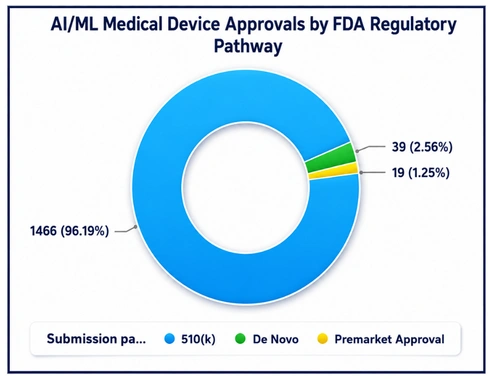
- The 510(k) pathway is the most widely adopted regulatory route for AI-enabled medical devices because it offers a streamlined approval process for devices that are substantially equivalent to an already legally marketed device. While new clinical trials are generally not required, manufacturers must demonstrate that their device is as safe and effective as the existing predicate device.
- In contrast, Premarket Approval (PMA) is the FDA’s most rigorous regulatory pathway, reserved for high-risk medical devices. It requires comprehensive clinical evidence to establish the device’s safety and effectiveness, often involving extensive clinical trials, making it both time-consuming and costly.
- The De Novo pathway is intended for novel, low- to moderate-risk Class I and II medical devices that have no legally marketed predicate. It provides an alternative regulatory route for first-of-their-kind innovations while ensuring appropriate safety and effectiveness standards are met.
EUROPE
In the European Union, AI-enabled medical devices are regulated under the Medical Device Regulation (MDR 2017/745), with manufacturers required to obtain CE marking through independent assessment by an EU-designated Notified Body, rather than approval from a single central agency. Under MDR’s software classification rule, Rule 11, most AI diagnostic tools that inform clinical decision-making are classified as Class IIa, IIb, or III, all of which require Notified Body review — a process that typically takes 12 to 24 months and can cost upwards of €300,000, making it considerably slower and more expensive than the FDA’s median 510(k) timeline. Since August 2026, this has been joined by a second layer of regulation under the EU AI Act, which classifies most diagnostic and therapeutic AI devices as “high-risk,” adding further requirements around data governance, human oversight, and technical documentation. In May 2026, EU lawmakers confirmed that medical devices remain fully subject to both MDR and the AI Act simultaneously, rather than being exempted from one , reinforcing that the EU’s path to market for AI medical devices is structurally more fragmented and time-intensive than the FDA’s centralized model, even as both frameworks pursue broadly comparable safety and evidence standards.
Where the FDA offers a single national authorization that immediately grants U.S. market access, the EU’s system requires manufacturers to navigate two parallel, only partially-integrated regulatory frameworks (MDR and the AI Act) through a market-based network of Notified Bodies — a structurally slower and more fragmented path to market, even though the underlying safety and evidence standards are broadly comparable.
The FDA has progressively evolved its regulatory framework to keep pace with rapid advancements in artificial intelligence and machine learning (AI/ML). The timeline below highlights key regulatory milestones that have shaped the development, evaluation, lifecycle management, and post-market oversight of AI-enabled medical devices.
Date | Event Type | Significance |
|---|---|---|
2 Apr 2019 | Proposed Regulatory Framework for Modifications to AI/ML-Based Software as a Medical Device (SaMD) | First proposal describing how continuously learning AI/ML software could be regulated. |
Jan 2021 | Artificial Intelligence and Machine Learning (AI/ML) Software as a Medical Device Action Plan | Established FDA’s roadmap for AI/ML medical device regulation. |
Oct 2021 | Good Machine Learning Practice (GMLP): Guiding Principles | Introduced 10 guiding principles for the development of safe and effective ML-enabled medical devices. |
Apr 2023 | Draft Guidance: Marketing Submission Recommendations for a Predetermined Change Control Plan (PCCP) for AI/ML-Enabled Device Software Functions | Proposed a framework allowing manufacturers to pre-specify certain future AI model modifications. |
Oct 2023 | Predetermined Change Control Plans for Machine Learning-Enabled Medical Devices: Guiding Principles | Published international guiding principles for implementing PCCPs in ML-enabled devices. |
15 Mar 2024 | Artificial Intelligence and Medical Products: How CBER, CDER, CDRH, and OCP are Working Together | Described the FDA’s coordinated agency-wide strategy for AI across medical products. |
Jun 2024 | Transparency for Machine Learning-Enabled Medical Devices: Guiding Principles | Established principles to improve transparency, communication, and user trust for ML-enabled devices. |
Dec 2024 | Final Guidance: Marketing Submission Recommendations for a Predetermined Change Control Plan for Artificial Intelligence-Enabled Device Software Functions | Finalized recommendations for managing AI software updates throughout a device’s lifecycle. |
6 Jan 2025 | Draft Guidance: Artificial Intelligence-Enabled Device Software Functions: Lifecycle Management and Marketing Submission Recommendations | Introduced comprehensive lifecycle management, documentation, transparency, bias mitigation, and marketing submission recommendations for AI-enabled medical devices. |
COMPETITIVE LANDSCAPE
Beyond the five core diagnostic specialties, the AI medical device landscape spans a wider set of competitive archetypes than a single “who leads where” table can capture. The table below segments the market by how each player competes rather than just where, distinguishing imaging OEMs scaling through acquisition, specialist vendors competing on deployment depth, Big Tech companies playing an infrastructure role rather than pursuing device clearances directly, and adjacent categories (surgical AI, wearables/RPM) where the competitive battle is still being defined. Two patterns stand out: reimbursement and foundation-model consolidation are emerging as the primary differentiators in the most mature segments (Radiology, Cardiology), while regulatory classification itself is the central strategic battleground in Wearables/RPM , a reminder that in this market, competitive position isn’t decided by technology alone.
Segment | Representative Players | Positioning |
|---|---|---|
Imaging OEM incumbents | GE HealthCare, Siemens Healthineers, Philips, Canon Medical, Fujifilm | Scale via device-embedded AI; acquisition-led AI capability build-out (e.g., GE’s absorption of Bay Labs, Caption Health, MIM Software) |
Radiology AI specialists | Aidoc, Viz.ai, Qure.ai, Annalise.ai, Gleamer, RadNet/DeepHealth | Deployment scale and workflow depth; increasingly foundation-model-led |
Cardiology AI specialists | Eko Health, HeartFlow, AliveCor, Cleerly, Ultromics, Cardiologs (Philips) | Reimbursement-led differentiation; foundation-model consolidation underway |
Neurology/stroke AI | Viz.ai, RapidAI (iSchemaView), Aidoc, Brainomix | Tight four-vendor field; workflow/care-coordination differentiation over raw accuracy |
Big Tech / infrastructure | Microsoft (Paige partnership), Google Health, NVIDIA (clinical AI infrastructure), Amazon (AWS HealthLake) | Platform and infrastructure plays rather than direct device clearance in most cases |
Surgical AI | Intuitive Surgical, Medtronic (Touch Surgery), Johnson & Johnson MedTech | Hardware-embedded AI; assistive/analytics focus over autonomous decision-making |
Wearables/RPM | Apple, Dexcom, Abbott (Lingo), Oura, Whoop, Samsung | Consumer/clinical boundary contested; regulatory classification is the central strategic battleground |
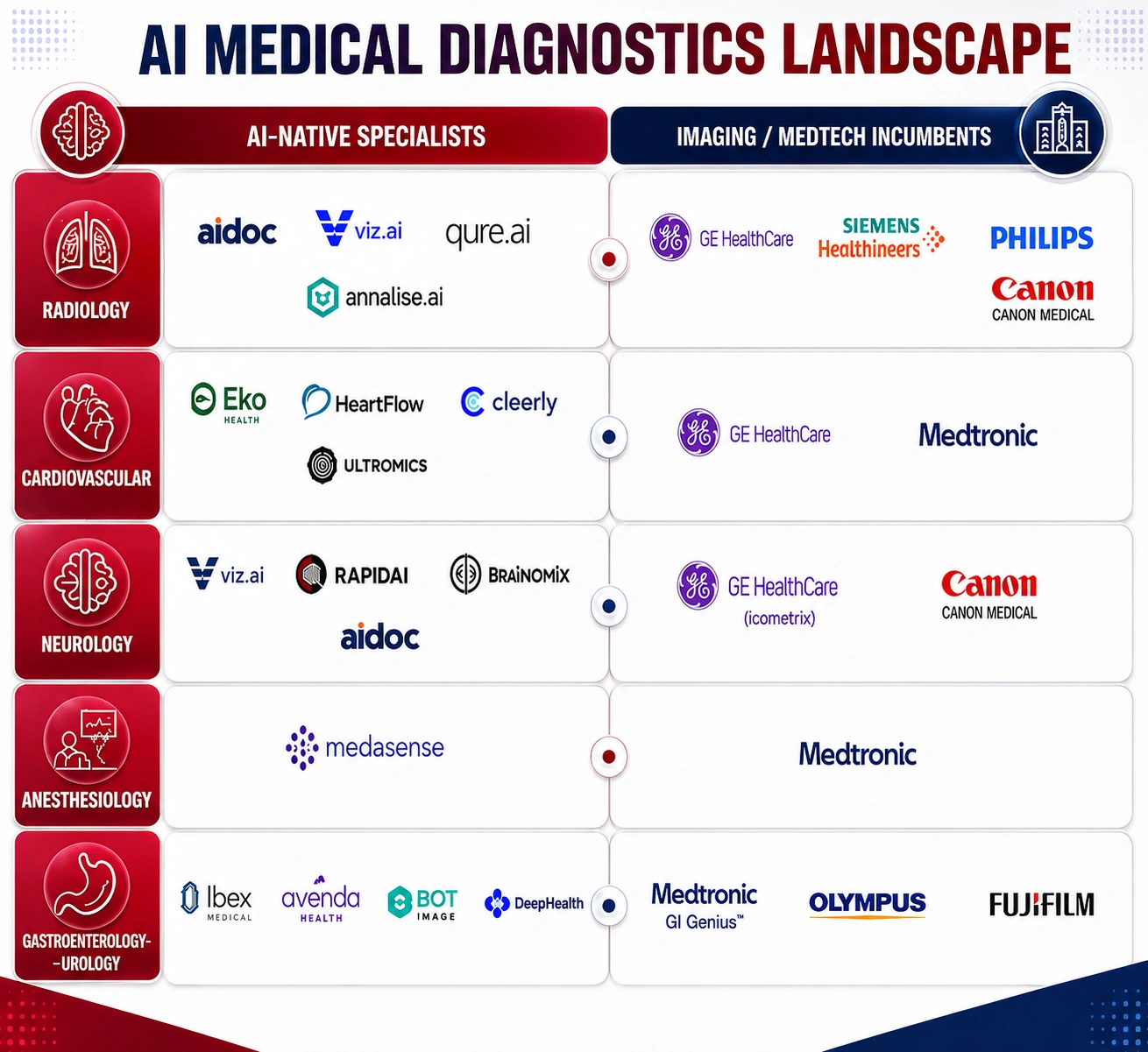
The competitive field for AI-enabled medical diagnostics splits into two distinct archetypes: AI-native specialists, venture-backed companies built from the ground up around a single algorithmic capability, and imaging/MedTech incumbents, established device manufacturers embedding AI into their existing hardware and software platforms. The table below maps verified, FDA-cleared players across the five focus specialties, revealing a critical structural pattern — AI-native challengers have achieved a genuine, near-even footing against incumbents in Radiology, Cardiovascular, and Neurology, but Anesthesiology remains almost entirely uncontested by AI-native entrants, positioning it as the clearest white space for a new competitor to establish first-mover advantage.
TREND ANALYSIS
FDA approvals continue to accelerate: The FDA authorized 92 AI-enabled medical devices in Q1 2026, representing a 28% quarter-over-quarter increase, with radiology continuing to account for the majority of approvals.
Foundation models are entering clinical practice: FDA clearances for foundation model-based medical devices mark a significant shift from task-specific AI toward more versatile, multi-purpose clinical AI systems.
Generative AI is approaching regulatory adoption: Although no FDA-authorized medical device currently incorporates generative AI or large language models (LLMs), recent regulatory milestones indicate that patient-facing generative AI applications are nearing commercialization.
Expansion beyond radiology: AI adoption continues to accelerate across cardiology, neurology, pathology, gastroenterology, and other clinical specialties, reflecting the broadening scope of AI-enabled diagnostics.
Growing reimbursement support: Healthcare reimbursement policies are increasingly recognizing the clinical value of AI-enabled diagnostic technologies, supporting broader adoption across healthcare systems.
Increasing clinical validation: A growing body of real-world evidence and clinical studies continues to demonstrate the effectiveness of AI-assisted diagnostics, strengthening clinician confidence and supporting wider regulatory acceptance.
Shift toward integrated clinical platforms: The industry is evolving from standalone AI algorithms to comprehensive clinical decision support platforms that integrate imaging, patient data, workflow automation, and predictive analytics
GE HealthCare’s absorption of Bay Labs, Caption Health, and MIM Software into its radiology AI authorization count is illustrative of a broader pattern: large incumbents are building AI capability through acquisition of specialist vendors rather than solely through internal R&D.
-
Maturity and growth rate move in opposite directions: Radiology, the most mature specialty (TRL 9), also has the lowest percentage growth rate (6.3%) , a classic large-base effect, where even a big absolute gain (69 clearances in Q1 2026) looks modest in percentage terms against 1,095 existing devices.
-
Cardiovascular is the standout: It combines a high maturity level (TRL 8.5) with the fastest growth rate of all five (8.1%) , a rare combination of “already proven” and “still accelerating,” which is exactly the profile that tends to attract the fastest-moving investment and partnership interest.
-
Neurology is quietly outperforming its size: Despite adding only 5 new clearances in Q1 2026, its 7.7% growth rate is nearly as high as cardiovascular’s — proportionally, neurology is expanding almost as fast as any specialty in this set.
-
Anesthesiology and gastroenterology-urology cluster together at the bottom-left: Lowest maturity, lowest growth, smallest net-new counts (1 each). This isn’t just “early stage,” it’s early stage and slow-moving, which is a meaningfully different story than a specialty that’s small but accelerating.
-
Where the volume actually is: Radiology’s bubble dwarfs the rest, a reminder that percentage growth and absolute scale are two different stories the chart lets you see at once — a specialty can be growing fast in percentage terms while still being commercially tiny in absolute terms (as anesthesiology and GI-urology show).
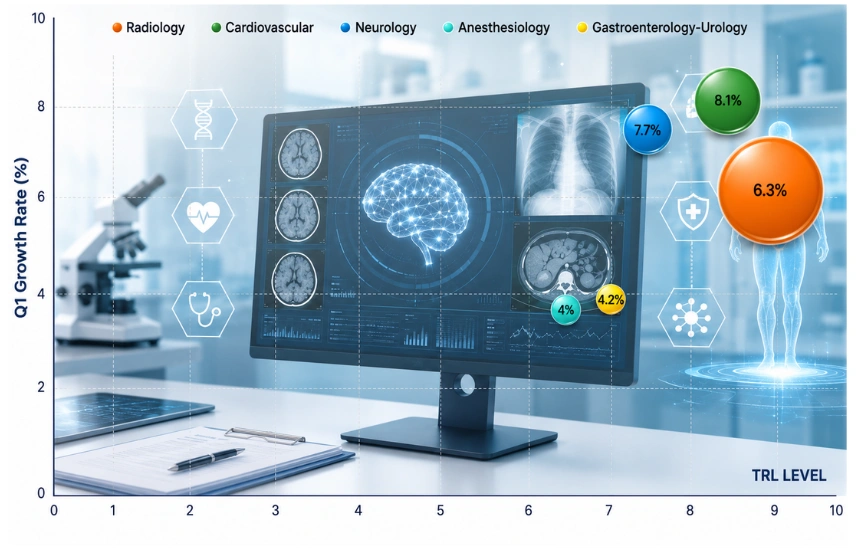
The chart plots each of the five focus specialties by technology maturity (TRL, x-axis) against their Q1 2026 growth rate (y-axis), with bubble size showing the absolute number of new FDA clearances added in the quarter. Together, the three variables show not just how mature each specialty is, but how fast it’s actually moving right now.
Note: Data was extracted directly from the FDA’s official AI-Enabled Medical Devices List (fda.gov/medical-devices/software-medical-device-samd/artificial-intelligence-enabled-medical-devices), filtered by specialty and decision date for Dec 30,2025 and Mar 30, 2026. Net New (Q1 2026) reflects the difference between these two cumulative clearance counts per domain. Q1 Growth Rate was self-calculated as Net New ÷ Dec 2025 base clearances.The chart plots TRL (x-axis) against Q1 Growth Rate (y-axis), with bubble size representing Net New clearances.
SWOT & RISK ANALYSIS
Demonstrated, measurable clinical impact in mature categories — GI Genius’s 99.7% sensitivity, stroke AI’s 30–52% reduction in door-to-notification time
Well-established regulatory precedent lowers uncertainty for new entrants in radiology and cardiology
Growing reimbursement infrastructure (CMS OPPS, NTAP) reduces commercial risk for well-evidenced platforms
Heavy reliance (95–97%) on the lighter-touch 510(k) pathway means many “FDA-cleared” claims carry less rigorous evidence than the clearance itself implies
Extreme specialty imbalance — radiology’s ~76% share leaves anesthesiology and gastroenterology-urology comparatively underdeveloped and under-resourced
Fragmented competitive field outside radiology/cardiology makes interoperability and workflow integration harder for health systems adopting multiple point solutions
Foundation-model consolidation creates room for platform plays that absorb multiple narrow tools , a clear white space for well-capitalized entrants
Anesthesiology and gastroenterology-urology remain comparatively underserved relative to their clinical need, offering first-mover advantage for focused entrants
Generative AI-powered clinical devices represent a genuinely open frontier, with RecovryAI’s Breakthrough Designation as the first concrete signal
Unresolved liability and standard-of-care questions, particularly in real-time specialties like anesthesiology, where AI failure to predict a critical event raises unsettled legal exposure
Data privacy and security concerns for sensitive physiological and imaging data could slow adoption or invite tighter regulation
Clinician trust and workflow-acceptance barriers remain a persistent adoption friction point regardless of algorithmic accuracy
Risk of regulatory tightening, growing scrutiny of evidence quality behind 510(k) clearances could raise the bar for new entrants relying on that pathway
Recommended Actions
- Map internal or partner capabilities against the five specialty areas to identify where the organization is over- or under-exposed relative to where FDA activity and reimbursement momentum are concentrated (cardiology and radiology currently offer the clearest near-term commercial footing)
- Prioritize evaluation of platforms with existing CMS reimbursement precedent (e.g., cardiac AI following the Eko/Ultromics model) over unreimbursed point solutions
- Begin tracking the FDA’s finalized Total Product Life Cycle guidance to ensure any internal or partner AI development is compliance-ready ahead of formal adoption.
- Shift evaluation criteria from “does it have 510(k) clearance” to “does it have prospective, multicenter clinical evidence” — particularly important given how thin the average evidence base is behind many 510(k)-cleared AI devices.
- Explore partnership or licensing opportunities in the still-fragmented anesthesiology and gastroenterology-urology segments, where first-mover positioning is still available.
- Evaluate foundation-model platform vendors (Aidoc, Eko Health) as potential strategic partners rather than single-feature point-solution vendors, anticipating continued market consolidation around multi-condition platforms.
- Position for the generative AI transition in clinical devices — monitor RecovryAI and any fast-following competitors’ regulatory progress as the clearest leading indicator of when to enter this category.
- Track consolidation and acquisition activity across the competitive landscape (e.g., GE HealthCare’s pattern of absorbing specialist AI vendors) as both a risk to monitor and an exit-path opportunity for smaller portfolio companies.
- Build a longer-horizon evidence-generation strategy (registries, prospective trials) now, anticipating that reimbursement bodies and regulators will continue raising the evidentiary bar beyond baseline 510(k) clearance.
APPENDIX
Data Sources & References
https://medicalfuturist.com/the-current-state-of-fda-approved-ai-based-medical-devices/
https://www.jmir.org/2026/1/e72410
https://link.springer.com/article/10.1007/s43681-025-00947-7
https://www.virtusa.com/digital-themes/artificial-intelligence-in-medical-devices
https://www.merillife.com/blogs/how-ai-is-shaping-medical-devices
https://pmc.ncbi.nlm.nih.gov/articles/PMC12978926/
https://www.fda.gov/medical-devices/software-medical-device-samd/artificial-intelligence-software-medical-device
https://www.sciencedirect.com/science/article/pii/S2514664524010592
https://link.springer.com/article/10.1007/s44174-025-00379-1
https://article.accscience.com/journal/AIH/2/3/aih_5173/aih_5173.pdf
https://pmc.ncbi.nlm.nih.gov/articles/PMC9955430/pdf/diagnostics-13-00688.pdf
https://assets.cureus.com/uploads/review_article/pdf/452999/20260225-179709-fzx730.pdf