
Data Center Cooling Market
Global Industry analysis, Size, Share, Growth, Trends, and Forecast 2026-2031
The market is projected to reach USD 42 billion by 2031, growing at a CAGR of 16.5 % during the forecast period (2026-2031).
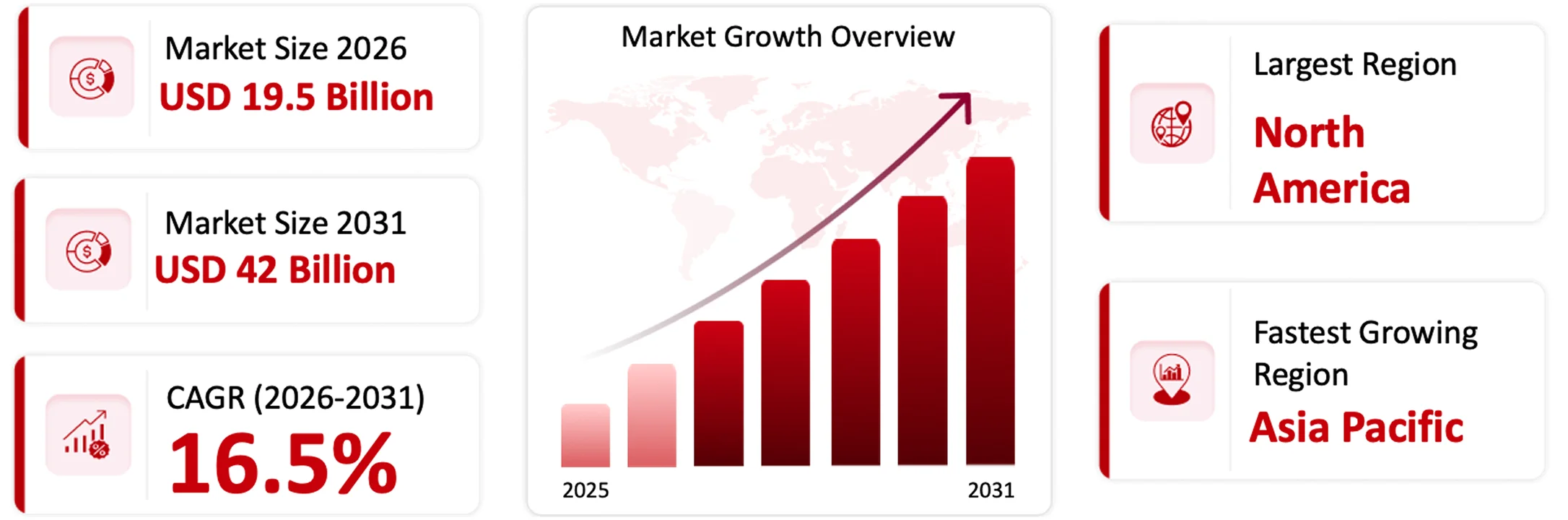
| Market Size (2026) | Forecast (2031) | CAGR (2026–2031) | Leading Region | Fastest Growing Region |
|---|---|---|---|---|
| USD 19.5 Billion | USD 42 Billion | 16.5 % | North America | Asia Pacific |
Summarize this report with:



Global Data Center Cooling Market Overview
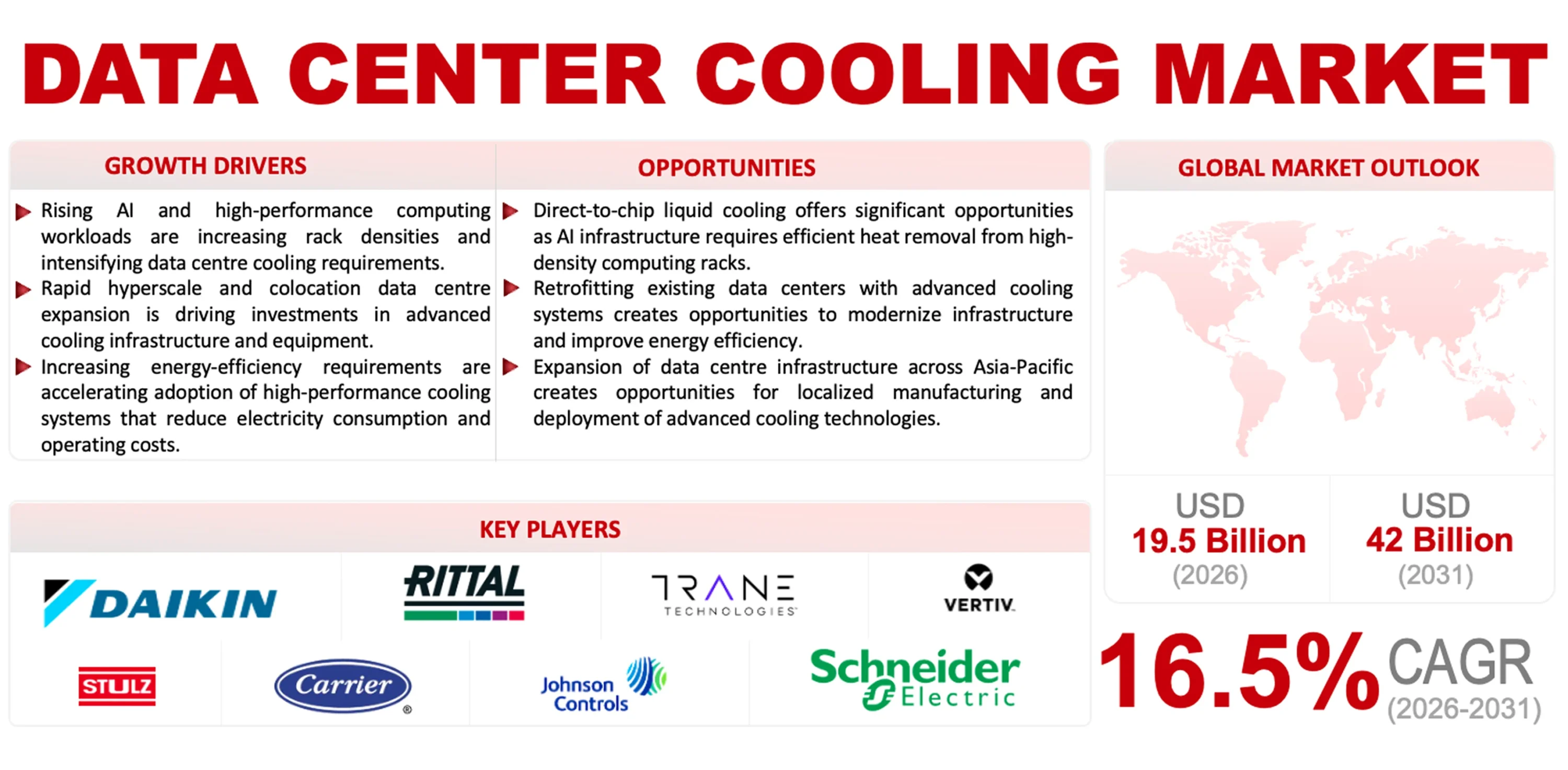
The global market for cooling data centers is going through a major development from old cooling technologies based on air to the latest effective heat management systems. The industry is showing growing preference for cooling technologies based on liquid cooling techniques along with traditional air-cooling technologies. Data center owners introduce technologies that combine air and liquid cooling systems in order to adapt to different temperature conditions in their data centers. The cooling industry can also be seen introducing new technologies based on intelligent cooling systems, automatic monitoring systems, and AI-powered optimization technology. Moreover, the industry of cooling systems is transforming to facilitate modularity and scalability, which would allow using different levels of cooling power depending on the evolution of technology and energy requirements. Consequently, today’s market players include not only traditional HVAC systems manufacturers but also innovators and developers of liquid cooling solutions and companies producing efficient cooling systems.
– Mayur Jain, Research Consultant, Wissen Research
The market is estimated to be USD 19.5 Billion in 2026 and is projected to reach USD 42 billion by 2031, growing at a CAGR of 16.5 % during the forecast period (2026-2031).
Technology Overview
The data center cooling market encompasses technologies used to manage heat generated by IT equipment and maintain suitable operating temperatures. Cooling system design involves assessing facility cooling requirements, selecting appropriate equipment, installing cooling infrastructure, and managing heat removal during operations. Technology selection depends on data center type, facility size, rack density, heat load, power consumption, climate conditions, available space, operational requirements, and customer standards. Major technologies include air conditioning, chilling units, cooling towers, liquid cooling systems, economizer systems, and control systems. Cooling approaches include room-based and row/rack-based configurations, while liquid cooling technologies include direct-to-chip and immersion cooling. Recent developments emphasize improved cooling efficiency, reduced energy and water consumption, and enhanced heat management for high-density computing environments. Advanced liquid cooling solutions, including closed-loop systems and adiabatic cooling, are also gaining attention for managing increasing thermal requirements. These technologies are applied across hyperscale, enterprise, and colocation data centres serving industries such as IT and telecom, BFSI, healthcare, manufacturing, energy, retail, and government.
Key Growth Drivers
- Rising data center capacity increases demand for efficient thermal management infrastructure, as expanding facilities require additional cooling equipment to maintain operating temperatures and support growing computing requirements.
- Increasing AI and high-performance computing workloads generate higher thermal management requirements, encouraging data center operators to adopt advanced cooling solutions capable of handling greater rack power densities and heat loads.
- Growing awareness of energy efficiency encourages operators to invest in cooling technologies that reduce power consumption, improve cooling performance, and support more efficient data center operations.
- Regulatory and sustainability requirements are strengthening the focus on energy performance, water consumption, and environmental reporting, encouraging data center operators to adopt more sustainable cooling infrastructure and technologies.
- Technological advancements in liquid cooling, including direct-to-chip, immersion, and closed-loop systems, are expanding cooling capabilities and supporting improved heat management in high-density computing environments.
- Growing investments in hyperscale and colocation data centers increase demand for scalable cooling infrastructure, as operators require reliable thermal management solutions to support expanding facilities and diverse customer workloads.
Data Center Cooling Market Key Highlights
Need deeper insights on this market?
Get full report access with detailed forecasts, competitive analysis, and segmentation.
Data Center Cooling Market Trends
The data center cooling market is evolving from conventional air-based cooling configurations towards more efficient and advanced thermal management architectures capable of supporting increasing computing densities and heat loads. Traditional air conditioning and room-based cooling remain important, while row/rack-based cooling and liquid cooling systems are gaining attention for high-density computing environments. Key technologies include chilling units, cooling towers, economizer systems, direct-to-chip cooling, immersion cooling, adiabatic cooling, and closed-loop liquid cooling. Control systems and improved cooling configurations are also supporting more effective temperature and heat management. These developments reflect the growing need to accommodate AI and high-performance computing workloads. Increasing emphasis on energy efficiency, reduced energy and water consumption, sustainability requirements, and expanding data centre infrastructure is further shaping technology adoption.
Liquid Cooling Advances for High-Density Data Center Infrastructure
Expansion of advanced liquid cooling portfolios: Schneider Electric unveiled its Motivair liquid cooling portfolio on 29 September 2025, covering coolant distribution units, rear-door heat exchangers, dynamic cold plates, liquid-to-air heat dissipation units, chillers, and technology cooling system loops, strengthening its offering for high-performance computing and AI workloads.
Increasing investment in liquid cooling manufacturing: Schneider Electric launched its first Indian Motivair liquid cooling manufacturing facility in Bengaluru on 18 February 2026, making India its third global production location for this technology and supporting the development of domestic manufacturing capabilities for high-density AI infrastructure.
Development of higher-capacity cooling architectures: The US Department of Energy’s COOLERCHIPS 1.5 programme, announced on 26 August 2026, targets cooling systems capable of managing thermal loads of up to 1 MW per rack, highlighting the industry’s focus on addressing the growing heat management requirements of AI data centres.
Diversification of liquid cooling approaches: Direct-to-chip, immersion, adiabatic, and closed-loop liquid cooling systems are receiving increasing attention as approaches to reduce data centre water consumption and manage higher thermal loads, providing operators with alternative architectures for different infrastructure and operational requirements.
Water consumption and infrastructure integration remain challenges: India’s government has highlighted water reduction as an important consideration in data centre cooling and identified multiple alternative cooling approaches, indicating that technology adoption must address both thermal performance and resource efficiency rather than focusing exclusively on heat removal.
Diversification of Disinfectant Formulations and Application Formats
Stronger sustainability reporting requirements: The European Commission’s Delegated Regulation (EU) 2024/1364 established a common framework for data centre sustainability ratings and reporting, with reporting deadlines including 15 May 2025, increasing the importance of monitoring energy and water performance across data centre infrastructure.
Development of future efficiency standards: The European Commission initiated work on minimum performance standards for data centres in early 2026 through a 24-month study, indicating a move towards more structured efficiency requirements that could influence cooling equipment selection, system design, and infrastructure investments.
Integration of cooling into energy-efficient facility design: The US Department of Energy’s best practices guide, published on 26 July 2024, identifies air management, cooling systems, electrical systems, environmental conditions, and heat recovery as interconnected considerations, reinforcing the importance of coordinated infrastructure design for improving overall facility efficiency.
Growing emphasis on water-efficient cooling infrastructure: India’s government identified direct-to-chip liquid cooling, immersion cooling, adiabatic cooling, and closed-loop liquid cooling as technologies being adopted to reduce water consumption, while its District Cooling Guidelines 2023 recommend treated water for cooling-tower make-up and alternative water sources wherever feasible.
Balancing efficiency, water availability, and operating requirements remains challenging: Data centre operators must consider energy consumption, water requirements, climate conditions, and infrastructure constraints when selecting cooling architectures, while emerging sustainability reporting and efficiency requirements increase the importance of demonstrating improved resource utilization alongside reliable temperature management.








Leading companies are focusing on advanced cooling system innovation, energy efficiency, liquid cooling capabilities, manufacturing expansion, integrated product portfolios, and improved thermal management solutions to address evolving requirements across hyperscale, enterprise, and colocation data centres
Strategic Activities Within the Data Center Cooling Market
Vertiv Holdings Co (U.S.) unveiled a global ecosystem offering that pairs an expanded collaboration with Dow with a new partnership with Solenis, so operators can run liquid cooling as one integrated thermal system. The offering links Vertiv’s infrastructure, monitoring and service network with coolant chemistry and water-treatment expertise. It helps customers keep fluids in good condition and tune performance across the system’s life.
Daikin Industries, Ltd. (Japan) introduced a new line of coolant distribution units for AI data centers, with single units reaching 2.5 MW, showing them at Data cloud Global Congress in Cannes. The range starts at 400 kW, up to ten units can run together under one control system, and preassembled multi-unit skids are offered for larger sites. The launch widens Daikin’s liquid cooling lineup for high-density AI facilities.
Mitsubishi Electric Corporation (Japan), through Mitsubishi Electric Trane HVAC US, rolled out the next generation of its s-MEXT precision cooling solution for data centers, server rooms, telecom facilities and other high-sensible-load applications, designed to work with P-Series outdoor units. The update refreshes its precision cooling range for smaller, high-heat-load IT spaces.
Carrier Global Corporation (U.S.) revealed plans to invest more than $600 million over three years in a new advanced manufacturing and engineering center in Fort Worth, Texas, with operations expected from 2027. The facility will exceed one million square feet and add commercial chiller production capacity, backed by record backlog in data centers and other sectors. The release lists data centers alongside other markets rather than as the sole target.
Data Center Cooling Market Insights
The Data Center Cooling Market encompasses equipment, systems, and services designed to manage heat generation and maintain optimal operating temperatures within data centre facilities. It covers hardware and services, including air conditioning, chilling units, cooling towers, liquid cooling systems, economizer systems, control systems, and other components. The main cooling technology groups include room-based cooling, row/rack-based cooling, direct-to-chip cooling, immersion cooling, adiabatic cooling, and closed-loop liquid cooling. These solutions support thermal management across hyperscale, enterprise, and colocation data centres. Market growth is driven by expanding data centre infrastructure, increasing adoption of cloud computing, rising AI and high-performance computing workloads, and growing rack power densities. Additionally, demand for energy-efficient infrastructure, reduced water consumption, sustainable cooling technologies, and improved heat management is encouraging investment in advanced cooling architectures.
The Data Center Cooling Market serves BFSI, IT & Telecom, Hyperscale Cloud and Colocation Operators, Research & Academic, Government & Defense, Retail, Energy, Manufacturing, Healthcare, and other end-use industries. IT & Telecom and cloud infrastructure require continuous cooling to support computing workloads, while hyperscale and colocation facilities need scalable thermal management for high-density equipment. BFSI data centres prioritize reliable temperature management to maintain uninterrupted operations, whereas research and academic facilities require cooling for computing-intensive applications. Government and defense facilities require dependable cooling infrastructure, while retail, manufacturing, energy, and healthcare organizations use enterprise and specialized data centres to support their digital operations. Cooling requirements are addressed through air conditioning, chilling units, cooling towers, liquid cooling systems, economizers, and control systems, deployed through room-based and row/rack-based configurations. Direct-to-chip, immersion, adiabatic, and closed-loop liquid cooling provide additional approaches for managing increasing heat loads. Cooling system suitability depends on heat load, rack density, energy efficiency, operating costs, facility design, reliability, and applicable regulatory requirements.
The Data Center Cooling Market is driven by expanding data centre capacity and increasing computing workloads, which require additional thermal management infrastructure to maintain suitable operating temperatures. Growing adoption of artificial intelligence and high-performance computing is increasing rack power densities and heat loads, encouraging investment in advanced cooling architectures. Greater awareness of energy efficiency is promoting cooling technologies that reduce power consumption and improve overall infrastructure performance, supported by government energy-efficiency initiatives. Regulatory and sustainability requirements, particularly those addressing energy performance and water consumption, are further encouraging operators to consider efficient cooling solutions. Technological advancements in direct-to-chip, immersion, adiabatic, and closed-loop liquid cooling are expanding options for managing demanding thermal requirements. Additionally, growing investments in hyperscale and colocation infrastructure are increasing demand for scalable cooling equipment and services. However, actual technology adoption depends on facility requirements, infrastructure compatibility, installation costs, operating conditions, and resource availability.
The Data Center Cooling Market is transitioning from conventional air-based cooling towards advanced liquid cooling architectures to address increasing computing densities and thermal requirements. Direct-to-chip, immersion, and closed-loop liquid cooling are gaining attention, alongside greater adoption of row/rack-based cooling configurations. Advanced control systems, temperature monitoring, airflow management, and energy-efficient cooling technologies are becoming important considerations in system design and operation. AI-driven thermal management and strategic partnerships are also supporting the development of integrated cooling solutions for high-performance computing environments. However, market adoption faces several challenges, including high installation costs and retrofitting constraints in existing facilities. Infrastructure compatibility can complicate the integration of advanced cooling systems, while energy consumption and water availability influence technology selection. Maintenance complexity and the need to integrate new equipment with existing cooling infrastructure can further increase operational requirements. Balancing thermal performance, reliability, resource consumption, and operating costs remains an important challenge for data centre operators.
Asia-Pacific is expected to register the fastest growth in the global Data Center Cooling Market, supported by the rapid expansion of hyperscale and colocation facilities across China, India, Japan, Malaysia, Indonesia, and Australia. The region is witnessing a shift toward larger-scale, AI-ready data centres, increasing demand for advanced thermal management infrastructure capable of supporting high-density computing environments. According to CBRE, Asia-Pacific data centre investment reached a record USD 11.6 billion in 2025, reflecting strong infrastructure development across emerging and established markets. Furthermore, the regional development pipeline reached 26.5 GW in the first half of 2026, with approximately 50% of under-construction capacity concentrated in Southeast Asia. This expansion is creating opportunities for advanced chillers, precision cooling systems, direct-to-chip liquid cooling, and other energy-efficient thermal management technologies.
Data Center Cooling Market Dynamics
Drivers: Expanding Data Center Infrastructure and Advanced Cooling Demand
- Rising data center capacity is increasing the need for dedicated cooling infrastructure to maintain suitable operating conditions across expanding facilities. India’s installed data centre capacity increased from approximately 375 MW in 2020 to around 1,500 MW by 2025, highlighting the growing requirement for thermal management equipment and services.
- Increasing AI and high-performance computing workloads are driving demand for cooling systems capable of handling higher rack densities and thermal loads. The US Department of Energy’s COOLERCHIPS 1.5 programme, announced on 26 August 2026, targets cooling systems capable of managing thermal loads of up to 1 MW per rack.
- Growing emphasis on energy efficiency is encouraging data centre operators to adopt cooling technologies that improve overall facility performance. The European Commission’s Delegated Regulation (EU) 2024/1364 established a common framework for data centre sustainability ratings and reporting, with reporting deadlines including 15 May 2025.
- Increasing sustainability requirements are strengthening demand for cooling solutions that address energy performance and water consumption. China’s National Development and Reform Commission and associated agencies issued a green and low-carbon development action plan for data centres in July 2024, including energy-saving upgrades and improved cooling efficiency.
Opportunities: Advanced Cooling Technologies and Infrastructure Investments
- Expansion of domestic liquid cooling manufacturing creates opportunities for equipment suppliers to serve growing regional demand. Schneider Electric launched its first Indian Motivair liquid cooling manufacturing facility in Bengaluru on 18 February 2026, making India its third global production location and enabling greater manufacturing capabilities for high-density AI infrastructure.
- Development of high-capacity cooling architectures creates opportunities for providers of specialized thermal management equipment. The US Department of Energy’s COOLERCHIPS 1.5 programme, announced on 26 August 2026, targets cooling systems capable of managing up to 1 MW per rack, supporting the development of solutions for demanding AI workloads.
- Growing adoption of integrated liquid cooling portfolios creates opportunities to supply multiple components through coordinated product offerings. Schneider Electric unveiled its Motivair portfolio on 29 September 2025, covering coolant distribution units, rear-door heat exchangers, dynamic cold plates, liquid-to-air heat dissipation units, chillers, and technology cooling system loops.
- Increasing demand for water-efficient cooling creates opportunities for developers of alternative thermal management architectures. India’s government identified direct-to-chip liquid cooling, immersion cooling, adiabatic cooling, and closed-loop liquid cooling as technologies being adopted to reduce data centre water consumption, supporting the development of solutions suited to resource-conscious facilities.
- Development of sustainability reporting and efficiency frameworks creates opportunities for cooling providers offering improved energy and resource performance. The European Commission initiated work on minimum performance standards for data centres in early 2026 through a 24-month study, potentially creating additional demand for efficient cooling equipment and infrastructure upgrades.
Challenges: Cost, Resource Constraints and Infrastructure Integration
- High installation costs can restrict the adoption of advanced cooling architectures, particularly when operators need to replace or substantially upgrade existing infrastructure. Liquid cooling systems involve specialized equipment and facility integration requirements, making investment planning important for operators balancing thermal performance, energy consumption, and operating costs.
- Retrofitting existing data centres with advanced cooling technologies can create infrastructure compatibility challenges. Existing facilities may require modifications to accommodate alternative cooling configurations, while integration with established equipment can increase installation complexity and operational requirements for cooling providers and data centre operators.
- Water availability and resource consumption create challenges for cooling infrastructure, particularly in locations facing water constraints. India’s government has identified direct-to-chip liquid cooling, immersion cooling, adiabatic cooling, and closed-loop liquid cooling as approaches for reducing water consumption, while its District Cooling Guidelines 2023 recommend treated water for cooling-tower make-up and alternative water sources wherever feasible.
- Increasing thermal loads create challenges for conventional cooling configurations and require improvements in heat management capabilities. The US Department of Energy’s COOLERCHIPS 1.5 programme targets cooling systems capable of managing up to 1 MW per rack, illustrating the demanding requirements associated with high-density AI infrastructure.
- Regulatory compliance and sustainability reporting increase operational responsibilities for data centre cooling operators. The European Commission’s Delegated Regulation (EU) 2024/1364 established a common data centre sustainability-rating and reporting framework, including reporting deadlines such as 15 May 2025, increasing the importance of tracking energy and water performance.
Technology and Market Insights
Data centre cooling technology is progressing from conventional air conditioning towards advanced thermal management architectures designed to accommodate increasing computing densities and heat generation. The technology landscape includes air conditioning systems, chilling units, cooling towers, liquid cooling systems, economizer systems, and control systems, supported by room-based and row/rack-based configurations. Air-based cooling uses air conditioning and associated cooling infrastructure to regulate facility temperatures, while liquid cooling approaches, including direct-to-chip, immersion, adiabatic, and closed-loop systems, provide alternatives for managing demanding thermal loads. These technologies serve hyperscale, enterprise, and colocation data centres, each with different infrastructure and operational requirements. Selection depends on facility size, data centre type, rack density, heat load, power consumption, climate conditions, available space, customer standards, and operating requirements. Temperature monitoring, airflow management, heat exchangers, pumps, and control systems support cooling operations where incorporated into facility designs. Monitoring, automation, energy efficiency, and operational performance increasingly influence cooling infrastructure investment decisions.
Technology Scope and Products
Data Center Cooling Market Segmentation
Want detailed insights from this report?
Competitive Landscape and Market Segments Insights
- The competitive landscape comprises diversified electrical and thermal management companies, specialized cooling manufacturers, and liquid cooling technology developers. Vertiv Group Corp., Schneider Electric SE, Johnson Controls International plc, Daikin Industries, Ltd., Trane Technologies plc, and Carrier Global Corporation represent diversified infrastructure and cooling suppliers, while CoolIT Systems Inc., Asetek A/S, Submer Technologies, and Iceotope Technologies Limited focus on specialized cooling solutions.
- Regional expansion is supported by manufacturing investments and localized infrastructure development. Schneider Electric expanded its liquid cooling manufacturing presence in India through its Bengaluru facility launched on 18 February 2026, while its Motivair portfolio supports cooling requirements across high-performance computing and AI infrastructure.
- Schneider Electric is strengthening its presence in advanced liquid cooling through portfolio development and manufacturing investment. Its Motivair portfolio, unveiled on 29 September 2025, includes coolant distribution units, rear-door heat exchangers, dynamic cold plates, liquid-to-air heat dissipation units, chillers, and technology cooling system loops, expanding its offering for high-density computing environments.
- Manufacturing expansion and technology development are evident in Schneider Electric’s Indian operations and the US Department of Energy’s COOLERCHIPS 1.5 programme.
- Asia Pacific is emerging as an important development region, supported by India’s growing data centre capacity and manufacturing investment. Schneider Electric’s Bengaluru liquid cooling facility and the presence of Daikin Industries, Ltd., Mitsubishi Electric Corporation, Fujitsu Limited, and Delta Electronics, Inc. provide established industry participation across regional cooling and infrastructure markets.
Air-based cooling maintained its leading position because of its established installed infrastructure, lower implementation complexity, operational familiarity, and compatibility with existing data centre architectures, particularly in conventional enterprise and colocation facilities.
-
Established technology adoption: Uptime Institute’s 2025 Cooling Systems Survey found that 75% of surveyed data centre operators used perimeter air cooling, making it the most widely deployed IT cooling approach.
-
Continued reliance on air-based infrastructure: The October 2025 ICEF Sustainable Data Centers Roadmap reported that 95% of nearly 1,000 surveyed data centre owners and operators relied predominantly on air-cooled systems in 2024.
-
Strong adoption of air-cooled heat rejection: Uptime Institute’s 2025 survey identified air-cooled chillers as the most commonly used external heat-rejection system, accounting for 35% of responses from 400 surveyed data centre operators.
-
Widespread use of conventional air-conditioning equipment: The same Uptime Institute survey found that direct expansion systems and air conditioners accounted for 22% of reported primary heat-rejection systems, demonstrating the continued relevance of conventional air-based infrastructure.
Hardware maintained the leading position because data centre cooling infrastructure requires substantial physical equipment, including chillers, cooling towers, air-handling units, heat exchangers, pumps, and liquid cooling components, whereas services primarily support installation, maintenance, and optimization of these systems.
-
Expansion of high-capacity cooling equipment: Boyd introduced its ROL2300 coolant distribution unit on 8 July 2025, offering 2.3 MW cooling capacity and supporting more than 10 NVIDIA NVL72 racks per unit.
-
Development of high-density heat exchangers: Vertiv launched its CoolLoop rear-door heat exchanger on 18 March 2025, offering cooling capacities of up to 80 kW per rack for AI and high-performance computing environments.
-
Commercialization of scalable liquid cooling equipment: Johnson Controls introduced its Silent-Aire coolant distribution unit portfolio on 8 September 2025, with scalable capacities ranging from 500 kW to more than 10 MW.
-
Expansion of industrial-scale cooling equipment portfolios: Carrier launched its data centre coolant distribution unit on 4 November 2025, offering multiple configurations ranging from 1.3 MW to 5 MW for hyperscale and colocation facilities.
North America maintained its leading position due to its mature data centre ecosystem, extensive hyperscale infrastructure, concentration of major cloud service providers, substantial AI investments, and early adoption of advanced cooling technologies.
-
Expansion of operational data centre capacity: CBRE reported that primary North American data centre markets reached 9,432 MW of total capacity by the end of 2025, representing 36% year-on-year growth and expanding demand for cooling infrastructure.
-
Record infrastructure absorption: Data centre users absorbed 2,497.6 MW across North America’s eight primary markets during 2025, representing a 38% increase from 1,809.5 MW in 2024 and reflecting strong demand for additional cooling installations.
-
Strong hyperscale and AI infrastructure demand: CBRE reported that North American primary-market vacancy declined to a record-low 1.4% by the end of 2025, despite a 36% increase in capacity, highlighting continued demand for new data centre facilities and thermal management systems.
-
Expansion of large-scale development projects: JLL reported that North America’s data centre construction pipeline reached approximately 35 GW in its year-end 2025 assessment, with 64% of planned construction capacity located outside traditional established markets, demonstrating continued infrastructure investment..
What This Report Covers-
This report provides a comprehensive analysis of the data center cooling market, offering insights into key trends, growth drivers, challenges, and future opportunities. It is designed to support strategic decision-making through a combination of quantitative data and qualitative analysis.
Specifically, the report covers:

Market Overview & Definition:
Overview of the market scope, structure, and key terminology

Key Market Trends:
Insights into emerging trends, technological advancements, and evolving demand patterns

Drivers, Restraints & Opportunities:
Analysis of key factors influencing data center cooling market growth

Competitive Landscape:
Overview of major players, their strategies, and recent developments

Detailed Patent Analysis:
This includes, top assignees, geography focus of top assignees, legal status, technology evolution, key patents and patent trends and innovations

Segmentation Analysis:
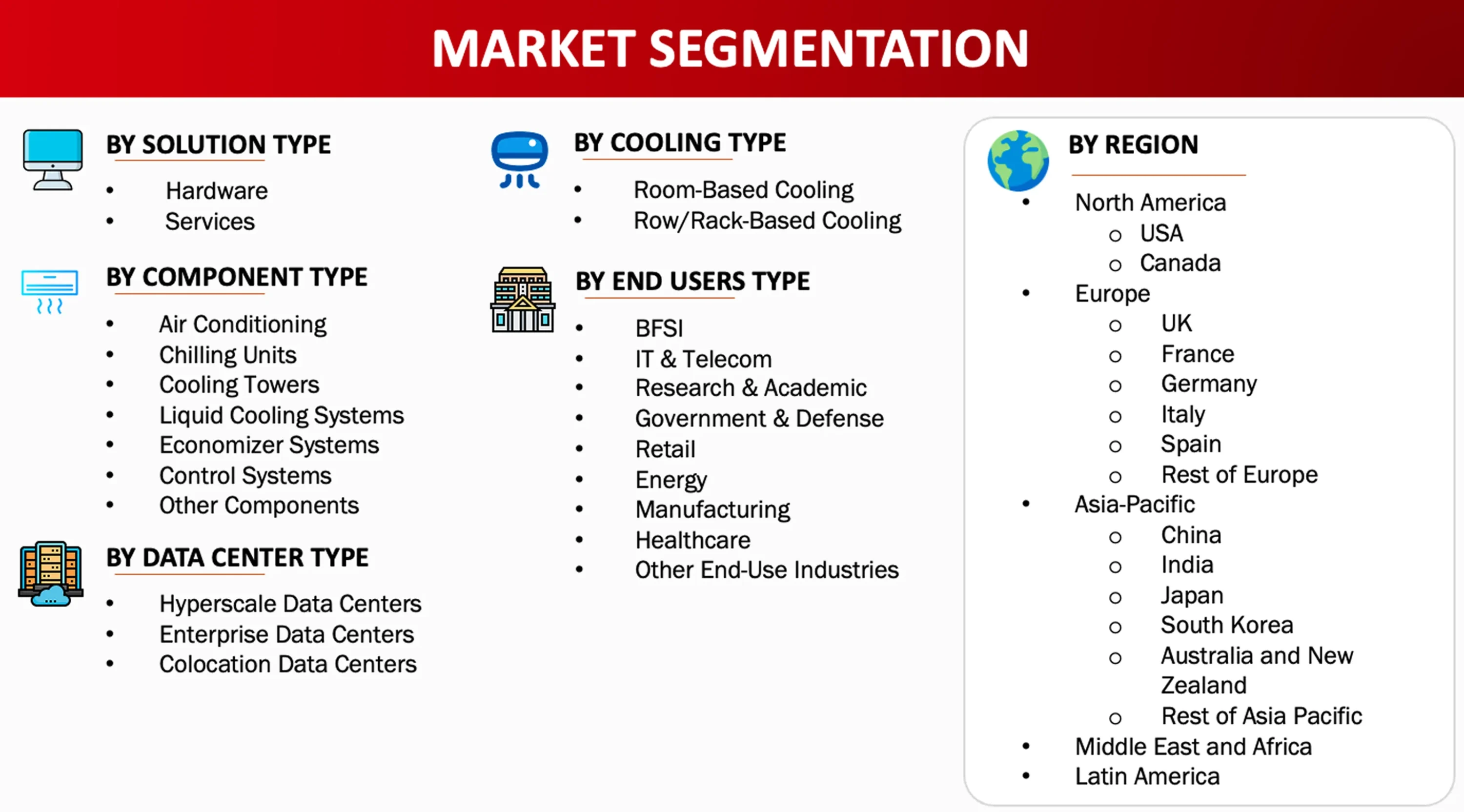
Breakdown by component type, by solution type, by type of cooling type, by data center type, end-use industries type, by region.

Regional Insights:
Key regional trends and growth opportunities

Future Outlook:
Strategic insights and future market direction
Research Methodology
The study of the data center cooling market is based on primary and secondary research, supported by data validation, cooling technology and component mapping, supply and demand assessment, company revenue and product portfolio analysis, energy efficiency assessment, data center capacity analysis, regulatory and sustainability assessment, end-use demand analysis, regional market assessment, and competitive landscape evaluation to ensure accuracy and reliability.
Market Definition: Data Center Cooling Market
The data center cooling market covers equipment, systems, and services used to regulate temperatures, remove heat, and maintain suitable operating conditions within data centre facilities. It includes hardware and services associated with air conditioning, chilling units, cooling towers, liquid cooling systems, economizer systems, control systems, and other cooling components. The market also encompasses cooling configurations and technologies designed to address different facility requirements and computing workloads.
The market is segmented by solution, component, type of cooling, data center type, and end-use industry. Cooling configurations include room-based cooling and row/rack-based cooling, while data centre categories include hyperscale, enterprise, and colocation facilities. End-use industries include BFSI, IT & Telecom, Research & Academic, Government & Defense, Retail, Energy, Manufacturing, Healthcare, and other end-use industries. General data centre infrastructure, IT hardware, power distribution equipment, and unrelated facility management services are excluded.
Key Stakeholders
The Data Center Cooling Market involves stakeholders across equipment manufacturing, technology development, infrastructure deployment, distribution, and end-user operations.
- Cooling Equipment Manufacturers
- Air Conditioning System Suppliers
- Chiller Manufacturers
- Cooling Tower Manufacturers
- Liquid Cooling Technology Providers
- Heat Exchanger Manufacturers
- Cooling System Integrators
- Engineering and Installation Contractors
- Data Center Developers
- Hyperscale Data Center Operators
- Colocation Service Providers
- Enterprise Data Center Operators
Key Objectives of the Study
- To define, describe, analyze, segment, and forecast the data center cooling market by component type, by solution type, by type of cooling type, by data center type, end-use industries type.
- To describe and forecast the market for five key regions: North America, Europe, Asia Pacific, Latin America, Middle-East & Africa
- To provide detailed information regarding key drivers, restraints, opportunities, and challenges influencing market growth
- To strategically analyze the micro indicators with respect to individual growth trends, prospects, and contributions to the overall market size
- To analyze opportunities for stakeholders in the data center cooling industry and emphasize on competitive landscape of the market
- To develop competitive benchmarking of the key market players based on technology specifications and end user
- To strategically profile key players and comprehensively analyze their product portfolio offerings, and core competencies
- To analyze competitive developments, such as launches and approvals, agreements, mergers and acquisitions, partnerships, joint ventures, investments and expansions, and collaborations, data center cooling domain
Need deeper insights on this market?
Get full report access with detailed forecasts, competitive analysis, and segmentation.
Research Approach
This research employs a systematic approach by using primary research along with secondary research to achieve full coverage and accuracy of information about the data center cooling sector. Through this approach, the current market trends in terms of consumer behaviour, technological developments, and competitive environment can be analysed thoroughly.
Secondary Research
Secondary research involves the collection of data from reliable sources such as industry databases, company annual reports, investor presentations, and regulatory filings. This process helps in understanding market trends, identifying key players, and gathering technical and commercial insights.
A comprehensive database of leading companies and market participants is developed through secondary research to support further analysis.
Primary Research
Primary research is conducted to validate findings from secondary research and to gain deeper insights into market dynamics. Interviews are carried out with industry stakeholders across both demand and supply sides, including executives such as CXOs, Vice Presidents, and Directors from business development, marketing, and product teams.
Data is collected through structured questionnaires, email interactions, and telephonic interviews across key regions including North America, Europe, Asia-Pacific, and Rest of the World.
Market Size Estimation
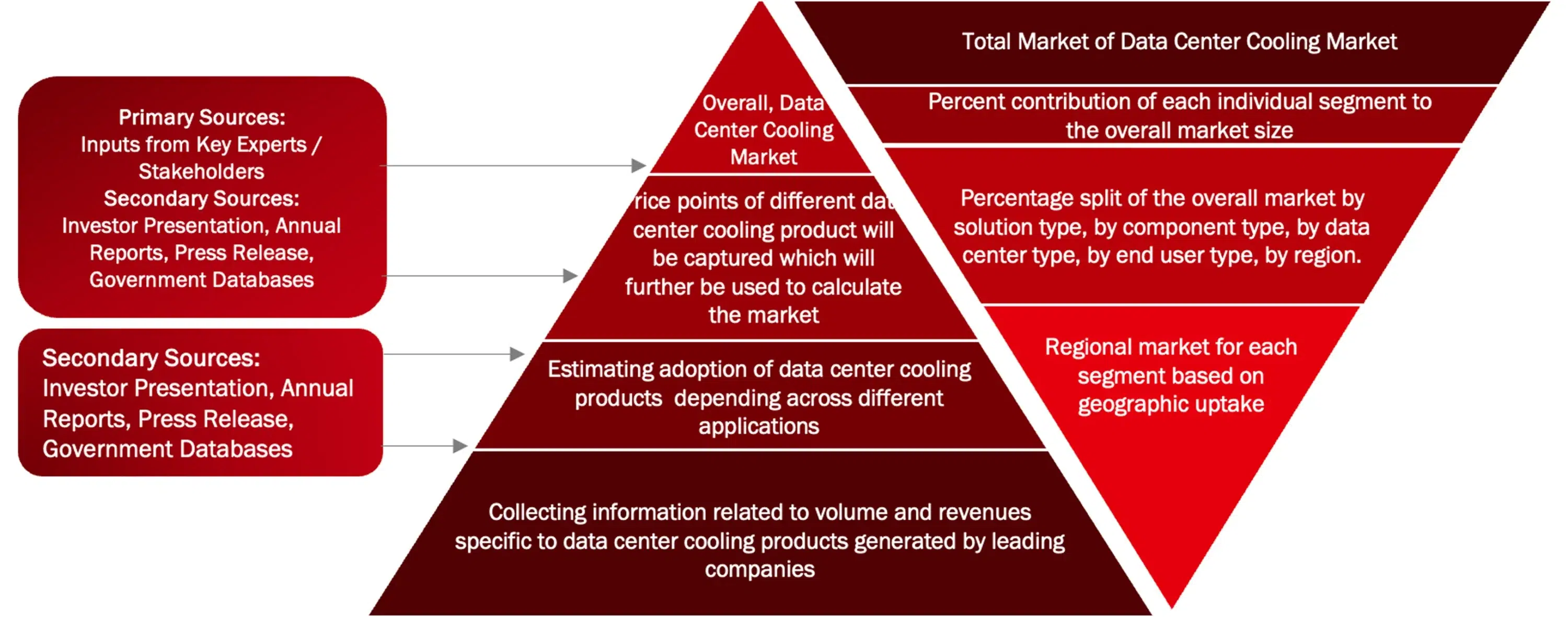
Market size estimation is performed using both top-down and bottom-up approaches. Key market players are identified, and their revenues are analysed to estimate the overall market size.
The market is further segmented based on:
- Product and service mapping across regions
- Adoption patterns across key application segments
- Insights gathered through primary and secondary research
Data Validation and Research Design
After estimating the overall market size, the data is validated using triangulation methods and market breakdown techniques to ensure accuracy and consistency. Both demand-side and supply-side factors are considered to refine the analysis.
The final data is validated through multiple sources to ensure reliability and to provide accurate insights across all market segments and regions.
Assumptions of the Study
The analysis of the data center cooling market is based on the following key assumptions:
- Trends in the industry are drawn from historical data and current information within the sector
- The future outlook is underpinned by constant economic conditions in the absence of shocks to the market
- The rate of adoption for data center cooling will rise steadily in all important regions
- The income statement and market share figures are estimated using available information from the industry and publicly available data
- The exchange rate and price trends will not be greatly affected during the forecast period
Scope and Limitations
Scope of the Study
This report offers an exhaustive overview of the international data center cooling market and includes the following components:
- Summary of market size, growth trends, and projections
- Carefully segmented market based on by component type, by solution type, by type of cooling type, by data center type, end-use industries type.
- Discussion of primary factors influencing the market
- Competitor analysis
- Insights into regional and national market performance
Limitations of the Study
Despite the best efforts being made to keep the results accurate, the study does suffer from some limitations:
- It has been done using both primary and secondary data that come with their own constraints
- Rapid developments in technology might affect the future course of market dynamics
- Some figures are only approximations due to lack of public disclosure
- The report is not an insurance against any disruptions in macroeconomics and geopolitics
- Future forecasts are indicative and subject to change due to altered industry dynamics
Data Triangulation and Market Breakdown
Data triangulation involved the combination of primary research, secondary research, and the Wissen Research analysis. Once the data points were sourced from the secondary market research, we sanitized the data points to make the market sizing and growth forecast more accurate by developing our own assumptions based on the inputs and insights we gather through the primary interviews with the industry experts. Once the data was thoroughly validated through primary interviews from both, demand and supply side of the market, our team of analyst and other team members involved finalized the market sizing and growth forecast.
Data Triangulation and Market Breakdown
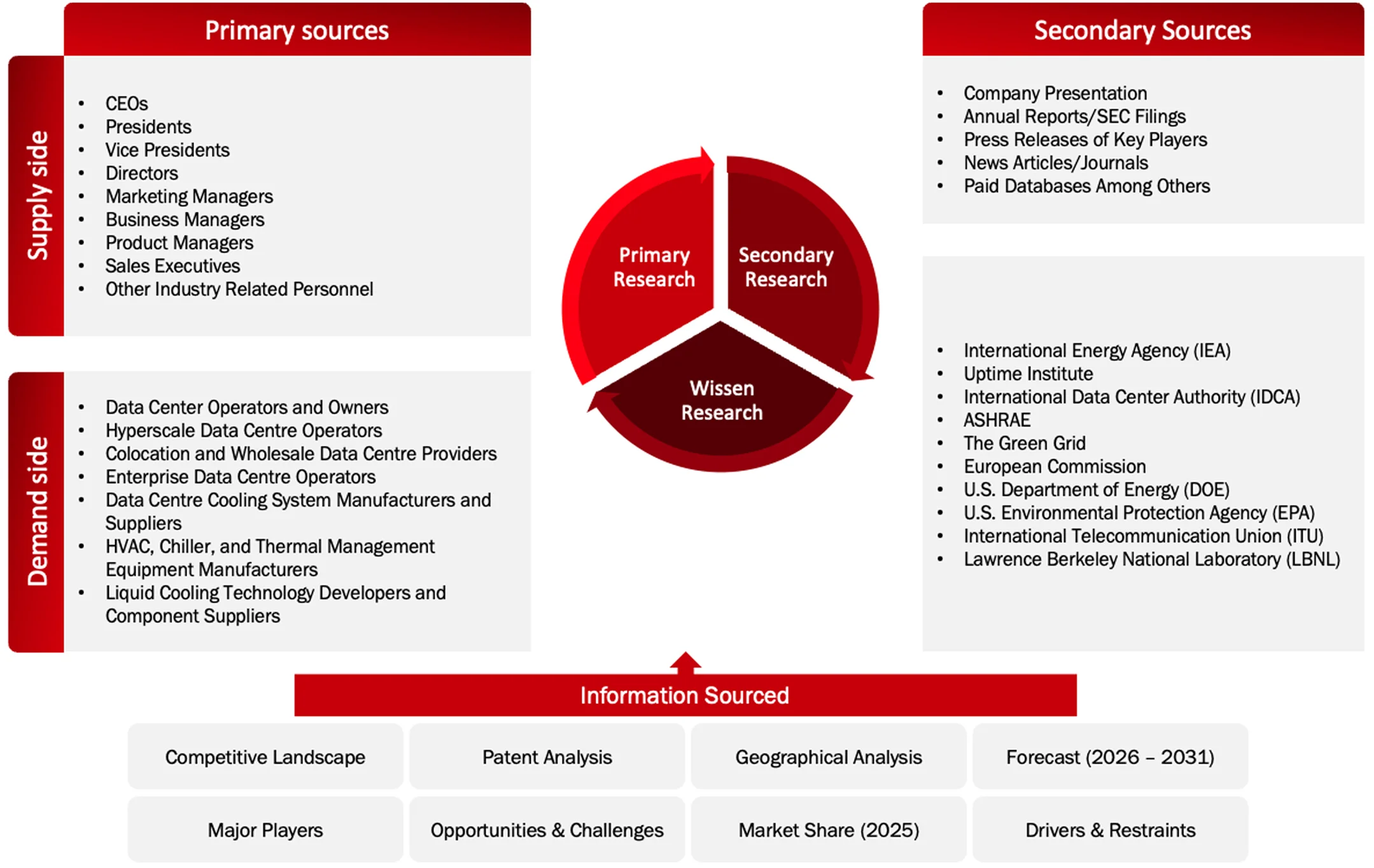
Data triangulation involved the combination of primary research, secondary research, and the Wissen Research analysis. Once the data points were sourced from the secondary market research, we sanitized the data points to make the market sizing and growth forecast more accurate by developing our own assumptions based on the inputs and insights we gather through the primary interviews with the industry experts. Once the data was thoroughly validated through primary interviews from both, demand and supply side of the market, our team of analyst and other team members involved finalized the market sizing and growth forecast.
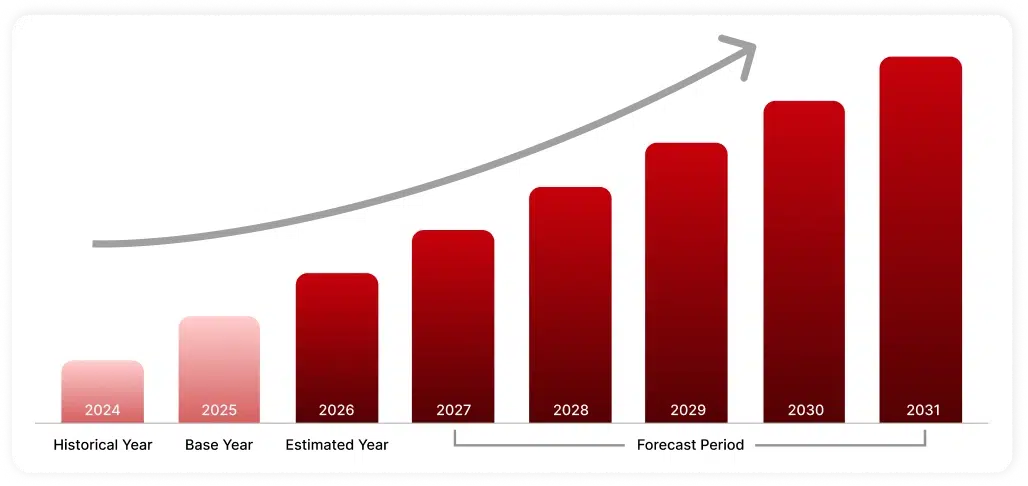
Year Framework
Bottom-Up Approach (Demand Side) And Top-Down Approach (Supply Side)
Bottom-Up Approach (Demand-Side Approach):
Determining the market size through the consolidation of demand among end-users, sectors, and geographic areas, which are calculated according to real-world demand conditions.
Top-Down Approach (Supply-Side Approach):
Calculating the market size through revenue and performance of the industry and its important companies, allocating the market size among various sectors.
Want detailed insights from this report?
Buy this Report
Choose the option that best fits your needs