
Prior Art for Mobile-to-Vehicle Communication Patents | Case Study
Case Study

What If Mobile-to-Vehicle Communication Was Already Known Before the Patent?

A classification-driven prior art investigation combined global patent searching, portfolio analysis, and technical evidence to uncover earlier approaches to mobile-to-vehicle communication.

Case Study Type Invalidation Search
Industry Vehicle Connectivity & Mobile-to-Car Communication
Publication Date November 13, 2026
Vehicle Connectivity image

The Client’s Challenge

A client sought to challenge a patent covering a vehicle communication system for wireless interaction between in-vehicle systems and mobile devices. The claimed technology addressed signal-origin determination, communication control, device and resource assessment and load determination for efficient application execution.

The challenge was to determine whether these features were genuinely novel or already disclosed in earlier vehicle connectivity technologies. Initial searches found broad mobile-to-vehicle communication references but failed to address the more specific claim elements, requiring a deeper prior art investigation.
Mobile-to-Car-Communication image

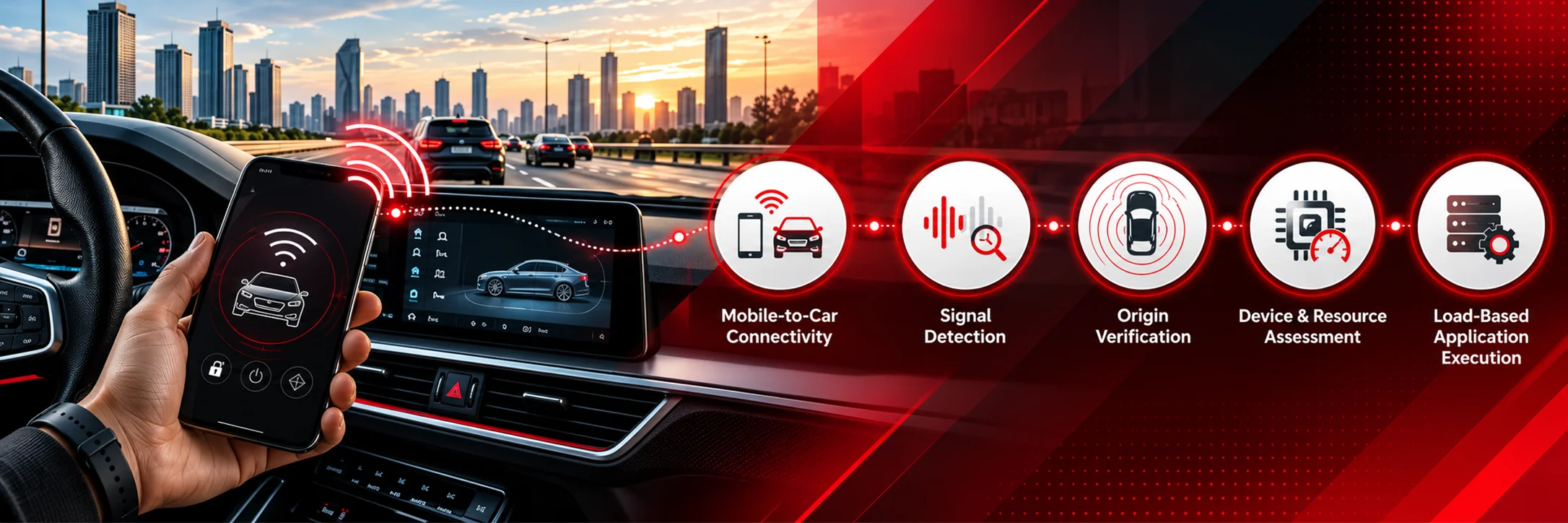
The search focused on the following principal product characteristics:

    • Wireless/Bluetooth communication between mobile devices and vehicles
    • Detection and analysis of incoming communication signals
    • Identification of signal origin within the vehicle
    • Assessment of device capabilities and available system resources
    • Load-based application execution and in-vehicle content sharing
Objective icon
CLIENT’S OBJECTIVE

Assess the validity of the patent by identifying earlier patent and non-patent disclosures covering mobile-to-vehicle communication, signal and device assessment, resource management and application execution.

To determine whether these claimed features were already known individually or collectively, thereby establishing a basis for challenging the patent’s novelty and non-obviousness.

Clients come to us for answers.
They leave with opportunities they didn’t know existed.

Our experts help organizations uncover insights, opportunities and strategic directions that traditional approaches often miss.

Wissen's Out-of-the-Box Approach

Classification-Driven Prior Art Investigation

  • Recognizing the limitations of conventional keyword searching, the investigation evolved toward a classification-driven strategy combining global patent searching, assignee and inventor analysis and technical comparison.
  • The objective was to uncover relevant disclosures that might not appear through searches based solely on the terminology used in the subject patent.

Identifying Relevant Prior Art

  • The investigation identified relevant disclosures from Denso Ten Ltd and Toyota Motor Corporation, alongside non-patent literature on smartphone–vehicle integration, providing technical leads on application execution, device capability identification and in-vehicle content presentation.

Our Methodology

Patent Feature Identification
Classification-Driven Search
Global Patent Search
Assignee and Inventor Analysis
Technical Reference Analysis
Comparative Claim Assessment
Patent Feature Identification
  • Extract key elements from patent claims.
  • Identify signal, device, resource, and load features.
  • Develop targeted search terms.
Classification-Driven Search
  • Combine keywords with IPC/CPC codes.
  • Target wireless communication and vehicle interfaces.
  • Refine searches beyond exact claim terminology.
Global Patent Search
  • Search US, Japanese, South Korean, and Chinese patents.
  • Identify relevant patent families.
  • Screen results for technical relevance.
Assignee and Inventor Analysis
  • Examine Toyota, Denso Ten, Hyundai, GM, and LG portfolios.
  • Trace related inventor patents.
  • Identify additional search leads.
Technical Reference Analysis
  • Review patent specifications and non-patent literature.
  • Examine application execution and device capabilities.
  • Identify relevant technical disclosures.
Comparative Claim Assessment
  • Map references against claim limitations.
  • Evaluate complementary technical disclosures.
  • Assess anticipation and obviousness separately.
Outcome:

The investigation identified relevant patent and non-patent references, providing a focused foundation for claim-level assessment and potential invalidation arguments.

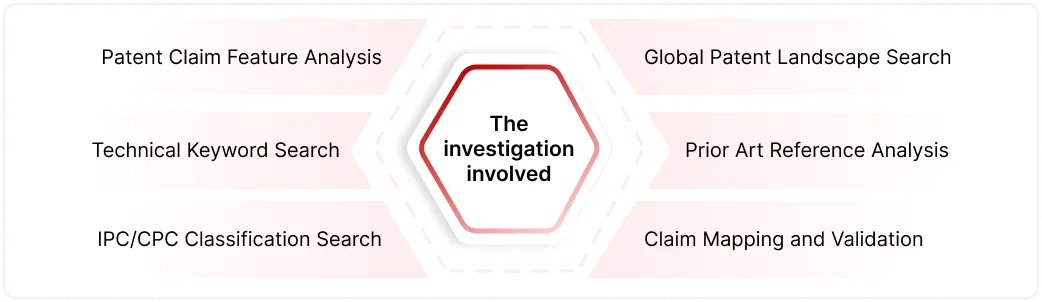
Patent Invalidation Search Methodology

The investigation combined keyword searching, patent classification analysis, global patent retrieval and technical reference comparison to identify prior art relevant to the subject patent.

Vehicle Connectivity methodology image

The investigation identified relevant disclosures concerning mobile-to-vehicle communication, application execution and device capability assessment, providing a basis for evaluating potential novelty and non-obviousness challenges.

Technical Challenges Addressed

Challenge 1: Identifying Relevant Prior Art

Initial searches identified vehicle communication patents but did not clearly disclose specific features such as resource assessment, load determination, and transmitted-information analysis.

Solution

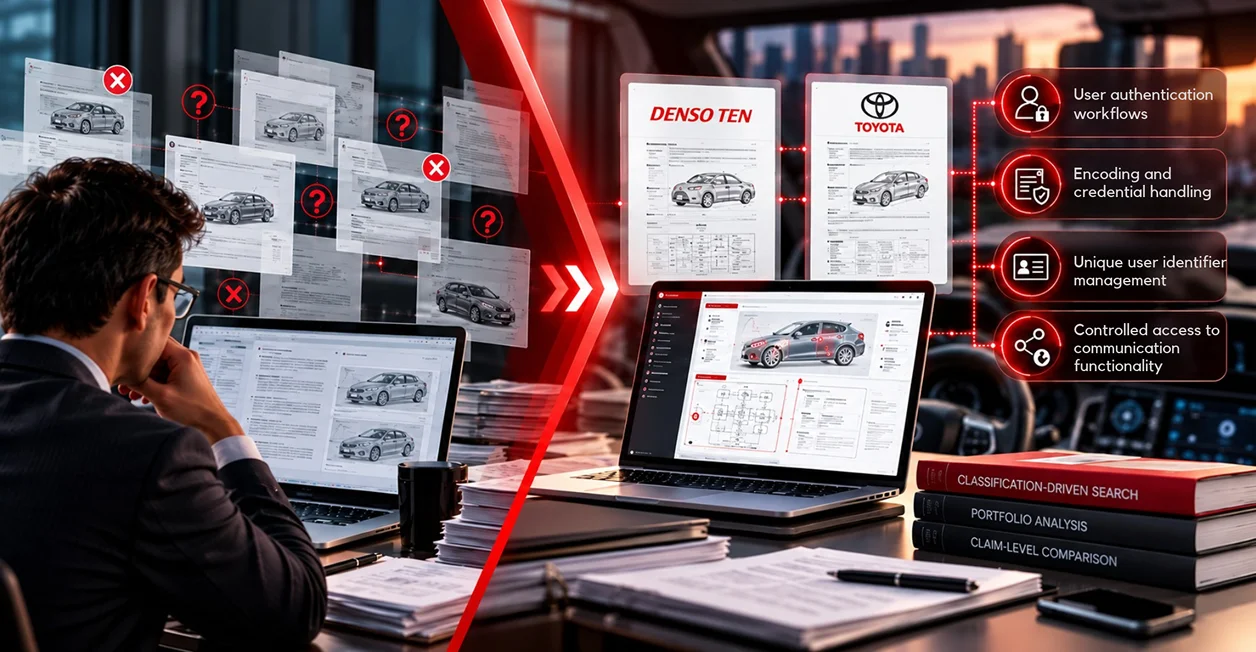
Classification-driven searching and portfolio analysis identified relevant disclosures from Denso Ten and Toyota, covering application execution and device capability identification. These references provided additional leads for claim-level comparison.

The analysis revealed:
  • User authentication workflows
  • Encoding and credential handling
  • Unique user identifier management
  • Controlled access to communication functionality

These findings demonstrated that access control mechanisms were already implemented in the identified system prior art before the patent’s filing date.

Challenge 2: Establishing Claim-Level Relevance

The identified references addressed different aspects of vehicle connectivity, making it difficult to determine whether they supported a novelty or non-obviousness challenge.

Solution

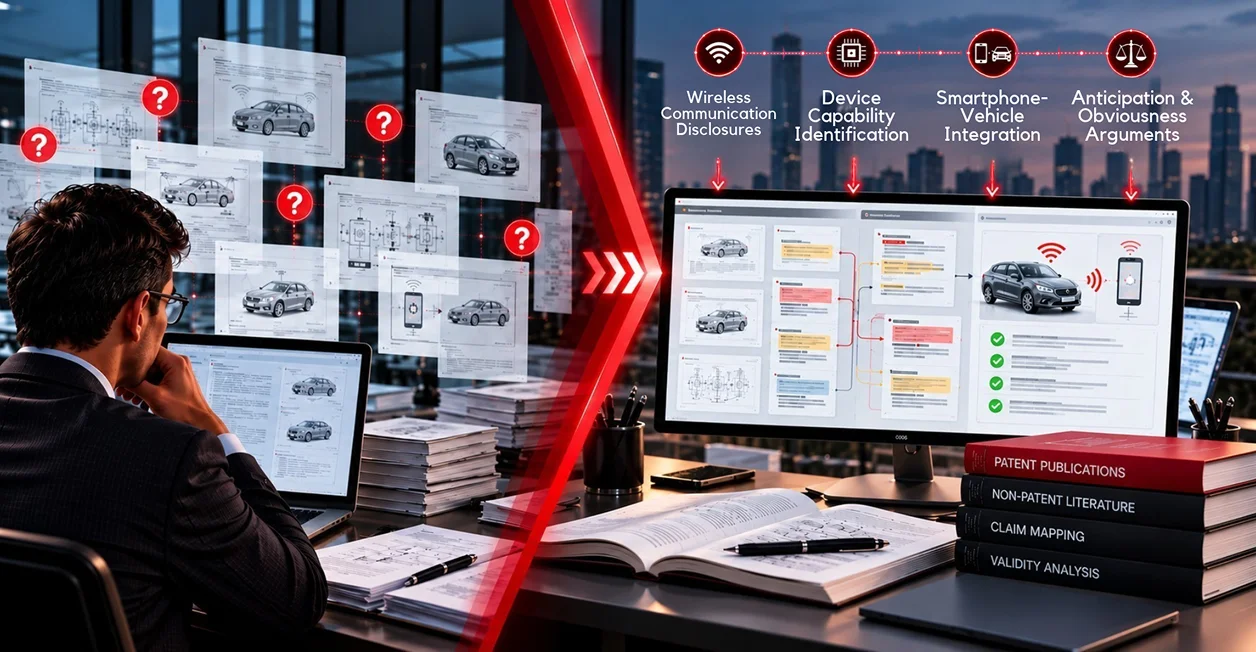
The investigation compared patent publications and non-patent literature covering wireless communication, device capabilities, and smartphone–vehicle integration. The disclosures provided a basis for evaluating potential anticipation and obviousness arguments, subject to claim mapping and publication-date verification.

The analysis revealed:
  • Wireless communication disclosures
  • Device capability identification
  • Smartphone–vehicle integration
  • Potential anticipation and obviousness arguments

The analysis revealed relevant disclosures on wireless communication, device capability identification, and smartphone–vehicle integration, providing a basis for evaluating potential anticipation and obviousness arguments.

Results & Business Impact

The investigation identified relevant patent and non-patent literature relating to mobile-to-vehicle communication, application execution, and device capability assessment, providing a foundation for evaluating potential challenges to the subject patent’s novelty and non-obviousness.

Key Outcomes

  • Key outcome Icon

    The investigation moved beyond conventional keyword-based searching and incorporated classification-driven and assignee-focused searches.

  • Key outcome Icon

    Relevant disclosures from Denso Ten and Toyota were identified, expanding the prior art evidence base.

  • Key outcome Icon

    Earlier approaches to application execution and device capability assessment were identified.

  • Key outcome Icon

    Claim-level evaluation was enabled by establishing leads for comparing prior art against patent limitations.

  • Key outcome Icon

    Potential anticipation and obviousness arguments were supported through the identification of relevant technical disclosures.

Strategic Business Impact

The investigation provided a more structured understanding of the prior art landscape surrounding mobile-to-vehicle communication. The approach can help organizations:

  • Identify potentially relevant patent assets earlier
  • Understand existing technical approaches and disclosures
  • Prioritize patents and references for subsequent legal review
  • Identify technology areas requiring additional investigation

Actual patent validity depends on factors including claim construction, applicable jurisdiction, publication dates, legal requirements, prosecution history, and the specific technical disclosures of each reference. The investigation therefore serves as an evidence base for subsequent legal and strategic assessment.

Could Relevant Prior Art Be Hidden Beyond Your Initial Search?

Our IP research team identifies relevant prior art, evaluates claim-level evidence, and supports patent validity challenges through focused investigations.