Intragastric Device Patent Invalidation Search Case Study
Case Study

Could Earlier Drug Delivery Technology Offer a New Route to Intragastric Device Invalidation?

The investigation examined biodegradable delivery capsules, gastric balloon architecture and moisture-responsive deflation mechanisms to assess potential patent invalidity arguments.

Case Study Type Invalidation Search
Industry Medical Devices
Publication Date November 16, 2026
Intragastric device image

The Client’s Challenge

The client required an invalidity assessment of a patented intragastric volume-occupying device designed to support minimally invasive obesity treatment. The central question was whether earlier technical disclosures could undermine the patentability of the claimed combination of delivery, inflation, sealing and controlled deflation features.

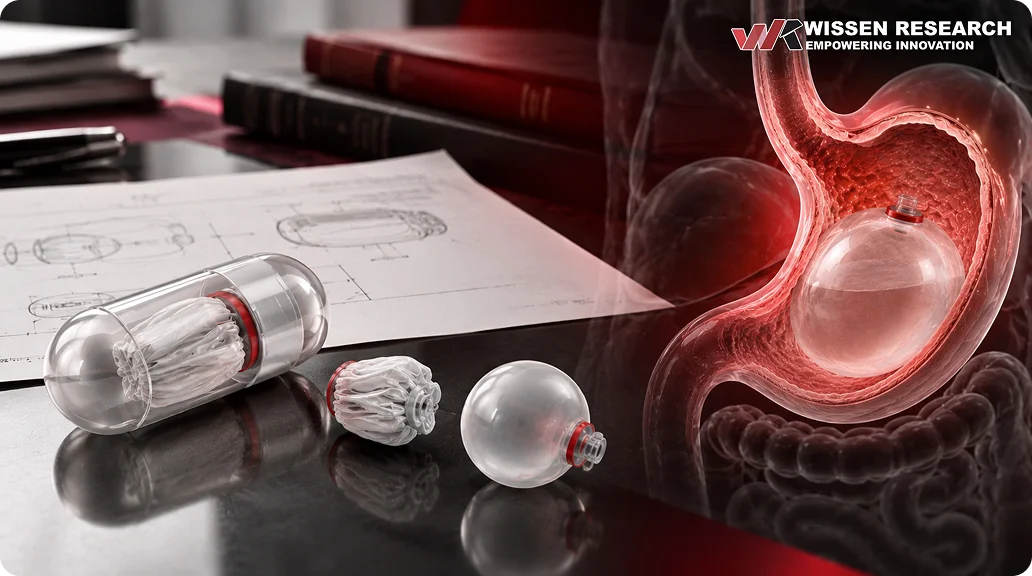
Unlike a conventional gastric balloon, which is generally introduced through an endoscopic or catheter-based procedure, the subject invention described a swallowable system designed to deliver a compact volume-occupying component into the stomach. The delivery capsule was intended to degrade after ingestion, allowing the device to deploy and perform its intended function.

Intragastric Device case study

The architecture incorporated several interacting features:

    • A degradable delivery capsule for swallowing and deployment.
    • A compactable volume-occupying component designed to expand within the gastrointestinal tract.
    • An integrated inflation and deflation arrangement.
    • A self-sealing valve mechanism.
    • A controlled deflation mechanism involving moisture-responsive materials.
Objective icon
CLIENT’S OBJECTIVE

Identify relevant earlier disclosures and evaluate their potential to challenge the subject patent’s claims on novelty and obviousness grounds.

Whether a technically reasoned combination of references could support a potential obviousness argument.

Clients come to us for answers.
They leave with opportunities they didn’t know existed.

Our experts help organizations uncover insights, opportunities and strategic directions that traditional approaches often miss.

Wissen’s Out-of-the-Box Approach:

Mechanism-Focused Prior Art Investigation

  • Recognizing the limitations of conventional searches focused primarily on intragastric balloon systems, the investigation expanded into related medical device technologies to identify earlier disclosures of the specific deflation mechanism.
  • To develop a more targeted invalidity assessment, the search focused on technologies that incorporated:
  • Biodegradable or moisture-responsive deflation valves.
  • Controlled deflation mechanisms
  • Swallowable drug delivery devices

Identifying Relevant Prior Art

  • A focused investigation identified two potentially relevant patent references addressing related aspects of balloon deflation and biodegradable valve technology.

  • However, neither reference, based on the available analysis, established the complete structural arrangement claimed in the subject invention, particularly the septum with a lip or ring and the combination of moisture-erodible and moisture-absorbing expandable materials.

  • To address this gap, the investigation evolved toward a mechanism-specific comparison of the identified disclosures, examining their functional similarities, structural differences, and potential relevance to an obviousness-based invalidity argument.

Our Methodology

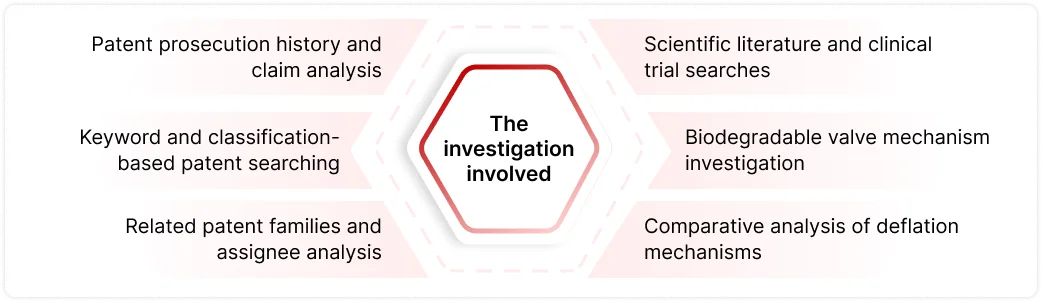
Patent Prosecution Review
Claim Deconstruction
Multi-Database Prior-Art Search
Cross-Domain Technology Search
Focused Deflation Mechanism Search
Technical Reference Analysis
Claim Mapping and Combination Assessment
Patent Prosecution Review
  • Examine office actions, examiner requisitions and applicant amendments.
  • Identify critical claim limitations and prosecution history insights.
Claim Deconstruction
  • Analyze the intragastric device architecture and independent claims.
  • Focus on the degradable capsule, valve structure and controlled deflation mechanism.
Multi-Database Prior-Art Search
  • Search patent databases, including Orbit, PatSnap, Espacenet, WIPO and USPTO.
  • Apply keyword, classification, assignee and inventor-based strategies.
Cross-Domain Technology Search
  • Investigate gastric balloon systems and swallowable drug delivery devices.
  • Explore biodegradable valves, controlled-release mechanisms and biocompatible materials.
Focused Deflation Mechanism Search
  • Target liquid-triggered valve erosion and moisture-responsive materials.
  • Examine septum, lip, ring, and expandable material configurations.
Technical Reference Analysis
  • Compare osmotic self-deflation and biodegradable valve mechanisms.
  • Identify structural similarities and missing claim elements.
Claim Mapping and Combination Assessment
  • Map identified disclosures against relevant claim limitations.
  • Evaluate potential obviousness arguments based on complementary technical teachings.
Outcome:

Identification of relevant prior-art disclosures addressing gastric balloon self-deflation and biodegradable valve technology, establishing a focused basis for assessing potential patent invalidity through claim mapping and combination analysis.

Prior-Art Search and Technical Investigation Methodology

The patent invalidation investigation focused on identifying prior-art disclosures relating to intragastric volume-occupying devices, degradable delivery capsules and controlled balloon deflation mechanisms.

case study methodology

Following the interim review, the search was refined to investigate whether earlier technologies disclosed balloon deflation through valve erosion caused by exposure to internal liquid.

Further analysis identified a swallowable drug delivery device incorporating a biodegradable deflation valve. This mechanism-focused investigation provided a basis for evaluating the relevance of the identified references and assessing their potential to support a patent obviousness argument.

Technical Challenges Addressed Through Prior-Art Analysis

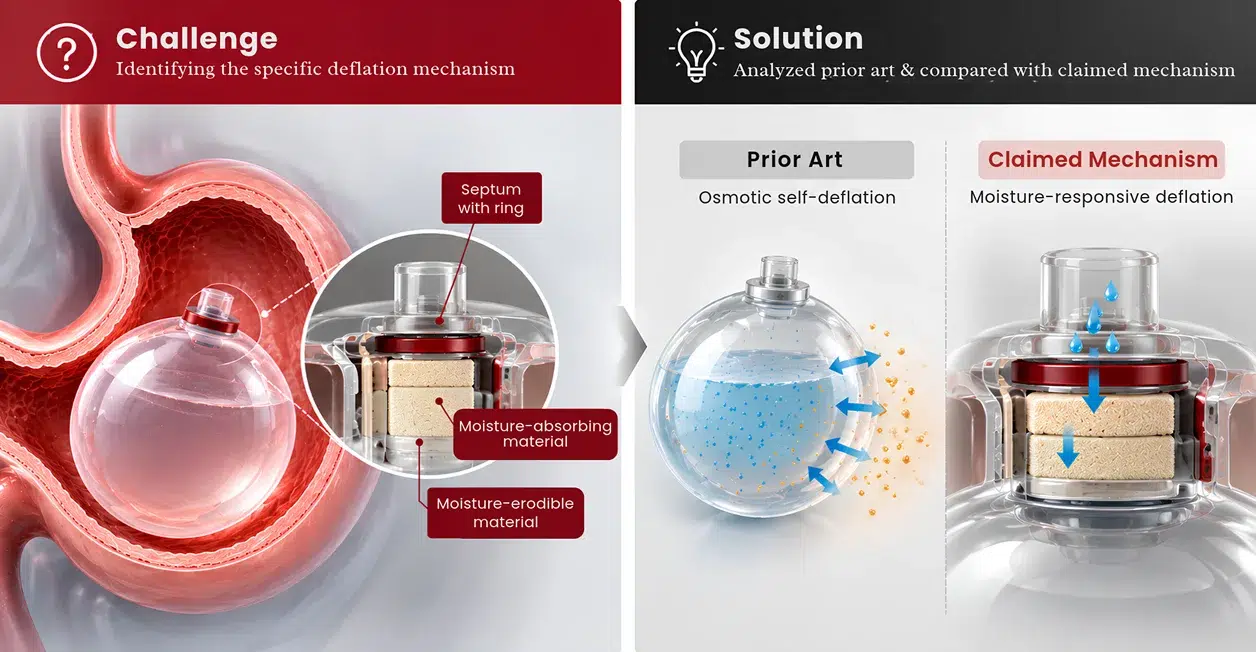
Challenge 1: Identifying the Specific Deflation Mechanism of the Intragastric Balloon

A key challenge involved determining whether the identified prior art disclosed the specific deflation mechanism of the subject intragastric volume-occupying device. The subject invention incorporated a septum with a lip or ring, moisture-erodible material, and moisture-absorbing expandable material to facilitate controlled balloon deflation.

Solution

A detailed analysis of the identified gastric balloon reference examined its osmotic self-deflation mechanism and compared it with the claimed structural arrangement.

The analysis revealed:
  • An inflatable gastric balloon with an osmotically active membrane.
  • Self-deflation through an imbalance between inflation fluid and intestinal contents.
  • Differences in the disclosed deflation mechanism compared with the claimed septum and moisture-responsive material arrangement.

These findings established a technical distinction between osmotic self-deflation and the specific moisture-responsive valve mechanism described in the subject invention.

Intragastric Device challenge photo
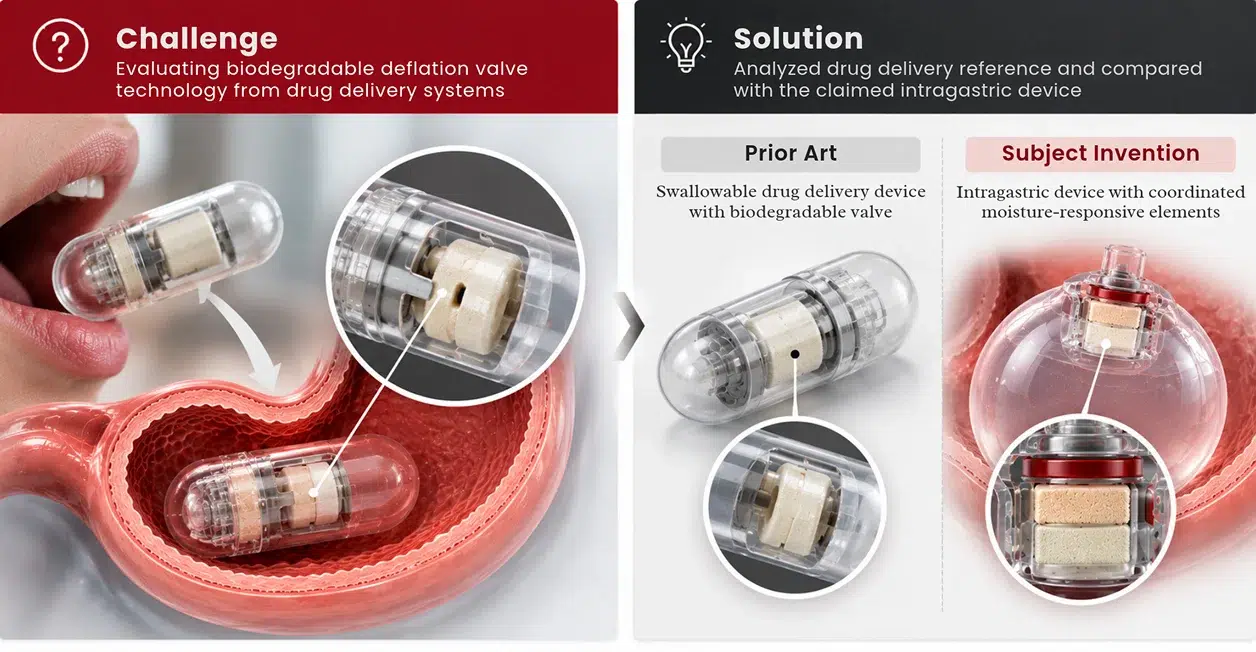
Challenge 2: Evaluating Biodegradable Deflation Valve Technology from Drug Delivery Systems

Another important challenge involved determining whether an earlier swallowable drug delivery device incorporating a biodegradable deflation valve could provide relevant prior-art teachings for the subject intragastric device. Although the reference shared functional similarities, it operated in a different gastrointestinal environment and lacked the complete claimed structural arrangement.

Solution

A focused search examined biodegradable deflation valves and related moisture-responsive mechanisms in drug delivery devices. The identified reference was compared with the subject invention to assess functional similarities and structural differences.

The analysis revealed:
  • A swallowable drug delivery device incorporating a biodegradable deflation valve.
  • Functional similarities in the use of a valve to facilitate balloon deflation.
  • Differences in application environment and the coordinated arrangement of the septum lip or ring, moisture-erodible material, and moisture-absorbing expandable material.

These findings identified a potentially relevant technical teaching for combination analysis while highlighting the structural differences requiring further assessment in evaluating a potential obviousness argument.

stomach gastric image

Results & Business Impact

The investigation identified relevant prior-art disclosures relating to intragastric balloon deflation and biodegradable valve mechanisms, providing a technical basis for evaluating potential invalidity arguments against the subject patent.

Key Outcomes

  • Key outcome Icon

    Identification of a gastric balloon reference describing an osmotic self-deflation mechanism.

  • Key outcome Icon

    Discovery of an additional reference disclosing a biodegradable deflation valve in a swallowable drug delivery device.

  • Key outcome Icon

    Identification of structural differences involving the septum lip or ring, moisture-erodible material, and moisture-absorbing expandable material.

  • Key outcome Icon

    Refinement of the search strategy to target the specific mechanism of liquid-induced valve erosion.

  • Key outcome Icon

    Development of a potential obviousness argument through comparative analysis of the identified references.

Strategic Business Impact

By expanding the investigation beyond conventional intragastric balloon technologies to related drug delivery systems, the analysis provided:

  • Broader prior-art coverage across related medical device technologies.
  • A focused basis for assessing potential obviousness arguments.
  • More targeted directions for further prior-art searching and claim analysis.
  • A clearer technical foundation for evaluating the strength of the patent's invalidity position.

The investigation demonstrated how mechanism-focused prior-art searching can uncover relevant technical teachings across different medical device applications, helping identify potential claim vulnerabilities that may not be apparent from searches limited to the same device category.

Could an Overlooked Technical Mechanism Challenge Your Patent?

Our team examines related technologies, component architectures and underlying mechanisms to identify relevant prior art and assess potential claim-level weaknesses.