
Summarize this report with:



Executive Summary
QR code traceability connects a physical product to a digital record, enabling businesses and consumers to track its journey from raw-material sourcing and manufacturing to distribution and the final point of sale. A QR code on a product isn’t just a link, it’s a doorway into a digital record of that product’s journey. QR traceability is evolving from a simple product-information tool into a broader digital product identity ecosystem that connects physical products with digital records across the entire lifecycle. While QR codes provide the identification layer, the real value comes from the supporting ecosystem of cloud platforms, enterprise integrations, authentication technologies, IoT, RFID, blockchain, and analytics.
Adoption is becoming increasingly industry-specific rather than technology-driven. Pharmaceuticals prioritize serialization and compliance, food focuses on traceback and recall readiness, luxury brands emphasize authentication, apparel and consumer goods are adopting connected product identities, and battery industries are preparing for lifecycle transparency and Digital Product Passports. Regulation is emerging as a key market driver, accelerating investments in traceability, sustainability reporting, and product transparency. However, long-term success will depend on solving challenges around interoperability, data quality, supplier participation, and system integration.
The future of QR traceability lies beyond tracking products—it lies in creating trusted digital identities that enable transparency, intelligence, circularity, and new business opportunities throughout the product lifecycle.
The competitive landscape remains fragmented rather than consolidated: no single company or patent holds a dominant blocking position, and credible players range from connected-product cloud platforms to narrower specialists in authentication and regulatory compliance. Blockchain and AI both appear in the ecosystem, but neither is currently a default or required component — blockchain remains a narrow complement used mainly in multi-party provenance cases, while AI-driven traceability analytics is the least mature, least evidenced layer of the stack, and represents the clearest open opportunity for a new commercial leader.
-
QR Codes Are Becoming Digital Identity Gateways: QR codes are shifting from static labels to dynamic connections between physical products and digital information, enabling traceability, authentication, compliance, and consumer engagement.
-
No Single Technology Fits Every Industry: Pharma reaches for mandated serialization codes. Fashion reaches for RFID-powered digital IDs. EV makers reach for blockchain. Luxury reaches for copy-proof QR codes. Treating these as interchangeable is the fastest way to sell or buy the wrong solution.
-
The Market Is Moving Toward Multi-Technology Platforms: QR, RFID, NFC, IoT, blockchain, and AI are becoming complementary technologies within broader traceability ecosystems rather than competing solutions.
-
Regulation Is Accelerating Adoption: Food traceability requirements, pharmaceutical serialization, Digital Product Passports, and sustainability regulations are transforming traceability into a strategic necessity.
-
Competitive Advantage Will Come From Data Intelligence: The future value of traceability will come not from generating product identities, but from using product data for analytics, risk detection, authentication, sustainability, and lifecycle management.
-
Digital Product Passports Will Shape the Next Phase: Traceability is expanding beyond supply chains toward full product lifecycle management, including repair, resale, reuse, and recycling.
-
Interoperability and Data Quality Are Critical Challenges: The ability to connect suppliers, platforms, and ecosystems with trusted data will determine successful large-scale adoption.
TECHNOLOGY LANDSCAPE
QR traceability is not a single technology, it is a stack: a physical identifier (the QR code) paired with a digital record system that lets a scan resolve to information about a specific product or batch. QR code traceability enables businesses to connect physical products with digital records, providing visibility into their journey from raw-material sourcing and manufacturing to distribution and the point of sale. At the consumer level, traceability can provide greater confidence in claims related to product authenticity, sustainability, and ethical sourcing. As supply chains become more complex, QR-enabled systems are increasingly evolving into broader digital traceability platforms that can integrate technologies such as IoT, RFID, and blockchain to strengthen data visibility, verification, and trust across the product lifecycle.
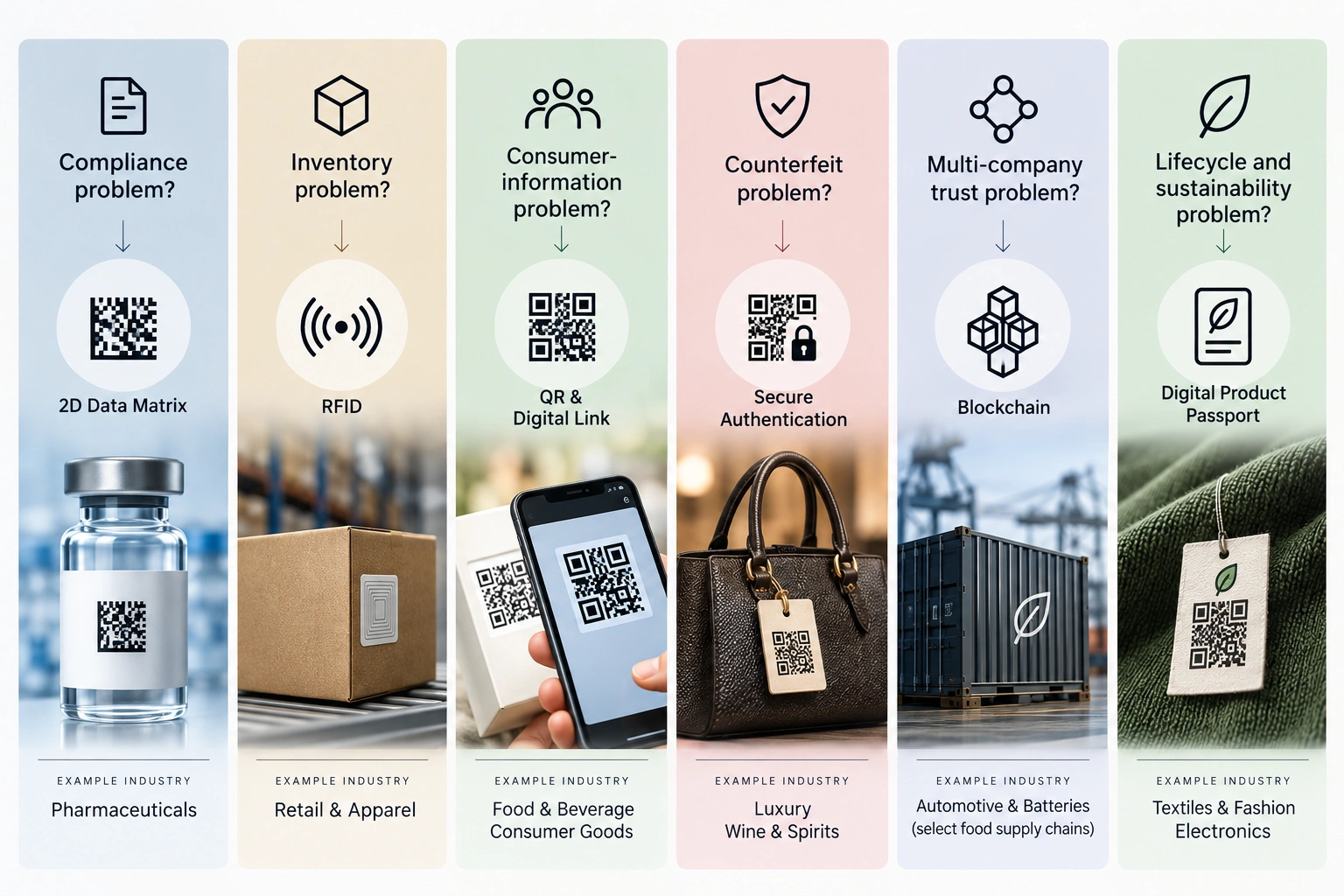
The most useful way to understand this space isn’t “how does a QR code work” — it’s “what problem is each industry actually solving, and which tool are they reaching for.” The table below is the fastest way to see the pattern; the industry write-ups after it explain the why behind each choice.
Industry | Main Technology Used | Why It Is Used | Technology Description | Example |
|---|---|---|---|---|
Pharmaceuticals | GS1 DataMatrix / Data Matrix for serialization and traceability; QR codes may be used separately for digital information | Regulatory compliance and drug verification | In many pharmaceutical regulatory systems, a Data Matrix–based 2D barcode is required for product identification, serialization, and supply-chain verification. For example, the EU Falsified Medicines Directive specifically requires a machine-readable Data Matrix for the unique identifier. QR codes are generally not substitutes for the mandated serialization carrier in such systems. | TraceLink – pharmaceutical serialization and supply-chain compliance platform |
Food & Beverage | QR codes / 2D barcodes for consumer-facing product information and traceability; blockchain in selected multi-party supply chains | Food safety, recalls and provenance | QR codes provide consumers with easy access to product information, origin, ingredients, and traceability data through a simple scan. Blockchain can be used where multiple supply-chain participants need to share and verify traceability records across a common network, improving data integrity and transparency. | IBM Food Trust — used in food-traceability initiatives involving companies including Walmart, Carrefour, and Nestlé |
Apparel & Fashion | RFID/NFC/QR-based digital IDs connected to a cloud platform | Inventory, circularity and product lifecycle | RFID enables automated, item-level inventory and supply-chain tracking, while QR and NFC can provide consumer-facing access to product information, authentication, and digital experiences. These technologies can be linked to a shared digital identity and managed through a connected product cloud. | Avery Dennison’s atma.io — adidas has used the platform for its Infinite Play buy-back initiative, while Gap Inc. has explored item-level traceability for Athleta products. |
Electric Vehicles / Batteries | Blockchain-enabled material traceability | Material sourcing and lifecycle compliance | EV supply chains involve multiple independent participants—from mines and processors to battery manufacturers and automakers. Blockchain-based systems can help create a shared, tamper-evident chain of custody, supporting responsible sourcing, human-rights due diligence, and verification of material origin. | Circulor — used by Volvo Cars and Polestar to trace critical battery materials, including cobalt, nickel, lithium, mica and graphite. |
Luxury Goods, Wine & Spirits | Secure QR codes with copy-detection technology | Anti-counterfeiting and authentication | The primary challenge is product authentication—determining whether an item is genuine or counterfeit. A standard QR code can be copied and reproduced on counterfeit packaging, whereas secure QR codes incorporate copy-detection features that can help distinguish an original code from an unauthorized reproduction. | Scantrust — used by Marchesi Antinori for anti-counterfeiting and product authentication of wine bottles, alongside other consumer and premium brands. |
General Retail / Consumer Packaged Goods | GS1 Digital Link-enabled 2D barcodes (including QR codes) | One code for retail and consumer information | The goal is to create a common product identity that can support multiple use cases—including retail operations, supply-chain data, regulatory information, and consumer-facing digital content. The same GS1 identifier can connect different users and applications to relevant information. | GS1 Digital Link — an open global standard rather than a technology owned by a single retailer or brand. |
Overall ecosystem maturity assessment: The QR traceability ecosystem is best characterized as bifurcated rather than uniformly mature — the data-carrier and basic-information layers (QR codes, GS1 Digital Link) are commercially mature and standardized, while the higher-value layers (verified authentication, blockchain interoperability, regulatory passport integration) remain at pilot-to-early-commercial stage, concentrated in specific high-value sectors (luxury goods, pharmaceuticals) rather than broadly diffused across CPG and other consumer categories.
Technology | TRL Stage | Description |
|---|---|---|
Digital Product Passport integration | Emerging, regulation-driven | Legally mandated but not yet in force for any product category as of this research; first mandatory deadline (batteries) is February 2027 |
Dynamic QR / digital product identity | Established, still scaling | Redirect-based QR enabling continuously updated per-item or per-batch content; Commercially available via multiple SaaS platforms |
Basic QR code product information (static QR, batch-level) | Widespread adoption | Widespread across food, consumer goods, and pharma labelling; baseline capability |
IoT-enabled traceability | Established for logistics monitoring; emerging for QR-anchored integration | Mature standalone cold-chain/asset-monitoring market; direct integration with QR-scan-based consumer traceability is a newer, less standardized pattern |
AI-enabled traceability and analytics | Emerging / early-stage | Machine learning applied to traceability data for anomaly detection, demand signals, fraud pattern detection; publicly available evidence of broad production deployment specific to QR traceability data is limited |
Core Components / Architecture
THE STRUCTURE OF QR CODE
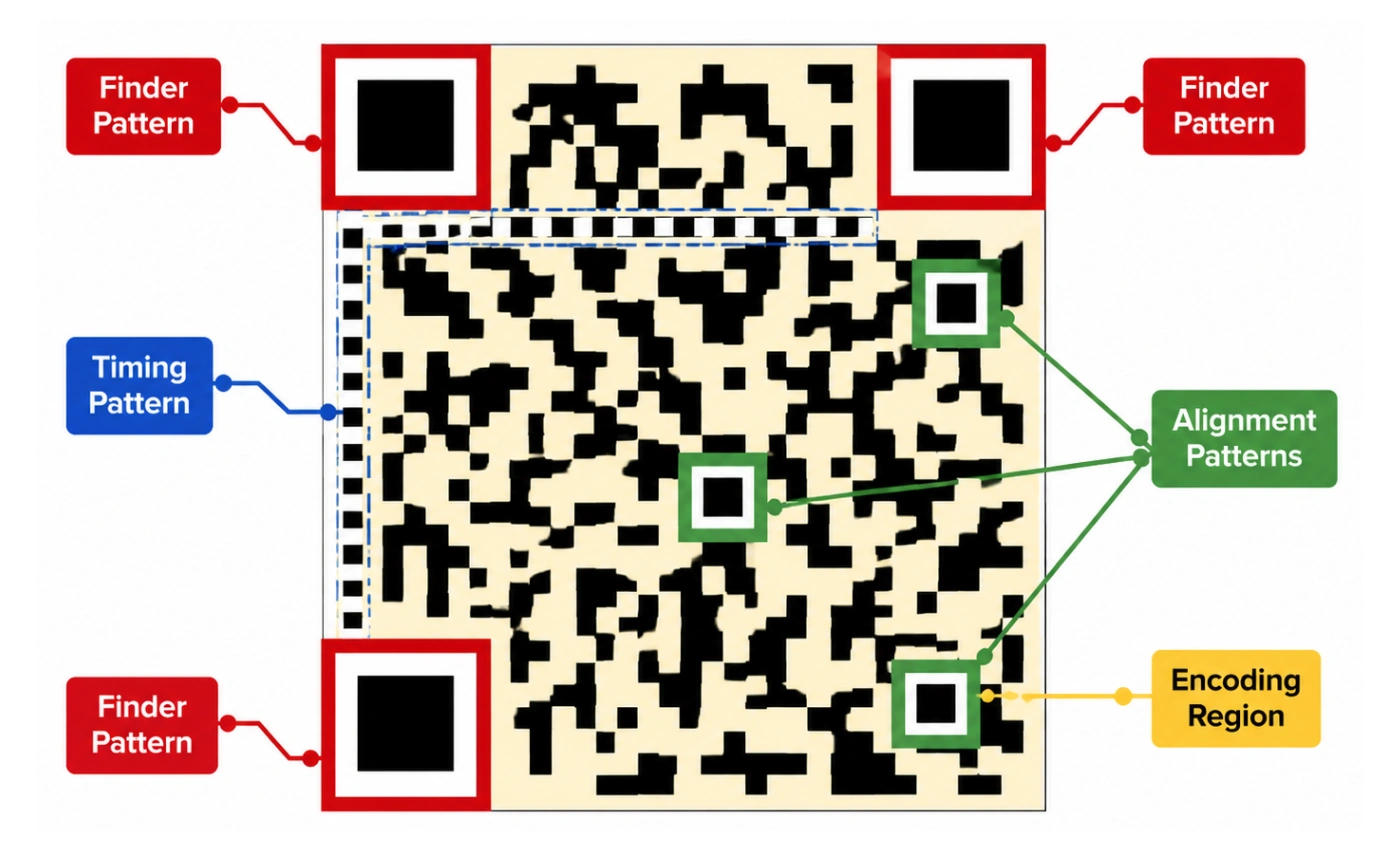
A QR code is a two-dimensional matrix barcode governed internationally by ISO/IEC 18004. The standard specifies QR code symbology characteristics, data character encoding methods, symbol formats, dimensional characteristics, error correction rules, a reference decoding algorithm, production quality requirements, and user-selectable application parameters. The QR code is composed of small black and white modules arranged in a structured grid and consists of:
- Finder Patterns: Three corner patterns detect the QR code’s position and orientation, enabling 360° scanning.
- Alignment Patterns: Correct QR code distortion, particularly nonlinear distortion.
- Timing Patterns: Alternating black and white modules establish the central coordinates of QR code cells.
- Encoding Region: Contains the encoded data, error-correction codewords, and version and format information.
QR Traceability Technology Stack
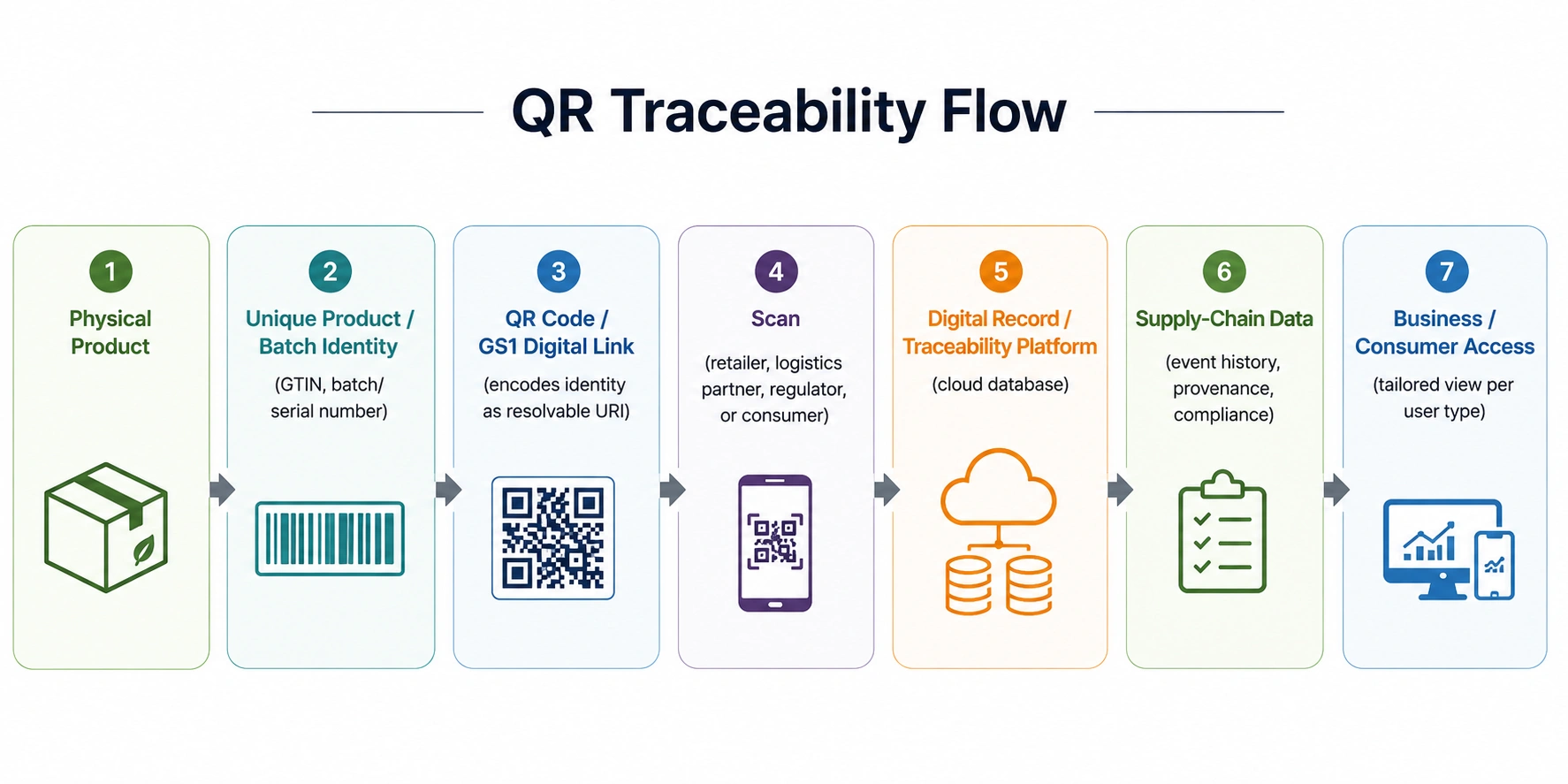
QR traceability is best understood as seven interacting layers, not a single product category.
Identification Layer — QR code symbol, product serialization scheme, GTIN (Global Trade Item Number), and the GS1 Digital Link URI structure that ties them together. A GS1 QR code is technically a standard ISO/IEC 18004 symbol whose first data codeword signals that the payload follows GS1 Application Identifier syntax — over 100 defined Application Identifiers exist, with (01) for GTIN, (10) for batch/lot, (17) for expiry date, and (21) for serial number among the most commercially used.
Data Layer — Cloud-hosted product master data, batch/serial records, and supply-chain event logs that the QR resolves to.
Connectivity Layer — APIs, ERP, WMS, and POS integrations that write events (production, shipment, receipt, sale) into the data layer and read identifiers at scan points. Industry descriptions of traceability implementation consistently list integration between ERP, MES, printing, and warehouse systems and a central traceability platform as a core requirement for capturing supply-chain events at their source.
Data Capture Layer — IoT sensors, RFID, and NFC, which complement QR by capturing environmental or bulk-scan data QR cannot.
Trust & Verification Layer — Authentication mechanisms (tamper-evident labels, digital signatures, hologram-QR combinations) and, selectively, blockchain/DLT for tamper-evident record-keeping.
Intelligence Layer — AI/analytics applied to traceability data for anomaly detection, demand signals, and (in more advanced deployments) digital twins of product/batch histories. This layer is comparatively early-stage across the ecosystem.
User Layer — Mobile apps, web resolvers, and consumer/business portals presenting the appropriate data view per audience.
A recurring finding across primary GS1 sources is that the identification and connectivity layers are the most mature and standardized, while the intelligence layer (AI-driven analytics on traceability data) is the least standardized.
COMPETITIVE LANDSCAPE
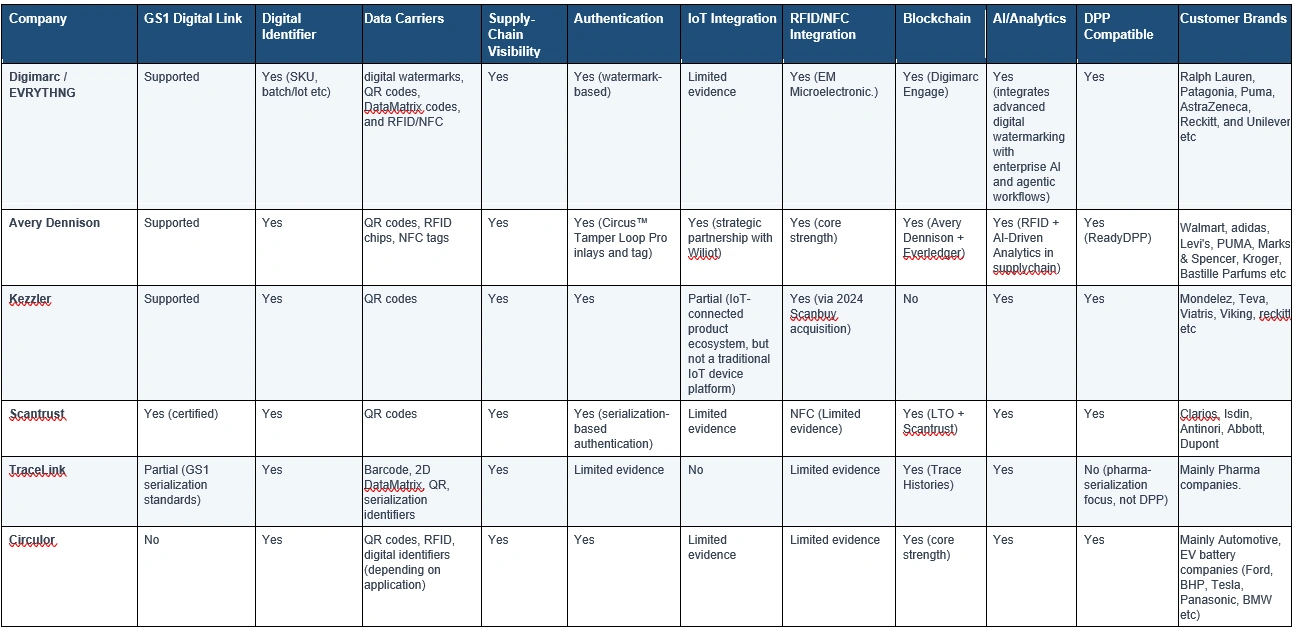
The competitive ecosystem around QR traceability is fragmented across several distinct roles rather than dominated by a small set of directly competing platforms offering identical capability. Four broad archetypes emerge:
Standards bodies and infrastructure providers (GS1) — do not compete commercially but set the interoperability rules the rest of the ecosystem builds on.
Connected-product / digital-identity cloud platforms (Digimarc/EVRYTHNG, Avery Dennison atma.io, Kezzler) — provide the cloud data layer plus digital-identity management, typically carrier-agnostic (QR, NFC, RFID) rather than QR-exclusive.
Authentication-specialist providers (Scantrust) — focus specifically on tamper-evident/copy-detection QR codes for anti-counterfeiting, positioning blockchain as a minor complement rather than the core offering.
Vertical compliance and industrial-materials providers (TraceLink for pharma DSCSA compliance; Circulor for industrial raw-material/EV battery provenance) — serve regulatory or ESG-driven traceability needs specific to one industry, often blockchain-anchored where multi-party trust is the central requirement.
Geographically, the reviewed players are concentrated in North America (Digimarc, TraceLink, AgileQR/121nexus, Honeywell) and Europe (Kezzler — Norway; Scantrust and Circulor — Switzerland/UK; Avery Dennison’s atma.io platform, though the parent is US-headquartered, has substantial European deployment). Adoption stage varies sharply by vertical: pharmaceutical serialization is fully mature and mandatory; food batch traceability is mature but its highest-profile US mandate (FSMA 204) is not yet enforced; consumer-goods brand protection and connected packaging are commercially active but voluntary; and Digital Product Passport-driven traceability is early-stage and regulation-paced rather than market-paced.
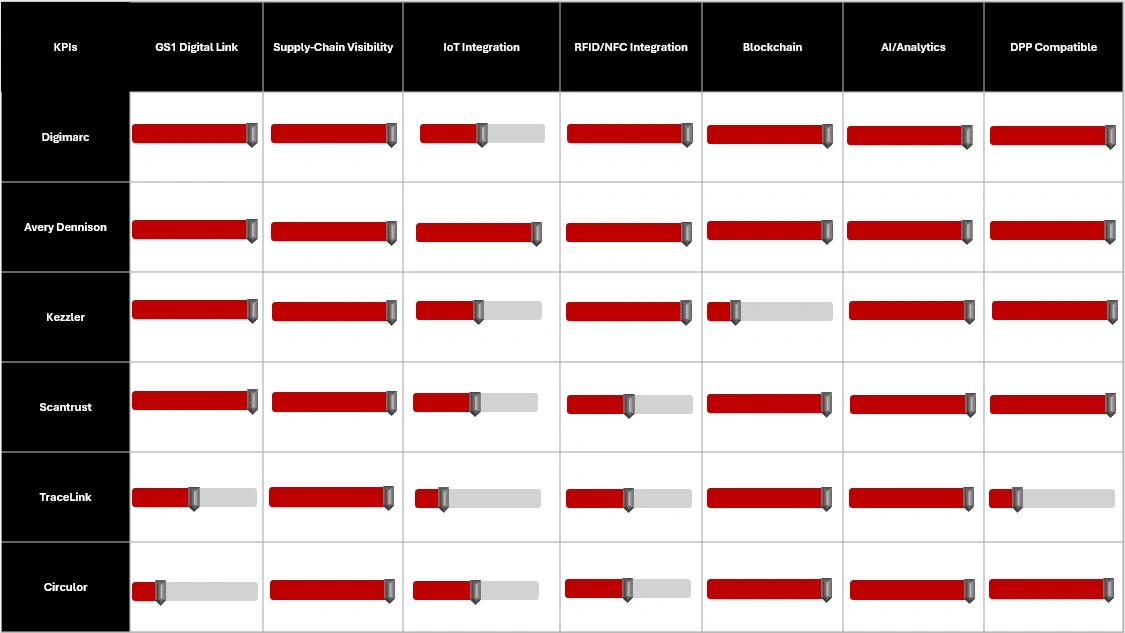
The scoring infographic translates these technology capabilities into High, Medium, and Low ratings, highlighting the relative technological strengths and differentiation of each company. This provides a quick view of where competitors have established capabilities and where technology gaps and opportunities for differentiation exist.
TREND ANALYSIS
Technology Is Becoming Industry-Problem Specific: There is no single “best” traceability technology. Industries are increasingly selecting technologies based on their primary problem: standardized identification and reporting for pharmaceuticals, QR-based consumer access for consumer goods, RFID for automated inventory, secure authentication for counterfeit-prone products, and blockchain selectively for multi-party material provenance.
Traceability Is Shifting from a Supply-Chain Function to Business Infrastructure: Traceability systems are no longer used only to track where a product has been. The same infrastructure can increasingly support recalls, authentication, inventory visibility, consumer information, sustainability reporting, and regulatory compliance.
Regulation Is Reshaping Technology Adoption by Industry: Regulatory requirements are turning traceability from a voluntary investment into a mandatory capability in industries such as pharmaceuticals, food, batteries, and chemicals. Importantly, regulation is not creating one universal market; different regulations are driving different technology choices.
Product Information Is Becoming Accessible at the Point of Interaction: QR codes and other digital identifiers are increasingly connecting physical products directly to digital information. Consumers, retailers, regulators, and supply-chain partners can access product information closer to the point where they interact with the product.
Sustainability Is Expanding the Purpose of Traceability: Traceability is increasingly being used to support material sourcing, carbon and sustainability information, repair, reuse, recycling, and end-of-life management. This is particularly significant for batteries, electronics, textiles, and other circular-economy industries.
The Transition from 1D to 2D Identification Is Creating New Infrastructure Opportunities: The growing ability of retail and enterprise systems to read 2D barcodes is expanding the role of product identifiers. Initiatives such as GS1 Sunrise 2027 could allow a single 2D barcode to support both traditional identification and access to digital information.
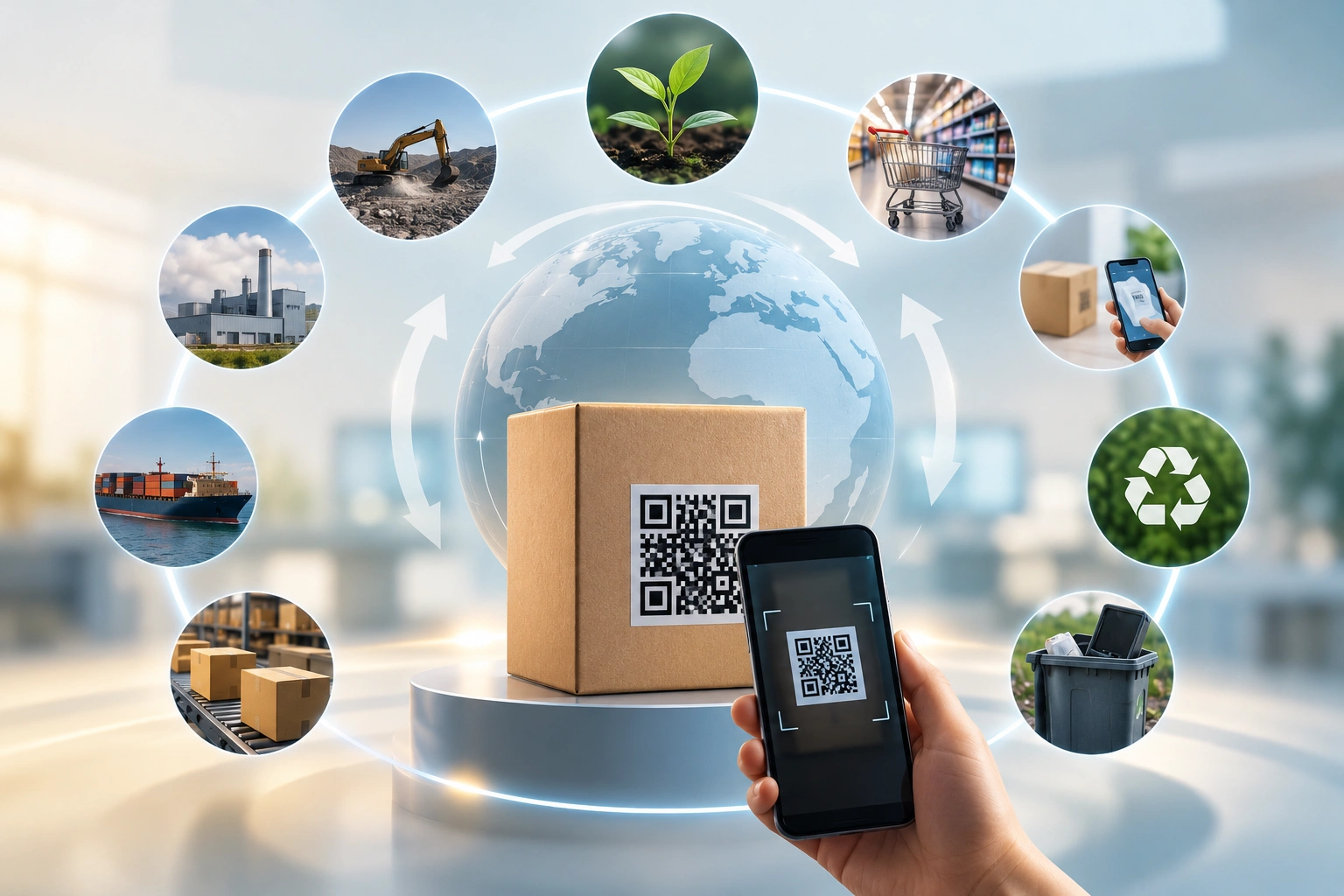
Traceability Is Moving Upstream to Raw Materials and Components: Traceability is increasingly beginning before final manufacturing. Companies are tracking materials such as cobalt, lithium, nickel, chemicals, diamonds, and other critical inputs from their source through processing and into finished products.
From Product Records to Product Events: Traceability systems are evolving from storing static product information to recording a sequence of lifecycle events—such as production, shipment, receipt, processing, sale, return, and recycling. The value is increasingly in understanding what has happened to a product over time.
Compliance and Commercial Traceability Are Becoming Two Distinct Markets: In pharmaceuticals and food, traceability is primarily driven by safety and compliance. In luxury goods, cosmetics, and apparel, it is increasingly used for authentication, consumer engagement, and brand value. The same technology can therefore have fundamentally different business models across industries.
Industry-Specific Platforms Are Gaining Importance: Generic traceability platforms are being supplemented by vertical specialists designed around specific industry problems. Pharmaceutical companies need serialization and compliance workflows, while battery manufacturers need material provenance and sustainability data.
The Small-Supplier Gap Is Emerging as a Major Implementation Challenge: Large companies may have sophisticated digital infrastructure, but end-to-end traceability depends on participation from smaller suppliers. The ability to onboard and connect less-digitized suppliers may become as important as the technology used by large enterprises.
Traceability Data Is Becoming a Shared Enterprise Asset: Once reliable product-level data is available, it can be used beyond traceability—for recalls, inventory planning, sustainability reporting, anti-counterfeiting, product analytics, and consumer engagement. This is improving the business case for traceability investments.
Data Quality and Verification Are Becoming the Next Competitive Battleground: Identifying and collecting product data is becoming easier. The harder challenge is ensuring that data from multiple supply-chain participants is accurate, complete, timely, and trustworthy. Future differentiation may increasingly come from data validation and governance rather than the identification technology itself.
Signal | Strength | Direction | Strategic Implication |
|---|---|---|---|
Traceability becoming industry-specific | High | Increasing | Traceability technology is increasingly selected based on the industry’s primary problem. |
Regulation-driven implementation | High | Increasing | Compliance is creating predictable demand across food, pharmaceuticals, batteries and other regulated sectors. |
2D codes becoming digital infrastructure | High | Increasing | Product codes are evolving from identification tools into gateways to digital product information. |
Multi-technology traceability systems | High | Increasing | QR, RFID, IoT, NFC and cloud systems are increasingly complementary rather than competing technologies. |
Traceability expanding across the product lifecycle | Medium-High | Increasing | Traceability is moving beyond supply-chain visibility into authentication, sustainability, repair, reuse and recycling. |
SWOT & RISK ANALYSIS
Problem-specific technology: Different technologies can be selected according to the industry’s primary need, such as compliance, inventory, authentication, or consumer transparency
Multi-purpose product identity: A single digital identity can support traceability, compliance, authentication, sustainability, and consumer information
Mature technology base: Core technologies such as QR codes, RFID, serialization, and cloud platforms are already commercially established
Regulatory and standards support: Growing regulation and common standards are creating a stronger foundation for large-scale traceability adoption
Easy consumer access: QR codes provide a simple and widely accessible connection between physical products and digital information
No universal solution: Different industries require different technology combinations, making traceability solutions difficult to standardize universally
Data quality dependency: The reliability of a traceability system ultimately depends on the accuracy and consistency of the data entered
Complex system integration: Connecting traceability platforms with ERP, WMS, manufacturing, and supplier systems can require significant effort
Uneven supplier readiness: Smaller suppliers may lack the digital infrastructure needed to participate effectively in end-to-end traceability
Fragmented ecosystem: Multiple standards, technologies, and platforms can create interoperability challenges across supply chains
Industry-specific solutions: Significant opportunities exist for tailored solutions addressing the specific needs of food, pharma, batteries, luxury, and apparel
Digital Product Passports: Lifecycle information requirements are creating new demand for persistent product identities and sustainability data
2D barcode transition: Next-generation 2D barcodes can increasingly connect retail, traceability, and consumer information through one product identity
Item-level digital identity: Serialization is gradually expanding beyond pharmaceuticals into high-value and regulation-driven industries
Data intelligence: Growing volumes of traceability data create opportunities for analytics, anomaly detection, fraud prevention, and predictive insights
Technology fragmentation: Proprietary systems and incompatible standards could limit interoperability across increasingly complex global supply chains
Regulatory complexity: Different requirements and changing timelines across countries can increase implementation costs and uncertainty
Cybersecurity risks: Greater digital connectivity increases exposure to data manipulation, unauthorized access, and platform security risks
Counterfeiting challenges: Standard QR codes can be copied, requiring additional authentication technologies in high-risk industries
High implementation costs: Advanced, item-level traceability may not provide sufficient economic value for low-margin products
STRATEGIC RECOMMENDATIONS
Manufacturers and Brands: Conduct a product and regulatory readiness assessment to identify where digital identity and traceability can deliver immediate value. Prioritize high-risk, high-value, regulated, or frequently recalled products rather than deploying item-level traceability across the entire portfolio.
Retailers: Assess POS systems, barcode scanners, product-information platforms, and backend infrastructure for readiness to support 2D product identifiers. Develop a phased transition strategy rather than treating 2D barcodes as a simple packaging upgrade.
Technology Providers: Focus on solving clearly defined industry problems—such as pharmaceutical serialization, food traceback, luxury authentication, or battery lifecycle management—rather than offering generic traceability platforms.
Supply-Chain Participants: Improve product and event data quality before introducing advanced traceability technologies. Establish consistent processes for capturing product, batch, shipment, and supply-chain information.
Industry Ecosystem Participants: Identify upcoming regulatory requirements and standards that could create near-term implementation demand, particularly in food traceability, battery passports, serialization, and digital product information.
Manufacturers and Brands: Move from isolated compliance and traceability projects toward a unified digital product identity capable of supporting multiple functions, including traceability, recalls, authentication, consumer information, and sustainability reporting.
Retailers: Expand the use of 2D product identifiers beyond checkout by integrating product scans with inventory visibility, expiry management, recall processes, and consumer-facing product information.
Technology Providers: Develop carrier-agnostic and integration-ready platforms capable of supporting QR codes, DataMatrix, RFID, NFC, and other identification technologies. Long-term differentiation will depend more on interoperability and enterprise integration than on code generation.
Supply-Chain Participants: Establish interoperable data-sharing mechanisms across suppliers, manufacturers, logistics providers, and retailers. Traceability should progressively evolve from a company-level capability into a network-level capability.
Industry Ecosystem Participants: Develop scalable supplier onboarding models, particularly for smaller suppliers that may lack sophisticated IT infrastructure. Lightweight data-sharing tools and standardized interfaces will be essential for achieving genuinely end-to-end visibility.
Participants: Develop scalable supplier onboarding models, particularly for smaller suppliers that may lack sophisticated IT infrastructure. Lightweight data-sharing tools and standardized interfaces will be essential for achieving genuinely end-to-end visibility.
Manufacturers and Brands: Develop persistent digital product identities that extend beyond the point of sale and support the complete product lifecycle, including repair, resale, reuse, refurbishment, and recycling.
Retailers: Position product identification infrastructure as part of a broader connected product ecosystem in which a single scan can support operational processes, consumer engagement, product verification, and lifecycle information.
Technology Providers: Shift from identification and data collection toward intelligent traceability platforms that can analyse product and supply-chain data to identify risks, inefficiencies, counterfeit activity, quality issues, and sustainability opportunities.
Supply-Chain Participants: Build trusted, interoperable data ecosystems that enable information exchange across the full value chain—from material suppliers to manufacturers, retailers, service providers, and recyclers.
Industry Ecosystem Participants: Prepare for Digital Product Passport and circular-economy models by developing governance frameworks for product data, including data ownership, access rights, verification, confidentiality, and cross-platform interoperability.
APPENDIX
https://www.sciencedirect.com/science/article/pii/S0924224424000608#bib5
https://www.mdpi.com/2071-1050/18/3/1422
https://www.sciencedirect.com/science/article/pii/S2772503025000192
https://www.emerald.com/bfj/article/126/13/72/1234077
https://www.emerald.com/apjba/article/doi/10.1108/APJBA-07-2025-0529/1380164
https://www.mdpi.com/1424-8220/26/5/1685
https://www.mdpi.com/2071-1050/14/8/4437
https://www.sciencedirect.com/science/article/pii/S2352146523004519
https://www.researchgate.net/profile/Dr-Abdal/publication/401787479_Harnessing_Artificial_Intelligence_for_Reverse_Supply_Chain_Logistics_in_the_FMCG_Sector_A_Comprehensive_Review_and_Future_Outlook_through_Case_Studies/links/69b14505e4cc384db5219be5/Harnessing-Artificial-Intelligence-for-Reverse-Supply-Chain-Logistics-in-the-FMCG-Sector-A-Comprehensive-Review-and-Future-Outlook-through-Case-Studies.pdf