How Blockchain is Revolutionizing Intellectual Property Management in the Digital Age
Intellectual property is no longer limited to patents, trademarks or copyrighted works. Today, it also includes software, digital content, proprietary algorithms, research data and other intangible assets that are central to business growth and innovation. As these assets become easier to create, share and commercialize, managing them has become significantly more complex.
Now, organizations need reliable ways to establish proof of creation, track ownership over time, manage licensing agreements and protect intellectual assets from misuse across digital platforms and global markets. Traditional IP systems remain essential, but many of these operational challenges require more efficient and transparent ways of managing information.
Blockchain is increasingly being explored as one such solution. Its ability to create immutable records, verify transactions and automate agreements through smart contracts makes it well suited for supporting intellectual property management. Rather than replacing existing legal frameworks, blockchain helps strengthen them by improving traceability, simplifying licensing and creating trusted records throughout the lifecycle of an intellectual asset.
This article explores how blockchain is being applied across different areas of intellectual property, the opportunities it presents, the challenges organizations should consider and the trends shaping the future of IP management.
Why Modern IP Management Needs to Evolve
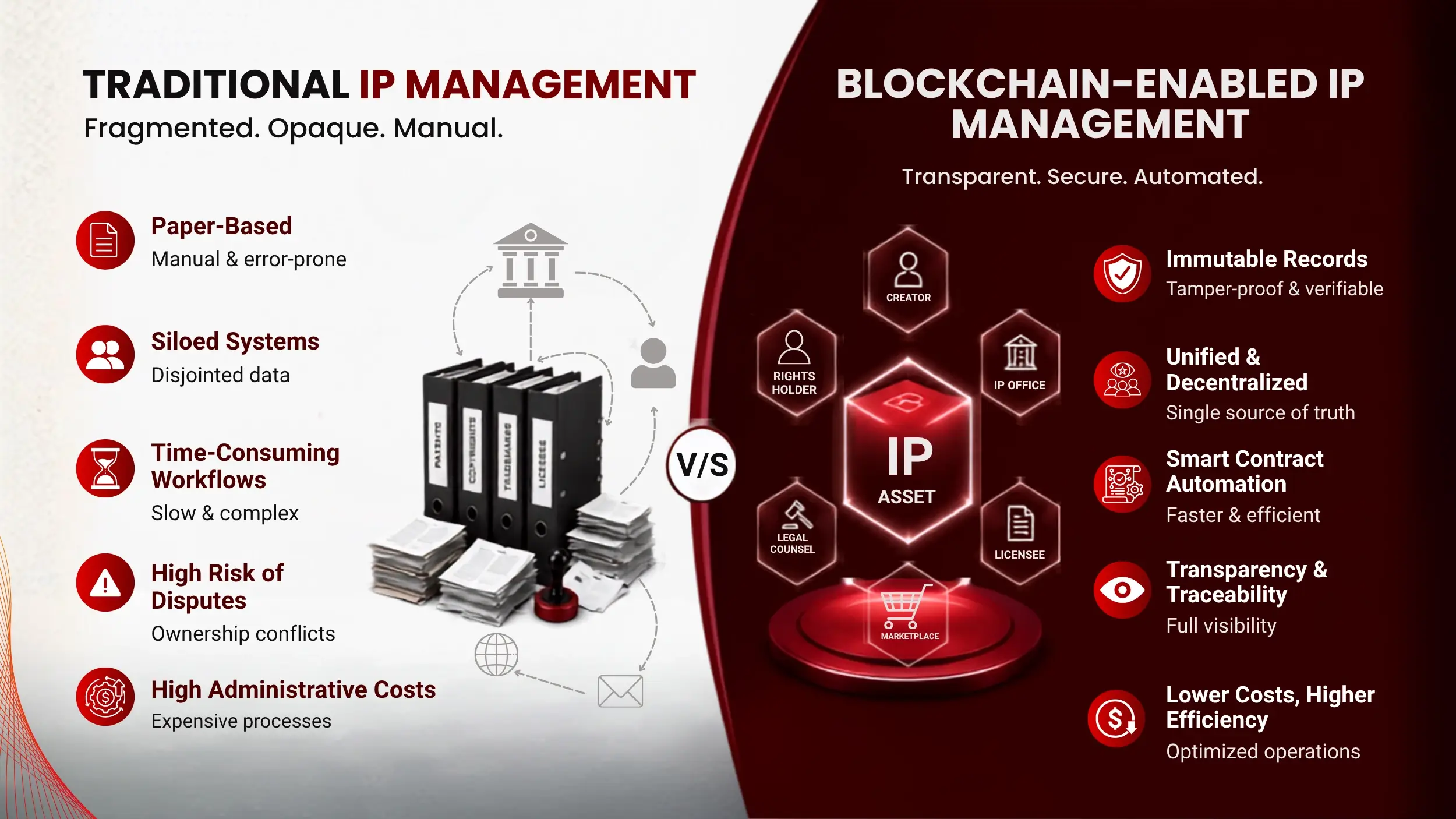
Intellectual property laws continue to provide the legal foundation for protecting innovation. However, managing intellectual property has become far more complex as businesses create, share and commercialize digital assets at an unprecedented scale. As a result, organizations are facing several operational challenges that extend beyond legal protection.
Establishing who created a digital asset and when, can be difficult once it has been copied, modified or shared across multiple platforms. While legal registration confirms ownership, maintaining a clear and verifiable history of an asset throughout its lifecycle often requires extensive documentation and manual verification.
The ease of distributing digital content has made copyright infringement and unauthorized use more common. At the same time, licensing agreements have become increasingly complex, involving multiple stakeholders, usage rights, territories and royalty structures. Managing these agreements efficiently while ensuring compliance remains a significant challenge for many organizations.
Counterfeit products continue to affect industries ranging from pharmaceuticals and electronics to luxury goods and consumer products. Verifying authenticity across global supply chains is difficult and inconsistent enforcement across jurisdictions often makes protecting trademarks both costly and time-consuming.
The growing use of AI-assisted content creation, collaborative research and cloud-based development has introduced new questions around authorship, ownership and rights management. As intellectual assets become more dynamic and distributed, organizations need better ways to document their creation, ownership and use.
Understanding Blockchain’s Role in Intellectual Property
Blockchain is best understood as a trusted record-keeping system. While it’s widely known for powering cryptocurrencies, its real value extends far beyond digital finance. For intellectual property, blockchain provides a secure and transparent way to record, verify and track information throughout an asset’s lifecycle.
Every record added to a blockchain is time-stamped, encrypted and linked to previous records, making it extremely difficult to alter without leaving a trace. This creates a reliable history of ownership, licensing and other transactions associated with an intellectual asset. One of blockchain’s greatest strengths in IP management is establishing digital provenance, a documented history that shows when an asset was created, who has owned or licensed it and how it has changed over time. This improves transparency and makes it easier to verify ownership, resolve disputes and demonstrate authenticity.
Blockchain can also simplify the commercial side of intellectual property through smart contracts. These are self-executing digital agreements that automatically carry out predefined actions once specific conditions are met. For example, a content creator can automate royalty payments whenever licensed work is sold or used, reducing manual administration and improving transparency for both licensors and licensees.
It’s important to note that blockchain does not replace intellectual property laws or registration authorities. Patents, trademarks and copyrights continue to be governed by existing legal frameworks. Instead, blockchain serves as a complementary layer that strengthens record management, improves traceability and supports more efficient administration of intellectual assets.
Must Read: New to blockchain? Our guide, Everything You Need to Know About Blockchain Technology, explains the fundamentals of distributed ledger technology, how blockchain works and its growing role across industries.
Challenges and Considerations for Blockchain Adoption
Intellectual property rights are governed by established legal systems while blockchain technologies continue to evolve alongside changing regulations. Although blockchain records can strengthen evidence of ownership and transactions, their legal recognition and the enforceability of smart contracts vary across jurisdictions.
Businesses often manage highly confidential information, including research data, product designs, proprietary algorithms and trade secrets. For this reason, enterprise blockchain solutions typically avoid storing sensitive documents directly on the blockchain. Instead, they record proofs or references that verify a document’s authenticity while keeping the original files in secure storage.
Public networks may not always meet the performance, scalability or governance requirements of organizations managing large intellectual property portfolios. Many businesses therefore evaluate private or permissioned blockchain networks that offer greater control, improved performance and better integration with existing enterprise systems.
Intellectual property data is rarely managed through a single platform. Patent databases, copyright registries, licensing systems, enterprise applications and legal management tools often operate independently. For blockchain to deliver long-term value, it must integrate with these existing systems rather than function in isolation.
Rather than adopting blockchain because it is an emerging technology, businesses should focus on specific challenges they want to solve whether that’s improving ownership records, streamlining licensing, enhancing product authentication or strengthening collaboration. A clearly defined business objective provides a stronger foundation for long-term success than technology adoption alone.
Practical Applications of Blockchain in Intellectual Property
In the digital age, creative works can be shared, copied or modified almost instantly. For creators and organizations, proving ownership is often just as important as protecting it.
Blockchain creates a time-stamped record of a digital asset when it is created, providing verifiable evidence of its existence at a specific point in time. As the asset is licensed, transferred or updated, each transaction can be recorded to create a transparent history of its lifecycle.
This is particularly valuable for digital content such as software, research papers, videos, music, photographs and artwork, where maintaining a clear record of ownership and usage can simplify rights management and help resolve disputes.
Innovation rarely happens in isolation. Research teams, universities, startups and enterprises often work together to develop new technologies, making it essential to maintain accurate records of contributions throughout the innovation process.
Blockchain provides a reliable way to document research milestones, invention disclosures, prototype development and other key activities. By creating an immutable record of these events, organizations can establish a clear timeline of how an innovation evolved.
This can also support prior art documentation and improve collaboration by creating greater transparency around contributions from different stakeholders.
Counterfeit products remain one of the biggest challenges for global brands. Beyond financial losses, counterfeit goods can damage brand reputation and reduce consumer trust.
Blockchain helps address this challenge by creating a verifiable digital record for products as they move through the supply chain. Manufacturing details, certifications, distribution records and ownership transfers can all be documented, allowing businesses to trace a product’s journey from production to the end customer.
Consumers can verify authenticity by scanning a QR code or digital identifier linked to blockchain records, making it easier to distinguish genuine products from counterfeit alternatives.
Licensing is one of the most important ways organizations monetize intellectual property, but managing agreements across multiple parties can be time-consuming and resource-intensive.
Blockchain-enabled smart contracts help automate many of these processes. Once predefined conditions are met such as receiving payment or confirming usage rights, the agreement is executed automatically without requiring manual intervention.
For example, a software provider can automatically grant access to licensed software after payment is received, while a musician or digital publisher can receive royalty payments each time licensed content is purchased or used under agreed terms.
Automating these routine tasks reduces administrative effort, minimizes delays and provides greater transparency for both licensors and licensees.
Unlike patents and copyrights, trade secrets depend on confidentiality. Whether it’s a proprietary manufacturing process, a product formula or confidential research data, organizations need to maintain strict control over sensitive information while enabling collaboration among trusted partners.
Blockchain can strengthen this process by creating verifiable records of document access, updates and approvals without exposing confidential information itself. Rather than storing sensitive documents on the blockchain, organizations typically use it to verify that documents have not been altered while keeping the actual files securely stored elsewhere.
This creates a trusted audit trail that improves accountability across collaborative projects involving research institutions, manufacturers, technology companies and other innovation partners.
Real-World Industry Use Cases of Blockchain
IPwe and the Global Patent Registry
Managing patents extends well beyond filing applications. Organizations must track ownership, evaluate portfolio strength, identify licensing opportunities and maintain accurate records throughout a patent’s lifecycle. Traditionally, this information has been spread across multiple databases and jurisdictions making patent transactions both time-consuming and difficult to navigate.
To address these challenges, IPwe, in collaboration with IBM, developed the Global Patent Registry (GPR), a blockchain-powered platform designed to improve transparency and efficiency in patent management. The registry combines blockchain with AI to consolidate current, historical and ownership-related patent information into a trusted digital record.
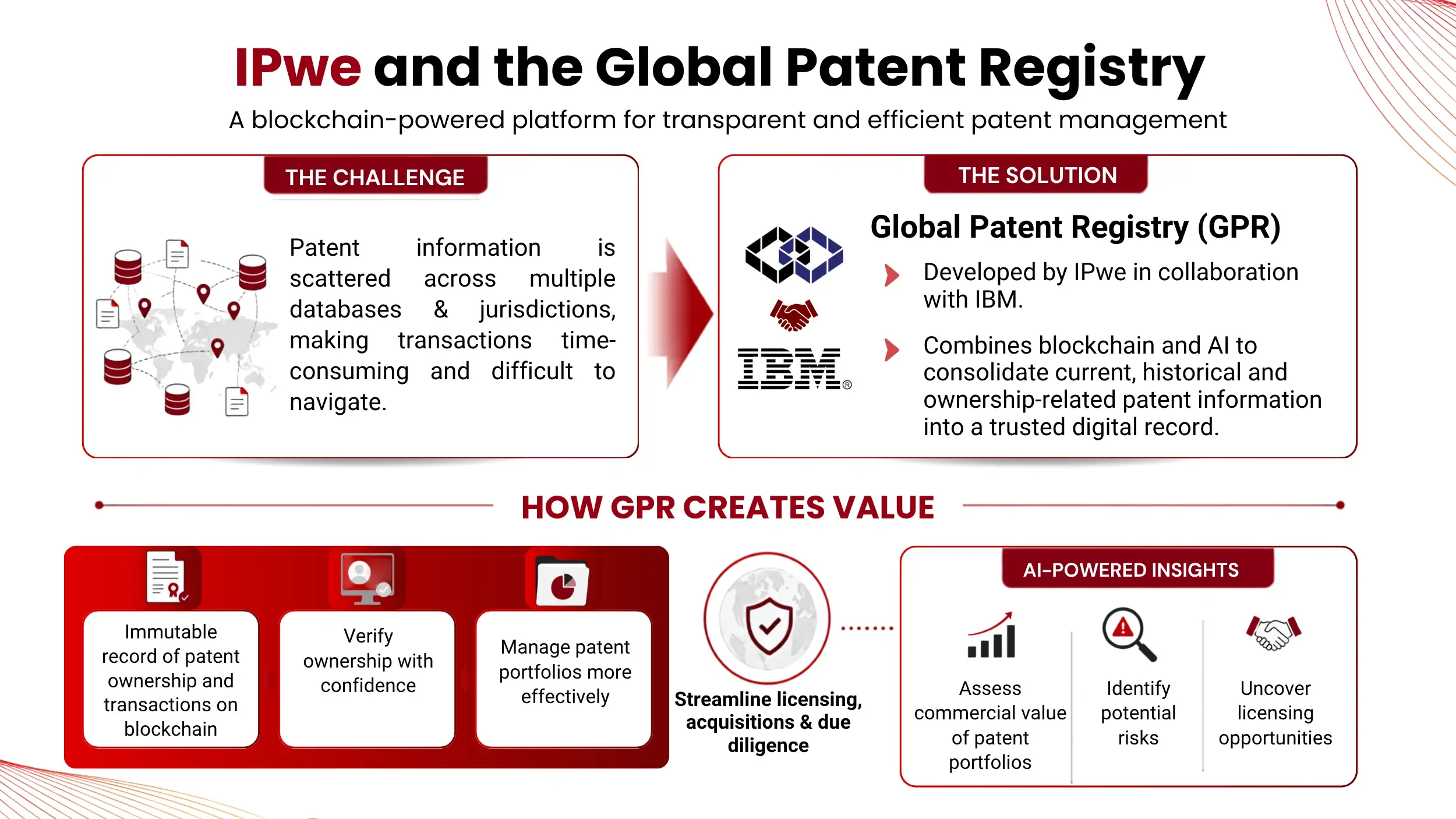
By creating an immutable record of patent ownership and transactions, the platform helps organizations verify ownership, manage patent portfolios more effectively and streamline activities such as licensing, acquisitions and due diligence. AI-powered analytics further enable businesses to assess the commercial value of patent portfolios, identify potential risks and uncover licensing opportunities.
Key Takeaway: IPwe demonstrates how blockchain can complement existing patent systems by creating a transparent and verifiable record of patent ownership and transactions while AI enhances portfolio analysis and commercialization opportunities.
Everledger and Digital Provenance for High-Value Assets
Establishing the provenance of high-value assets is essential for industries where authenticity directly influences value. Everledger is one of the earliest companies to demonstrate how blockchain can address this challenge by creating secure digital identities for valuable products.
Initially developed to improve the traceability of diamonds, Everledger has since expanded its platform to support luxury goods, fine wines, apparel and other premium assets. The platform combines blockchain with technologies such as QR codes, NFC tags, RFID and AI to create a verifiable record of an asset’s journey from its origin and manufacturing history to ownership transfers and resale.
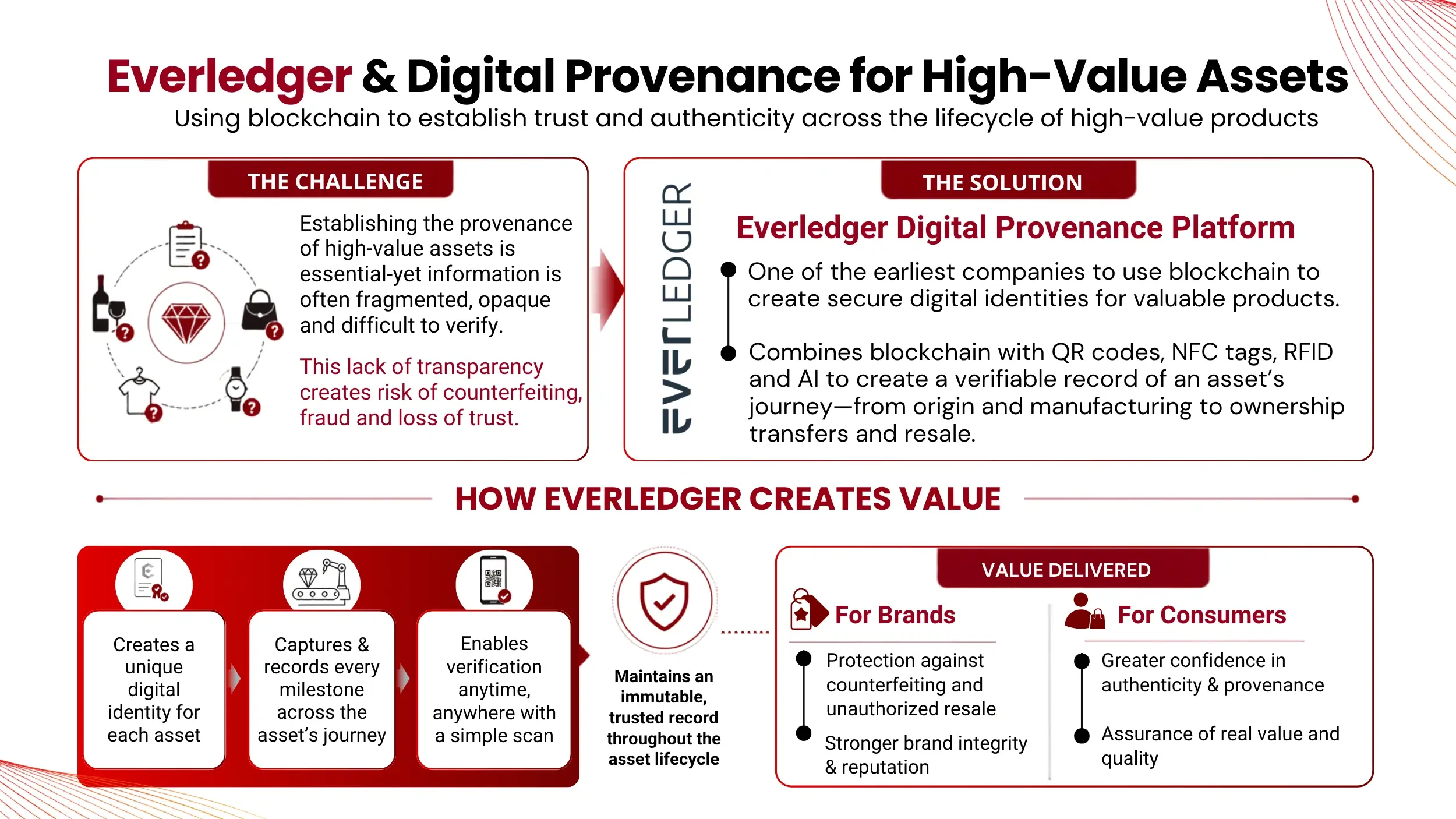
For brands, this improves protection against counterfeiting and unauthorized resale. For consumers, it provides greater confidence in a product’s authenticity and provenance. By maintaining a trusted record throughout the asset’s lifecycle, Everledger demonstrates how blockchain can strengthen both intellectual property protection and brand integrity in industries where trust is a competitive advantage.
Key Takeaway: Digital provenance powered by blockchain enables organizations to verify authenticity, strengthen brand protection, and build long-term consumer trust throughout the lifecycle of high-value products.
Aura Blockchain Consortium and Luxury Brand Authentication
Counterfeit goods remain one of the biggest challenges for luxury brands, affecting everything from brand reputation to customer trust. To address this, leading luxury groups including LVMH, Prada Group, Richemont (Cartier) and OTB Group formed the Aura Blockchain Consortium, a collaborative initiative that uses blockchain to improve product authenticity and traceability.
Through Aura, each eligible luxury product is assigned a unique digital identity recorded on a blockchain. Consumers can access this information by scanning a QR code or compatible digital tag, allowing them to verify a product’s authenticity, trace its origin, and access details such as ownership history, after-sales services, and sustainability information.
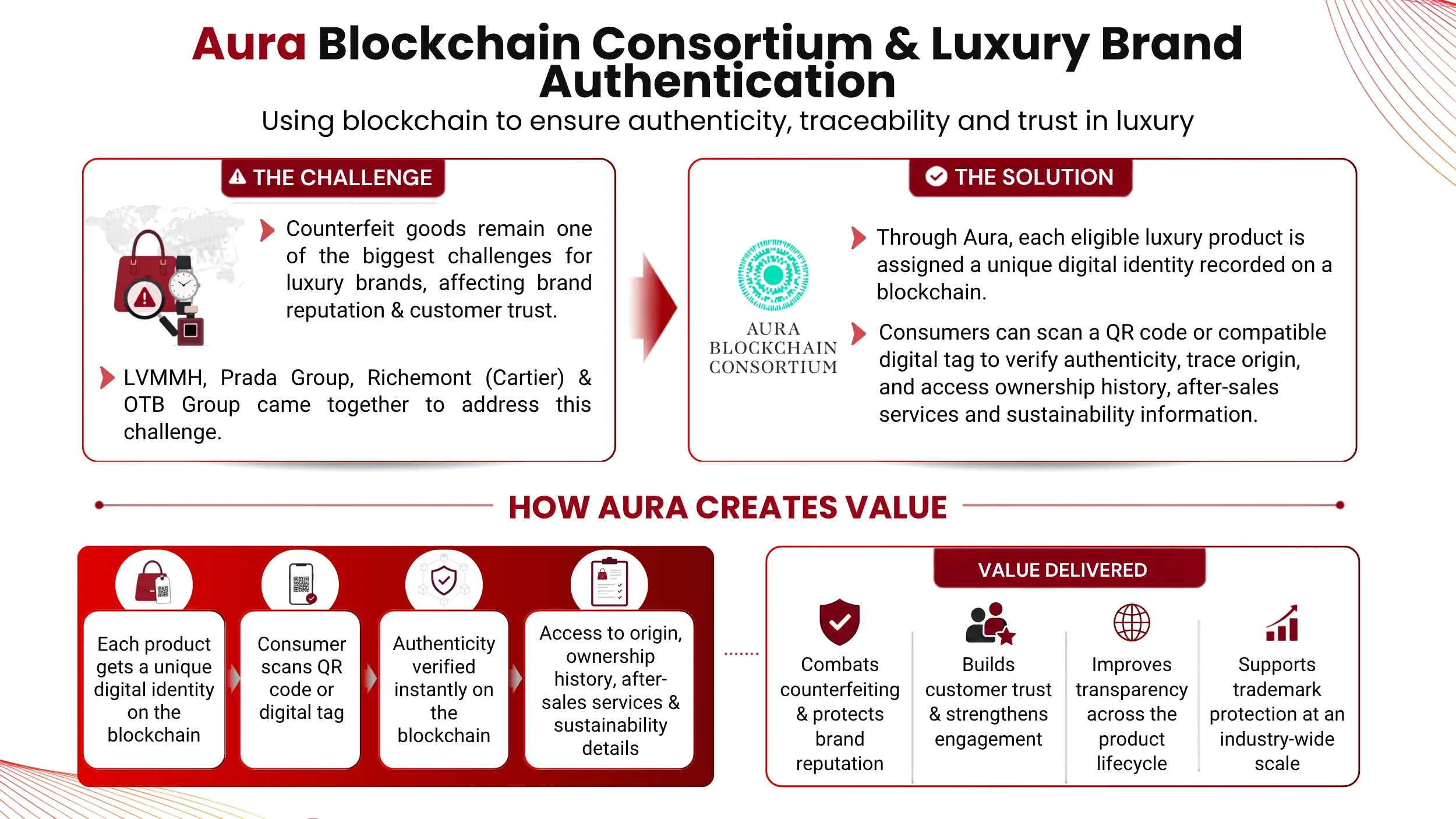
Beyond combating counterfeiting, Aura supports the broader concept of digital product passports, enabling brands to strengthen customer engagement while improving transparency across the product lifecycle. The consortium has also expanded to include more than 50 luxury brands and millions of registered products, demonstrating how blockchain can support trademark protection at an industry-wide scale.
Key Takeaway: Blockchain helps luxury brands move beyond traditional authentication methods by creating trusted digital identities that strengthen trademark protection, improve supply chain transparency, and enhance the customer experience.
Emerging Trends Shaping Convergence of Blockchain and Intellectual Property
1. AI Is Redefining Content Ownership
Generative AI has transformed how businesses create software, marketing content, product designs, technical documentation and other digital assets. As AI becomes part of the creative process, organizations face new questions around authorship, ownership, licensing and accountability.
While blockchain cannot determine who legally owns AI-generated content, it can help establish a transparent record of how an asset was created, when it was created and how ownership or licensing has changed over time. Combined with emerging content credentials and metadata standards, blockchain can strengthen digital provenance and improve confidence in the authenticity of digital assets.
2. Tokenization Is Creating New Ways to Commercialize Intellectual Property
Organizations are beginning to explore how blockchain can make intellectual property easier to license, share and monetize.
One area of growing interest is the tokenization of intellectual assets, where licensing rights, royalty interests or other commercial rights are represented digitally on a blockchain. Although adoption is still evolving, this approach has the potential to simplify licensing, enable new revenue models and support collaborative ownership of assets such as patents, software, creative works and research outputs.
3. Digital Identity Is Strengthening Trust Between Collaborators
Decentralized digital identity solutions allow individuals and organizations to maintain secure, verifiable credentials that can be shared without relying entirely on centralized systems. When combined with blockchain, these identities can improve authorship verification, strengthen collaboration and reduce disputes over contributions.
4. Digital Product Passports Are Enhancing Product Transparency
Digital Product Passports (DPPs) are emerging as a way to record key information about a product, including its origin, materials, manufacturing history, authenticity, repairability and sustainability. Blockchain can provide a trusted record for this information, helping manufacturers demonstrate compliance while strengthening trademark protection and reducing the risk of counterfeit products entering the market.
5. Blockchain Works Best as Part of a Broader Digital Strategy
Organizations are increasingly combining blockchain with artificial intelligence, cloud platforms, IoT devices, digital identity solutions and advanced analytics to improve how intellectual assets are created, managed, protected and commercialized.
The Road Ahead for Intellectual Property Management
As innovation becomes more digital, collaborative and data-driven, intellectual property management must evolve to keep pace. Protecting IP has also become about maintaining accurate records, simplifying licensing, establishing trust and enabling seamless collaboration across organizations and borders.
Blockchain offers practical solutions to many of these operational challenges. By creating verifiable records of ownership, improving traceability and automating routine processes through smart contracts, it can help organizations manage intellectual assets with greater efficiency and transparency. While the technology is still evolving, its potential extends far beyond recordkeeping, supporting new approaches to digital provenance, rights management and IP commercialization.
As technologies such as artificial intelligence, decentralized identity and tokenization continue to reshape the innovation landscape, the demand for trusted, transparent and interoperable IP management systems will only grow. Organizations that begin exploring these technologies today will be better positioned to protect their intellectual assets, strengthen collaboration and adapt to the changing nature of innovation.
The future of intellectual property will be built on a combination of legal expertise, digital technologies and trusted data. And blockchain is becoming an important part of the journey.
Frequently Asked Questions (FAQs)
Blockchain creates immutable, time-stamped records that help establish proof of creation, document ownership history, improve digital provenance and support transparent licensing and rights management.
No. Blockchain does not replace legal intellectual property protections. Patents, copyrights and trademarks continue to be governed by applicable laws and registration authorities. Blockchain serves as complementary technology that strengthens documentation and record management.
Smart contracts automate predefined actions such as licensing approvals, royalty payments, and access permissions, reducing administrative effort while improving transparency and operational efficiency.
Blockchain can record creation metadata, establish provenance, document ownership changes, and improve transparency throughout the lifecycle of AI-assisted digital assets. However, legal questions regarding AI authorship and ownership continue to evolve and are governed by applicable intellectual property laws.
Not necessarily. Organizations should evaluate whether blockchain’s capabilities such as decentralization, transparency and immutable recordkeeping align with their specific business objectives and operational requirements before implementation.
The Best Decisions Start With Better Intelligence.
Connect the dots across technology, markets, competition and innovation with research designed to support strategic decision-making.