Patent Invalidation Search: Carbon Nanotube Battery Case Study
Case Study

What If Carbon Nanotube Measurements Could Challenge a Lithium-Ion Battery Patent?

How a refined prior-art investigation translated experimental nanotube dimensions and oxygen-content measurements into a technically grounded challenge to patent claims covering lithium-ion battery compositions.

Case Study Type Invalidation Search
Industry Battery Technology
Publication Date November 17, 2026
Li-ion battery image

The Client’s Challenge

A client sought support in challenging a patent covering a composition intended for use in lithium-ion batteries. The challenged patent covered a composition comprising discrete carbon nanotubes and crystals of lithium-ion-active material. Two numerical limitations were central to the claimed distinction: a carbon nanotube aspect ratio of 10–400 and an oxidation level of 4–20% by weight of the nanotube.

The challenge was to determine whether these parameters represented a meaningful technical distinction over earlier research or whether relevant characteristics were already disclosed in existing battery-material studies.
Li-Ion battery clients challenge image

The patent claims primarily covered:

    • Discrete carbon nanotubes incorporated into a composition for lithium-ion batteries.
    • Lithium-ion-active material crystals forming part of the claimed composition.
    • Carbon nanotubes having an aspect ratio ranging from 10 to 400.
    • Carbon nanotubes having oxidation levels ranging from 4% to 20% by weight of the carbon nanotube.
    • A combination of nanotube dimensional and oxidation characteristics intended to distinguish the claimed composition from existing battery technologies.
Objective icon
CLIENT’S OBJECTIVE

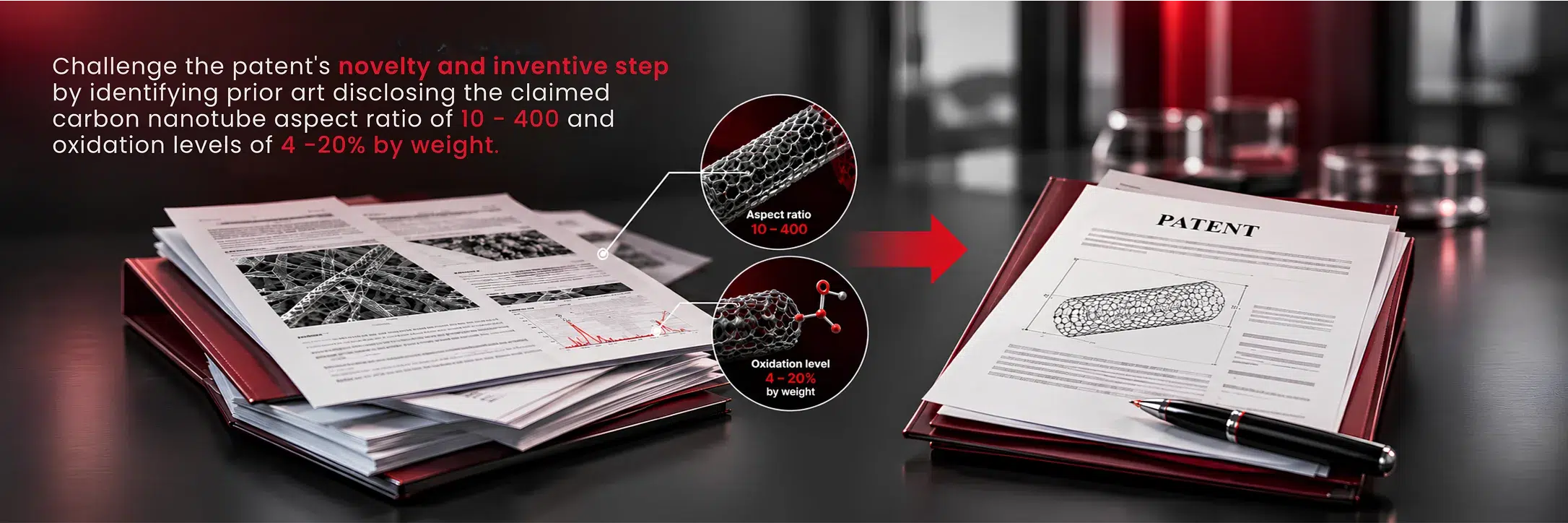
Challenge the patent’s novelty and inventive step by identifying prior art disclosing the claimed carbon nanotube aspect ratio of 10–400 and oxidation levels of 4–20% by weight.

The key was to establish whether earlier experimental measurements and battery-material disclosures already encompassed these claimed characteristics either through a single reference or a technically supported combination of references.

Clients come to us for answers.
They leave with opportunities they didn’t know existed.

Our experts help organizations uncover insights, opportunities and strategic directions that traditional approaches often miss.

Wissen’s Out-of-the-Box Approach:

Beyond Conventional Keyword-Based Prior Art Searching

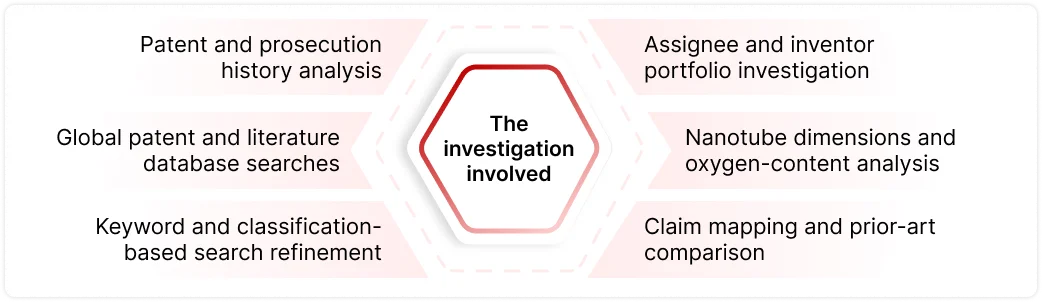
  • Recognizing the limitations of conventional keyword-based searching, the investigation evolved toward a more targeted analysis of experimental disclosures and numerical parameters reported in existing lithium-ion battery research.
  • To identify prior art capable of challenging the claimed composition, the investigation expanded beyond exact terminology to include scientific studies that disclosed relevant carbon nanotube characteristics through measurable parameters, including:
  • Nanotube length and diameter
  • Aspect ratio derived from reported dimensions
  • Oxygen content and surface functionalization

Identifying Relevant Prior Art

  • A refined search strategy was developed to uncover earlier disclosures that might not explicitly use the same terminology as the subject patent. This approach identified two potentially relevant references involving multi-walled carbon nanotubes (MWNTs).

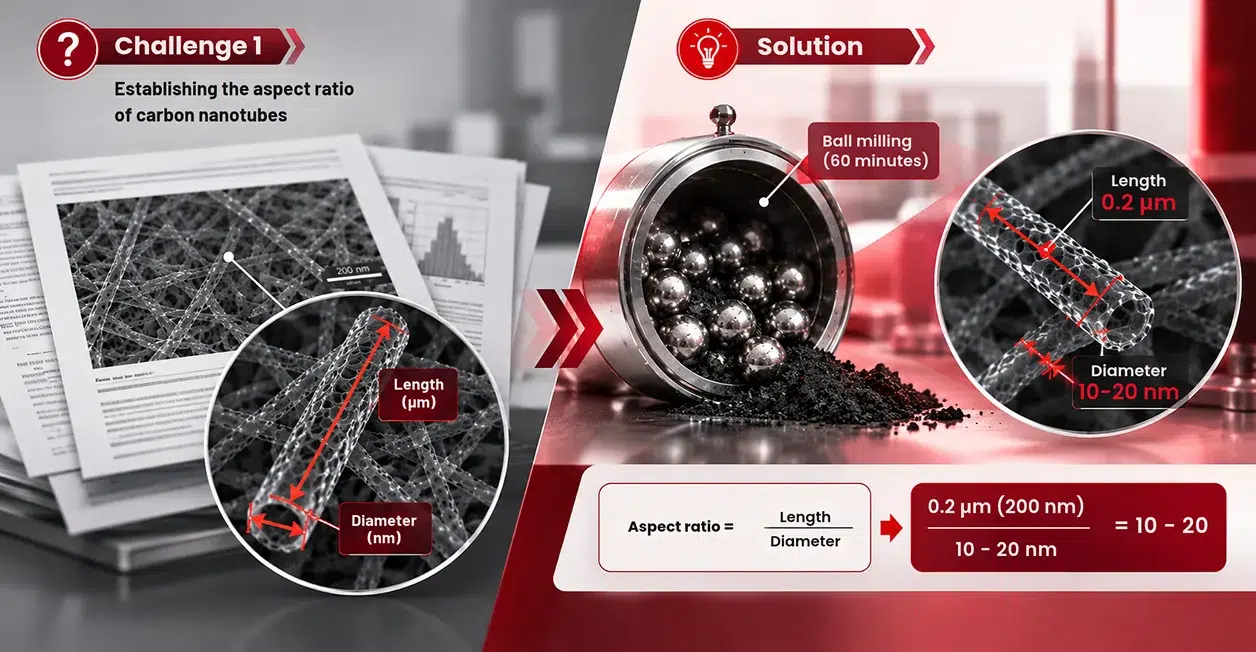
  • The first reference examined the effects of ball milling on MWNTs and reported a reduction in average nanotube length to approximately 0.2 µm after 60 minutes. By correlating this measurement with the reported nanotube diameter of 10–20 nm, the investigation calculated an aspect ratio of approximately 10–20, falling within the subject patent’s claimed range of 10–400.

  • The second reference described MWNTs in a lithium-ion battery electrode system and reported additional dimensional and oxygen-content measurements relevant to the claimed material characteristics.

Our Methodology

Traditional Search Limitations
Refined Prior-Art Search
Experimental Data Analysis
Claim Mapping Against Prior Art
Evidence Validation
Patent Invalidation Assessment
Traditional Search Limitations
  • Identified gaps in conventional keyword searches.
  • Addressed terminology differences in nanotube measurements.
  • Focused on the claimed numerical ranges.
Refined Prior-Art Search
  • Expanded keywords to include length, diameter, and oxygen content.
  • Searched global patent and scientific databases.
  • Traced relevant assignees and inventors.
Experimental Data Analysis
  • Extracted MWNT dimensions and oxygen-content data.
  • Calculated aspect ratios from reported measurements.
  • Compared results with the claimed range of 10–400.
Claim Mapping Against Prior Art
  • Mapped disclosures against individual claim limitations.
  • Evaluated nanotube dimensions and chemical properties.
  • Assessed complementary prior-art references.
Evidence Validation
  • Verified reported measurements and units.
  • Examined oxygen-content measurement comparability.
  • Identified remaining evidence gaps.
Patent Invalidation Assessment
  • Evaluated individual-reference disclosures.
  • Assessed potential inventive-step arguments.
  • Developed an evidence-based validity assessment.
Outcome:

Identification of relevant prior art providing a technical basis to challenge the claimed carbon nanotube parameters.

Prior-Art Search Methodology

The investigation involved a structured patent and scientific literature search to identify earlier disclosures relevant to the claimed carbon nanotube composition used in lithium-ion batteries.

Li-Ion-batteries methodology

The analysis identified two relevant prior-art references describing multi-walled carbon nanotubes in lithium-ion battery-related research.

These findings established a technical basis for evaluating the overlap between previously reported nanotube characteristics and the claimed numerical ranges. The references were further assessed for their relevance to the claimed composition and their potential to support novelty or inventive-step challenges, subject to verification of the original disclosures and measurement parameters.

Technical Challenges Addressed Through Prior-Art Analysis

Challenge 1: Establishing the Aspect Ratio of Carbon Nanotubes

A key challenge involved determining whether previously reported carbon nanotube dimensions fell within the claimed aspect ratio of 10–400. The identified prior art described multi-walled carbon nanotubes (MWNTs) by their length and diameter without explicitly specifying the aspect ratio.

Solution

Analysis of the reported experimental measurements identified a study examining the effects of ball milling on MWNTs used for lithium insertion. The study reported an average nanotube length of approximately 0.2 µm after 60 minutes of ball milling and a diameter of approximately 10–20 nm. By applying the formula aspect ratio = length ÷ diameter, the investigation derived an aspect ratio of approximately 10–20, overlapping with the range claimed in the subject patent.

The analysis demonstrated that:
  • Nanotube length reduction following ball milling.
  • Reported MWNT diameters of approximately 10–20 nm.
  • Calculated aspect ratios falling within the claimed range.

These findings established a relevant dimensional correspondence between the earlier experimental study and the patent’s claimed aspect-ratio limitation, subject to verification of the original measurements and their applicability to the claimed composition.

Challenge 2: Correlating Oxygen Content with the Claimed Oxidation Level

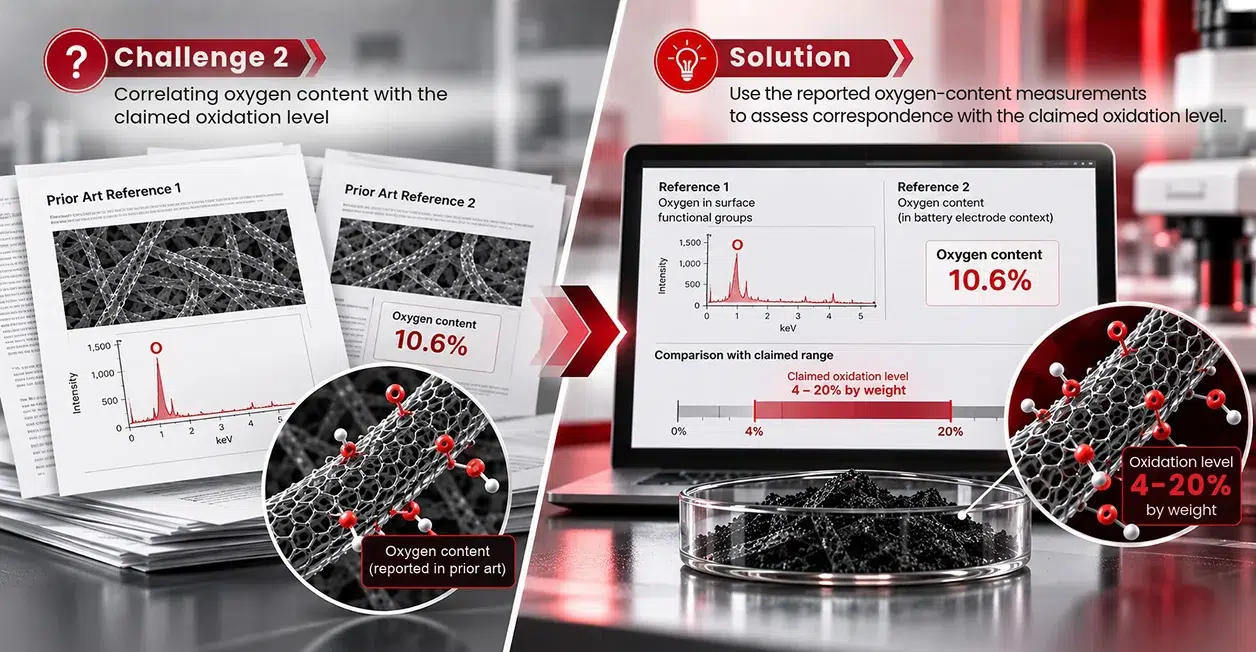
Another important challenge involved determining whether earlier studies disclosed carbon nanotubes with oxidation levels corresponding to the claimed range of 4–20% by weight. The identified references reported oxygen-content measurements, but their equivalence to the patent’s specified oxidation parameter required careful assessment.

Solution

The investigation examined oxygen-related measurements reported in two prior-art references. The first study reported oxygen content in the surface functional groups of purified MWNTs, while the second reported an oxygen content of 10.6% in a lithium-ion battery electrode-related context.

The analysis identified the following relevant disclosures:
  • Oxygen content in surface functional groups of purified MWNTs.
  • A reported oxygen-content value of 10.6% in the second reference.
  • Potential correspondence with the patent’s claimed oxidation range of 4–20% by weight.

These findings identified potentially relevant prior-art evidence for evaluating the claimed oxidation limitation. However, confirming the correspondence requires verification that the reported measurements use a comparable analytical method, unit and weight basis.

sodium ion battery image

Results & Business Impact

The investigation identified relevant prior-art references containing technical disclosures that could challenge the claimed dimensional and chemical characteristics of carbon nanotubes used in lithium-ion battery compositions.

Key Outcomes

  • Key outcome Icon

    Identification of relevant prior art on MWNTs in lithium-ion batteries.

  • Key outcome Icon

    Calculation of aspect ratios overlapping with the claimed range of 10–400.

  • Key outcome Icon

    Identification of oxygen-content data relevant to the claimed oxidation range.

  • Key outcome Icon

    Strengthened technical basis for novelty and inventive-step assessment.

  • Key outcome Icon

    Identification of critical evidence requiring further validation.

Strategic Business Impact

By combining targeted patent searching with scientific literature analysis and quantitative evaluation of experimental measurements, the investigation provided:

  • Broader prior-art coverage beyond keyword searches.
  • Improved claim-level technical assessment.
  • More focused patent invalidation strategies.
  • Greater clarity on evidence gaps and validation requirements.
  • Stronger support for informed IP decision-making.

The investigation demonstrated how interpreting experimental measurements alongside structured claim analysis can uncover relevant prior art that may otherwise remain overlooked, helping IP stakeholders assess patent validity with greater technical precision.

Could Earlier Research Challenge Your Patent Claims?

Our team investigates scientific literature, technical disclosures and quantitative claim limitations to identify relevant evidence and assess its significance.