

Case Study: Patentability of Pharmaceutical Composition - Wissen Research

How Do You Find Prior Art When the Same Drug Is Described in Different Ways?

A strategic patentability search that revealed how dosage normalization and therapeutic context can uncover stronger pharmaceutical prior art.

Type Patentability Search
Industry Pharmaceuticals
Published 24 July, 2026

The Client's Challenge

The client sought a comprehensive patentability assessment for a pharmaceutical composition comprising bupropion and a phosphodiesterase-5 (PDE5) inhibitor intended for the treatment of female sexual dysfunction and delayed ejaculation.

The claimed invention defined both active ingredients within specific dosage ranges, with daily administration forming an important aspect of the therapeutic regimen.
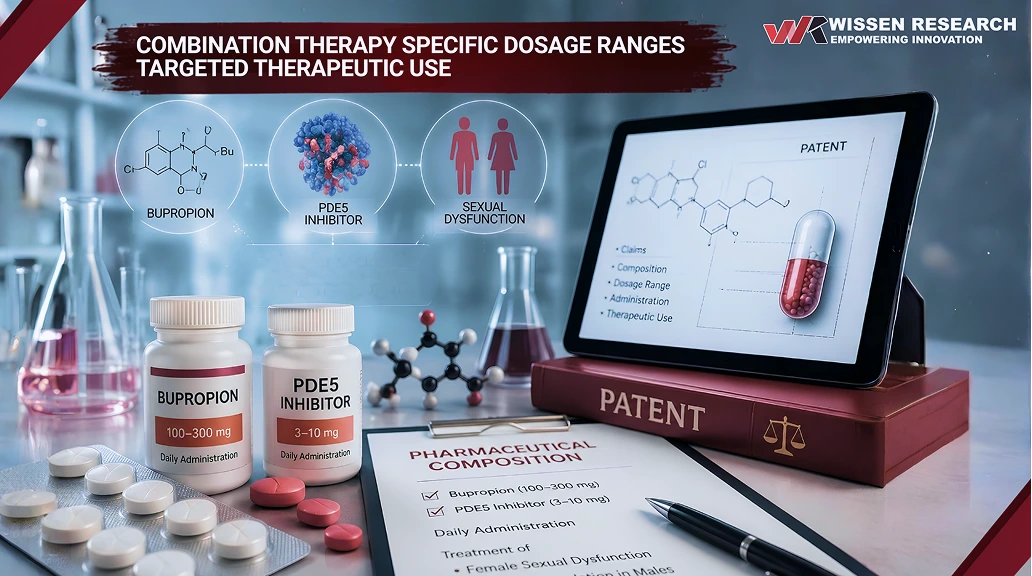
This investigation required evaluating the novelty of an entire treatment framework involving:

    • Combination of bupropion with a PDE5 inhibitor
    • Defined dosage ranges for both active ingredients
    • Daily administration regimen
limitations icon
CLIENT OBJECTIVE

Determine whether the claimed pharmaceutical composition, dosage ranges and therapeutic application satisfied the requirements for patentability.

Clients come to us for answers.
They leave with opportunities they didn’t know existed.

Our experts help organizations uncover insights, opportunities and strategic directions that traditional approaches often miss.

Wissen’s Out-of-the-Box Approach:

Looking beyond the Conventional Keyword Search

  • Recognizing these limitations, the investigation shifted from a conventional keyword-driven search toward a strategy centered on the functional relationship between dosage, administration conditions, and therapeutic application.
  • Rather than searching exclusively for the exact claimed dosage ranges, the analysis considered how equivalent treatment protocols were represented across patents and scientific literature.

Our Methodology

Expanded Therapeutic Analysis
Dosage Normalization
Composition-Level Review
Scientific Literature Correlation
Patentability Evaluation
Expanded Therapeutic Analysis
  • Analyze closely related therapeutic indications
  • Evaluate overlapping mechanisms of action
  • Identify clinically relevant treatment analogues
Dosage Normalization
  • Compare fixed-dose and weight-based dosing
  • Interpret equivalent dosage representations
  • Normalize administration conditions
Composition-Level Review
  • Assess active ingredient combinations
  • Compare dosage windows
  • Review treatment frequency and duration
Scientific Literature Correlation
  • Evaluate non-patent publications
  • Compare clinical evidence
  • Cross-reference pharmaceutical disclosures
Patentability Evaluation
  • Compare all identified references against the claimed invention
  • Assess novelty of the overall composition
  • Identify the closest prior art
Outcome

This strategic shift enabled the investigation to evaluate disclosures that would have remained undetected using traditional search methods.

Technical Challenges Addressed

Challenge 1: Identifying Relevant Prior Art Beyond Exact Dosage Expressions

One of the primary technical challenges involved locating prior art despite inconsistent dosage representations across patent and scientific literature.

Solution

Instead of restricting the search to fixed dosage values, equivalent dosage expressions and alternative reporting methods were systematically analyzed.

The analysis revealed:
  • Identification of references not retrieved through unconventional searches.
  • Dosage normalization expanded the relevant prior art landscape.

This broader approach enabled identification of references that would likely remain hidden through narrow keyword searching.

Challenge 2: Distinguishing Relevant Therapeutic Disclosures

Another challenge involved differentiating references directed toward therapeutically related but legally distinct medical conditions.

Solution

The investigation categorized literature according to therapeutic indication, treatment objective, dosage strategy and composition.

The analysis revealed:
  • Separated disclosures related to smoking cessation and premature ejaculation
  • Filter out references to female sexual dysfunction and delayed ejaculation.

This allowed the investigation to capture disclosures that described comparable dosage concepts using different scientific conventions.

Results & Business Impact

The refined investigation successfully identified multiple highly relevant references supporting the patentability assessment.

Key Outcomes

    • Three highly relevant patent references were identified.
    • One closely aligned non-patent scientific publication was identified.
    • Additional references describing related pharmaceutical compositions were documented for completeness.
    • The investigation expanded the relevant prior art beyond conventional keyword searches.
    • The client received a stronger evidence base for evaluating patentability.
Strategic Business Impact

This investigation illustrates that pharmaceutical patentability assessments often require more than conventional literature searches. By accounting for variations in:

  • dosage representation
  • administration protocols
  • and therapeutic terminology

The methodology provides a structured framework that can be applied to future composition-based patentability investigations involving complex formulations and therapeutic combinations.

EXPERT IP RESEARCH SERVICES

Need Support for Complex Pharmaceutical Patent Investigations?

Our team specializes in pharmaceutical patentability analysis, prior art research and evidence-driven investigations for complex composition-based patent claims.