

A client approached Wissen Research to evaluate the validity of a patent covering an advanced video game controller designed to deliver a more immersive gaming experience through an integrated combination of hardware features and user interaction mechanisms. Unlike conventional controller designs that introduce incremental improvements to individual components, the subject patent claimed a coordinated architecture in which multiple technologies including a distinctive button configuration, localized haptic feedback, adaptive trigger resistance and ergonomic grip geometry worked together to enhance gameplay and user comfort. While each feature appeared technically familiar in isolation, the patent positioned their specific combination as a novel and non-obvious advancement over existing controller technologies. The client sought to determine whether equivalent functionality had already existed before the patent’s priority date and whether sufficient prior art could be identified to challenge the patent’s validity.
The Client's Challenge
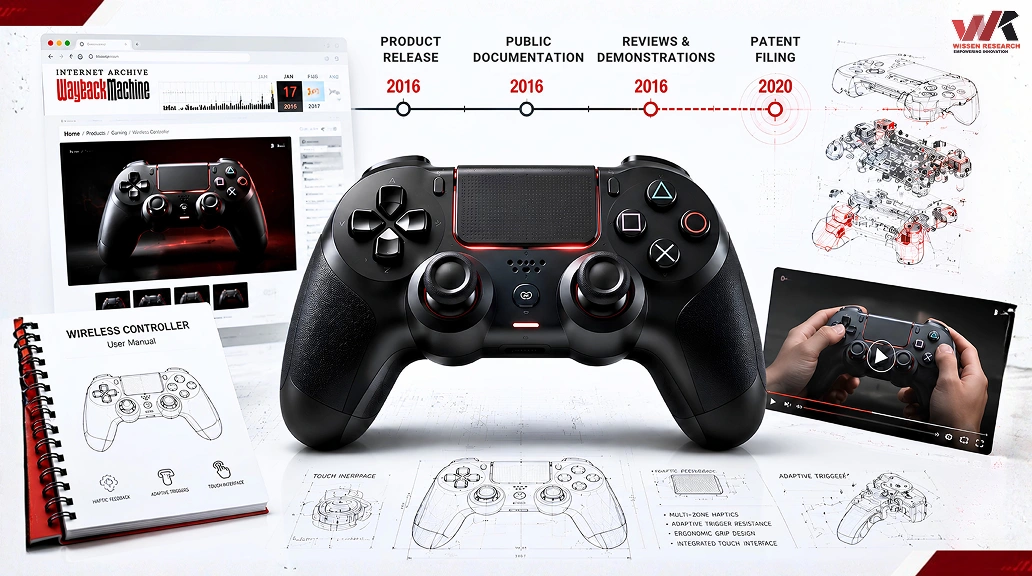
The patent claims primarily covered:
- A controller incorporating a distinctive button arrangement featuring a centrally positioned touch-sensitive interface.
- Localized haptic feedback motors capable of generating different vibration responses during gameplay.
- Adaptive trigger mechanisms capable of dynamically changing resistance based on game events.
- Ergonomic grip geometry designed to accommodate different hand sizes during extended gameplay.
- Integration of these hardware components into a unified controller architecture delivering an immersive gaming experience.

Required evidence capable of supporting a Section 102 anticipation strategy rather than relying solely on an obviousness argument under Section 103.
Traditional Prior Art Investigation Approach
The investigation focused on identifying technical disclosures across widely recognized documentary sources, including:
Conventional Investigation Strategy
Several technically relevant references were identified during this phase. These documents described controller ergonomics, touch-sensitive interfaces, programmable triggers, vibration systems, and other related technologies.
Traditional Prior Art Investigation Workflow

Technology Understanding
- Analyze the patent specification and claims.
- Identify the essential controller architecture and interaction mechanisms.
- Define the technical scope of the investigation.

Literature Search
- Develop keywords and technical synonyms.
- Search patent databases using CPC/IPC classifications.
- Review academic publications and technical documentation.
- Explore gaming hardware literature and archived manuals.

Prior Art Screening
- Evaluate relevance based on claims and embodiments.
- Remove unrelated references.
- Categorize references according to disclosed features.

Technical Mapping
- Compare identified disclosures against individual claim limitations.
- Record supporting figures, descriptions and technical teachings.
- Identify missing claim elements.

Multi-Reference Analysis
- Combine complementary disclosures from multiple references.
- Assess whether the combined teachings addressed all patent claims.
- Evaluate the strength of an obviousness position.
Outcome: These findings supported a credible Section 103 obviousness position but they did not satisfy the substantially higher evidentiary threshold required for Section 102 anticipation.

- Public documentation primarily emphasized product features rather than underlying implementation.
- Product manuals summarized functionality but rarely documented complete controller architecture.
- Marketing material highlighted user benefits instead of engineering details.
- Individual references disclosed isolated controller features rather than the complete claimed combination.
- Historical documentation often became inaccessible after product discontinuation.
- Demonstrations of real-world product functionality were scattered across multiple independent sources.
- The available documentary evidence provided stronger support for Section 103 obviousness than for Section 102 anticipation.
These limitations suggested that continuing the investigation within conventional documentary sources alone was unlikely to uncover the single enabling reference required by the client.
Wissen’s Out-of-the-Box Approach:
System Prior Art Through Product History Reconstruction
- The most persuasive evidence may exist not in traditional prior art databases, but within the historical footprint left by the product itself.
- Recognizing this, the investigation expanded to include publicly available evidence associated with commercial controllers released before the patent's priority date.
- The evaluation considered controllers exhibiting one or more characteristics relevant to the patent, including:
- Integrated touch-sensitive interfaces
- Multi-zone haptic feedback mechanisms
- Adaptive trigger technologies
- Ergonomic grip configurations
Identifying Potential System Prior Art
-
A historical review of commercially released gaming controllers was conducted with emphasis on products introduced before the patent’s priority date.
-
Through this review, the investigation identified a commercially available controller released several years before the subject patent.
-
Although publicly available documentation described many of its capabilities, the available literature alone did not fully establish every claim limitation.
-
The investigation therefore expanded to authenticate the controller’s technical characteristics using multiple independent public evidence sources.
Our Methodology
- Multiple references required to reconstruct the invention
- Limited implementation-level detail
- Marketing materials emphasized features rather than architecture
- Stronger support for Section 103 than Section 102
- Review commercially released controllers
- Prioritize products released before the priority date
- Assess functional similarity to patent claims
- Recover archived webpages
- Obtain historical user manuals
- Verify product release timeline
- Collect publicly available documentation
- Analyze product demonstrations
- Review unboxing videos
- Examine independent reviews
- Document observable controller functionality
- Study publicly available teardown investigations
- Validate internal hardware configuration
- Correlate observed implementation with claimed features
- Compare evidence against individual claim limitations
- Corroborate findings across independent sources
- Assess whether the product constitutes a single enabling prior art reference
System Prior Art Investigation Methodology
The system prior art investigation focused on identifying, authenticating and technically validating commercially available video game controllers released before the subject patent’s priority date.
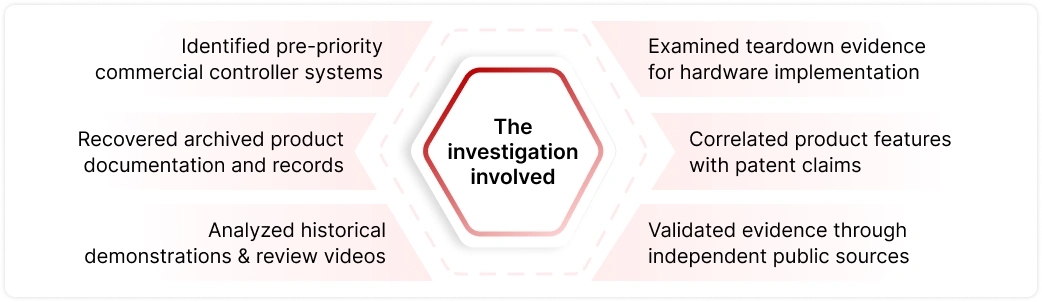
This methodology enabled the investigation to move beyond fragmented documentary disclosures and assess a commercially available product as a potential system prior art reference supported by reproducible public evidence.
Evidence Collection & Validation
Rather than relying on a single source, multiple public records were analyzed and cross-validated, including:
 Multi-Source Evidence Collection
Archived Manufacturer Documentation
Historical Product Demonstrations
Independent Technical Reviews
Public Technical Teardown Analysis
Multi-Source Evidence Collection
Archived Manufacturer Documentation
Historical Product Demonstrations
Independent Technical Reviews
Public Technical Teardown Analysis
Each significant technical observation was verified across multiple independent evidence sources whenever possible.
Technical Challenges Addressed Through System Prior Art Investigation
One of the primary challenges was determining whether the identified controller implemented the claimed combination of hardware features as a unified system rather than as isolated design elements.
Historical product documentation was analyzed alongside archived demonstration videos and manufacturer specifications to reconstruct the controller’s overall architecture.
- Touch-sensitive button layout
- Localized haptic feedback
- Adaptive trigger mechanisms
- Ergonomic grip design
By correlating these findings across multiple independent sources, the investigation demonstrated that the controller functioned as a cohesive hardware platform rather than a collection of unrelated features.
Even where technical similarity could be established, the evidence would have limited value unless it could also demonstrate that the controller was publicly accessible before the patent’s priority date. Historical product information often becomes fragmented as websites change, documentation disappears, and products are discontinued.
A structured historical validation process was undertaken to reconstruct the controller’s public release history using multiple independent records.
- Archived manufacturer webpages
- Historical manuals and documentation
- Time-stamped product demonstration videos
- Gaming reviews and articles
- Public teardown analyses
This evidence substantially strengthened the assessment that the product represented authentic and verifiable system prior art rather than a later reconstruction.
Results & Business Impact
The resulting evidence provided the client with a more comprehensive basis for assessing whether the claimed invention had already been placed in the public domain before the patent’s priority date.
Key Outcomes
-

Expanded the investigation from conventional documentary prior art to authenticated system prior art.
-
Recovered historical manufacturer documentation that was no longer available through current product websites.
-
Validated product availability through archived webpages and historical publication records.
-
Corroborated technical functionality using independently published demonstration videos and product reviews.
-
Supplemented functional observations with publicly available teardown analysis to better understand hardware implementation.
-
Established a reproducible chain of evidence suitable for supporting a stronger Section 102 anticipation assessment.
By reconstructing the historical record surrounding a commercially released product, the investigation provided the client with:
- Combined documentary and system prior art
- Increased confidence in historical technology availability
- Reduced reliance on multi-reference obviousness arguments
- Authenticated commercial products as prior art
- Reproducible evidence framework for hardware evaluations
More broadly, the engagement demonstrated that publicly available products when supported by independent historical evidence can become valuable prior art assets that might otherwise remain overlooked.
Conclusion & Implications
This case study highlights the importance of adapting patent invalidation strategies to reflect how modern technologies are introduced and documented. The investigation began with a comprehensive review of patents, technical publications and product documentation. Although these sources established a strong technical background, they primarily supported an obviousness-based analysis because no single reference disclosed the complete combination of claimed controller features. Recognizing this limitation, the investigation expanded beyond conventional literature to evaluate commercially available products released before the patent’s priority date. By reconstructing the controller’s historical record through archived documentation, independent product demonstrations, technical reviews and teardown analysis, the project established a substantially stronger and independently verifiable evidence chain. The investigation reinforces the importance of: