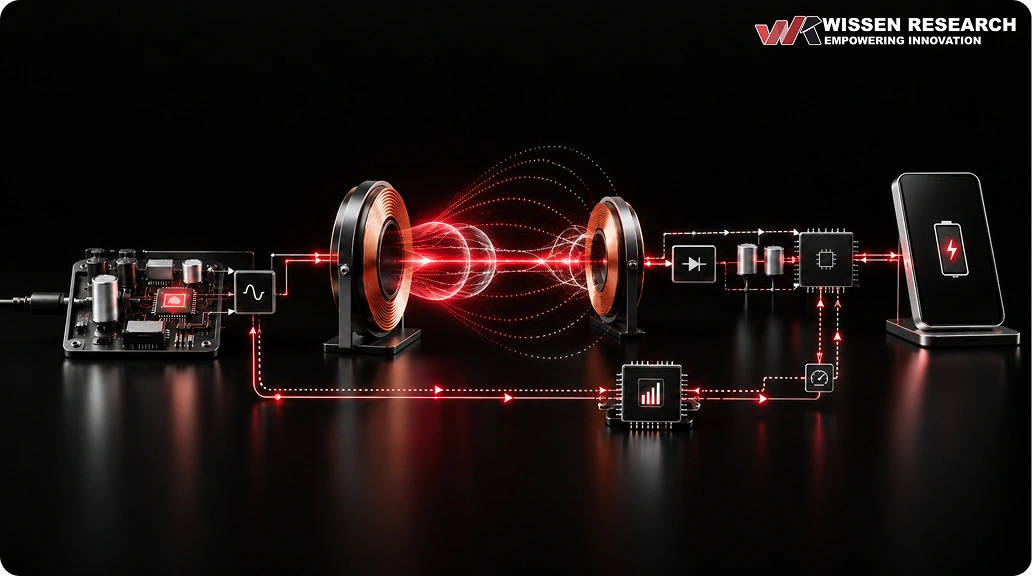
Circuit Claim Decomposition for Patent Invalidation Search

Can Breaking a Circuit Claim Into Fundamental Elements Reveal Hidden Prior Art?

A circuit-level investigation combining claim decomposition, classification searching, non-patent literature and competitor analysis uncovered an anticipatory reference beyond conventional keyword-based search strategies.

Type Invalidation Search
Industry Wireless Power and Electronics
Published September 09, 2026
Circuit based patent hero image

The Client's Challenge

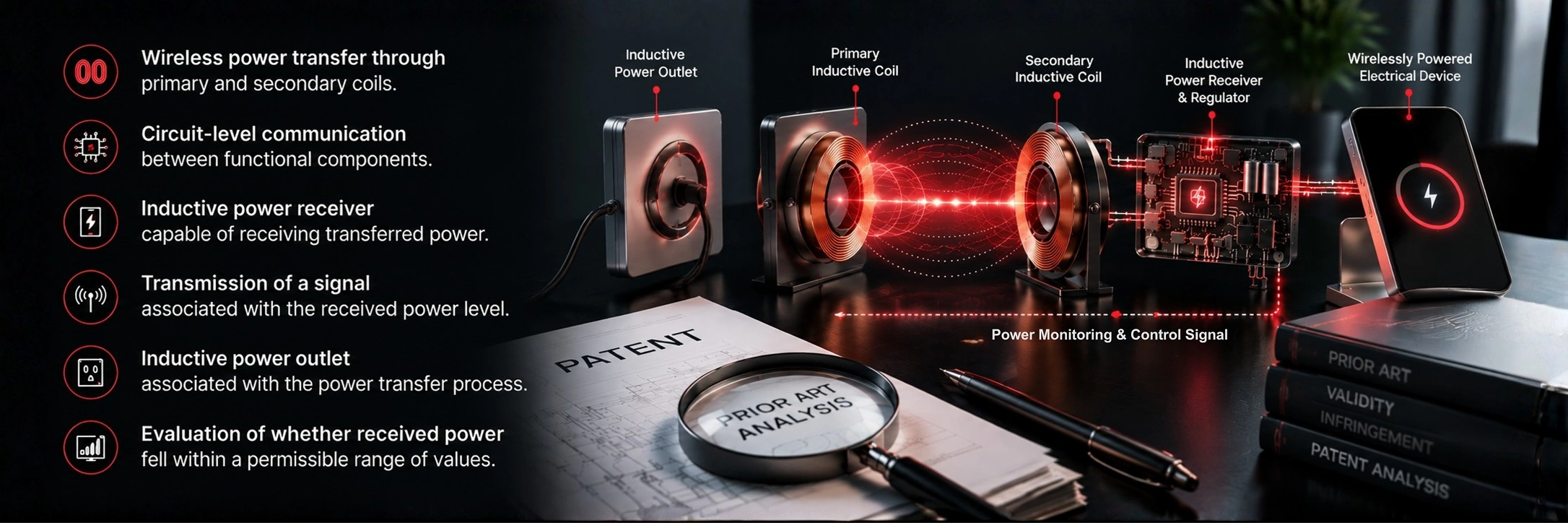
A client sought patent litigation support in connection with an invalidation search involving an inductive power transfer system for wirelessly transferring power to an electrical device. The subject patent disclosed a circuit architecture involving an inductive power receiver, primary and secondary inductive coils, an inductive power outlet, a signal transmitter and a regulator.

File wrapper analysis was performed to understand the novelty of the subject matter and the grounds on which the patent had been granted. This provided important context for determining which technical limitations were likely to be central to the patent’s distinction over the prior art.
Circuit challenge image

The investigation focused on whether prior art could disclose:

    • Wireless power transfer through primary and secondary inductive coils.
    • An inductive power receiver capable of receiving transferred power.
    • An inductive power outlet associated with the power transfer process.
    • Circuit-level communication between functional components.
    • Transmission of a signal associated with the received power level.
    • Evaluation of whether received power fell within a permissible range of values.
Objective icon
CLIENT'S OBJECTIVE

The objective was to identify strong prior art capable of challenging the validity of the subject patent.

Determine whether earlier technical disclosures could address the specific arrangement and sequence of circuit operations claimed by the patent.

To understand the claimed circuit well enough to determine where the relevant technical evidence might exist and how that evidence could be discovered.

Clients come to us for answers.
They leave with opportunities they didn’t know existed.

Our experts help organizations uncover insights, opportunities and strategic directions that traditional approaches often miss.

Wissen's Out-of-the-Box Approach:

Searching Beyond Keywords Through Functional Circuit Analysis

  • Recognizing the limitations of conventional keyword-based searching, the investigation evolved beyond searching for prior art based solely on the terminology used in the patent claims.
  • To enable a broader and more technically grounded assessment of prior art evidence, the investigation expanded beyond conventional keyword searching to include a functional analysis of circuit operation and multiple alternative search pathways, including:
  • Breaking the claimed circuit into fundamental technical elements
  • Conducting inventor, assignee and citation analysis
  • Identifying wireless charging manufacturers and their corporate affiliates

Identifying the Underlying Circuit Operation

  • A focused technical investigation was conducted to understand how the claimed inductive power transfer circuit operated beyond the individual names of its components.

  • However, these references did not consistently disclose the specific functional sequence associated with evaluating the received power, determining whether it fell within a permissible range, transmitting a perpetuation signal and maintaining the operation of the primary inductive coil at the required power level.

  • To overcome this limitation, the claim was broken down into smaller fundamental technical elements, and the search strategy was expanded to focus on circuit functionality, patent classifications, non-patent literature and the broader technology ecosystem.

Our Methodology

Traditional Search Limitations
Functional Decomposition of the Claim
Classification-Based Prior Art Searching
Expansion Into Alternative Technical Sources
Competitor, Assignee and Affiliate Analysis
Citation and Inventor Analysis
Claim Mapping and Anticipatory Reference Identification
Traditional Search Limitations
  • Keyword-based searches identify individual circuit components
  • Narrow claim terminology limits retrieval of technically similar circuits
  • Different terminology may describe similar circuit operations
  • Specific functional sequences remain difficult to identify through keywords alone
Functional Decomposition of the Claim
  • Break the circuit claim into smaller fundamental technical elements
  • Separate circuit components from their functional relationships
  • Identify power conditions, signal generation and control actions
  • Understand the underlying operational sequence of the circuit
Classification-Based Prior Art Searching
  • Identify relevant IPC and CPC classifications
  • Explore classes independently and in combination
  • Use classifications to identify technically related circuit architectures
  • Add relevant keywords selectively to refine large result sets
Expansion Into Alternative Technical Sources
  • Explore non-patent literature related to power transfer circuits
  • Identify alternative technical terminology and circuit descriptions
  • Examine relevant technical disclosures beyond conventional patent databases
  • Expand the available prior art landscape
Competitor, Assignee and Affiliate Analysis
  • Identify companies manufacturing wireless charging technologies
  • Conduct assignee searches across relevant technology portfolios
  • Examine corporate affiliates and related entities
  • Identify potentially relevant technical disclosures outside direct assignee searches
Citation and Inventor Analysis
  • Analyze backward and forward citations of relevant references
  • Identify earlier technical developments
  • Conduct inventor searches to trace related circuit technologies
  • Expand the investigation through connected patent portfolios
Claim Mapping and Anticipatory Reference Identification
  • Compare identified circuit operation with individual claim limitations
  • Evaluate the functional relationship between circuit components
  • Identify disclosures addressing the claimed operational sequence
  • Prepare detailed claim charts and supporting technical evidence
Outcome:

An anticipatory reference was identified through functional circuit analysis, classification searches, and alternative technical sources, with additional references supporting broader invalidity arguments.

Prior Art Search Methodology

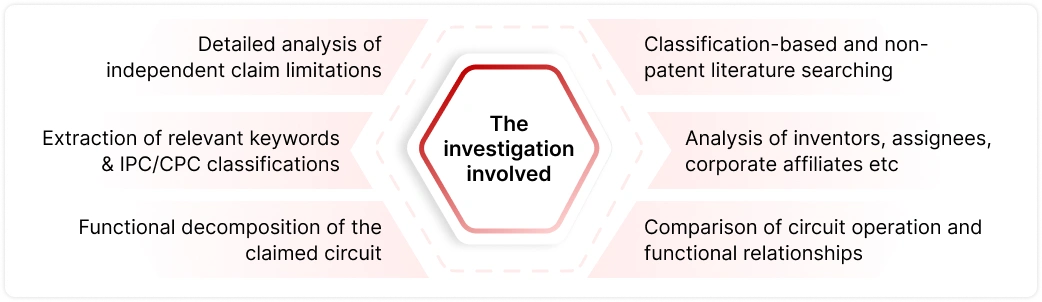
The investigation involved a structured analysis of the subject patent and its relevant technical landscape.

circuit based patent methodology image

The investigation revealed that relevant prior art could be identified more effectively by analyzing the functional operation of the circuit rather than relying solely on the terminology used in the patent claims.

Most importantly, the findings demonstrated that breaking the claimed circuit into fundamental technical elements and expanding the search beyond conventional keyword strategies could uncover prior art addressing the critical claim limitations, strengthening the client’s patent invalidation position.

Technical Challenges Addressed Through Circuit Prior Art Analysis

Challenge 1: Identifying the Claimed Power Control Sequence

One of the key technical questions involved determining whether an earlier inductive power transfer system disclosed the specific sequence in which the received power is evaluated and a signal is transmitted to maintain the operation of the inductive power outlet.

Solution

The conventional keyword-based search was expanded by breaking the claim into smaller fundamental technical elements and analyzing the functional operation of the power transfer circuit.

The analysis focused on:
  • Inductive power reception and power transfer workflows
  • Evaluation of received power against a permissible range of values
  • Signal transmission associated with maintaining power transfer
  • Control of the inductive power outlet and primary inductive coil

This approach enabled the investigation to identify prior art based on the functional operation of the circuit rather than relying solely on the terminology used in the patent claims.

Challenge 2: Finding Relevant Prior Art for a Narrow Circuit Arrangement

Another important challenge involved identifying prior art that disclosed not only the individual components of the inductive power transfer system, but also the specific functional arrangement between those components.

Solution

The investigation expanded beyond conventional keyword searching to include IPC/CPC classification analysis, non-patent literature, citation analysis, and assignee, inventor, competitor and affiliate searches.

The investigation identified and analyzed:
  • Relevant IPC and CPC classifications associated with inductive power transfer circuits
  • Alternative technical terminology from patent and non-patent literature
  • Citation relationships between relevant prior art references
  • Patent portfolios associated with wireless charging companies and their affiliates

These additional search pathways helped uncover technically relevant prior art that could not be efficiently identified through conventional keyword-based searches alone.

Results & Business Impact

The final investigation identified an anticipatory prior art reference capable of supporting the client’s patent invalidation position.

Key Outcomes

  • Key outcome Icon

    Identification of a strong prior art reference relevant to the claimed circuit functionality.

  • Key outcome Icon

    Development of an anticipation-focused invalidation position based on the identified technical disclosure.

  • Key outcome Icon

    Identification of additional references relevant to obviousness and TSM arguments.

  • Key outcome Icon

    Detailed claim charts mapping relevant prior art disclosures.

  • Key outcome Icon

    Searcher comments and technical summaries supporting review of the references.

  • Key outcome Icon

    Use of IPC and CPC classifications as a primary investigative route.

Strategic Business Impact

By moving beyond conventional keyword-based searching and incorporating claim decomposition, classification-driven searching, non-patent literature and competitor analysis, the investigation provided:

  • Stronger patent invalidation support
  • Improved identification of technically relevant circuit prior art
  • Broader prior art coverage beyond conventional keyword searches
  • Greater confidence in evaluating narrow functional claim limitations
  • Additional references supporting obviousness and TSM-based arguments

The approach demonstrated how combining a functional understanding of circuit operation with multiple search strategies can uncover highly relevant prior art that may remain undiscovered through conventional keyword-based methodologies alone.

Need to Look Beyond Keywords to Find the Right Prior Art?

Our team combines claim analysis, classification intelligence, evidence mapping, and alternative search strategies to uncover the most relevant technical evidence.