Multi-Reference Invalidity Search: Hemangioma Patent

What Happens When Three Prior-Art References Challenge a Hemangioma Drug Patent?

A structured investigation connected disclosures on beta-blocker therapy, propranolol-based hemangioma treatment and dosage to develop a potential challenge to a US patent.

Case Study Type Invalidation Search
Industry Pharmaceuticals
Publication Date November 11, 2026
Hemangioma drug image

The Client's Challenge

A client requested an invalidity search for a US patent claiming a method of treating hemangioma using a beta-blocker, particularly propranolol or a pharmaceutically acceptable salt, subject to a daily dosage limit of 5 mg/kg of the patient’s body weight.

The central challenge was not simply to identify publications mentioning propranolol or hemangioma independently. It was to determine whether earlier disclosures addressed the relevant claimed features with sufficient technical specificity to support a meaningful patent validity challenge.
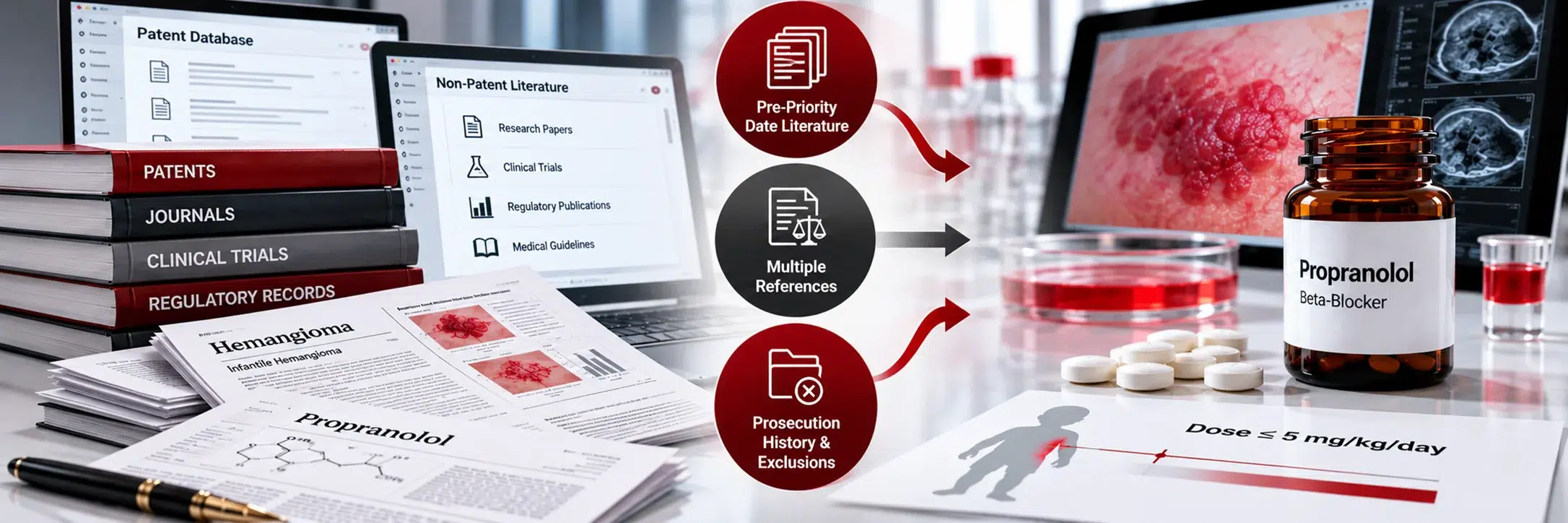
Hemangioma Drug case study

The investigation focused on three principal technical features:

    • Treatment of hemangioma, particularly capillary or infantile capillary hemangioma.
    • Administration of a beta-blocker, specifically propranolol or a pharmaceutically acceptable salt.
    • A daily dosage not exceeding 5 mg/kg of body weight.
Objective icon
CLIENT’S OBJECTIVE

Identify relevant patent and non-patent literature published or otherwise available before the applicable priority date. Assess whether multiple references could collectively support a reasoned obviousness challenge.


Account for relevant disclosures already considered during patent prosecution and the exclusions defined for the investigation.

Clients come to us for answers.
They leave with opportunities they didn’t know existed.

Our experts help organizations uncover insights, opportunities and strategic directions that traditional approaches often miss.

Wissen’s Out-of-the-Box Approach

From Conventional Prior-Art Searching to Multi-Reference Analysis

  • Recognizing the limitations, the strategy evolved beyond conventional keyword-based searching to a broader, claim-focused investigation.
  • The objective was to identify related disclosures that could collectively support a potential challenge to the patent’s inventiveness. The investigation expanded to include:
  • Chemical analog and structure-based searching
  • Citation and similar-document analysis
  • Cross-jurisdictional patent searching
  • Claim-feature mapping

Identifying Relevant Prior Art

  • The investigation identified three references as particularly relevant to the claimed treatment method.

  • By comparing these disclosures against the key claim features, the investigation established a structured basis for evaluating a potential obviousness challenge.

Our Methodology

Traditional Search Limitations
Comprehensive Prior-Art Search
Chemical Structure and Analog Search
Multi-Database Patent and Literature Analysis
Three-Reference Claim Mapping
Evidence Assessment and Invalidity Strategy
Traditional Search Limitations
  • No single reference disclosed all claimed features.
  • Relevant disclosures spanned different therapeutic contexts.
  • Terminology and translations complicated claim mapping.
  • Key literature had already appeared in prosecution records.
Comprehensive Prior-Art Search
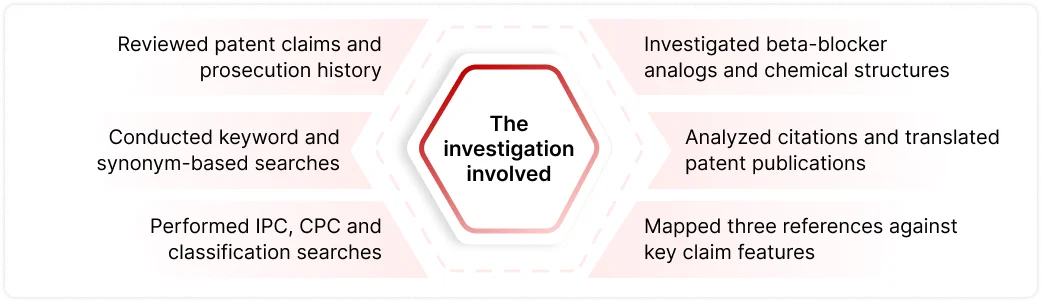
  • Review granted claims and prosecution history.
  • Search keywords, synonyms, and classifications.
  • Combine searches with assignees and inventors.
  • Conduct citation and similarity searches.
Chemical Structure and Analog Search
  • Search beta-blocker analogs using STN.
  • Run exact and substructure searches.
  • Explore propranolol synonyms and chemical identifiers.
  • Screen structurally related compounds.
Multi-Database Patent and Literature Analysis
  • Search patent and national databases.
  • Review scientific literature and clinical publications.
  • Explore chemical and regulatory resources.
  • Analyze translated non-US patent documents.
Three-Reference Claim Mapping
  • US’319: Beta-blockers for hemangioma.
  • WO’319: Propranolol for capillary hemangioma.
  • WO’234: Dosage disclosure in another clinical context.
  • Compare overlapping features and claim limitations.
Evidence Assessment and Invalidity Strategy
  • Map disclosures against granted claims.
  • Verify publication dates and prior-art status.
  • Apply the project’s exclusion criteria.
  • Assess potential obviousness arguments.
Outcome:

Three related prior-art references addressing overlapping claim features, supporting further evaluation of a potential obviousness-based invalidity challenge.

Prior-Art Search Methodology

The investigation involved a comprehensive, multi-database search to identify prior-art disclosures.

Hemangioma Drug Investigation

The investigation identified three relevant prior-art references addressing overlapping features of the claimed invention.

US’319 disclosed beta-blockers for hemangioma treatment, WO’319 discussed propranolol for capillary or infantile capillary hemangioma, and WO’234 disclosed a dosage of 5 mg/kg per day in a different therapeutic context.

Technical Challenges Addressed Through Pharmaceutical Prior-Art Analysis

Challenge 1: Identifying Prior Art Covering the Claimed Combination of Hemangioma Treatment, Propranolol and Dosage

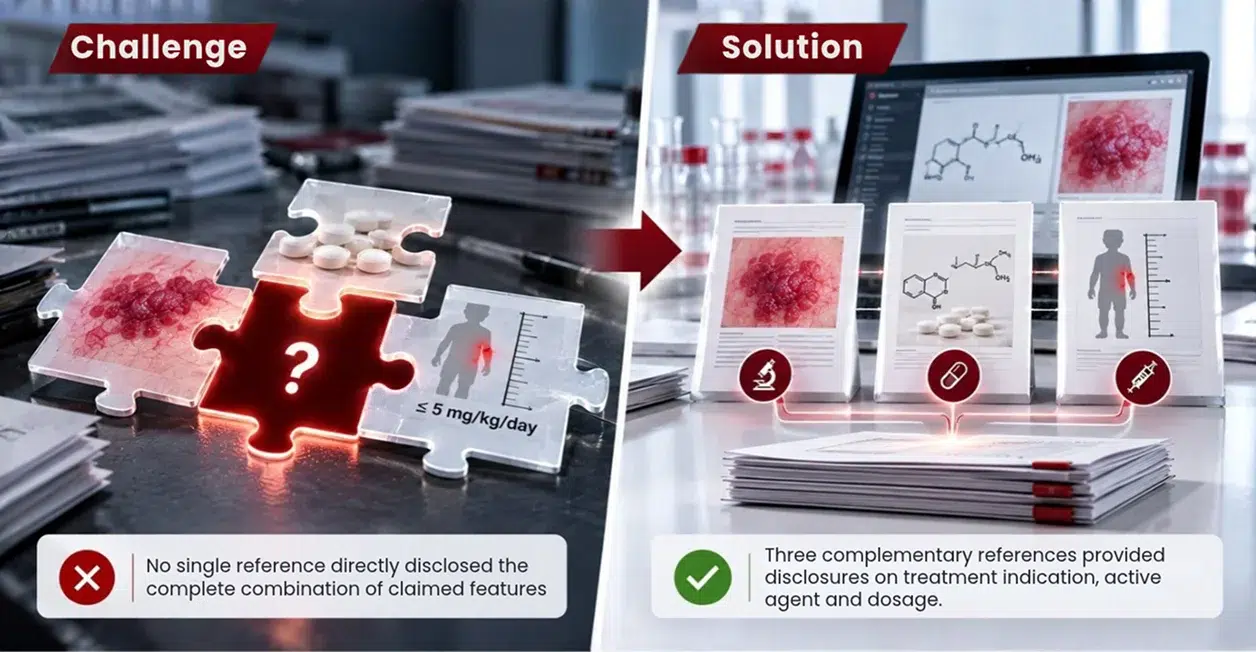
A key challenge involved identifying earlier disclosures that addressed the principal features of the subject patent: treatment of capillary or infantile capillary hemangioma, administration of a beta-blocker specifically propranolol or a pharmaceutically acceptable salt, and a daily dosage not exceeding 5 mg/kg of body weight. Although relevant pharmaceutical literature was identified, no single reference directly addressed the complete combination of these features.

Solution

A focused, multi-strategy prior-art investigation examined patent publications, scientific literature, chemical information resources, and related disclosures. Keyword and classification searches were supplemented by chemical analog searches, citation analysis, and detailed examination of the patent’s prosecution history.

The analysis revealed:
  • US’319: Disclosed the use of beta-blockers in the treatment of hemangioma.
  • WO’319: Specifically discussed propranolol as a beta-blocker for capillary or infantile capillary hemangioma.
  • WO’234: Described administration of a beta-blocker-containing medicament at a dosage of 5 mg/kg per day in a different clinical context involving neuropathic pain associated with enchondromatosis and multiple cavernous hemangiomas.

These findings established a structured basis for comparing the therapeutic indication, active agent and dosage limitation across the identified references. While the disclosures collectively supported further assessment of a potential obviousness challenge, the combination did not, by itself, establish anticipation or conclusively demonstrate invalidity.

Hemangioma Drug challenge and solution image
Challenge 2: Correlating Disclosures Across Different Therapeutic Contexts and Patent Jurisdictions

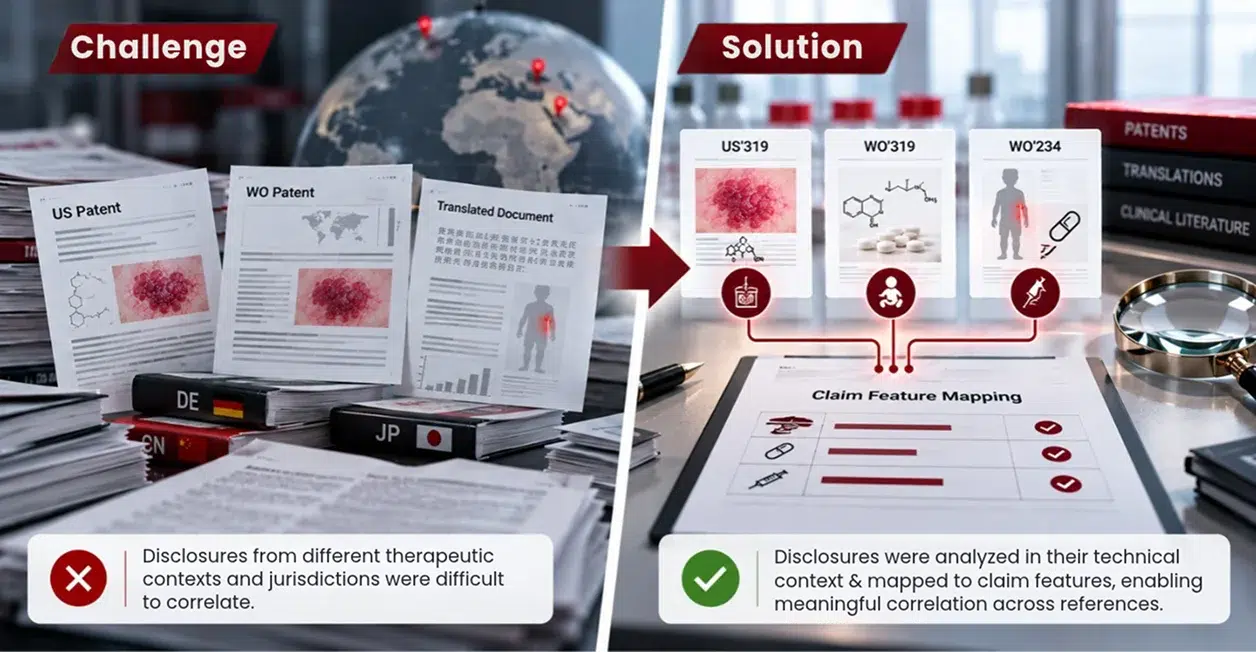
Another important challenge involved determining whether disclosures from different clinical contexts could meaningfully inform the assessment of the claimed hemangioma treatment method. The dosage disclosure in WO’234 related to a different therapeutic context while relevant information from non-US patent publications also required interpretation through translated text. Establishing technical relevance therefore required more than matching drug names or numerical dosage values.

Solution

The investigation examined each reference in its technical context and mapped its disclosures against the principal claim features. Translated patent documents were reviewed alongside available bibliographic information and the surrounding technical disclosure to assess their relevance to the subject patent.

The analysis focused on:
  • The therapeutic indication disclosed in each reference.
  • The beta-blocker or propranolol-specific teaching.
  • The disclosed dosage and its clinical context.
  • Differences between the individual disclosures and the claimed treatment method.

The findings strengthened the technical foundation for a potential multi-reference obviousness argument and provided a clearer framework for subsequent claim mapping and legal review.

Results & Business Impact

The final investigation identified three related prior-art references that addressed key features of the subject patent through a structured, multi-reference analysis. Although no single reference directly disclosed the complete claimed combination, the findings established a basis for evaluating a potential obviousness challenge.

Key Outcomes

  • Key outcome Icon

    Identification of three related prior-art references addressing key features of the claimed hemangioma treatment method.

  • Key outcome Icon

    Mapping of disclosures concerning beta-blocker therapy, propranolol use for capillary or infantile hemangioma, and a dosage of 5 mg/kg per day.

  • Key outcome Icon

    Expansion of the investigation through chemical analog searches, classification-based queries, citation analysis, and non-US patent publications.

  • Key outcome Icon

    Development of a structured, multi-reference evidence base for evaluating a potential obviousness challenge.

  • Key outcome Icon

    Identification of the technical differences and evidentiary gaps requiring further claim-level and legal assessment.

Strategic Business Impact

By expanding the investigation beyond a single-reference search and incorporating chemical analog analysis, citation searching, and cross-reference claim mapping, the investigation provided:

  • A broader assessment of relevant pharmaceutical prior art.
  • A structured basis for evaluating a potential obviousness challenge.
  • Improved visibility into overlaps and gaps across therapeutic, drug-specific and dosage disclosures.
  • A focused foundation for further legal review and claim-level analysis.
  • Better-informed decision-making regarding the potential strength of the patent invalidity position.

The investigation demonstrated how combining multiple search methodologies with systematic analysis of related pharmaceutical disclosures can uncover potential invalidity arguments that may remain unidentified through conventional keyword searching alone.

Could Earlier Pharmaceutical Research Challenge Your Patent?

Our team connect patent claims with relevant scientific, chemical and technical disclosures to identify potential challenges and evidence gaps.