
Industrial Automation Market
Global Industry analysis, Size, Share, Growth, Trends, and Forecast 2026-2031
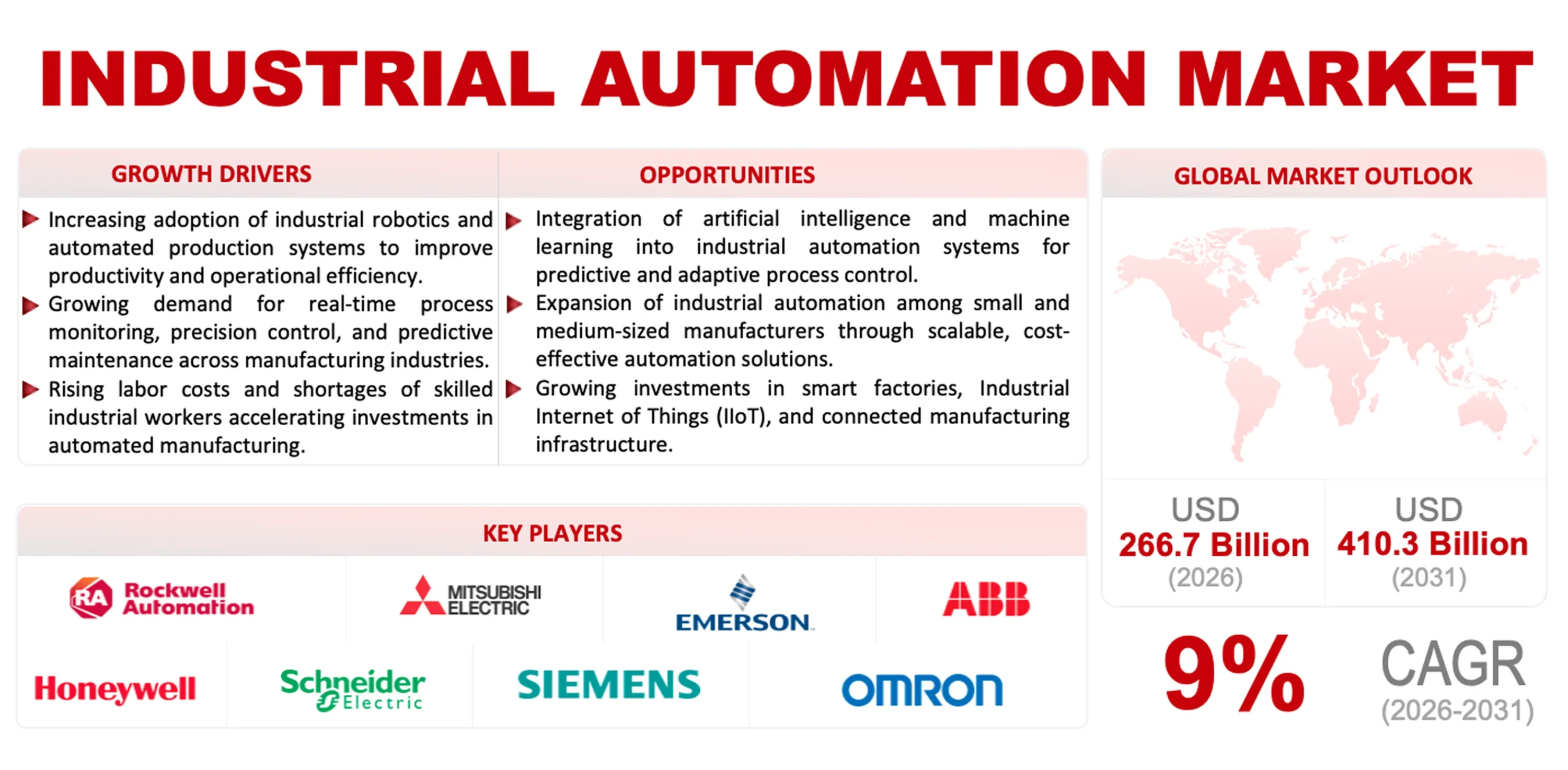
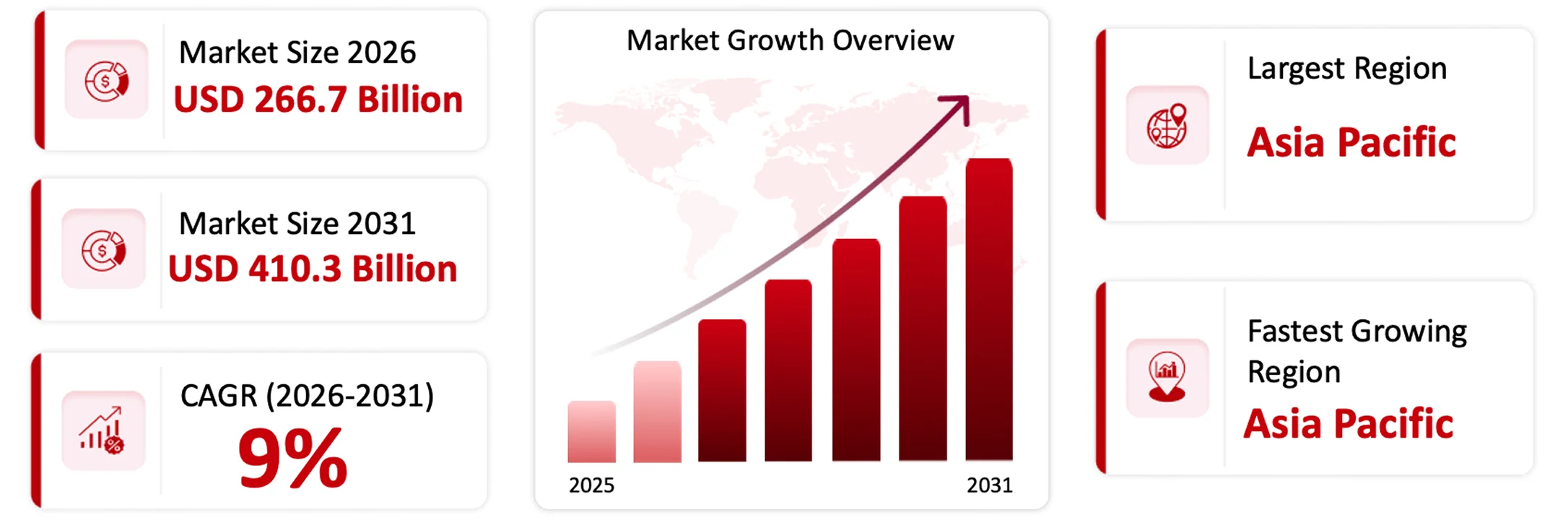
The market is projected to reach USD 410.3 billion by 2031, growing at a CAGR of 9 % during the forecast period (2026-2031).
| Market Size (2026) | Forecast (2031) | CAGR (2026–2031) | Leading Region | Fastest Growing Region |
|---|---|---|---|---|
| USD 266.7Billion | USD 410.3 Billion | 9 % | Asia-Pacific | Asia Pacific |
Summarize this report with:



Global Industrial Automation Market Overview
“In my view The shift from traditional, hardware-oriented control systems toward integrated, software-based production solutions is evident in the development of the global industrial automation industry. Various companies have implemented programmable logic controllers, robotics, machine vision systems, distributed control systems, and industrial software since they want to boost performance, product quality, control of processes, and machinery usage. The increase in demand for industrial automation is prompted by labor shortage, increasing quality standards, and the need to control complex processes in automotive, electronics, food industry, pharmacy, etc.”
– Mayur Jain, Research Consultant, Wissen Research
The market is estimated to be USD 266.7billion in 2026 and is projected to reach USD 410.3 billion by 2031, growing at a CAGR of 9 % during the forecast period (2026-2031).
Technology Overview
Industrial automation technology includes hardware, software, and communication systems that are utilized for the monitoring, controlling, and optimizing of industrial processes. Machine-level and plant-wide processes are managed by programmable logic controllers (PLC), distributed control systems (DCS), and supervisory control and data acquisition (SCADA) systems. On the other hand, the operational stage of industrial automation technologies is represented by sensors, actuators, machine vision, and industrial robots. Industrial automation software also combines manufacturing execution systems (MES), digital twins, and advanced analytics, which serve as a link between technological processes and corporate systems. Moreover, artificial intelligence, industrial Internet of Things (IIoT), and edge computing offer the use of technologies for real-time decision-making, predictive maintenance, and process optimization. The growing implementation of interoperable solutions is accompanied by the emergence of industrial cybersecurity options, which facilitate the provision of connected, flexible, and resilient manufacturing.
Key Growth Drivers
- Growing demands for semiconductor manufacturing capacity: New semiconductor wafer plants need strict temperature, pressure, gas-flow, and contamination management, which leads to the higher demand for automation systems, sensors, robots, and integrated control systems.
- Electrifying the automotive production process: Battery manufacturing, electric motor assembly, and battery pack integrations need automated material handling, robotic welding, vision-based detection, and traceability systems in order to ensure uniform production across big volume manufacturing operations.
- Serialization of pharma production and process regulation: The complex production of biopharma products as well as regulatory requirements for traceability make it necessary to implement automated inspection systems, batch control systems, paperless technology, and accurate dosing tools in pharmaceutical production lines.
- Automated food inspection and packaging: High-speed production lines require machine vision systems, automated weighing, filling level verification, and reject systems, which result in a reduction of lost products and a guarantee of correct packaging of the finished product.
- Brownfield redevelopment of plants: Companies are replacing outdated PLCs, old drives, and unintegrated systems of automation with connected platforms of automation to improve visibility of equipment and enable remote diagnostics without the need to completely renovate the plant.
- Energy optimization of processes: In the chemical, oil & gas, and metallurgy sectors, advanced process control systems, variable frequency drives, and real-time monitoring are put into operation, which helps to stabilize the process and reduce the amount of energy consumed per unit of output.
Industrial Automation Market Key Highlights
Need deeper insights on this market?
Get full report access with detailed forecasts, competitive analysis, and segmentation.
Industrial Automation Market Trends
It is evident that the industrial automation industry is transitioning toward operators using artificial intelligence, in which companies are implementing predictive maintenance, process optimization, and quality inspection through the machine learning method. The role of collaborative and autonomous vehicles is increasing in flexible manufacturing and intralogistics. Digital twins allow companies to perform virtual tests on mechanisms before implementation, while edge computing allows for fast decision-making in the factory environment. Companies are moving toward the use of flexible and software-based automating systems that are in demand for the upgrade of old companies.
Industrial AI is Moving from Pilot Projects to Production-Scale Automation
Artificial intelligence (AI) is increasingly being incorporated in industrial automation, mainly focusing on increasing the utilization of AI technologies in production processes, quality control, maintenance, and operation process management. Adoption figures show that there is a real utilization of technology: Cisco’s 2026 report shows that 61% of manufacturers implementing AI technology in production processes and 83% of firms planning to increase their AI budget.
The most successful examples of AI results are at specific factories. AI makes it possible for machine vision systems to spot defects and mistakes or to define abnormal conditions with the help of technology and functions of the sensor. AI also enables industries to adjust parameters according to the changing production conditions.
Creating integration of AI with industrial control systems, edge computing, and big data technology is a complex task. The ability to establish the required integration is based on the availability of proper machine data, IT/OT connections, and the level of work of legacy systems. The KPMG study indicates that 49% of respondents of the interviewed executives use AI for business needs and 68% plan to use it in production.
Industrial robotics is expanding beyond automotive assembly into broader manufacturing operations
Industrial robotics is progressing from conventional automotive welding and material handling into electronics assembly, metal processing, manufacturing machinery, and other applications that depend on repeatability. The International Federation of Robotics (IFR) revealed that industries installed 542,000 industrial robots worldwide in 2024, more than double the annual number recorded 10 years ago. The global active stock hit 4.664 million units, which is a 9% increase from a year before.
Recent statistics confirm this expansion. The report issued by the IFR states that installations suffered an increase and reached 603,000 units by 2025, up by 11%. The automotive sector and electronics manufacturing had a respective growth rate of 10%. Meanwhile, metal processing and machinery production enjoyed 22% growth, thus confirming that diversification of industrial applications is moving beyond automotive. As many as 66,000 of collaborative robots or cobots have been installed worldwide, which means that they occupy around 11% of the whole industrial robotics market.
The increasing automation of production bottlenecks such as machine tending, component handling, inspection, pallet moving, and other repetitive operations is pushing for wider adoption. Cobots provide manufacturers with more opportunities to perform operations that require human-robot collaboration while autonomous mobile robots facilitate the transport of goods internally.
Key Players in the Industrial Automation Market
Leading companies in the global industrial automation market are focusing on industrial control systems, programmable logic controllers (PLCs), sensors, drives, industrial robotics, automation software, process control platforms, and integrated digital manufacturing solutions. Competition is shaped by technology integration, installed equipment base, product reliability, software capabilities, cybersecurity, global service networks, and the ability to automate complex production processes across discrete and process industries.








Strategic Activities Within the Industrial Automation Market
Emerson Electric Co. (U.S.) announced plans to establish a 3,500-square-meter automation solutions service center in Qatar’s Umm Alhoul Free Zone, featuring the region’s first certified in-country flow calibration laboratory. The facility will provide measurement instrumentation, control system integration, spare parts, and training services to improve operational efficiency and reduce customer downtime across the Middle East and Africa.
City Electric Supply (CES) (U.S.) partnered with Siemens Digital Industries (Germany) to expand industrial automation and control solutions through its Industrial Automation Solutions division. The partnership strengthened CES’s capabilities in PLC systems, control panels, drives, SCADA, application engineering, and troubleshooting, supporting smart manufacturing, operational efficiency, and automation customers across North America.
ABB Ltd. (Switzerland) agreed to acquire Rotork plc (U.K.) through a recommended all-cash offer valued at approximately USD 5.5 billion, expanding its industrial automation portfolio in intelligent flow control, electric actuators, and instrumentation. The proposed acquisition aimed to strengthen ABB’s field-device capabilities and industrial process automation.
American Industrial Partners (AIP) completed its acquisition of Honeywell International Inc.’s (U.S.) Intelligrated and Transnorm businesses, combining them with Trew under common ownership to create a warehouse automation provider. The combined organization offered conveyor systems, robotics, sortation, automated storage and retrieval systems, software, and lifecycle services, generating over USD 1 billion in 2025 revenue.
Industrial Automation Market Insights
The global industrial automation market is changing from isolated machine-control systems to connected production settings that combine control hardware, robotics, industrial software, and real-time data analytics. The demand stems from factory modernization, rising production complexity, quality control regulations, and the need for enhanced equipment usage. The current investments are particularly relevant for semiconductor production, electric cars battery production, electronics assembly, and pharmaceuticals, where accuracy and process consistency are crucial. Manufacturers are increasingly enhancing their existing facilities along with launching new automated production lines leading to the demand for PLCs, sensors, actuators, industrial robots, and automation services. Industrial AI, edge computing, and predictive maintenance are widening the scope of software applications, whereas legacy systems integration, cybersecurity, and CAPEX still stay key factors affecting the adoption.
Industrial automation is implemented in manufacturing, process-based industries, and hybrid production processes. The automotive and transportation sectors use robotic technologies for welding, painting, assembly, and automated inspection. Electronics and semiconductor manufacturers focus on precise motion control, visual inspection by machines, materials-handling technology, and processing technology that requires a clean environment. The food-and-beverage industry relies on automation in filling, packaging, weighing, and quality monitoring activities. The pharmaceutical industry employs batch process control, machine inspection, control of processes, and e-records of production. The chemical, oil and gas, and energy industries rely on DCS, SCADA, sensing systems, and instruments. The various applications link equipment, production processes, and machines using automation software, industrial networking and robotics.
Various options are becoming available in the field of modernization of brownfield factories, autonomous material handling solutions, AI-enabled quality inspection techniques, and integrated automation software products. It is possible for manufacturers to gradually improve the existing technologies by introducing new programmable logic controllers, drives, and sensors without going through costly upgrades of production facilities. The same can be said about activities in semiconductor fabrication, battery-cell manufacturing, and electronic assembling where good production results require perfect execution of motions, inspection activities, and provision of full traceability. Autonomous mobile robots can help improve internal material movement within the warehouses, production lines, and other production locations by using the capabilities of machine vision for proper defect detection.
There are several impediments to the acceptance of industrial automation due to the high cost involved in its initial setup. The replacement of the old control system often requires an interruption of production processes, reconfiguration of hardware, upgrading of software components, and extensive validation. Some companies with several production units may also have difficulties associated with the need to have compatible communication standards and methods of organizing the production process. Another issue is that automation systems may increase cybersecurity threats as compromised controllers or industrial communication networks can negatively affect production processes. Additionally, in case of manufacturing processes in the pharmaceutical or food sectors there may be a need for significant validation prior to the introduction of the automated process. Significant investment can also lead to problems for small businesses with their ability to get financing needed for automation projects.
The Asia-Pacific region is recognized for being the front-runner in industrial automation due to its thriving electronic, semiconductor, automotive, machinery, and electrical equipment production base. Industrial Robotics, Factory Automation, and Advanced Manufacturing are being practiced by countries such as China, Japan, and South Korea, while India’s focus lies on the development of its manufacturing capabilities in behalf of the automotive components, electronic, pharmaceutical and industrial machinery industries. It is indicated by the international federation of robotics (IFR) that the Asia-Pacific region has accounted for 74% of total installed industrial robots in the world. This serves as evidence that the Asia-Pacific region has made a significant claim for factory automation. What makes the demand of the region stronger is the investment in technology, which improves production efficiency and boosts requirements to manufacturing precision. The general adoption of industrial robots can be considered as a low measure of automation rate since in order to establish which region is growing faster than all other regions in the whole market, there is a need to look on more data related to automation activities.
Industrial Automation Market Dynamics
Drivers: Expansion of Industrial Robotics and Automated Manufacturing
- Rising global deployment: Factories installed more than 600,000 industrial robots in 2025, an 11% year-on-year increase. The global operational stock reached approximately 5 million units, demonstrating sustained investment in automated production equipment.
- China’s manufacturing automation: China installed approximately 354,000 industrial robots in 2025, accounting for 59% of global installations, with deployments increasing 20% year on year. This reflects the scale of automation investment in manufacturing-intensive industries.
- Acceleration in India: India installed nearly 10,500 industrial robots in 2025, up 15% from the previous year. Annual installations grew at an average rate of 27% between 2020 and 2025, indicating increasing automation adoption across its manufacturing base.
- Adoption beyond traditional automotive applications: Robot installations in the metal and machinery industries increased 22% in 2025, while electronics and automotive installations each rose 10%. This broadens demand for robotics, machine vision, motion control, and integrated production systems.
- Continued investment outlook: Global industrial robot installations are forecast by IFR to increase 9% in 2026 to approximately 655,000 units. This expected expansion supports demand for controllers, sensors, drives, robotic systems, and automation integration services.
Opportunities: AI-Enabled Automation and Semiconductor Manufacturing Expansion
- AI entering live industrial operations: Cisco’s 2026 State of Industrial AI study found that 61% of surveyed organizations were using AI in live industrial operations, while 83% planned to increase AI spending. This creates opportunities for industrial AI software, connected sensors, edge computing, and intelligent control systems.
- AI infrastructure requirements: In the same study, 97% of respondents expected AI workloads to affect industrial network requirements, and 51% anticipated higher connectivity and reliability requirements. This creates opportunities for industrial networking, edge devices, and real-time data infrastructure alongside conventional automation hardware.
- India’s semiconductor investment pipeline: As of December 2025, India had approved 10 semiconductor projects across six states, involving total investments of ₹60 lakh crore. These facilities create potential demand for precision process control, automated material handling, environmental monitoring, inspection, and equipment-control systems.
- Expansion of semiconductor ecosystem support: India’s Union Budget 2026–27 allocated ₹1,000 crore to India Semiconductor Mission 2.0, targeting semiconductor equipment, materials, design capabilities, research, and workforce development. These initiatives can widen opportunities for automation suppliers serving domestic semiconductor manufacturing and associated supply chains.
- Predictive maintenance and automated inspection: Cisco’s 2026 research identifies predictive maintenance, process automation, automated quality inspection, logistics, and energy forecasting as industrial AI applications already delivering operational benefits. Suppliers can develop application-specific solutions that reduce unplanned downtime, improve inspection consistency, and optimize equipment performance.
Challenges: Industrial Cybersecurity and Legacy-System Integration
- Limited visibility into connected assets: Honeywell’s 2026 OT Cybersecurity Benchmark Report found that only 21% of surveyed organizations had a complete inventory of their operational technology assets, despite 88% describing their cybersecurity programs as mature. Incomplete inventories complicate the secure modernization of connected automation systems.
- Material financial consequences of cyber incidents: The same study reported an average of 16.2 hours of downtime from respondents’ most significant cybersecurity incidents, with losses reaching up to USD 500,000 per hour. These consequences increase the cost and complexity of securing industrial control infrastructure.
- Gaps in industrial threat detection: The 2025 SANS ICS/OT Security Survey found that only 49% of surveyed organizations had detection capabilities specifically designed for industrial control systems, and just 26% of that group considered those capabilities highly effective. Limited visibility can delay the identification of threats affecting production equipment.
- Slow recovery after cyber incidents: SANS reported in November 2025 that nearly half of surveyed industrial cybersecurity incidents were detected within 24 hours, yet almost one in five took more than a month to remediate fully. Recovery complexity can prolong production disruption even when incidents are detected relatively quickly.
- Integration and skills constraints: Cisco’s 2026 study found that 43% of surveyed industrial organizations reported limited or no collaboration between IT and operational technology teams. This complicates the coordination required to integrate new automation platforms, maintain reliable industrial networks, and implement cybersecurity controls without disrupting production
Technology and Market Insights
Technological innovation in the industrial automation market is shifting toward software-defined control, AI-enabled operations, connected equipment, and flexible production systems. Manufacturers are integrating programmable logic controllers (PLCs), industrial robots, machine vision, sensors, and industrial software to improve production precision, equipment utilization, and process visibility. Industrial Internet of Things (IIoT), edge computing, and digital twins are enabling real-time monitoring, predictive maintenance, and virtual testing of production processes. Robotics applications are expanding beyond automotive assembly into electronics, metalworking, food processing, and intralogistics. Modernization of legacy equipment is also creating demand for interoperable control platforms, industrial networking, and cybersecurity solutions. Adoption remains influenced by integration costs, workforce capabilities, operational reliability, and measurable returns on investment.
Technology Scope and Products
Industrial Automation Market Segmentation
Want detailed insights from this report?
Competitive Landscape and Market Segments Insights
- Competition is increasingly shaped by regional supplier substitution. Chinese robot manufacturers supplied 55% of industrial robots installed in China in 2025, up from approximately 28% a decade earlier, intensifying competition for established international vendors.
- Portfolio breadth creates differentiation across automation categories. Siemens AG (Germany), ABB Ltd. (Switzerland), and Rockwell Automation, Inc. (U.S.) compete across different combinations of control hardware, software, motion systems, and lifecycle services, influencing their ability to serve integrated factory requirements.
- Robotics specialization is becoming more important as demand diversifies. Industrial robot installations in the metal and machinery industries increased 22% in 2025, creating competitive opportunities for suppliers with application-specific robotic systems, machine tending, and flexible production solutions.
- Software is a measurable source of competitive differentiation. Siemens AG (Germany) generated €6.17 billion in software revenue within its Digital Industries business in fiscal 2025, demonstrating the scale of software alongside its factory and process automation portfolio.
- Strategic transactions are reshaping automation portfolios. ABB Ltd. (Switzerland) agreed in October 2025 to sell its robotics division to SoftBank Group for approximately USD 5.4 billion, with completion expected in the second half of 2026 subject to approvals and other conditions.
- Installed base and service capabilities influence competitive positioning. Rockwell Automation, Inc. (U.S.) reported USD 2.20 billion in Lifecycle Services sales in fiscal 2025, reflecting the commercial importance of services alongside hardware and software in supporting automation systems throughout their operating life.
Industrial robotics demonstrated strong adoption in 2025, supported by rising automation across manufacturing industries, increasing demand for production precision, and the deployment of flexible robotic systems.
-
Record global deployment: Factories installed 603,000 industrial robots in 2025, an 11% increase year on year, while the global operational stock reached 5.079 million units. (Source: International Federation of Robotics [IFR], 2026).
-
Expanding manufacturing applications: Industrial robot installations in metal and machinery increased 22% in 2025, while automotive and electronics installations each grew 10%, demonstrating demand across major manufacturing industries. (Source: IFR, 2026).
-
Collaborative robot adoption: Collaborative robots accounted for 66,000 new installations in 2025, equivalent to 11% of industrial robot deployments, highlighting the expansion of flexible automation alongside conventional industrial robots. (Source: IFR, 2026).
-
Established commercial suppliers: FANUC Corporation (Japan), Yaskawa Electric Corporation (Japan), ABB Ltd. (Switzerland), and KUKA AG (Germany) compete in industrial robotics, motion control, and integrated manufacturing automation, supporting adoption across diverse production environments.
Automotive and transportation manufacturing represents a major application for industrial automation, driven by high-volume assembly, precision welding, painting, inspection, and the growing complexity of electric vehicle production.
-
Established robotic demand: Automotive manufacturers installed 126,088 industrial robots worldwide in 2024, representing approximately 23.3% of the 542,000 industrial robots installed globally that year. (Source: IFR, 2025).
-
U.S. automotive automation: The U.S. automotive industry installed approximately 13,500 industrial robots in 2025, remaining the country’s largest industrial robot application despite a 1% year-on-year decline. (Source: IFR, 2026).
-
Competing application demand: Electronics manufacturers installed 128,899 industrial robots in 2024, slightly exceeding the automotive industry’s 126,088 units, demonstrating the importance of electronics as a competing source of industrial robotics demand. (Source: IFR, 2025).
-
Increasing production complexity: Electric vehicle manufacturing requires automated battery-cell handling, battery-pack assembly, robotic joining, and automated testing, expanding automation requirements beyond conventional vehicle assembly lines.
Asia-Pacific maintained a leading position in industrial automation adoption, supported by its extensive electronics, automotive, machinery, and electrical equipment manufacturing base and concentrated industrial robotics deployment.
-
Concentration of global installations: China installed 354,000 industrial robots in 2025, accounting for approximately 58.7% of the global total of 603,000 units. (Source: IFR, 2026).
-
Regional deployment concentration: Asia accounted for 74% of global industrial robot installations in 2024, compared with 16% in Europe and 9% in the Americas, highlighting the concentration of manufacturing automation in Asia. (Source: IFR, 2025).
-
India’s expanding automation adoption: India installed approximately 10,500 industrial robots in 2025, an increase of 15% year on year. Annual installations grew at an average rate of 27% between 2020 and 2025. (Source: IFR, 2026).
-
Growth in higher-technology manufacturing: UNIDO reported that global manufacturing output in higher-technology industries grew 5.8% in 2025 compared with 2024, supporting demand for precision automation, inspection, and process-control technologies across manufacturing-intensive economies. (Source: UNIDO, 2026).
What This Report Covers-
This report provides a comprehensive analysis of the industrial automation market, offering insights into key trends, growth drivers, challenges, and future opportunities. It is designed to support strategic decision-making through a combination of quantitative data and qualitative analysis.
Specifically, the report covers:

Market Overview & Definition:
Overview of the market scope, structure, and key terminology

Market Size & Forecast:
Historical data and future projections across key segments and regions

Key Market Trends:
Insights into emerging trends, technological advancements, and evolving demand patterns

Drivers, Restraints & Opportunities:
Analysis of key factors influencing industrial automation market growth

Competitive Landscape:
Overview of major players, their strategies, and recent developments

Detailed Patent Analysis:
This includes, top assignees, geography focus of top assignees, legal status, technology evolution, key patents and patent trends and innovations

Segmentation Analysis:
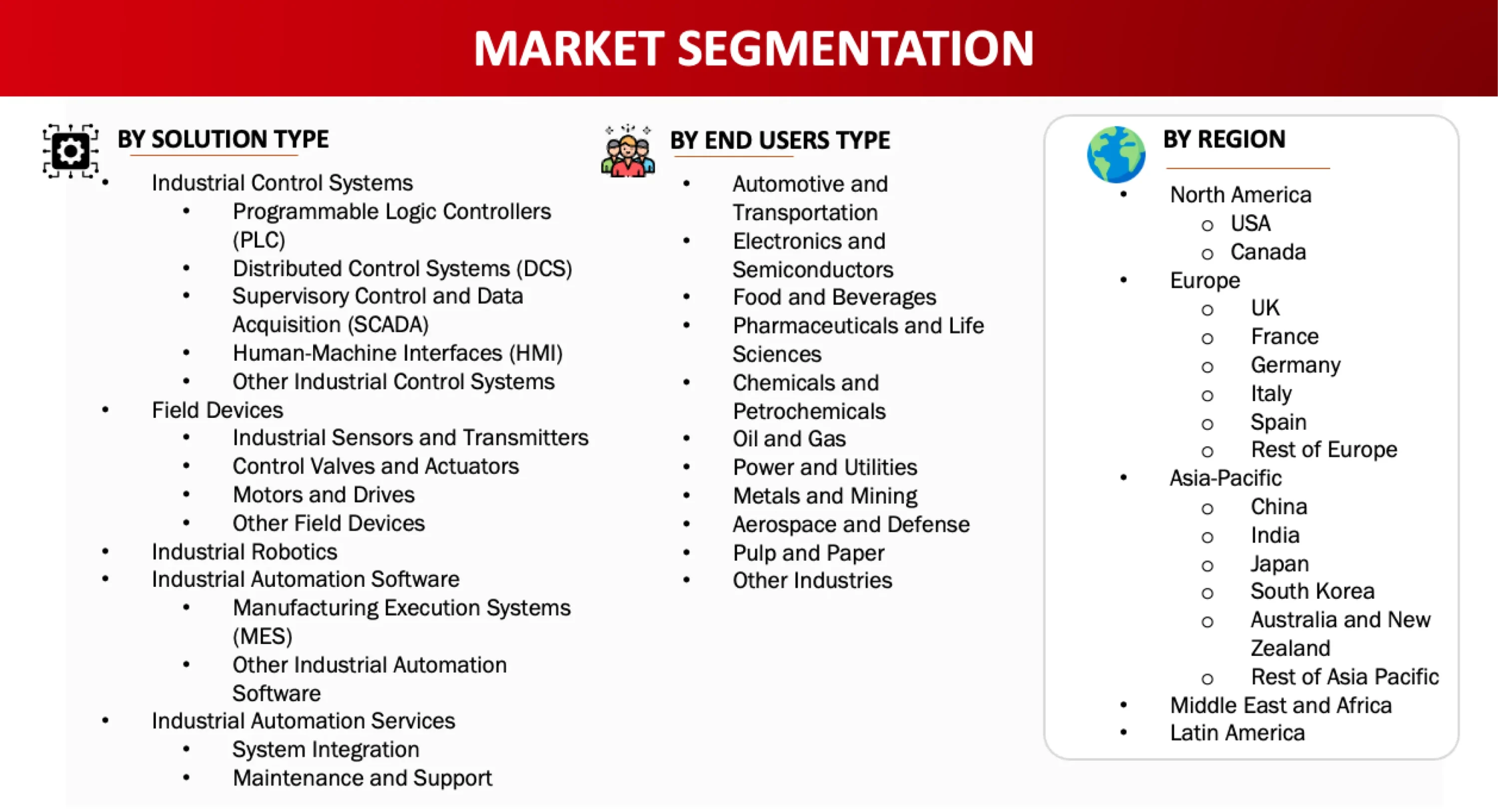
Breakdown by solution type, by end users type, by region

Regional Insights:
Key regional trends and growth opportunities

Future Outlook:
Strategic insights and future market direction
Research Methodology
The study of the global industrial automation market is based on a combination of primary and secondary research methodologies, supported by data validation, automation solution and technology mapping, control system and field device assessment, industrial robotics analysis, software and services evaluation, end-use industry demand assessment, regional adoption analysis, company revenue and product portfolio analysis, manufacturing and deployment capacity assessment, installed-base evaluation, technology integration assessment, industrial digitalization analysis, cybersecurity and interoperability assessment, competitive benchmarking, and analytical modelling to ensure accuracy and reliability.
Market Definition: Industrial Automation Market
The global industrial automation market comprises the development, supply, integration, and commercialization of hardware, software, and services used to automate industrial processes, manufacturing operations, production lines, and infrastructure systems. The market covers industrial control systems, field devices, industrial robotics, industrial automation software, and industrial automation services used to improve operational efficiency, productivity, process consistency, quality control, safety, and resource utilization.
The market includes automation solutions deployed across automotive and transportation, electronics and semiconductors, food and beverages, pharmaceuticals and life sciences, chemicals and petrochemicals, oil and gas, power and utilities, metals and mining, aerospace and defense, pulp and paper, and other industries. The study considers technologies such as programmable logic controllers (PLCs), distributed control systems (DCS), supervisory control and data acquisition (SCADA), human-machine interfaces (HMIs), industrial sensors, actuators, machine vision systems, industrial robots, manufacturing execution systems (MES), digital twins, and industrial artificial intelligence. It also evaluates system integration, brownfield modernization, manufacturing digitalization, interoperability, cybersecurity, scalability, deployment economics, installed-base expansion, and competitive positioning.
Key Stakeholders
The global industrial automation market involves a broad ecosystem of stakeholders:
- Industrial Automation System Manufacturers
- Chemicals and Petrochemicals Producers
- Electronics and Semiconductor Manufacturers
- Automotive and Transportation Manufacturers
- Industrial Cybersecurity Solution Providers
- Industrial Networking and Industrial IoT Technology Providers
- Industrial Automation System Integrators
- Industrial Automation Software Providers
- Industrial Robotics Manufacturers
- Industrial Sensor and Field Device Manufacturers
- Industrial Control System (PLC, DCS, SCADA, and HMI) Providers
Key Objectives of the Study
- To define, describe, analyze, segment, and forecast the industrial automation market by solution type, by end user industry type.
- To describe and forecast the market for five key regions: North America, Europe, Asia Pacific, Latin America, Middle East & Africa
- To provide detailed information regarding key drivers, restraints, opportunities, and challenges influencing market growth
- To strategically analyze the micro indicators with respect to individual growth trends, prospects, and contributions to the overall market size
- To analyze opportunities for stakeholders in the industrial automation industry and emphasize on competitive landscape of the market
- To develop competitive benchmarking of the key market players based on technology specifications and end user
- To strategically profile key players and comprehensively analyze their product portfolio offerings, and core competencies
- To analyze competitive developments, such as launches and approvals, agreements, mergers and acquisitions, partnerships, joint ventures, investments and expansions, and collaborations, industrial automation domain
Need deeper insights on this market?
Get full report access with detailed forecasts, competitive analysis, and segmentation.
Research Approach
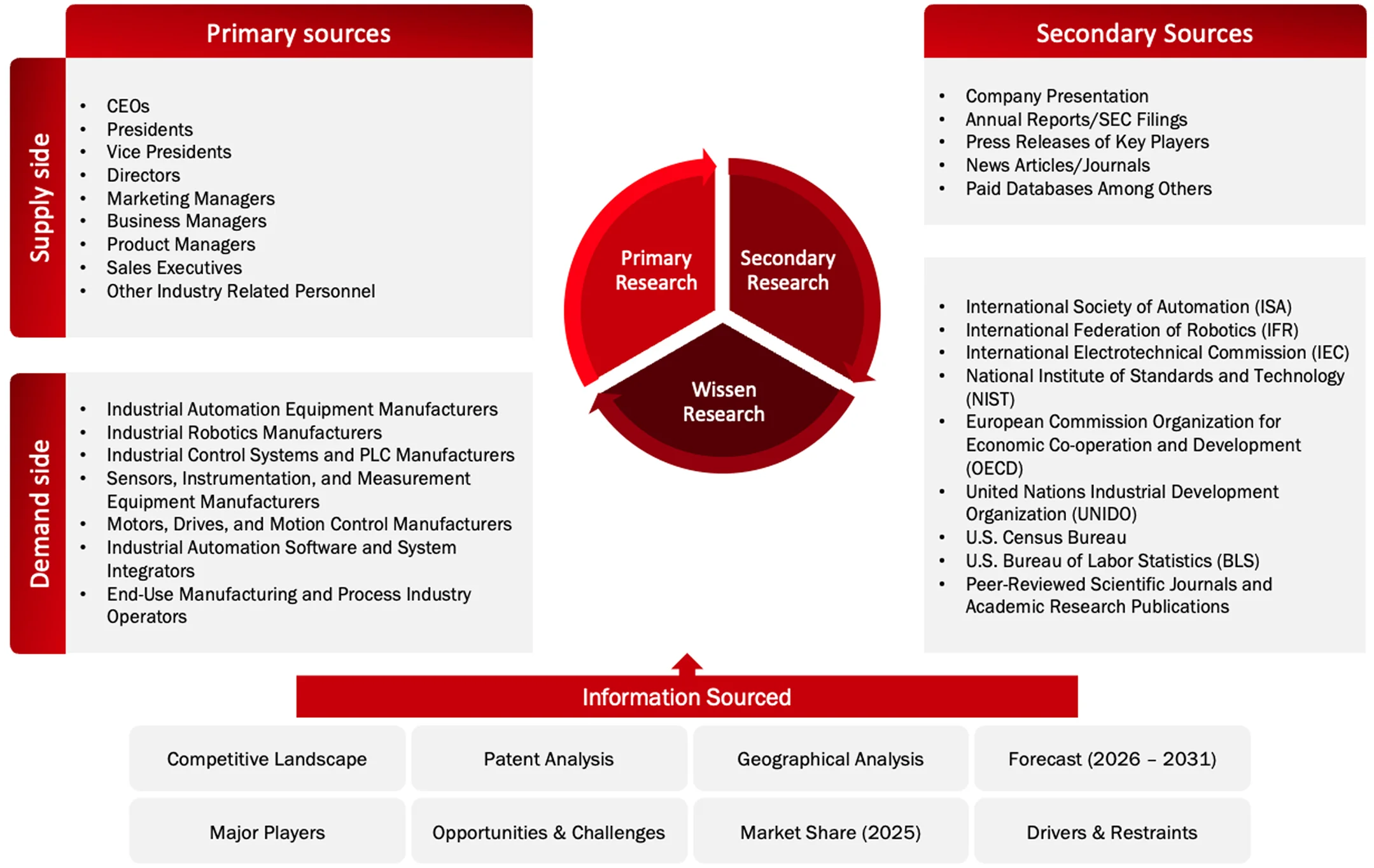
This research employs a systematic approach by using primary research along with secondary research to achieve full coverage and accuracy of information about the industrial automation sector. Through this approach, the current market trends in terms of consumer behaviour, technological developments, and competitive environment can be analysed thoroughly.
Secondary Research
Primary research is conducted to validate findings from secondary research and to gain deeper insights into market dynamics. Interviews are carried out with industry stakeholders across both demand and supply sides, including executives such as CXOs, Vice Presidents, and Directors from business development, marketing, and product teams.
Data is collected through structured questionnaires, email interactions, and telephonic interviews across key regions including North America, Europe, Asia-Pacific, and Rest of the World.
Primary Research
Primary research is conducted to validate findings from secondary research and to gain deeper insights into market dynamics. Interviews are carried out with industry stakeholders across both demand and supply sides, including executives such as CXOs, Vice Presidents, and Directors from business development, marketing, and product teams.
Data is collected through structured questionnaires, email interactions, and telephonic interviews across key regions including North America, Europe, Asia-Pacific, and Rest of the World.
Market Size Estimation
Market size estimation is performed using both top-down and bottom-up approaches. Key market players are identified, and their revenues are analysed to estimate the overall market size.
The market is further segmented based on:
- Product and service mapping across regions
- Adoption patterns across key application segments
- Insights gathered through primary and secondary research
Data Validation and Research Design
After estimating the overall market size, the data is validated using triangulation methods and market breakdown techniques to ensure accuracy and consistency. Both demand-side and supply-side factors are considered to refine the analysis.
The final data is validated through multiple sources to ensure reliability and to provide accurate insights across all market segments and regions.
Assumptions of the Study
The analysis of the industrial automation market is based on the following key assumptions:
- Trends in the industry are drawn from historical data and current information within the sector
- The future outlook is underpinned by constant economic conditions in the absence of shocks to the market
- The rate of adoption for industrial automation will rise steadily in all important regions
- The income statement and market share figures are estimated using available information from the industry and publicly available data
- The exchange rate and price trends will not be greatly affected during the forecast period
Scope and Limitations
Scope of the Study
This report offers an exhaustive overview of the international industrial automation market and includes the following components:
- Summary of market size, growth trends, and projections
- Carefully segmented market based on market by solution type, by end user industry type.
- Discussion of primary factors influencing the market
- Competitor analysis
- Insights into regional and national market performance
Limitations of the Study
Despite the best efforts being made to keep the results accurate, the study does suffer from some limitations:
- It has been done using both primary and secondary data that come with their own constraints
- Rapid developments in technology might affect the future course of market dynamics
- Some figures are only approximations due to lack of public disclosure
- The report is not an insurance against any disruptions in macroeconomics and geopolitics
- Future forecasts are indicative and subject to change due to altered industry dynamics
Data Triangulation and Market Breakdown
Data triangulation involved the combination of primary research, secondary research, and the Wissen Research analysis. Once the data points were sourced from the secondary market research, we sanitized the data points to make the market sizing and growth forecast more accurate by developing our own assumptions based on the inputs and insights we gather through the primary interviews with the industry experts. Once the data was thoroughly validated through primary interviews from both, demand and supply side of the market, our team of analyst and other team members involved finalized the market sizing and growth forecast.
Data Triangulation Methodology
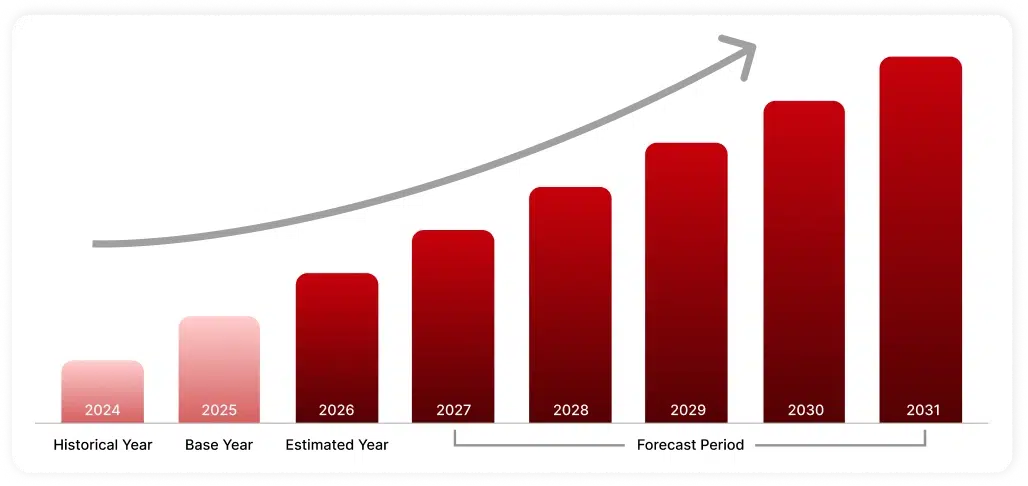
Year Framework
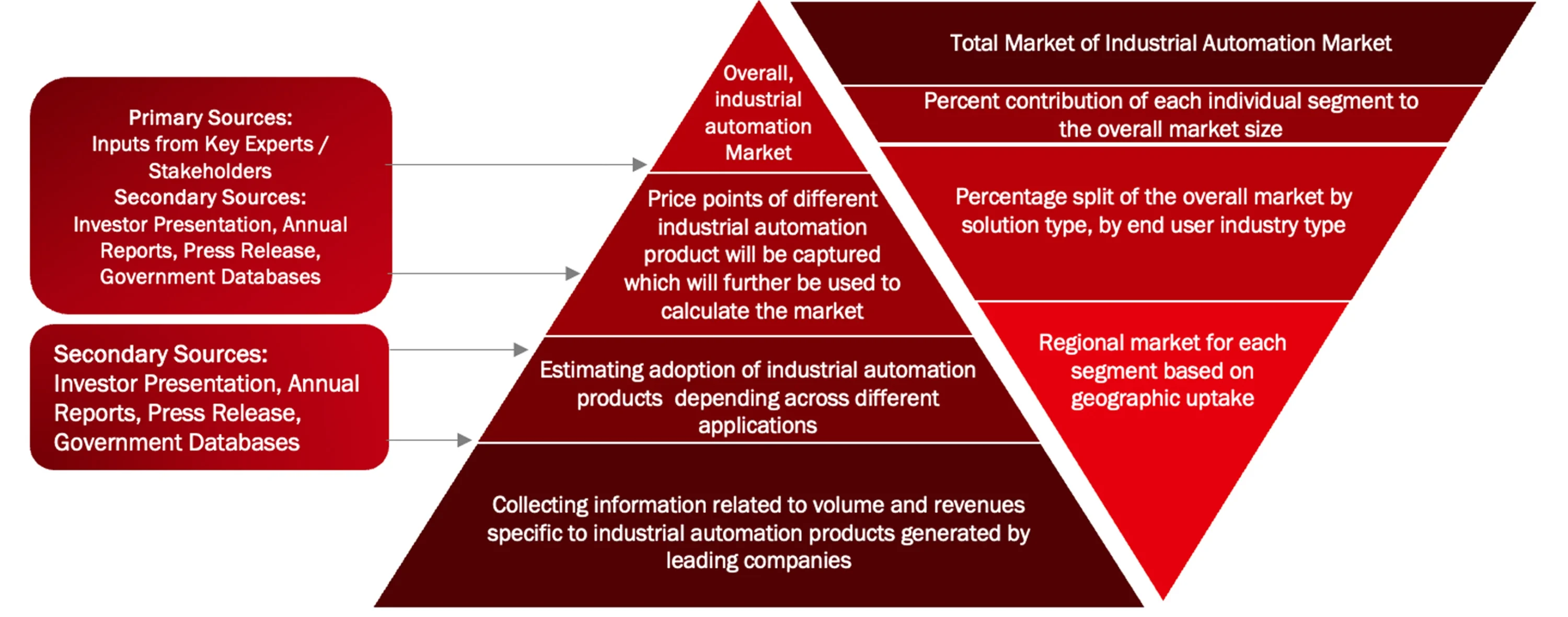
Bottom-Up Approach (Demand Side) And Top-Down Approach (Supply Side)
Bottom-Up Approach (Demand-Side Approach):
Determining the market size through the consolidation of demand among end-users, sectors, and geographic areas, which are calculated according to real-world demand conditions.
Top-Down Approach (Supply-Side Approach):
Calculating the market size through revenue and performance of the industry and its important companies, allocating the market size among various sectors.
Want detailed insights from this report?
Buy this Report
Choose the option that best fits your needs