
Lateral Flow Assays Market
Global Industry analysis, Size, Share, Growth, Trends, and Forecast 2026-2031
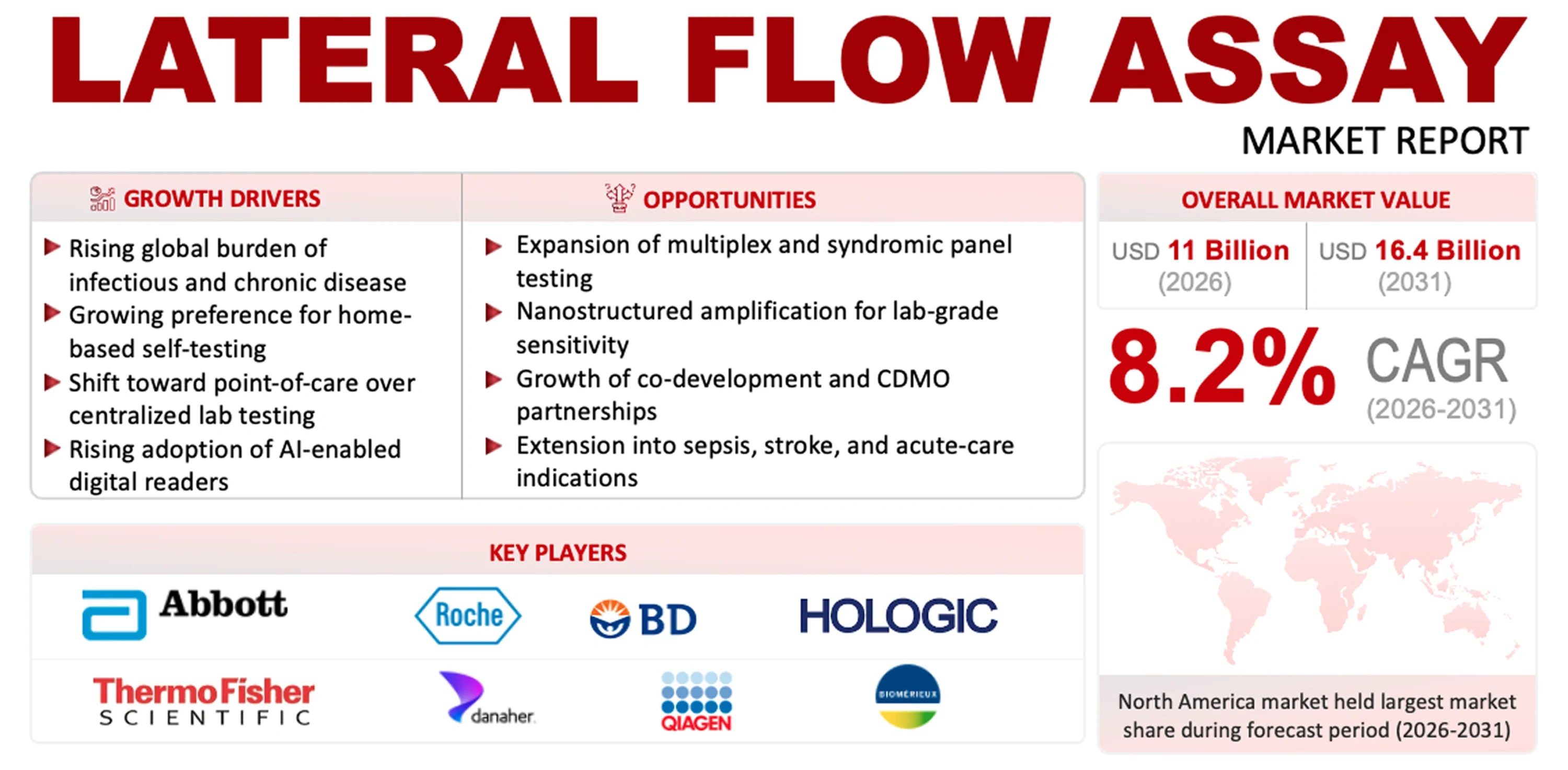
The global lateral flow assays market is projected to reach USD 16.37 billion by 2031, growing at a CAGR of 8.2% during the forecast period.
| Market Size (2026): | Forecast (2031): | CAGR (2026–2031): | Leading Region: | Fastest Growing Region: |
|---|---|---|---|---|
| $ 11.04 Billion | $ 16.37 Billion | 8.20 % | North America | Asia Pacific |
Summarize this report with:



Market Overview
Lateral flow assays are diagnostic strips which provide a quick and visual answer typically in the form of a colored line about the presence of a specific analytes in a sample (working on immunochromatographic/molecular detection principles). The sample migrates through the membrane by capillary action, interacts with labeled detection conjugates, and generates a signal when the target analyte binds to capture molecules immobilized on the test line. In conventional visual LFAs, there is no need for a laboratory, an outside power source or an expert technician, but advanced quantitative LFAs using digital readers may require powered detection systems.
The market includes physical products based on lateral flow technology, such as test strips, assay kits, reagents, ancillary consumables, and reader systems including handheld and benchtop devices used for enhanced result interpretation and quantification. It includes each environment in which these tests take place including hospitals and clinics that perform them for testing infections and heart conditions, people doing the tests themselves at home for the purposes of pregnancy and fertility testing, laboratories testing blood and urine, food testing and environmental studies to identify contaminants in products even before they hit the market, and pharmaceutical companies using these strips for quality control purposes during the manufacturing process.
Based on current market estimates, the global lateral flow assay market is projected to reach USD 11.04 billion in 2026 and is expected to grow steadily to USD 16.37 billion by 2031, expanding at a CAGR of 8.20% during the forecast period from 2026 to 2031.
Technology Overview
A lateral flow assay is an immunochromatographic diagnostic platform that typically uses a porous membrane, such as nitrocellulose, to enable sample migration through capillary action. The liquid carries labeled detection conjugates from the conjugate pad and produces a detectable signal when the target analyte interacts with recognition elements, such as antibodies, antigens, or nucleic acid probes, immobilized on the membrane. Several types of products were based on the principle, among them test strips, cassettes, dipsticks, devices for ancillary consumables, like lancets and extraction buffers, and stationary or portable devices that provide calibration of the results through the visual appearance of the line. Current research and development is focused at enhancing the sensitivity of tests to laboratory levels, increasing number of different analytes to be tested with one device, and introducing digital readout.
Key Growth Drivers
- Rising global prevalence of infectious diseases, cardiac conditions, and chronic illnesses requiring rapid, decentralized diagnostic confirmation
- Growing elderly population and increased focus on preventive healthcare, sustaining demand across hospitals, clinics, and home-care settings
- Continued high consumption of home-based diagnostic kits, a habit reinforced during the COVID-19 pandemic and now extending into pregnancy, fertility, and chronic-disease self-monitoring
- Technological advancements toward multiplex detection formats and AI-enabled digital readers are improving result interpretation, quantification, and expanding clinical applications
- Rapidly expanding healthcare infrastructure and diagnostic access in developing economies
Lateral Flow Assay Market Key Highlights
Need deeper insights on this market?
Get full report access with detailed forecasts, competitive analysis, and segmentation.
Lateral Flow Assay Market Trends
The lateral flow assay market is expanding as diagnostic companies are focusing more on multiple detection capabilities, integration of digital readers, and widening the use of home test kits beyond hospitals and clinics. The increased use of rapid tests by the patients and doctors during pandemic has also influenced the trend.
Among the main trends in the industry is the change from single-analyte qualitative strips to multiplex detection assays, which can confirm the presence of several targets in one sample, along with the increasing use of AI-enabled digital readers, which interpret visual results.
Growing Adoption of Multiplex Detection Assays
There is a growing trend among manufacturers to innovate lateral flow tests that can measure more than just presence/absence, thus allowing for the identification of several pathogens or biomarkers simultaneously. This technology overcomes the limitations of traditional lateral flow assays and is especially useful in syndromic infectious disease testing, such as the combined respiratory test for influenza, RSV, and COVID-19, and cardiac marker testing, where several biomarkers must be measured at once.
CRISPR-Enhanced Nucleic Acid LFAs
The underlying biochemistry of the lateral flow strip is evolving. The use of CRISPR/Cas enzymes (Cas12a, Cas13, etc.) and lateral flow readouts results in the generation of nucleic acid tests with RNA-specific guide-RNA-based analysis enabling low-cost nucleic acid detection with minimal laboratory infrastructure requirements. A 2025 study in Nature Communications produced a solution to the long-standing issue of false positive results in CRISPR-LFA designs while allowing the testing of multiple pathogens at once with just one strip (which remains challenging using conventional single-analyte antibody-based LFAs). Similar developments can be observed in food safety-related testing: a 2025 method has combined magnetic bead enrichment with CRISPR-based testing, making it possible to test for food pathogens simultaneously.
Integration of AI and Digital Connectivity into Reader Platforms
AI-assisted interpretation and connected digital readers are emerging technologies increasingly adopted in advanced LFA platforms. This is especially important when talking about chronic disease management, environmental testing, and food safety where digital records enhance traceability, quality control, and regulatory compliance compared with conventional visual interpretation.
Key Players in the Lateral Flow Assay Market
The major companies operating in the LFA industry are focusing on product innovation, enhancing multiplex and digital reader’s capacity, strategic alliances, and geographical expansion for gaining competitive advantage in the market.





Strategic Activities Within the Lateral Flow Assay Market
VolitionRx Limited (US) has announced that its lateral flow device designed for measuring nucleosomes at the point-of-care was found to have a close correlation (Spearman 0.85, Pearson 0.881) with the established laboratory-based Nu.Q NETs platform, thus confirming the feasibility of deploying the device for identifying impaired patients at the hospitals based on finger-prick blood samples.
BBI Solutions (UK) has formed a strategic alliance with Lateral Dx (UK) to combine Lateral Dx’s capacity for assay development with BBI’s ISO 13485-certified manufacturing capabilities and lead customers from idea to full production with reduced time to market; the companies will initiate a significant commercial initiative under this partnership.
F. Hoffmann-La Roche Ltd (Switzerland) has signed a supply and manufacturing option agreement with Sapphiros (US) granting exclusive rights to at least one billion lateral flow tests annually from Sapphiros’ UK reel-to-reel production process, alongside access to the company’s forthcoming instrument-free multiplex molecular platform for point-of-care and home testing.
Abingdon Health plc (UK) has entered into an agreement with Okos Diagnostics (Netherlands) for the co-development and commercialization of a rapid avian influenza (H5N1) lateral flow assay kit for bovine and human use.
Lateral Flow Assay Market Insights
The global lateral flow assay market is on an upward trajectory, owing to health systems adopting decentralised testing processes developed during the pandemic era and technologies are making it possible to use the method in conditions that were earlier only available in special laboratories. The market benefits from easing the rules in the US, where the emergency licensing of the technology has been replaced by normal licensing procedures and long-term contracts ensuring high-output production. The market size is expected to be equal to USD 11.04 billion in 2026 and USD 16.37 billion in 2031.
Medical diagnostics take the lead in an overall consumption, providing users with diverse diagnostic applications such as panels for respiratory and sexually transmitted infections, cardiovascular biomarkers including troponin, BNP/NT-proBNP, CK-MB, D-dimer, and myoglobin, pregnancy tests, lipid panels, drugs of abuse testing and other investigations. The largest consumers among the institutions are hospitals and laboratories; however, home settings also take plenty of market share in terms of unit volume. Additionally, veterinary diagnostics, food safety testing, and environmental and pharmaceutical testing are among the biggest branches, which have similar but different regulatory policies and documentation requirements.
The main force behind demand in the market is the reliable diagnostic results that can be achieved right at the point of contact with the patient. Therefore, there is no need to go through the slow and expensive process of transportation of samples and centralized processing. Improvements in sensitivity made possible by using nanomaterials and isothermal amplification make this new approach applicable to situations that involve more serious clinical decisions. Moreover, digital readers and algorithmic interpretation meet the documentation and tracing requirements set by legislation. Finally, implementing effective contracts for the delivery of different products prevents supply chain problems and allows businesses to continue providing their services in case of an outbreak.
Key trends are the increasing use of multiplex detection, adoption of digital/AI technology into readers, and retail-led development of self-testing methods. Yet, the sector encounters problems like sensitivity and specificity being much lower compared to laboratory methods like PCR, resistance from patients and professionals to abandon existing processes of diagnosis, and stricter regulatory scrutiny concerning test approval in the scenario of pandemic emergency authorizations.
The Asia Pacific region is anticipated to witness the fastest growth rate in the lateral flow assay (LFA) market result of increasing investment in medical infrastructures, rising demand for diagnostic tests, and an expanding government support for diagnostic facilities, both urban and rural. Growing local-international partnerships and funding for research initiatives in China, India and Japan have positioned the region as one of the emerging forces on the global demand for LFAs.
Lateral Flow Assay Market Dynamics
Drivers: Increasing Disease Burden and Shift Toward POC (Point-of-Care) Testing
The major driver of the LFA market is the increasing burden of infectious and chronic diseases globally and the aging population. Consequently, there is sustained need for point-of-care testing across many clinical and home-care environments. Hospitals and clinics have increasingly preferred to use lateral flow testing method rather than centralized lab testing method in order to avoid delays in testing. This trend has made home testing kits more popular after the COVID-19 outbreak.
Opportunities: Expansion of Multiplex Assay & AI/Digital Reader Integration
The most evident opportunity lies in transforming conventional single-plex detection formats to multiplex formats too, which attracts additional investment into design membranes and specialized conjugate pads. The increasing emergence of AI-enabled digital readers would bring about quantitatively connected-data capability, thus facilitating the penetration of this type of LFA technology into the field of chronic disease management and home monitoring of patients, which are new fields for LFA technique itself.
Challenges: Perceptions of Accuracy, Regulations, and Workflows
The industry is consistently afflicted by issues regarding accuracy, as concerns regarding sensitivity, specificity, and result interpretation can limit adoption of certain LFA formats for high-risk clinical decisions. The regulations surrounding infectious disease testing are not clear at the moment, leading to complications with regulatory department requirements after the pandemic. Furthermore, traditional diagnostic procedures are proving more successful than LFA-based formats in the industry, resulting in the reluctance of hospitals to change their procedures.
Product Innovation and Market Insights
The lateral flow assay industry exists at the nexus of materials science and diagnostics, with innovations lying in the area of membrane/conjugate pad design for multiplexing, signal amplification technology to bridge the sensitivity gap between laboratory tests, and reader technology with its hardware and software components to provide quantitative and data-enabled functionality to the standard qualitative strip. The trend is growing towards collaborations and manufacturing partnerships by bringing together assay design experts with ISO-certified manufacturers to bring down time-to-market, a concept that has become widespread due to competition from midsize firms with R&D capacities similar to Abbott, Roche, and Thermo Fisher Scientific without their own manufacturing capacity.
Technology Scope and Products
Lateral Flow Assay Market Segmentation
Want detailed insights from this report?
Industry Developments and Competitive Landscape
The rivalry in the lateral flow assay industry is mainly determined by three main capabilities: the limit of detection, multiplexing capability, and ability to provide digital results. Start-ups are competing with major diagnostic corporations that rely on established processes and production capacity, while new players attempt to solve the problems related to increasing sensitivity using innovative technologies such as nanotechnology. Contract development and manufacturing collaborations have emerged as a logical means of reaching the market for companies that do not manufacture their own products.
Kits and reagents generated a dominant share of revenues as these are recurring consumable products in any use scenario and do not involve any capital investment at the user end. The segment is made up of test strips, cassettes, dipsticks, and supporting products such as lancets, buffers, and collection devices. Scale economies are pronounced: reel-to-reel process is able to deliver production volumes of billions of units per year, which is evident in Sapphiros’ five billion units’ capability in the UK reflecting its supply contracts with Roche.
It has been noted that multiplex techniques have been gaining a lot more traction than single-analyte techniques largely owing to the clinical requirement for syndromic differentiation using one sample and one step. The layer of certainty in terms of commercial aspect is shown in Roche’s agreement with Sapphiros where the access to an upcoming instrument-free multiplex technology is established, which aims to achieve laboratory-comparable analytical performance.
In 2025, North America had the largest market share by revenue owing to the advanced healthcare facilities and the high volume of diagnostic tests along with a strong delivery of self-diagnostic kits through the retail pharmacy network. Companies such as ACON, Thermo Fisher Scientific Inc. contribute to the region’s strong LFA ecosystem through advanced diagnostic kit and reader platforms.
What This Report Covers-
This report provides a comprehensive analysis of the lateral flow assay market, offering insights into key trends, growth drivers, challenges, and future opportunities. It is designed to support strategic decision-making through a combination of quantitative data and qualitative analysis.
Specifically, the report covers:

Market Overview & Definition:
Overview of the market scope, structure, and key terminology

Market Size & Forecast:
Historical data and future projections across key segments and regions

Key Market Trends:
Insights into emerging trends, technological advancements, and evolving demand patterns

Drivers, Restraints & Opportunities:
Analysis of key factors influencing lateral flow assay market growth

Competitive Landscape:
Overview of major players, their strategies, and recent developments

Detailed Patent Analysis:
which includes, top assignees, geography focus of top assignees, legal status, technology evolution, key patents and patent trends and innovations

Segmentation Analysis:
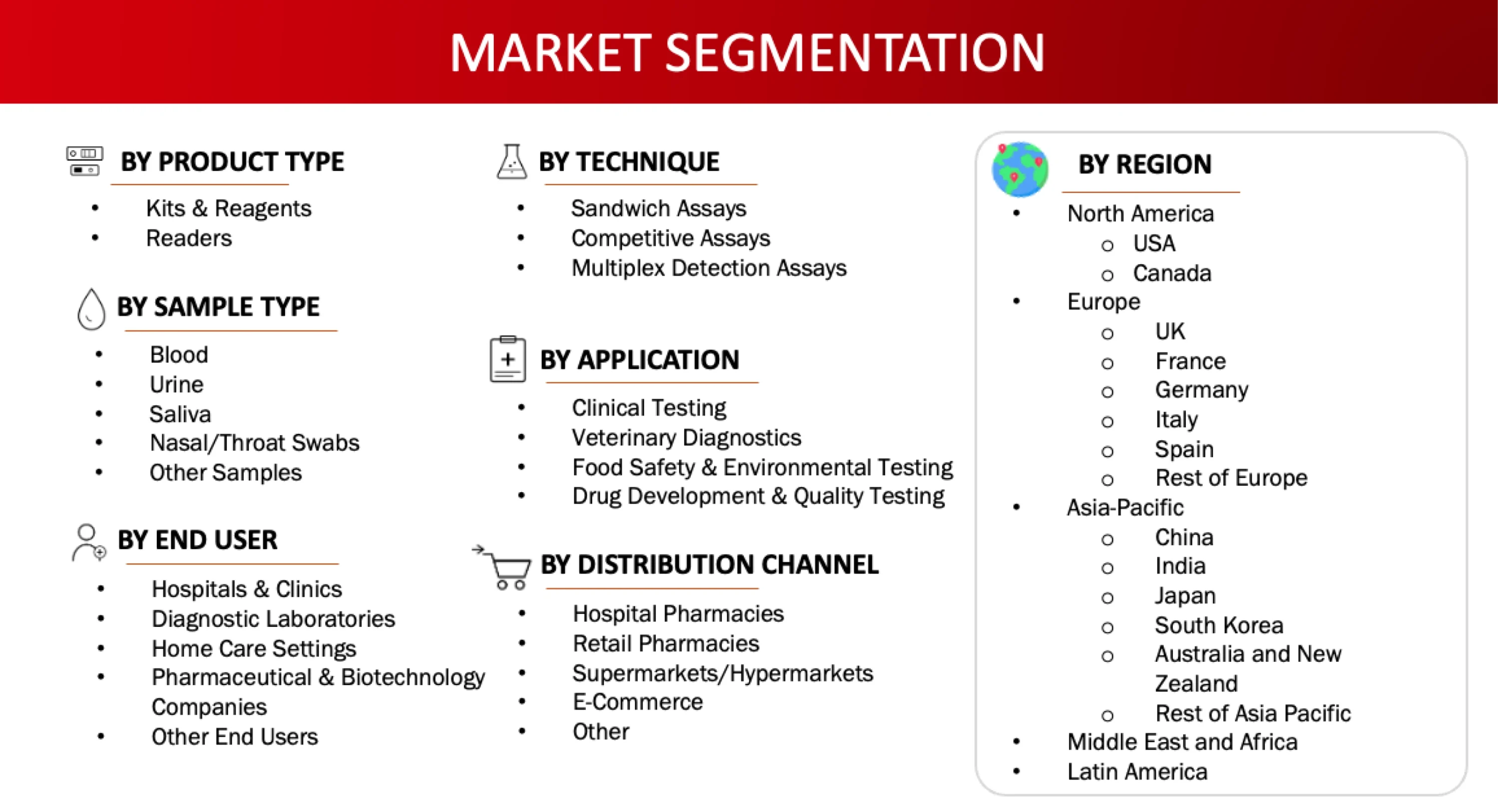
Breakdown by product, technique, application, sample type, end user, distribution channel, and region

Regional Insights:
Key regional trends and growth opportunities

Future Outlook:
Strategic insights and future market direction
Research Methodology
The analysis of the lateral flow assay market is based on a combination of primary and secondary research approaches, complemented by data validation and analytical assessment to ensure the accuracy, consistency, and reliability of market findings.
Market Definition: Lateral Flow Assay Market
The lateral flow assay market refers to the development, production, and supply of immunochromatographic diagnostic products used to detect target analytes in biological, food, and environmental samples for the detection, diagnosis, screening, and monitoring of diseases and health conditions. Lateral flow assay solutions include kits and reagents such as test strips, cassettes, dipsticks, and ancillary consumables, along with benchtop and digital/handheld readers used to interpret and quantify test results.
Modern lateral flow assay technologies incorporate advanced label chemistries, signal amplification, multiplexing, quantitative readout, and digital connectivity capabilities to improve testing sensitivity, specificity, accuracy, speed, and result traceability. Key technique categories include sandwich assays, competitive assays, and multiplex detection assays. Lateral flow assay solutions are used across hospitals and clinics, diagnostic laboratories, home care settings, pharmaceutical and biotechnology companies, and other end-user settings for applications including clinical testing, veterinary diagnostics, food safety and environmental testing, and drug development and quality testing.
Key Stakeholders
The lateral flow assay market involves a diverse ecosystem of stakeholders:
- Lateral Flow Assay Technology Developers
- Lateral Flow Test Kit and Reagent Manufacturers
- Lateral Flow Reader and Instrument Manufacturers
- In Vitro Diagnostics and Point-of-Care Testing Companies
- Antibody, Conjugate, and Nitrocellulose Membrane Suppliers
- Contract Development and Manufacturing Organizations (CDMOs)
- Pharmaceutical and Biotechnology Companies
- Hospitals and Healthcare Providers
- Diagnostic Laboratories
- Retail Pharmacies, Distributors, and E-Commerce Platforms
- Academic and Research Institutions
- Clinical Research Organizations
- Regulatory and Government Organizations
- Investors and Industry Associations
Key Objectives of the Study
- To define, describe, analyze, segment, and forecast the lateral flow assay market by product, technique, application, sample type, end user, and distribution channel
- To describe and forecast the market for four key regions: North America, Europe, Asia Pacific, and Rest of the World
- To provide detailed information regarding key drivers, restraints, opportunities, and challenges influencing market growth
- To analyze opportunities for stakeholders in the lateral flow assay industry and emphasize the competitive landscape of the market
- To develop competitive benchmarking of key market players based on technology specifications, product offerings, and end-user applications
- To strategically profile key players and comprehensively analyze their product portfolio offerings, technological capabilities, and core competencies
Need deeper insights on this market?
Get full report access with detailed forecasts, competitive analysis, and segmentation.
Research Approach
This research employs a systematic approach by using primary research along with secondary research to achieve full coverage and accuracy of information about the lateral flow assay sector. Through this approach, the current market trends in terms of consumer behavior, technological developments, and competitive environment can be analyzed thoroughly.
Secondary Research
Secondary research involves the collection of data from reliable sources such as industry databases, company annual reports, investor presentations, and regulatory filings. This process helps in understanding market trends, identifying key players, and gathering technical and commercial insights.
A comprehensive database of leading companies and market participants is developed through secondary research to support further analysis.
Primary Research
Primary research is conducted to validate findings from secondary research and to gain deeper insights into market dynamics. Interviews are carried out with industry stakeholders across both demand and supply sides, including executives such as CXOs, Vice Presidents, and Directors from business development, marketing, and product teams.
Data is collected through structured questionnaires, email interactions, and telephonic interviews across key regions including North America, Europe, Asia-Pacific, and Rest of the World.
Market Size Estimation
Market size estimation is performed using both top-down and bottom-up approaches. Key market players are identified, and their revenues are analyzed to estimate the overall market size.
The market is further segmented based on:
- Product and service mapping across regions
- Adoption patterns across key application segments
- Insights gathered through primary and secondary research
Data Validation and Research Design
After estimating the overall market size, the data is validated using triangulation methods and market breakdown techniques to ensure accuracy and consistency. Both demand-side and supply-side factors are considered to refine the analysis.
The final data is validated through multiple sources to ensure reliability and to provide accurate insights across all market segments and regions.
Assumptions of the Study
The analysis of the lateral flow assay market is based on the following key assumptions:
- Trends in the industry are drawn from historical data and current information within the lateral flow assay sector
- The future outlook is underpinned by constant economic conditions in the absence of major shocks to the market
- The adoption rate of lateral flow assay technologies will rise steadily across all important regions
- Advancements in signal amplification, multiplex detection, digital and AI-enabled readers, sample collection formats, and point-of-care and home testing will continue to drive growth in the lateral flow assay market
- Market size and market share figures are estimated using available information from the industry and publicly available data
- The regulatory environment, healthcare expenditure, diagnostic testing volumes, reimbursement conditions, and pricing trends for lateral flow assay products and technologies will not be significantly disrupted during the forecast period
Scope and Limitations
Scope of the Study
This report offers an exhaustive overview of the international lateral flow assay market and includes the following components:
- Summary of market size, growth trends, and projections
- Carefully segmented market based on product, technique, application, sample type, end user, distribution channel, and geography
- Discussion of primary factors influencing the market
- Competitor analysis
- Insights into regional and national market performance
Limitations of the Study
Despite the best efforts being made to keep the results accurate, the study does suffer from some limitations:
- It has been done using both primary and secondary data that come with their own constraints
- Rapid developments in technology might affect the future course of market dynamics
- Some figures are only approximations due to lack of public disclosure
- The report is not an insurance against any disruptions in macroeconomics and geopolitics
- Future forecasts are indicative and subject to change due to altered industry dynamics
Data Triangulation and Market Breakdown
Data triangulation involved the combination of primary research, secondary research, and the Wissen Research analysis. Once the data points were sourced from the secondary market research, we sanitized the data points to make the market sizing and growth forecast more accurate by developing our own assumptions based on the inputs and insights we gather through the primary interviews with the industry experts. Once the data was thoroughly validated through primary interviews from both, demand and supply side of the market, our team of analyst and other team members involved finalized the market sizing and growth forecast.
Data Triangulation Methodology
Sources: U.S. Food and Drug Administration, European Medicines Agency, National Institute of Standards and Technology, International Organization for Standardization, International Electrotechnical Commission, Federal Communications Commission, Occupational Safety and Health Administration, American National Standards Institute, Device Coordination Group, Company Website, Press Releases, Annual Reports, Paid Data Sources, and Wissen Research Analysis.
Year Framework
Bottom-Up Approach (Demand Side) And Top-Down Approach (Supply Side)
Bottom-Up Approach (Demand-Side Approach):
Determining the market size through the consolidation of demand among end-users, sectors, and geographic areas, which are calculated according to real-world demand conditions.
Top-Down Approach (Supply-Side Approach):
Calculating the market size through revenue and performance of the industry and its important companies, allocating the market size among various sectors.
Want detailed insights from this report?
Buy this Report
Choose the option that best fits your needs