
Alginate Fermentation FTO Search: Engineered Pseudomonas

Could Patent Mapping Reveal Whether a Proprietary Slime-Producing Microbe Was Free to Commercialize?

A comprehensive FTO search confirmed freedom to operate for proprietary alginate fermentation using genetically modified Pseudomonas fluorescens strains.

Case Study Type Freedom-to-Operate (FTO) Search
Industry Biotechnology
Publication Date August 24, 2026
Alginate Image

The Client’s Challenge

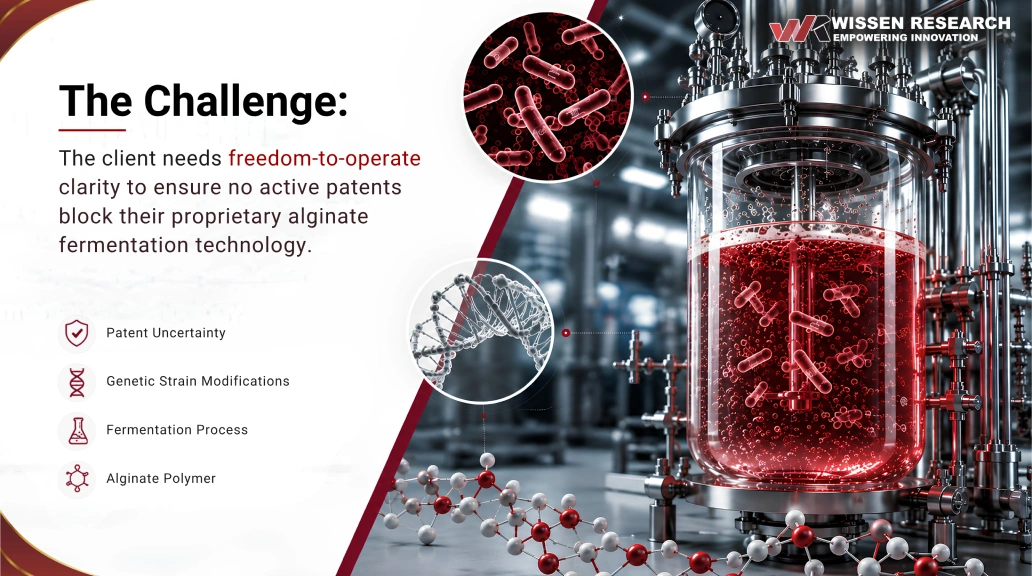
The client was developing a proprietary fermentation platform based on genetically modified strains of Pseudomonas fluorescens capable of producing alginate. Since the core fermentation program was maintained as a trade secret, understanding the surrounding patent environment became essential before moving toward commercialization.

Alginate is a naturally occurring polysaccharide widely used due to its viscosity, gel-forming properties and biocompatibility. Its applications include food stabilizers and thickening agents, pharmaceutical formulations, biomedical materials and drug delivery systems.

The challenge was determining whether active third-party patent rights could restrict the client’s ability to manufacture alginate using engineered microbial strains. Earlier patent protections in the field had expired but related developments involving microbial engineering, alginate biosynthesis pathways and strain optimization required careful assessment.
Patent in Alginate Fermentation Image

The investigation focused on claim elements associated with:

    • Mutant or engineered Pseudomonas fluorescens strains.
    • Genetic modifications influencing alginate synthesis.
    • Regulation of alginate polymer composition.
    • Mannuronate and guluronate residue characteristics.
    • Fermentation methods enabling microbial alginate production.
Objective icon
CLIENT’S OBJECTIVE

Determine whether any active third-party patent rights could restrict the client’s planned commercialization of alginate produced through genetically modified Pseudomonas fluorescens fermentation.

Identifying live patent claims covering the relevant microbial strains, genetic modifications, alginate biosynthesis mechanisms, fermentation processes and resulting polymer characteristics.

Clients come to us for answers.
They leave with opportunities they didn’t know existed.

Our experts help organizations uncover insights, opportunities and strategic directions that traditional approaches often miss.

Wissen’s Out-of-the-Box Approach:

From Broad Patent Searching to Claim-Level FTO Analysis

  • Recognizing that a conventional keyword-driven patent search could identify numerous references relating to alginate and Pseudomonas fermentation, the investigation evolved toward a more focused freedom-to-operate assessment.
  • To determine whether the client’s proprietary fermentation platform faced any active third-party patent restrictions, the investigation focused particularly on patents covering:
  • Genetic regulation of alginate biosynthesis and epimerization
  • Fermentation-based alginate production
  • Mannuronate and guluronate residue characteristics

Identifying Relevant Patent Rights

  • A focused global patent investigation was conducted across major patent databases to identify patent families potentially relevant to microbial alginate production.

  • Search strategies combined technical keywords, genetic variants, synonyms, IPC/CPC classifications, citation analysis and similar-document searches to capture both direct and indirectly relevant disclosures.

  • Particular attention was given to active patent rights, since expired patents could provide technical background but would not represent current FTO barriers.

  • To overcome the limitation of broad technical similarity, the investigation progressed to detailed claim-level analysis and legal-status assessment.

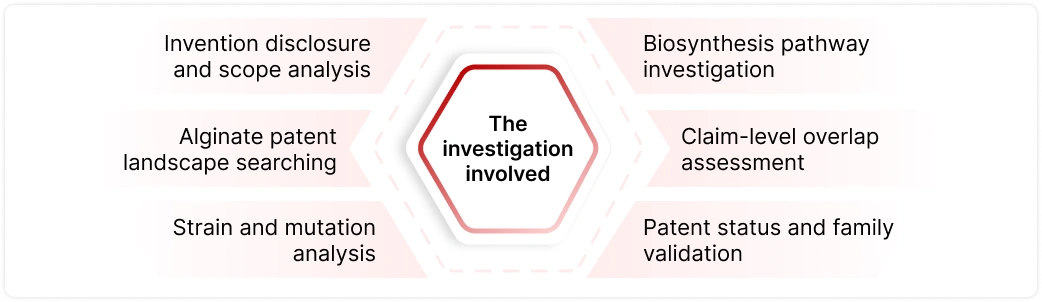
Our Methodology

Invention Disclosure Analysis
Broad Patent Landscape Search
Genetic Variant & Pathway Analysis
Classification & Claim Screening
Citation & Similarity Expansion
Legal Status Validation
FTO Claim Mapping
Invention Disclosure Analysis
  • Analyze proprietary fermentation technology
  • Extract critical technical features
  • Define FTO search scope
  • Identify strain-specific characteristics
Broad Patent Landscape Search
  • Search alginate-related patent disclosures
  • Search Pseudomonas variants
  • Expand technical synonyms
  • Apply global patent databases
Genetic Variant & Pathway Analysis
  • Analyze Pseudomonas fluorescens variants
  • Investigate relevant genetic mutations
  • Examine alginate biosynthesis pathways
  • Assess epimerization mechanisms
Classification & Claim Screening
  • Apply relevant IPC/CPC classifications
  • Filter technically relevant patents
  • Review independent patent claims
  • Assess claim-level technical overlap
Citation & Similarity Expansion
  • Analyze backward patent citations
  • Analyze forward patent citations
  • Identify related patent families
  • Conduct similar-document searches
Legal Status Validation
  • Verify active patent rights
  • Exclude expired patent rights
  • Review jurisdiction-specific status
  • Validate relevant patent families
FTO Claim Mapping
  • Map technology against active claims
  • Compare strain and process features
  • Assess potential infringement overlap
  • Establish commercialization freedom
OUTCOME:

Claim-level FTO analysis of alginate fermentation patents confirmed freedom to operate for the client’s proprietary Pseudomonas fluorescens production platform within the investigated scope.

FTO Investigation Methodology

The patent references corresponding to alginate fermentation technologies were identified through global patent databases and evaluated for their relevance to the client’s commercialization plans.

Alginate methodolgy image

The investigation revealed several technically relevant patents covering Pseudomonas strains, alginate biosynthesis, genetic modifications, and fermentation-based production.

Most importantly, the findings demonstrated that the identified active patent claims did not create an actionable overlap with the client’s proprietary fermentation platform, supporting freedom to operate within the investigated scope.

Technical Challenges Addressed Through FTO Analysis

Challenge 1: Identifying Active Patent Risks Around Engineered Pseudomonas fluorescens

Determine whether active patents covered mutant or genetically modified Pseudomonas fluorescens strains used for microbial alginate production.

Solution

The investigation combined strain-specific searches with claim-level analysis to identify potentially relevant patent rights. Genetic variants, mutations, and Pseudomonas-based alginate production disclosures were examined to distinguish broad technical similarity from enforceable claim overlap.

The analysis revealed:
  • Pseudomonas fluorescens strain disclosures
  • Mutant strain production methods
  • Genetic modification approaches
  • Alginate biosynthesis-related claims

The identified references were further evaluated based on their current legal status and relevance to the client’s production platform.

Challenge 2: Assessing Patent Overlap in Alginate Biosynthesis and Polymer Characteristics

Determine whether patents covering genetic regulation of alginate synthesis or specific mannuronate/guluronate characteristics could restrict the client’s fermentation process.

Solution

The investigation examined patents addressing alginate biosynthetic pathways, including genetic modifications affecting epimerization and polymer composition. Claim elements were compared against the client’s relevant technical features to assess potential FTO overlap.

The analysis revealed:
  • Alginate pathway modification disclosures
  • Epimerization-related genetic mechanisms
  • Polymer composition characteristics
  • Strain-specific production features

These findings enabled the investigation to separate expired or technically related disclosures from active patent claims presenting potential commercialization risk.

Results & Business Impact

The FTO investigation provided the client with clarity regarding the patent environment surrounding microbial alginate production.

Key Outcomes

  • Key outcome Icon

    Identified relevant patent families associated with alginate fermentation technologies.

  • Key outcome Icon

    Evaluated active patent rights relevant to engineered Pseudomonas production systems.

  • Key outcome Icon

    Distinguished expired foundational patents from enforceable third-party rights.

  • Key outcome Icon

    Assessed genetic modification and polymer characteristic-related claims.

  • Key outcome Icon

    Confirmed freedom to operate within the investigated technology scope.

Strategic Business Impact

The investigation enabled the client to make commercialization decisions with improved IP confidence. Key strategic benefits included:

  • Reduced uncertainty before market entry.
  • Better understanding of competitor patent positions.
  • Improved trade secret protection strategy.
  • Early identification of potential patent risks.
  • Greater confidence in advancing proprietary fermentation development.

Need Clarity Before Commercializing Biotechnology Innovations?

Our team supports biotechnology companies with FTO analysis, patent landscapes and claim-level investigations for complex biological technologies.