
Wearable Technology Market
Global Industry analysis, Size, Share, Growth, Trends, and Forecast 2026-2031
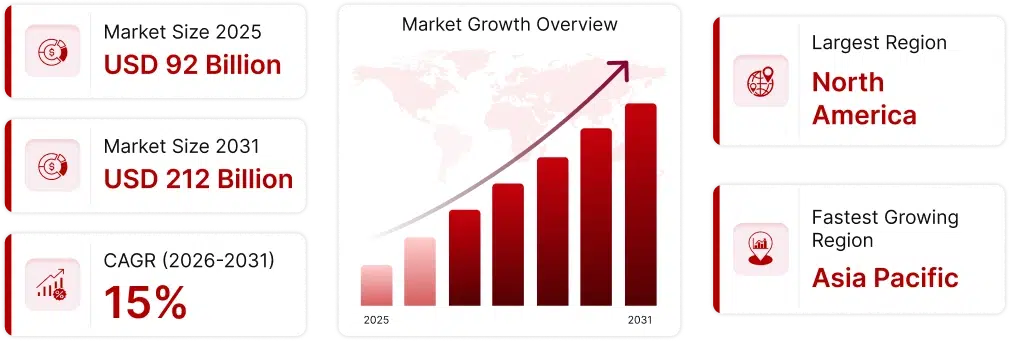
The global wearable technology market is projected to reach USD 212 billion by 2031, growing at a CAGR of 15% during the forecast period.
| Market Size 2026 | Market Size 2031 | CAGR (2026-2031) | Largest Region | Fastest Growing Region |
|---|---|---|---|---|
| USD 105.5 Billion | USD 212 Billion | 15% | North America | Asia Pacific |
Summarize this report with:



Market Overview
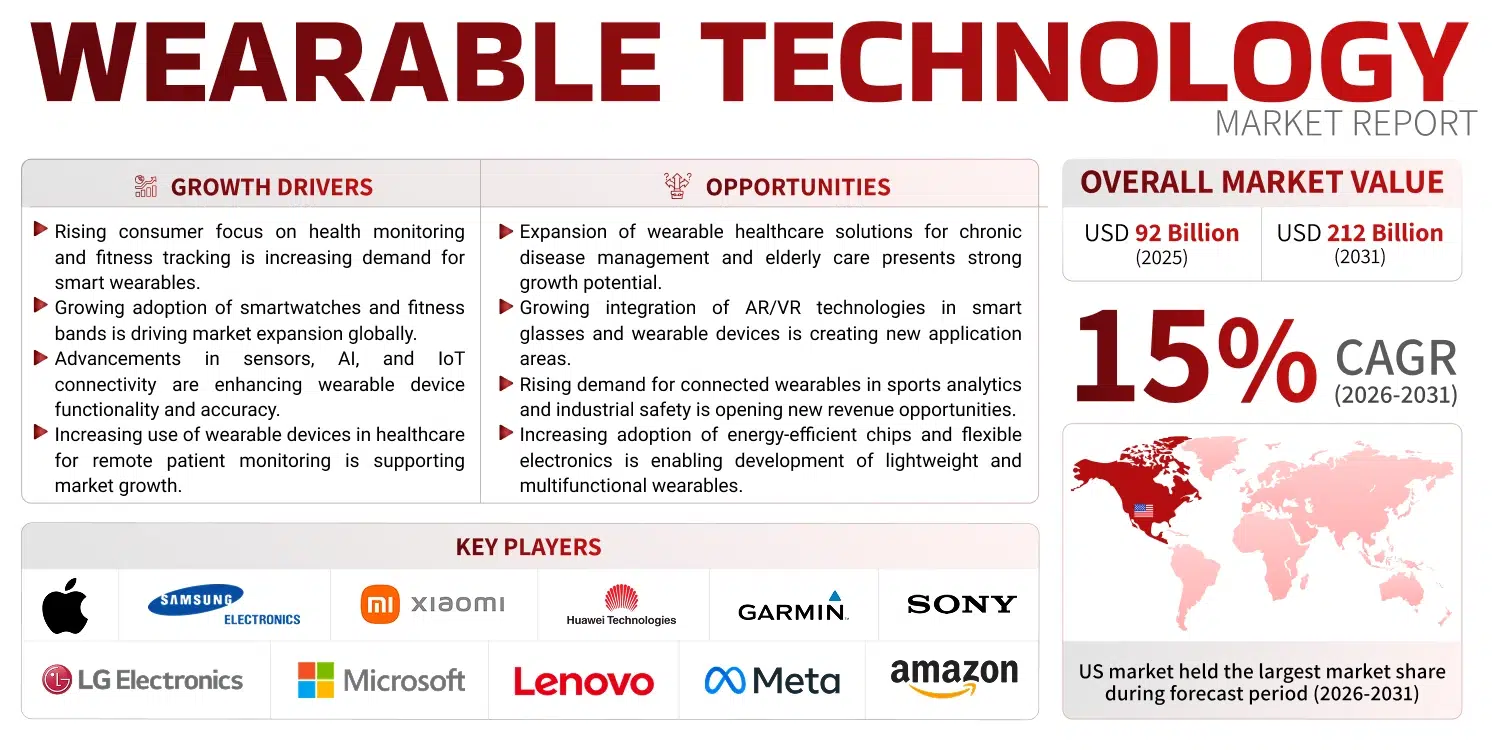
The global wearable technology market is witnessing rapid growth, driven by increasing consumer demand for health and fitness monitoring, rapid advancements in sensor and connectivity technologies, growing integration with healthcare systems, and expanding applications across wellness, medical, and enterprise sectors. The market was valued at USD 105.5 billion in 2026 and is projected to reach USD 212 billion by 2031, growing at a CAGR of 15% during the forecast period (2026-2031).
Technology Overview
Due to developments in micro sensors and low power electronics, wearable devices are capable of providing accurate and comfortable continuous monitoring of an individuals health status and physical activities. As consumers look forward to preventive healthcare and personalized services, wearable devices are advancing from basic fitness devices to become comprehensive health management systems that can be used for applications like telemedicine, disease diagnostics, and health optimization.
Key Growth Drivers
- The growing interest in preventative medicine and fitness drives the need for health and fitness tracking.
- The development in sensor technology, miniaturization, and batteries enhances the efficiency and comfort of the gadgets.
- The use of artificial intelligence and data analytics enables real-time data analysis and predictive health monitoring.
- The expansion of the 5G network and IoT ecosystem facilitates seamless connectivity and data exchange.
- The increased adoption of remote patient monitoring accelerates their use in healthcare applications.
- The rise in disposable income and changing lifestyles increase the demand for smart wearables.
Wearable Technology Market Key Highlights
Need deeper insights on this market?
Get full report access with detailed forecasts, competitive analysis, and segmentation.
Wearable Technology Market Trends
The consumer electronics industry, the healthcare sector, and tech companies are making greater investments into wearable devices based on the increasing interest in Smart rings, AI-powered wearables, mental health tracking, enterprise/industrial wearables, wearables + telehealth integration, continuous health tracking and connectivity. Some of the major companies in this regard include Apple Inc., Samsung Electronics, Garmin and Fitbit Inc., which have increased their offerings in wearables with the help of their advanced smartwatches, smart rings, fitness trackers, and other health devices featuring biosensors and artificial intelligence systems. The emphasis is being placed by companies on real-time health tracking and an improved user experience, as well as the development of certain functionalities such as remote patient monitoring and sleep monitoring.
Wearable Technology Industry Trends- AI-Powered Wearables
The use of wearable devices equipped with AI technology can be considered yet another prevailing trend making its way in the wearable technology industry with regard to the types of products being used. This is due to the gradual introduction of technologies based on artificial intelligence in order to provide custom predictive analytics. Although at one point in time, the primary role of these devices was merely information tracking, now, AI-supported wearables try to examine people’s behavior and environment in order to give out suggestions or even warnings about the users’ health condition. The increasing interest toward solutions for health and lifestyle analysis has contributed towards the adoption of these wearables. Among others, companies such as Apple Inc., Google LLC, and Samsung Electronics have started incorporating smart capabilities into their wearable product lines.
Asia Pacific Wearable Technology Market Trends Insights
The Asia-pacific wearable technology market is expected to grow at a higher CAGR during the forecast period 2026-2031. The higher growth of Asia-pacific region can be attributed to large size consumer base, increasing disposable income and rising digital transformation. Majority of the growth in this region is expected to come from countries like, China, Japan, South Korea, India, and other Asia-pacific countries owing to higher adoption of smart watches, fitness bands, and increasing awareness regarding personal health and wellness. Furthermore, key electronic companies such as Xiaomi Corporation and Huawei Technologies having their operations in the region is also supporting the market growth.
Key Players in Wearable Technology Market
Leading companies in the wearable technology market are focusing on innovation, strategic partnerships, and expansion of health-centric features to strengthen their market position.












These players are actively investing in advanced sensor technologies, AI-driven health analytics, and energy-efficient designs to meet the growing demand for continuous health monitoring and connected lifestyle applications.
Strategic Activities within Wearable Technology Market
Samsung Electronics announced a partnership with Verily Life Sciences to integrate Verily’s precision health platform, Pre, with the Samsung Galaxy Watch 8. This collaboration aims to monitor real-world populations and generate evidence to support research for life sciences organizations and government bodies. Pre is an AI-enabled platform designed to process both structured and unstructured multimodal data, enabling AI deployment, workflow orchestration, and advanced analytics.
California Institute of Technology (US) and Meta Platforms, Inc. (Meta) (US) entered into a partnership aimed at advancing the science of smart wearables. This collaboration combines Caltech’s expertise in materials science, sensing technologies, and machine learning with Meta’s research in human–technology interaction, with the goal of driving innovation in next-generation wearable devices.
Qualcomm (US) and Xiaomi (China) extend their collaboration with a multi-year agreement to lead innovation with premium wearables, smartphones, AR/VR glasses, tablets etc.
Wearable Technology Market Insights
The market for wearable healthcare devices is witnessing an era of accelerated growth fueled by an increased interest of consumers in their health and wellbeing and monitoring of vital signs in real time. With healthcare delivery systems evolving to become more proactive and mobile-oriented, the traditional approach to episodic monitoring is proving to be ineffective in addressing health issues.
In order to facilitate timely insights and interventions, wearable devices are poised to play a significant role by providing users with the possibility to track their condition continuously, detect risks at the initial stages, and maintain seamless interactions with various digital platforms.
Continuous health monitoring and connectivity continue to play an essential role in fueling the growth of wearable devices due to increased demand for the same. The rapid rise in the use of health-focused smartwatches and fitness trackers that come with functionalities such as heart-rate tracking, electrocardiogram, SpO2 measurement, and sleep tracking contributes to this development.
Advanced biosensors, AI-based analytical techniques, and smartphone integration help boost the abilities of wearables through real-time data processing and personalized advice. This becomes increasingly important for remote patient monitoring and treatment of chronic diseases in which reliable data collection results in better treatment outcomes.
There are rapid developments going on in the wearables sector due to the increase in the importance of continuous monitoring of personal health, fitness, and connectivity. The realization of preventive care in healthcare has brought about the need for health monitoring to be done continuously.
Through wearable devices, there is a continuous collection of vital signs with increasing accuracy and power consumption efficiency. Wearable devices are used for remote patient monitoring and wellness management. Key players like Apple Inc., Samsung Electronics, and Garmin Ltd. are among those that are rigorously researching biosensors, AI-powered analytics, and connectivity systems within the ecosystem.
There is a considerable evolution in the wearables industry as there is now a strong focus on new generation of biosensors, analytics, and connectivity to digital health platforms. The use of wearable products such as watches and wristbands that can measure features such as ECG, blood oxygen levels, and sleep status shows that users prefer real-time health statistics.
However, challenges such as data privacy, low battery, and clinical accuracy, among others, may hinder the development of the industry.
The Asia-pacific wearable technology market is expected to grow at a higher CAGR during the forecast period 2026-2031. The higher growth of Asia-pacific region can be attributed to large size consumer base, increasing disposable income and rising digital transformation. Majority of the growth in this region is expected to come from countries like, China, Japan, South Korea, India, and other Asia-pacific countries owing to higher adoption of smart watches, fitness bands, and increasing awareness regarding personal health and wellness. Furthermore, key electronic companies such as Xiaomi Corporation and Huawei Technologies having their operations in the region is also supporting the market growth.
Wearable Technology Market Dynamics
Drivers: Advances in semiconductor technology and sensor miniaturization are allowing the creation of increasingly sophisticated, powerful, energy-efficient wearable devices
Recent advances in semiconductor technology, such as the development of Gate-All-Around (GAA) transistors and novel semiconductor chip packaging techniques, are providing manufacturers with the ability to produce smaller, more powerful semiconductors that are also more energy efficient, which automatically benefits wearable devices. Sensor miniaturization is making it feasible to integrate multiple advanced sensors, like an electrocardiogram (ECG), blood oxygen saturation (SpO2), and body temperature sensors, into portable wearable devices without affecting their wearability or energy efficiency. For example, the latest Apple Watch series uses advanced silicon chips and miniaturized sensors to continuously monitor vital signs, track fitness activities, and ensure extended battery life.
Opportunities: Further integration of wearable devices with IoT technology and smart products, like smart home products, AR/VR headsets, and enterprise applications beyond the domain of health and fitness
The increasing use of wearable devices in association with IoT technology and smart products has made wearables the center of the connected living experience. For example, not only can a smartwatch be used to control the lights at home and receive real-time health updates but can also be integrated with an AR headset for seamless navigation in workspaces, showing how far wearable devices have come beyond fitness.
Challenges: Data security issues associated with increasing levels of sensitive data collection, including biometric information, continue to be a challenge in making the technology more prevalent
This is because of the amount of sensitive biometric data and personal information gathered by wearables, such as heart rates, sleep habits, and geographical location. As a result, wearables serve as appealing attack vectors for hackers seeking to exploit and manipulate personal information, raising serious issues about privacy and security concerns. For example, the security flaws in fitness trackers are enough to let hackers manipulate health data or use them as gateways to other devices in the healthcare system, which would put patients at risk of dangerous health treatments.
Technology and Market Insights
The global market for wearable technology is showing tremendous growth as there is an increase in the demand for monitoring health status and fitness in real time as well as for consumer electronics that are connected. With the help of sophisticated sensors, connectivity, and software, wearable technology helps to track various physiological data and activity levels of individuals in real time. The drivers of growth for the wearable technology market include increasing health consciousness, adoption of digital healthcare services, and advancements in technologies such as artificial intelligence (AI) and IoT.
Technology Scope and Products
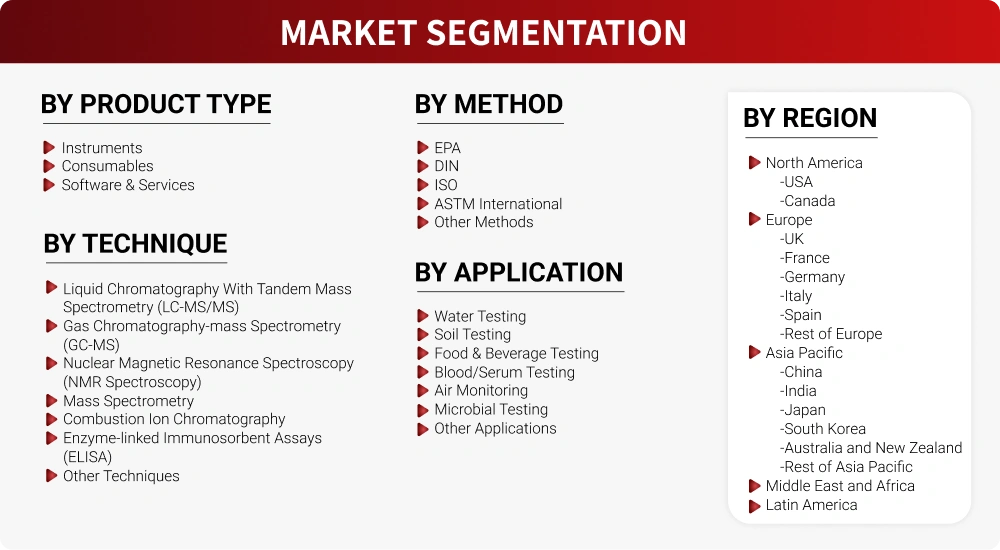
Wearable Technology detailed Market Segmentation
Want detailed insights from this report?
Industry Developments and Competitive Landscape
As the technologies behind sensors, low power chips, and software integration keep evolving, increasingly more precise, compact, and energy efficient wearables are being developed. Among the biggest industry players that are already making investments into future technologies include Apple Inc., Samsung Electronics, and Garmin Ltd. They have been expanding into the development of new generations of biosensors, artificial intelligence-based health platforms, and establishing strategic alliances with healthcare companies to enhance their capabilities and competitiveness in the market.
Wrist-wear became the most significant product line in the wearable technology market during 2025 owing to wide consumer acceptance, enhanced health monitoring features, and ongoing innovation in smartwatch and fitness bands.
-
Shipments of smartwatches and fitness bands represented more than 55%-60% of the total shipment of wearable devices facilitated by increased awareness of health conditions and inclusion of new technologies, including ECG, SpO₂, and sleep monitoring.
-
Wristwear represents considerable convenience for users, constant monitoring features, and easy pairing with smartphones, which allows it to register up to 2-3 times more active usage per day when compared to other wearables, such as clothing and headwear.
-
Increasing preventive measures in the area of fitness and health have raised demands for wristwear products by approximately 25%-30% in urban and semi-urban communities.
-
Companies like Apple Inc., Samsung Electronics, and Xiaomi Corporation remain at the top in this market segment due to constant innovations in this area, new product launches, and competitive pricing strategies.
The Consumer Electronics segment became the leading application segment within the wearable technology market by 2025, holding an important market share of around 45%, attributed to growing usage of smart watches, fitness trackers, and hearables by common users.
-
An increase in the number of connected consumer electronics and increasing the use of smartphones have contributed significantly to the demand for wearable technology that can easily be connected to a digital platform, resulting in increased demand for wearables.
-
Innovation in products has enabled users to make good use of additional features like health monitoring, voice assistances, and contactless payments, which have increased the replacement rate by up to 20-25%.
-
Consumer preference for fitness and wellness monitoring applications has increased, thus generating huge demand for wearable technologies in everyday use.
-
Companies like Apple Inc., Samsung Electronics, and Huawei Technologies are dominating the wearable technology market by diversifying their product lines.
North America was the leading geographical segment of the wearable technology market in terms of the market share, owing to the high penetration of wearable technology among consumers, presence of strong digital healthcare ecosystems, and presence of innovative technology giants.
-
The region accounts for ~35-40% of the total wearable technology market revenue in the globe, which is a consequence of high usage of smart devices in the region, along with adoption of advanced health monitoring wearable products.
-
Growing preference for prevention of healthcare issues and managing chronic diseases has resulted in rising demand for wearable products equipped with advanced features like heart rate detection, ECG, and remote patient monitoring capabilities in North America.
-
High-level of ecosystem integration in smartphones, fitness apps, and healthcare applications is driving ~2x higher levels of user engagement and adoption of subscription-based health services than the emerging regions.
-
Leading companies like Apple Inc., Fitbit Inc. (recently acquired by Alphabet Inc.) and Garmin Ltd. are continuously expanding their businesses through product innovations and collaborations.
What This Report Covers
This report provides a comprehensive analysis of the wearable technology market, offering insights into key trends, growth drivers, challenges, and future opportunities. It is designed to support strategic decision making through a combination of quantitative data and qualitative analysis.
Specifically, the report covers:

Market Overview & Definition: Overview of the market scope, structure, and key terminology.

Market Size & Forecast: Historical data and future projections across key segments and regions

Key Market Trends: Insights into emerging trends, technological advancements, and evolving demand patterns

Drivers, Restraints & Opportunities: Analysis of key factors influencing market growth

Competitive Landscape: Overview of major players, their strategies, and recent developments

Detailed Patent Analysis: Top Assignees, Geography Focus of Top Assignees, Legal Status, Technology Evolution, Key Patents and Patent Trends and Innovations

Segmentation Analysis: Breakdown by product, application, component, and region

Regional Insights: Key regional trends and growth opportunities

Future Outlook: Strategic insights and future market direction
Research Methodology
The study of the wearables technology market is based on a combination of primary and secondary research methodologies, supported by data validation and analytical modeling to ensure accuracy and reliability
Market Definition: Wearable Technology Market
Wearable technology is an industry focused on designing, developing, producing, and marketing electronic devices that can be worn on the body. These devices combine sophisticated sensors, advanced connectivity solutions, and innovative software to monitor, analyze, and improve users’ health, fitness, and daily activities. By using technologies such as IoT, artificial intelligence (AI), and biometrics, wearable devices can provide real-time data insights, continuously track physiological indicators, and interact seamlessly with connected products and services.
Common examples of wearable technology include smartwatches, fitness trackers, smart glasses, hearables, as well as newer innovations like smart rings and smart clothing. These devices offer features such as heart rate monitoring, blood oxygen saturation tracking, sleep analysis, GPS navigation, and contactless payment systems, making them valuable for both personal and medical use.
Key Stakeholders
The wearable technology market involves a diverse ecosystem of stakeholders across the semiconductor, telecommunications, and computing industries.
- Device Manufacturers
- Compon ent and Technology Suppliers (sensor, chip, battery, and connectivity module providers)
- Software Developers (operating systems, health and fitness app developers)
- Healthcare Providers (hospitals, clinics, telemedicine companies
- Pharmaceutical Companies
- Biotechnology Firms
- Insurance Providers (private and public health insurers)
- Regulatory Authorities (FDA, EMA, etc.)
- Research Institutions and Universities
- Patient Advocacy Groups
- Pharmacy and Distribution Networks (wholesale distributors, pharmacies, retail channels)
- Policy Makers (government bodies, health ministries, legislators)
- Contract Research Organizations (CROs)
- Investors (venture capitalists, private equity firms)
Key objectives of the Study
- To define, describe, analyze, segment, and forecast the wearables technology market by products, by operation and by applications.
- To describe and forecast the market for four key regions: North America, Europe, Asia Pacific, and Rest of the World.
- To provide detailed information regarding key drivers, restraints, opportunities, and challenges influencing market growth
- To strategically analyze the micro indicators with respect to individual growth trends, prospects, and contributions to the overall market size
- To analyze opportunities for stakeholders in the wearables technology treatment industry and emphasize on competitive landscape of the market
- To develop competitive benchmarking of the key market players based on technology specifications and end users.
- To strategically profile key players and comprehensively analyze their product portfolio offerings, and core competencies
- To analyze competitive developments, such as launches and approvals, agreements, mergers and acquisitions, partnerships, joint ventures, investments and expansions, and collaborations, wearables technology domain.
Need deeper insights on this market?
Get full report access with detailed forecasts, competitive analysis, and segmentation.
1. Research Approach
This research adopts a systematic approach by combining primary and secondary research to ensure comprehensive coverage and accurate information about the wearable technology sector. This method enables a thorough analysis of current market trends, including consumer behavior, technological advancements, and the competitive landscape within the industry.
Secondary Research
Secondary research involves the collection of data from reliable sources such as industry databases, company annual reports, investor presentations, and regulatory filings. This process helps in understanding market trends, identifying key players, and gathering technical and commercial insights.
A comprehensive database of leading companies and market participants is developed through secondary research to support further analysis.
Primary Research
Primary research is conducted to validate findings from secondary research and to gain deeper insights into market dynamics. Interviews are carried out with industry stakeholders across both demand and supply sides, including executives such as CXOs, Vice Presidents, and Directors from business development, marketing, and product teams.
Data is collected through structured questionnaires, email interactions, and telephonic interviews across key regions including North America, Europe, Asia-Pacific, and Rest of the World.
Market Size Estimation
Market size estimation is performed using both top-down and bottom-up approaches. Key market players are identified, and their revenues are analyzed to estimate the overall market size.
The market is further segmented based on:
- Product and service mapping across region
- Adoption patterns across key application segments
- Insights gathered through primary and secondary research
Data Validation and Research Design
After estimating the overall market size, the data is validated using triangulation methods and market breakdown techniques to ensure accuracy and consistency. Both demand-side and supply-side factors are considered to refine the analysis.
The final data is validated through multiple sources to ensure reliability and to provide accurate insights across all market segments and regions.
2. Assumptions of the Study
The analysis of the wearable technology market is based on the following key assumptions:
- Trends in the industry are drawn from historical data and current information within the sector
- The future outlook is underpinned by constant economic conditions in the absence of shocks to the market
- The rate of adoption for wearable technologies will rise steadily in all important regions
- Technological improvements including artificial intelligence, IoT, and sensor technology will continue to boost market expansion
- The income statement and market share figures are estimated using available information from the industry and publicly available data
- The exchange rate and price trends will not be greatly affected during the forecast period
Scope and Limitations
Scope of the Study
This report offers an exhaustive overview of the international wearable technology market and includes the following components:
- Summary of market size, growth trends, and projections
- Carefully segmented market based on products, applications, components, and geography
- Discussion of primary factors influencing the market
- Competitor analysis
- Insights into regional and national market performance
Limitations of the Study
Despite the best efforts being made to keep the results accurate, the study does suffer from some limitations:
- It has been done using both primary and secondary data that come with their own constraints
- Tempestuous developments in technology might affect the future course of market dynamics
- Some figures are only approximations due to lack of public disclosure
- The report is not an insurance against any disruptions in macroeconomics and geopolitics
- Future forecasts are indicative and subject to change due to altered industry dynamics
3. Data Triangulation and Market Breakdown
Data triangulation involved the combination of primary research, secondary research, and the Wissen Research analysis. Once the data points were sourced from the secondary market research, we sanitized the data points to make the market sizing and growth forecast more accurate by developing our own assumptions based on the inputs and insights we gather through the primary interviews with the industry experts. Once the data was thoroughly validated through primary interviews from both, demand and supply side of the market, our team of analyst and other team members involved finalized the market sizing and growth forecast.
Data Triangulation Methodology
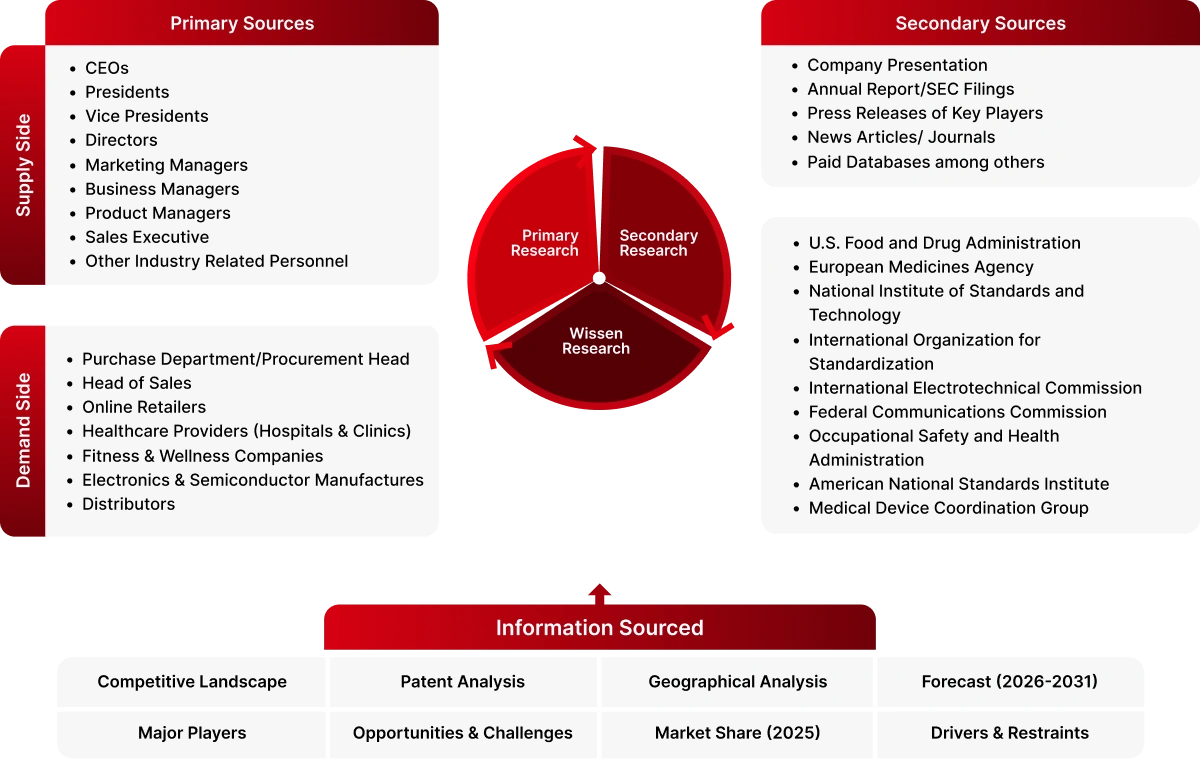
Sources: U.S. Food and Drug Administration, European Medicines Agency, National Institute of Standards and Technology, International Organization for Standardization, International Electrotechnical Commission, Federal Communications Commission, Occupational Safety and Health Administration, American National Standards Institute, Device Coordination Group, Company Website, Press Releases, Annual Reports, Paid Data Sources, and Wissen Research Analysis.
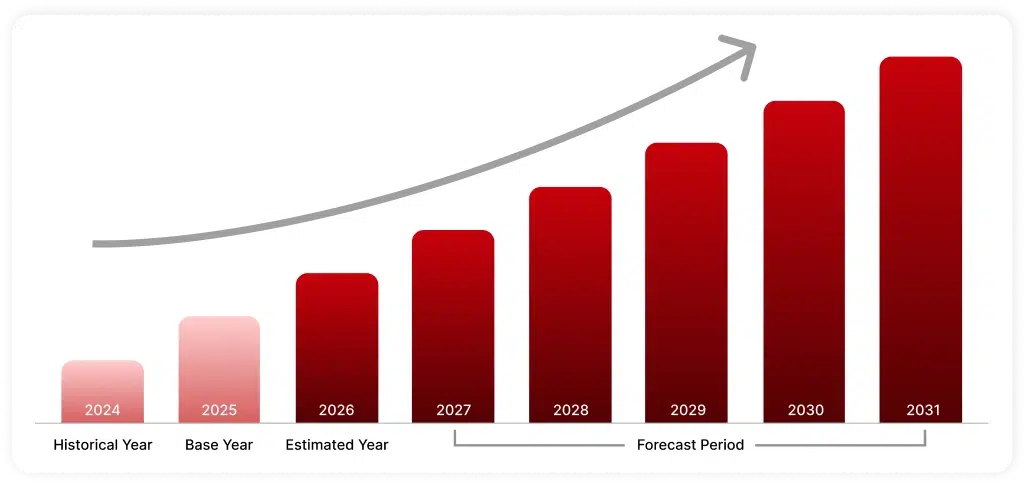
4. Years Framework
5. Bottom up approach (Demand Side) and Top down approach (Supply Side)
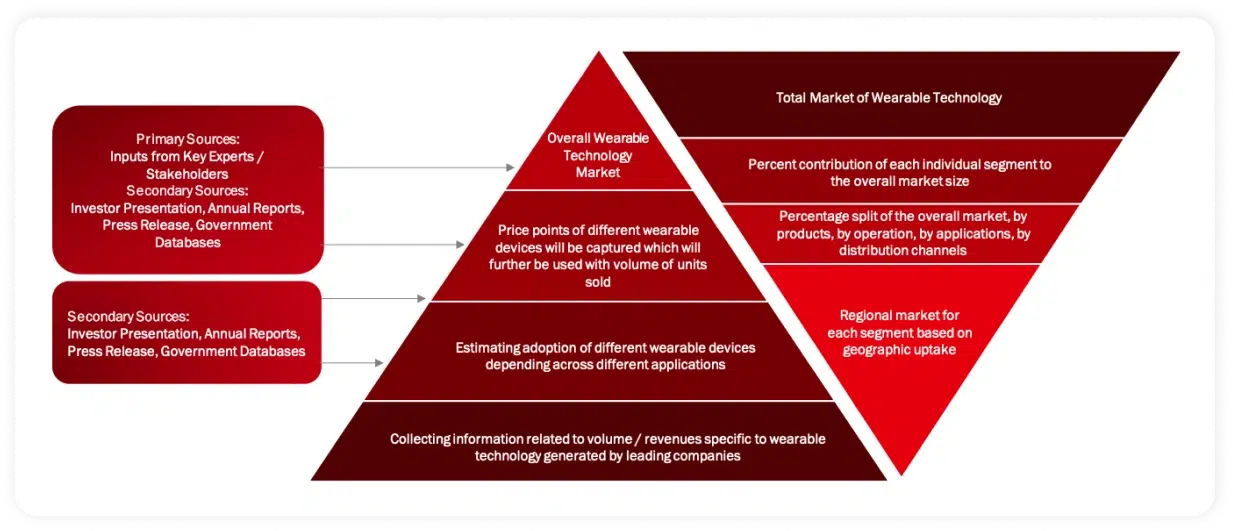
Bottom-Up Approach (Demand Side Approach):
Determining the market size through the consolidation of demand among end-users, sectors, and geographic areas, which are calculated according to real-world demand conditions.
Top Down Approach (Supply Side Approach):
Calculating the market size through revenue and performance of the industry and its important companies, allocating the market size among various sectors.
Want detailed insights from this report?
Buy this Report
Choose the option that best fits your needs