

Summarize this report with:



Executive Summary
In April 2024, Abbott got two very different verdicts on nearly the same idea. Its bioresorbable coronary stent had already been pulled from the market years earlier after real-world data showed it caused more clots than the metal stents it replaced. That same month, its peripheral bioresorbable scaffold, Esprit BTK, won FDA approval and now looks like a genuine clinical win. Same polymer. Same core idea. Opposite outcome. The material was never the deciding factor — where in the body it goes, and how the device is engineered around it, is.
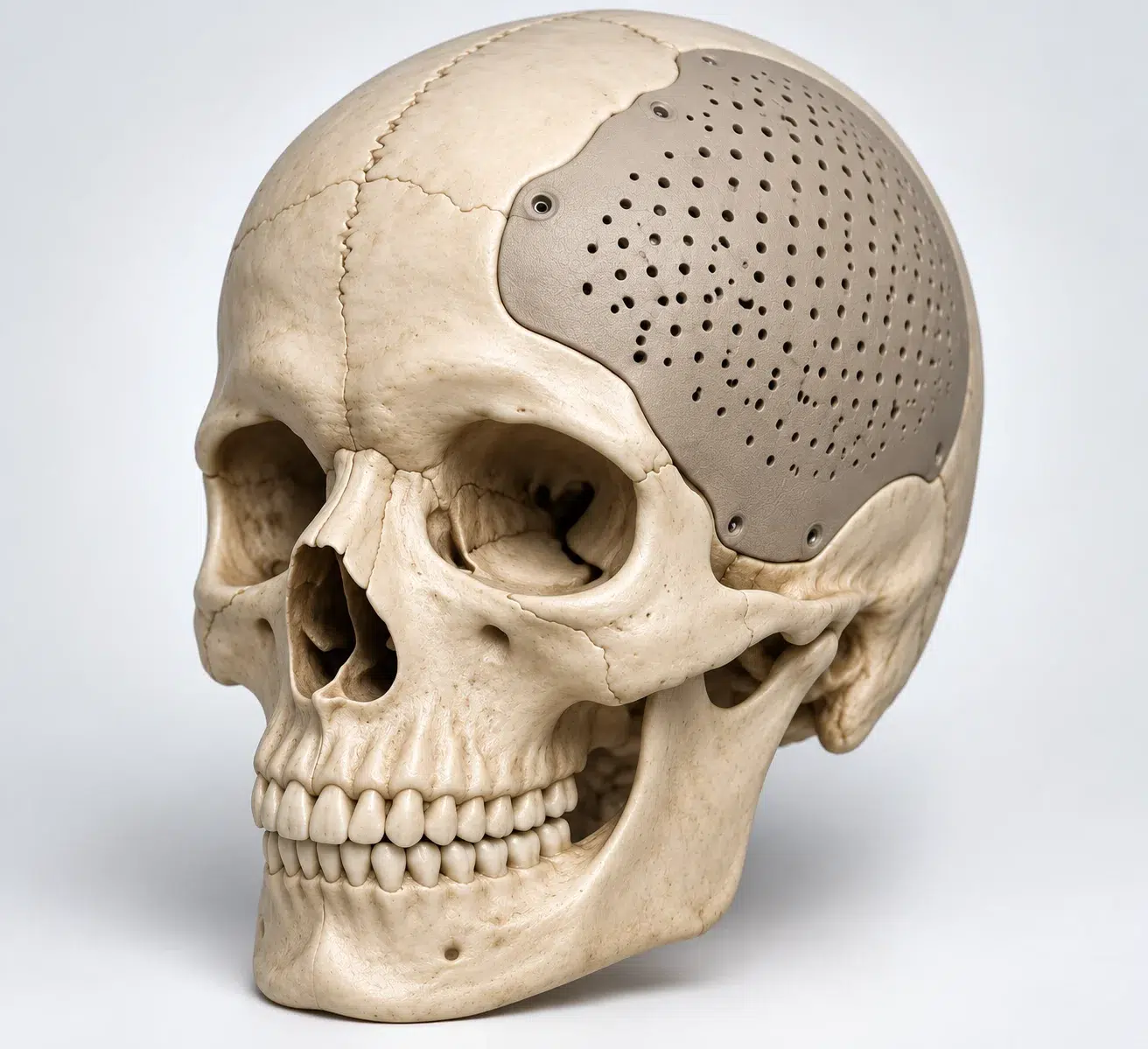
The polymers themselves — PEEK, PLGA, PLA, silicone are, in most cases, decades old and chemically unremarkable at this point. What’s actually moving is what gets built around them. In that same month, 3D Systems got FDA clearance for the first 3D-printed PEEK skull implant, using PEEK chemistry that’s been around since the 1980s. The breakthrough wasn’t a new material, it was a new way of shaping an old one.
That pattern shows up in the competitive landscape too: no company here is strong across the board. Evonik and Corbion own bioresorbable chemistry with almost no PEEK presence; Victrex owns PEEK completely with zero bioresorbable footprint. This isn’t a market waiting to consolidate — it’s one where narrow specialization, plus the right supplier partnership, is the actual winning move. Meanwhile, the loudest buzzwords in this space — smart polymers, conductive bioelectronics, 4D-printed implants remain almost entirely stuck in the lab. Strong research, real patents, but no confirmed product actually inside a patient yet. That gap between what gets published and what gets implanted is the one thing worth remembering before any decision gets made in this space.
-
The material is 40 years old, The FDA clearance is brand new. In April 2024, 3D Systems got clearance for the first 3D-printed PEEK skull implant, but PEEK itself has been used in implants since the 1990s. Nothing new was invented here. What changed is how the material is shaped, not what it’s made of
-
The same chemistry produced a landmark approval and a market withdrawal — from the same company. Abbott’s Esprit BTK (a dissolving polymer scaffold for leg arteries) was approved in April 2024. A near-identical polymer approach, used in a coronary scaffold years earlier, was pulled from the market after patients showed higher rates of clot-related complications. Same material philosophy, opposite outcomes because anatomy decided the result, not the polymer.
-
Nobody’s competing on chemistry anymore, they’re competing on purity. The raw chemistry behind bioresorbable polymers (PLGA, PLA) is decades old and largely unprotected. What Evonik and Corbion actually sell today is cleaner material — lower residual monomer, tighter batch control. A new entrant trying to compete by inventing a “better” polymer is fighting the wrong battle.
-
One word, two technologies: that’s the trap hiding inside ‘hydrogel. Wound-care hydrogels have been commercially proven for decades. Injectable and 3D-bioprinted hydrogels, despite sharing the same name are still mostly stuck in the lab. Anyone pitching “hydrogel technology” as one category is brushing aside a maturity gap of about 20 years.
-
A single supplier failure could quietly stall the industry’s most exciting recent breakthrough. 3D Systems’ FDA-cleared PEEK implant workflow depends entirely on one material, from one supplier — Evonik. That’s a single-source dependency sitting underneath the most celebrated development.
-
There’s a sustainability claim nobody has actually made yet — and whoever makes it first wins. Every major polymer supplier talks about “sustainable” or “bio-based” materials. Not one publishes environmental data specific to their medical-grade manufacturing process, which is far more resource-intensive than the commodity-plastic version of the same chemistry. That’s an open, unclaimed differentiation opportunity sitting in plain sight.
-
The next frontier isn’t blocked by science, it’s blocked by an unanswered safety question. Carbon-based nanocomposites (graphene, carbon nanotubes) have real performance advantages over the hydroxyapatite composites already in commercial implants. What’s stopping them isn’t performance — it’s that nobody yet knows how the body clears carbon nanomaterials over the long term.
TECHNOLOGY LANDSCAPE
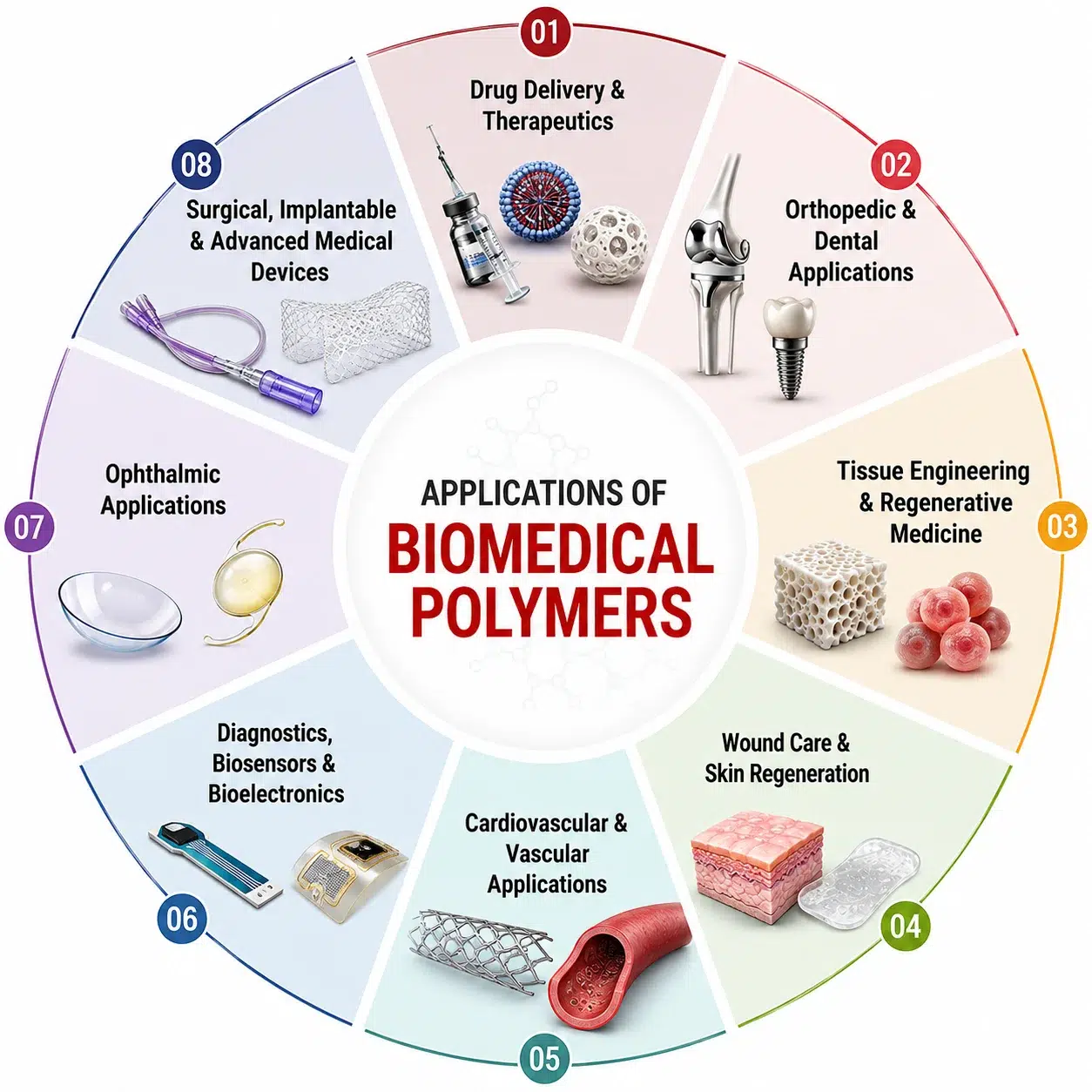
Biomedical polymers are polymeric materials engineered for use in medical devices, implants, drug delivery, tissue engineering, and regenerative medicine. They differ from commodity polymers less in base chemistry (many share backbones with industrial plastics i.e. PLA, PE, PTFE etc) and more in the qualification burden: documented biocompatibility (ISO 10993), traceable GMP/ISO 13485-aligned manufacturing, sterilization compatibility, characterized extractables/ leachables, and, for degradable polymers, characterized degradation products and kinetics. Polymers are used pervasively in healthcare because they offer a combination of properties unmatched by metals or ceramics: tunable mechanical stiffness (from rigid PEEK to elastomeric silicone), processability into complex or patient-specific shapes, radiolucency (useful for imaging alongside implants), and critically the ability to be engineered for controlled degradation, drug loading, or surface bio-functionality. Key material classes include PEEK, PTFE, silicone, PMMA, PLA, PGA, PLGA, PCL, and bio-derived polymers such as collagen, chitosan, and alginate.
What Makes a Polymer Biomedical?
A polymer is considered biomedical when it can perform its intended medical function while maintaining an acceptable level of compatibility with the body. Its suitability is evaluated based on biocompatibility, toxicity, inflammatory and immune responses, blood and tissue compatibility, degradation behaviour, mechanical performance, and stability during sterilization. Thus, biomedical polymers must balance functional performance with biological safety and long-term reliability.
Biomedical polymers can be classified based on their origin, degradation behaviour, material structure, and functional properties. The following classification highlights the major polymer families used in healthcare. The categories are not mutually exclusive; for example, a polymer can be both synthetic and bio-based, or synthetic biodegradable and bioresorbable.
Type & Examples | Key Properties | Biomedical Applications | What’s Really Happening | Watch Point | Examples |
|---|---|---|---|---|---|
Natural polymers (Collagen, gelatin, chitosan, alginate, hyaluronic acid, silk fibroin) | Bioactive motifs; generally biodegradable; batch variability | Wound care, HA dermal fillers/viscosupple mentation, hemostats, scaffolds | Sourcing and biological variability are key risks for animal-derived polymers such as collagen, increasing interest in recombinant and fermentation-derived alternatives. | Recombinant/fermentation-derived versions are displacing animal-sourced natural polymers in new development. | Evonik (VECOLLAN®) — a fermentation-derived, non-animal recombinant collagen, commercially launched in 2022, with a clinical-trial-grade version added in September 2025. Established players in the natural-polymer finished product space include Anika Therapeutics (hyaluronic acid viscosupplementation). |
Synthetic biodegradable | Hydrolytically degradable; tunable via copolymer ratio | Sutures, orthopedic fixation, drug-delivery microspheres/implants, GTR/GBR membranes | Core chemistries are mature, shifting differentiation toward purity, molecular-weight control, residual monomer/catalyst levels, and processing consistency. | This is a manufacturing-quality contest, not an R&D one — new entrants competing on chemistry alone struggle to differentiate. | Evonik (RESOMER®) and Corbion (PURASORB®) — the two established suppliers of medical-grade bioresorbable polyester raw material used across the drug-delivery and fixation industry. |
Synthetic non-biodegradable (PEEK, PMMA, UHMWPE, PTFE, silicone, polyurethanes) | High mechanical/chemical stability; long-term biostability | Joint replacement (UHMWPE), spinal cages (PEEK), bone cement (PMMA), vascular grafts (PTFE), IOLs (silicone/PMMA) | For mature polymers, innovation is increasingly shifting from polymer chemistry toward manufacturing, customization, and application-specific processing. | Traditional machined/molded PEEK is being displaced by additive manufacturing of the same material, not a new one. | Victrex/Invibio (PEEK-OPTIMA™) — supplier behind 15M+ implanted PEEK devices; 3D Systems, which received FDA 510(k) clearance in April 2024 for the first additively manufactured PEEK cranial implant, built on Evonik’s VESTAKEEP® i4 3DF PEEK resin. |
Hydrogels (PEG-, alginate-, HA-, GelMA-based networks) | High water content; tunable stiffness/injectability | Wound dressings, viscosupplementation, drug depots, bioinks, contact lenses | “Hydrogel” encompasses widely different maturity levels: conventional wound-care hydrogels are established, while injectable and bioprinted systems remain less mature. | Always ask which hydrogel before assuming maturity; bioprinted variants are the real frontier. | Smith+Nephew (established wound-care hydrogel dressings) |
Bio-based polymers (Bio-based PLA (corn/sugarcane feedstock), some PHAs) | Renewable feedstock origin | Same applications as synthetic PLA once medically qualified | Medical-grade sustainability evidence remains less standardized than broader biopolymer sustainability claims. | Whoever publishes real medical-grade LCA data first gets a defensible, non-borrowed sustainability story. | No publicly verified example identified |
Polymer nanocomposites (Hydroxyapatite–PLA/PCL, graphene–polymer, CNT–polymer, nanocellulose–polymer) | Enhanced mechanical/bioactive/conductive properties vs. neat polymer | Bone-graft substitutes, conductive scaffolds, drug carriers | Nanocomposite maturity varies significantly; established fillers such as HA have a stronger translational base, while carbon-based systems face greater long-term safety and clinical-translation challenges. | Carbon-nanomaterial composites are stalled on an unresolved safety question, not a performance one — a harder barrier to clear. | Victrex/Invibio (PEEK-OPTIMA™ HA Enhanced) — the clearest commercially proven nanocomposite with published in vivo bone-apposition data |
Bioresorbable polymers (PLGA, PLA, PGA, PDO, PCL) | Fully metabolized/degraded in vivo | Orthopedic fixation, drug-eluting implants, select vascular scaffolds (BTK peripheral — approved; coronary — mixed history) | Clinical outcomes depend on indication, anatomy, device design, and degradation behavior—not simply on the use of a bioresorbable polymer. | “Bioresorbable” isn’t an automatic upgrade — anatomy decides the outcome, not the polymer. Coronary use remains a cautionary path; peripheral use is succeeding. | Abbott (Esprit BTK) — an everolimus-eluting PLLA scaffold approved by the FDA in April 2024 for peripheral (below-the-knee) artery disease, built on bioresorbable polymer. |
Note: Bioresorbable polymers substantially overlap with the “synthetic biodegradable” category; bioresorbability is a functional/application-oriented distinction rather than a completely separate chemical class.
“Natural,” “bio-based,” “biodegradable,” and “biocompatible” are not interchangeable attributes. Natural polymers can have sourcing and immunogenicity risks; bio-based polymers are not necessarily biodegradable; and biodegradability does not by itself establish biocompatibility. Ultimately, suitability depends on the polymer chemistry, formulation, processing, device configuration, intended use, and biological exposure.
Patent Number / Application | Title / Subject matter | Assignee / Company | Filing Date | Grant Date | Product Mapped |
|---|---|---|---|---|---|
US12146175B2 | Method for producing a recombinant bacterial collagen-like protein (CLP) | Evonik Operations GmbH | 2022-08-03 | 2024-11-19 | Evonik (VECOLLAN®) |
US11945197B2 | Multilayer polylactide based structure and articles made therefrom | TotalEnergies Corbion BV | 2021-03-05 | 2024-04-02 | Corbion (PURASORB®) |
US10143572B2 | Assessment of a drug eluting bioresorbable vascular scaffold | Abbott Cardiovascular Systems Inc | 2014-09-04 | 2018-12-04 | Esprit BTK |
Core Components / Architecture
Biomedical Polymer: Design Layers & Their Primary Effects
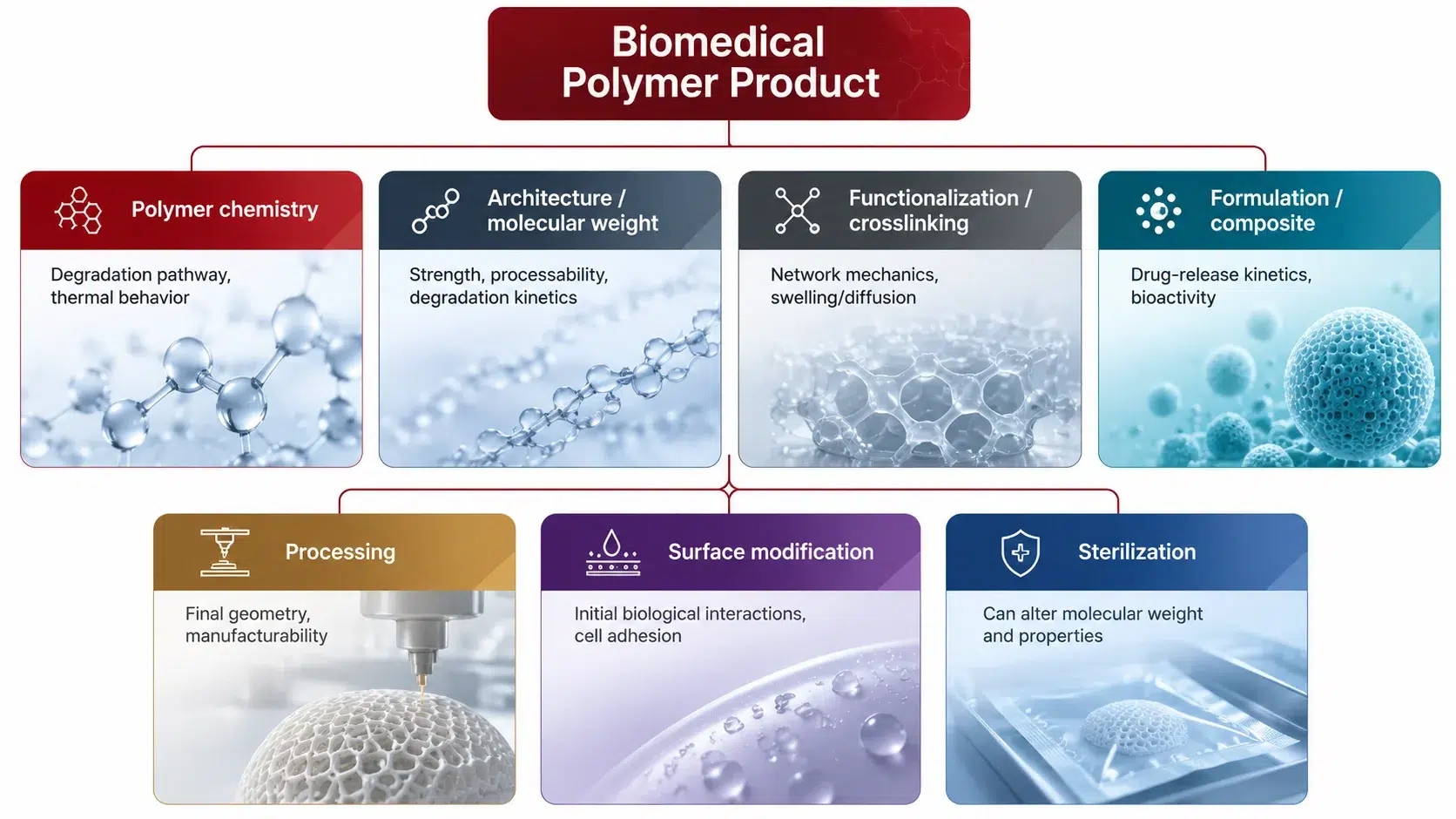
Biomedical polymer products can be viewed as a layered architecture in which each design and manufacturing layer builds on the preceding one and can independently influence performance, manufacturability and regulatory risk.
Polymer Chemistry — Determines fundamental degradation, thermal and mechanical behaviour.
Polymer Architecture & Molecular Weight — Controls strength, viscosity, processability and degradation kinetics.
Functionalization / Crosslinking — Adds specific chemical, mechanical or biological functionality.
Formulation / Composites — Incorporates drugs, fillers, reinforcing or bioactive phases.
Processing — Converts the material into the required geometry and structure.
Surface Modification — Controls initial interactions with proteins, cells, blood and tissue.
Sterilization — Ensures microbial safety while maintaining material and device performance.
These components interact to determine the performance, manufacturability, biological response and regulatory suitability of the final biomedical polymer product.
Recent Developments (Last 12 Months)
15 April 2024 — 3D Systems VSP® PEEK Cranial Implant. FDA 510(k) clearance was granted for 3D Systems’ patient-specific, additively manufactured PEEK cranial implant workflow using Evonik VESTAKEEP® i4 3DF PEEK and the EXT 220 MED printer. 3D Systems described it as the first FDA-cleared additively manufactured PEEK implant intended for cranioplasty. The technology had supported nearly 40 cranioplasties in Europe before U.S. clearance. Planned extensions into spine, trauma/fixation and bioresorbable applications remained forward-looking rather than cleared indications.
26 April 2024 — Abbott Esprit™ BTK. FDA approved the everolimus-eluting Esprit BTK resorbable scaffold for infrapopliteal disease in patients with chronic limb-threatening ischemia. The scaffold uses a PLLA backbone and is designed to provide temporary vascular support before resorption. This represents a significant anatomy-specific clinical/regulatory milestone but should not be interpreted as broad validation of bioresorbable vascular scaffolds across coronary or other indications.
Pipeline — 4D Medicine 4Degra® interference screw. 4D Medicine is developing a bioabsorbable interference screw based on its proprietary polycarbonate-urethane 4Degra® platform, following more than 15 years of R&D. The company previously anticipated FDA 510(k) clearance in early 2026; however, its current regulatory disclaimer states that the products are not currently cleared, approved or authorized. It should therefore be treated as a pipeline milestone to watch, not a confirmed clearance.
2025–2026 — Evonik parenteral drug-delivery platform. Evonik continues to expand and commercialize its RESOMER®/LACTEL® bioresorbable polymer portfolio alongside formulation, manufacturing and CDMO capabilities for complex parenteral drug delivery. Its 2026 EUDRAGIT®/EUDRACAP® awards provide broader drug-delivery context but relate primarily to oral delivery, rather than implant-focused polymer developments.
Key takeaway: The strongest verified developments are manufacturing/process innovation in additively manufactured PEEK implants and a clinical/regulatory milestone for below-the-knee bioresorbable vascular scaffolding. The evidence does not indicate a major new biomedical-polymer chemistry breakthrough in this period. 4D Medicine’s 4Degra® interference screw remains a pipeline technology rather than a confirmed FDA-cleared product.
COMPETITIVE LANDSCAPE
The competitive landscape splits into four distinct roles, and treating them as directly comparable can lead to misleading conclusions because each competes at a different layer of the value chain.
- Base-polymer material suppliers develop and supply medical-grade polymer platforms, formulations, and grades, with examples including Evonik, Corbion, and Victrex/Invibio.
- Specialty processors and compounders convert these materials into precision components through extrusion, compounding, molding, coating, and other processing technologies, including Röchling Medical, Zeus, and Foster Corporation.
- Device manufacturers and integrators incorporate polymers into regulated, clinically validated products and implants, including Abbott, Medtronic, Boston Scientific, Stryker, and Zimmer Biomet.
- Manufacturing-technology and workflow providers enable new fabrication routes that can transform established polymers into patient-specific products, exemplified by 3D Systems and its FDA-cleared PEEK additive-manufacturing workflow.
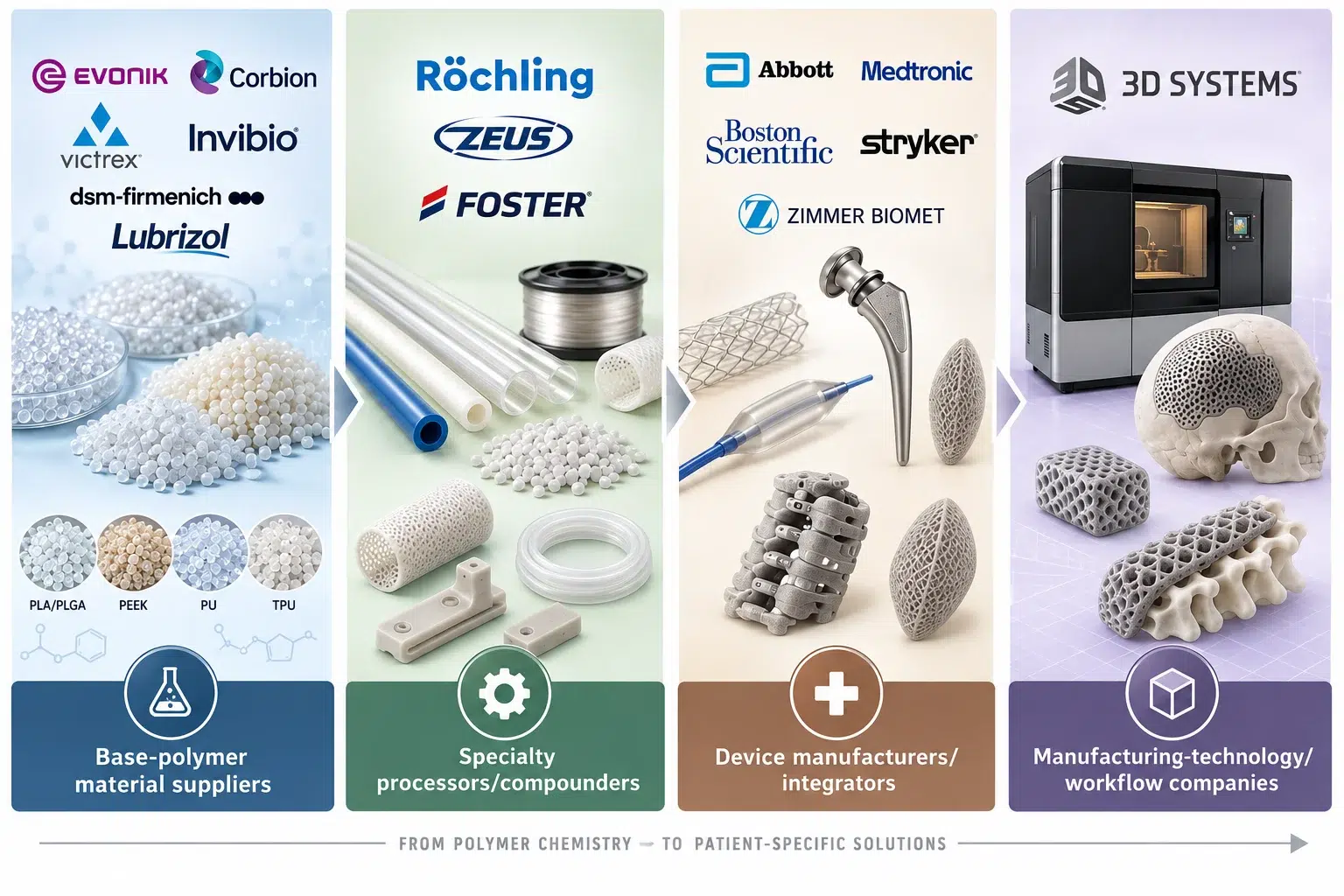
The competitive landscape spans the medical-polymer value chain, from material development and specialty processing to device integration and advanced manufacturing. The table below highlights the three most relevant companies in each category, selected based on their verified technology capabilities, application relevance, and market positioning.
Category | Company | Medical Polymer Technologies / Platforms | Key Applications | Key Competitive Strength |
|---|---|---|---|---|
Base-polymer material suppliers | Evonik | RESOMER® / LACTEL® bioresorbable polymers; VESTAKEEP® PEEK; VECOLLAN® recombinant collagen | Drug delivery, orthopedic fixation, medical textiles, 3D printing | Broad medical-polymer portfolio across bioresorbables, drug delivery, PEEK and AM materials |
Base-polymer material suppliers | Corbion | PURASORB® lactide/glycolide/caprolactone/(m)PEG polymers; GMP-grade resorbable polymers | Drug delivery, orthopedic devices, tissue regeneration, medical textiles | Strong GMP platform, customization and co-development capability |
Base-polymer material suppliers | Victrex / Invibio | PEEK-OPTIMA®; HA Enhanced; Ultra-Reinforced PEEK | Spine, trauma, orthopedic, dental, cranio-maxillofacial implants | Leading implantable PEEK specialist with 15M+ implanted devices and >20 years of clinical history |
Specialty processors / compounders | Zeus | Medical-grade PTFE, FEP, PFA, PEEK and other engineering-polymer extrusion | Catheters, guidewires, vascular access, medical tubing | Strong fine-diameter extrusion and medical tubing expertise |
Specialty processors / compounders | Röchling Medical | Medical-grade thermoplastic processing, compounding and component manufacturing | Device components, diagnostic products, drug-delivery components | Broad medical processing, molding and cleanroom manufacturing capabilities |
Specialty processors / compounders | Foster Corporation | Medical polymer compounding, radiopaque/additive compounds and specialty formulations | Catheters, tubing, device components | Established medical-polymer compounding and formulation expertise |
Device manufacturers / integrators | Boston Scientific | Bioabsorbable- and durable-polymer drug-delivery coatings, including SYNERGY® and other DES platforms | Cardiovascular and interventional devices | Strong polymer-enabled drug delivery and drug-eluting stent capabilities |
Device manufacturers / integrators | Abbott | PLLA-based resorbable scaffold and drug-eluting polymer/device platforms | Peripheral vascular and cardiovascular devices | Demonstrated commercial resorbable-polymer device capability through Esprit™ BTK |
Device manufacturers / integrators | Medtronic | Polymer-enabled stent, catheter and device technologies, including BioLinx® | Cardiac devices, coronary stents, neuromodulation, catheters | Deep integration of polymer technologies into complex regulated devices |
Manufacturing-technology / workflow companies | 3D Systems | PEEK additive manufacturing and patient-specific medical printing workflows | Cranial and orthopedic implants, patient-specific devices | FDA-cleared PEEK additive-manufacturing workflow and strong medical AM capabilities |
Manufacturing-technology / workflow companies | EOS | Polymer additive-manufacturing platforms and medical production workflows | Patient-specific components, medical devices and implants | Established industrial AM platform with strong medical manufacturing capabilities |
Manufacturing-technology / workflow companies | Stratasys | Polymer 3D-printing platforms and medical-grade additive-manufacturing solutions | Anatomical models, surgical planning, medical components | Major healthcare polymer-AM platform, particularly strong in clinical visualization, surgical planning and customized medical applications |
TREND ANALYSIS
-
Minimally invasive procedures continue to create demand for polymer-based components where their flexibility, low friction, deliverability and imaging-related properties provide application-specific advantages. FDA documentation identifies polymers such as PTFE, PVP and silicone in catheters, guidewires and delivery systems used in minimally invasive procedures.
-
Regenerative medicine continues to drive development of hydrogels and polymeric scaffolds, although research activity remains substantially broader than established clinical and commercial adoption
-
Long- acting drug delivery remains a mature and active polymer application. PLGA-based injectable and implantable systems have multiple FDA-approved commercial products, with continued development of long-acting formulations and manufacturing capabilities
-
Long- acting drug delivery remains a mature and active polymer application. PLGA-based injectable and implantable systems have multiple FDA-approved commercial products, with continued development of long-acting formulations and manufacturing capabilities
-
Population ageing and chronic disease are broader healthcare demand drivers for orthopedic, cardiovascular and drug-delivery applications. However, this report has not independently established a biomedical-polymer-specific demand estimate. WHO reports that the global population aged 60 years and older is projected to increase from 1 billion in 2020 to 1.4 billion by 2030 and 2.1 billion by 2050
Emerging Sub-trends to Watch
High momentum / Early deployment
The 2024 FDA clearance of 3D Systems’ patient-specific PEEK cranial implant provides direct evidence of clinical/regulatory movement from additive manufacturing toward customized polymer implants
Established / Continuing momentum
A mature but still highly active area, particularly PLGA-based depot systems and advanced parenteral delivery. This is a continuing innovation trend, rather than an emerging technology
Strong research momentum / Early translation
A genuine frontier involving polymers that respond to temperature, pH, light, magnetic fields or other stimuli for drug delivery, tissue engineering and biomedical devices. Commercial/clinical adoption remains much lower than research activity
Growing research / Early translation
Strong activity in responsive hydrogels for drug delivery, regenerative medicine and tissue engineering, but broad commercial translation remains limited
Emerging
A genuine emerging sub-trend combining additive manufacturing with stimuli-responsive polymers/hydrogels to create time-dependent changes in shape or function. Biomedical applications include implants, scaffolds and drug delivery, but sterilization, reproducibility, degradation and regulatory challenges still limit clinical translation
Emerging / Strong research momentum
Particularly relevant to neural interfaces, flexible bioelectronics and sensing. The research base is strong, but widespread commercial implant adoption remains limited.
SWOT & RISK ANALYSIS
Decades of accumulated biocompatibility, manufacturing, and regulatory precedent across a genuinely diverse set of chemistries (PLGA, PEEK, UHMWPE, silicone, PCU, PMMA, PTFE), not a single narrow platform
Demonstrated ability to layer new value (additive manufacturing, purification, surface modification) onto already qualified chemistries :the fastest and lowest regulatory-risk innovation path
Mature, de-risked long-acting drug-delivery platform (PLGA/PLA) with active ongoing CDMO investment
Biocompatibility/chemical-characterization burden is a genuine, rising bottleneck for novel chemistries (smart, conductive, nanocomposite polymers) :evidenced by FDA’s September 2024 draft chemical-analysis guidance
Degradation-rate and degradation-product reproducibility across lots/geometries remains a persistent technical challenge for bioresorbables, and outcomes are genuinely anatomy-specific (coronary vs. peripheral bioresorbable scaffolds)
Sterilization compatibility varies significantly by polymer family, constraining processing/sterilization choices
Expansion of AM-fabricated PEEK implants beyond cranial applications into spinal/trauma, building directly on the verified 2024 regulatory precedent
Long-acting/depot drug-delivery platform extension into new therapeutic areas, leveraging proven PLGA/PLA chemistry
Bioresorbable orthopedic-screw and comparable platforms nearing regulatory clearance (e.g., 4D Medicine’s pipeline) represent a near-term (12–18 month) commercialization watch item
Regulatory delays and rising chemical-characterization requirements disproportionately affect novel-chemistry entrants versus incumbents with legacy data packages
Clinical-translation risk is real and anatomy-specific for bioresorbable vascular scaffolds, as directly evidenced by the contrast between Esprit BTK’s approval and the earlier coronary-scaffold withdrawal history
Supply-chain dependence on a small number of specialty suppliers (Evonik/Corbion for bioresorbable polymers, Victrex/Invibio for medical PEEK) creates single/dual-source risk for device OEMs, including for 3D Systems’ PEEK-AM workflow, which itself depends on Evonik’s VESTAKEEP resin
STRATEGIC RECOMMENDATIONS
- Material Suppliers— BUILD.
These companies compete primarily on purity, consistency, and manufacturing reliability rather than on new chemistry. Evonik’s low-residual-monomer PLGA grades and its PLA-PEG copolymer line are good examples of this working in practice. The recommended move is to continue investing in this direction , it is a low-risk extension of an already-proven strength, not a new bet. - Medical-Device Companies — MONITOR.
FDA’s approach to chemical-safety testing is tightening, and the September 2024 draft guidance is likely to be finalized in some form. There is nothing to build yet, but device companies should ensure their extractables-and-leachables testing protocols can be updated quickly once the final guidance is issued, rather than reacting after the fact. - Startups (particularly in bioresorbable devices) — Maintain Disciplined Regulatory Disclosure.
Where a device has not yet received clearance, this should be stated plainly and consistently — 4D Medicine’s own website is a useful model. Overstating regulatory status to investors or partners carries real reputational and legal risk and is easily avoided.
- Large Device Manufacturers — PARTNER.
3D Systems’ FDA clearance for a 3D-printed PEEK cranial implant, built on Evonik’s existing material, is a proven and replicable model. Device manufacturers should look to extend this same supplier-partnership approach into spinal and trauma applications rather than attempting to build independent PEEK-printing or material-qualification capability from scratch, since the underlying material has already cleared the hardest regulatory hurdle. - Additive-Manufacturing Companies — BUILD, Indication by Indication.
A clearance for one anatomical application (e.g., cranial) does not automatically extend to another (e.g., spinal). 3D Systems’ approach of pursuing device-specific clearances is the correct model, and other AM companies entering this space should plan for the same indication-by-indication regulatory pathway rather than assuming transferability. - Material Suppliers — PARTNER, Rather Than Vertically Integrate.
The stronger strategic position for material suppliers is to partner with device and AM companies (as Evonik has done with 3D Systems) rather than attempting to commercialize finished devices themselves. This captures the upside of the growing patient-specific-implant trend while avoiding direct device-level regulatory liability.]
- Large Players — MONITOR.
Conductive polymers and bioresorbable electronics remain largely confined to research and pilot settings, with no confirmed mainstream commercial implant identified in this review. This is a category to track closely rather than commit capital to at this stage. - Startups — LICENSE the Foundational Chemistry, BUILD the Differentiating Layer.
Rather than re-developing well-established bioresorbable polymer chemistry, startups should license it from established suppliers and direct their own R&D toward the genuinely novel component of their technology — such as conductivity, stimuli-responsiveness, or a new formulation approach - Material Suppliers — BUILD Selectively into Bioelectronics.
This represents a longer-horizon, higher-uncertainty opportunity. Suppliers are nonetheless well-positioned to become early materials partners to bioelectronic device developers — mirroring the supplier role Evonik already plays for 3D Systems in PEEK — rather than attempting to commercialize a finished sensor-enabled implant independently. - Industry-Wide — MONITOR and Support Standards Development.
Two areas merit coordinated, sector-level attention: developing credible sustainability/life-cycle data specific to medical-grade polymers (currently a genuine evidence gap), and engaging proactively with regulators on chemical-characterization methodology for novel polymer chemistries, ahead of further tightening.