
Could 3GPP Standards Uncover the Prior Art to Invalidate a Telecom Patent? - Wissen Research

Could 3GPP Standards Uncover the Prior Art to Invalidate a Telecom Patent?

A telecom patent invalidation investigation that moved beyond 3GPP standards to uncover foundational IETF RFC disclosures behind secure mobile key management architectures.

Case Study Type Invalidation Search
Industry Telecommunications
Publication Date July 31, 2026
Patent Invalidation For Telecom Patent

The Client's Challenge

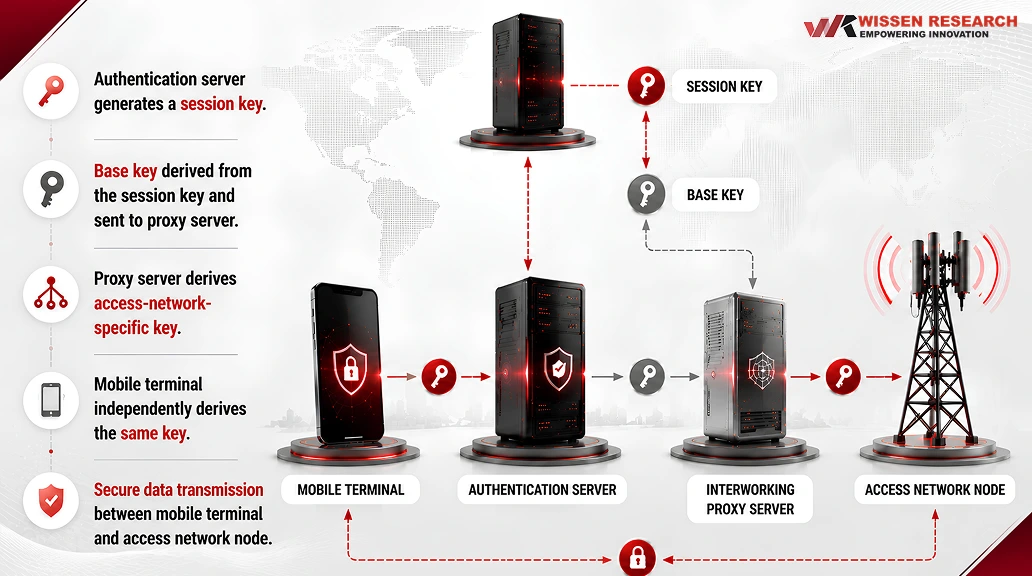
The client sought to invalidate a patent claiming an architecture for generating and distributing an access-network-specific key between a mobile terminal, an authentication server, an interworking proxy and an access network node. The objective was to identify prior art demonstrating that the claimed security workflow had already been publicly disclosed before the patent’s priority date.

Given the telecommunications focus of the invention, the investigation initially concentrated on 3GPP specifications, technical reports and historical meeting contributions. These standards represent the primary technical foundation for mobile network development and are typically the most relevant starting point for telecommunications patent searches.
Telecom Patent Invalidation

The patent claims primarily covered:

  • • Generation of a session key during the authentication process.
    • Derivation of a base key from the authenticated session key.
    • Secure transmission of the base key to an interworking proxy server.
    • Generation of an access-network-specific key by the proxy server.
    • Independent derivation of the same access-network-specific key by the mobile terminal.
    • Secure communication between the mobile terminal and the access network node using the derived key.

limitations icon
CLIENT’S OBJECTIVE

Identify publicly available prior art capable of demonstrating that the patented security architecture had already been disclosed before the patent’s priority date.

Achieving this objective required looking beyond conventional telecommunications literature while maintaining technical accuracy, chronological integrity and evidentiary reliability.

Clients come to us for answers.

They leave with opportunities they didn’t know existed.

Our experts help organizations uncover insights, opportunities and strategic directions that traditional approaches often miss.

Wissen’s Out-of-the-Box Approach:

Beyond 3GPP Standards Through Protocol Lineage Analysis

  • Recognizing the limitations of a standards-focused investigation, the strategy evolved beyond conventional telecommunications prior art searching.
  • While 3GPP specifications represent the primary reference point for mobile network technologies, many security architectures implemented within cellular systems are built upon foundational networking concepts developed across broader Internet protocol ecosystems.
  • The analysis focused on identifying earlier technical disclosures that established the fundamental concepts behind:
  • Session key generation
  • Secure key transfer
  • Credential synchronization
  • Encrypted data transmission

Identifying Foundational Networking Prior Art

  • The analysis identified that several architectural concepts associated with the claimed invention were not exclusive to cellular networks.

  • Instead, similar approaches had been documented within earlier Internet security frameworks that predated their adoption in mobile communication architectures.

  • The investigation strategy evolved from searching for direct terminology matches to understanding the technical lineage of the invention.

Our Methodology

Traditional Standards Search Limitations
Expansion Into Foundational Networking Protocols
Backward Citation Analysis
Technical Correlation With Patent Claims
Evidence Validation
Traditional Standards Search Limitations
  • 3GPP-focused standards investigation
  • Missing pre-priority disclosures
  • Fragmented architecture reconstruction
  • Limited invalidity support
Expansion Into Foundational Networking Protocols
  • Broader Internet security analysis
  • IETF RFC investigation
  • Authentication framework evaluation
  • Foundational concept identification
Backward Citation Analysis
  • Review of later related patents
  • Earlier reference identification
  • Technology lineage reconstruction
Technical Correlation With Patent Claims
  • RFC-to-claim technical comparison
  • Key derivation mechanism analysis
  • Authentication workflow assessment
  • Claim limitation mapping
Evidence Validation
  • RFC publication date verification
  • Pre-priority availability confirmation
  • Independent evidence cross-validation
  • Reproducible invalidity evidence
Outcome:

By tracing the technology back to its networking foundations, previously overlooked prior art opportunities were identified.

Protocol Investigation Methodology

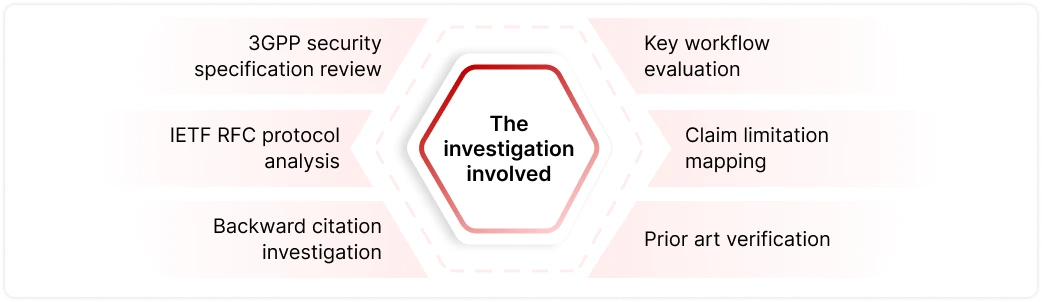
The investigation involved a structured analysis of telecommunications standards, Internet protocol specifications, and historical technical disclosures to identify foundational prior art relevant to the claimed security architecture.

Methodology for Telecom Patent Invalidation

By combining standards analysis, technology lineage assessment, and citation-driven discovery, the methodology enabled identification of technically relevant prior art beyond conventional telecommunications sources.

Technical Challenges Addressed

Challenge 1

Did Earlier Networking Protocols Already Define the Claimed Key Derivation Architecture?

One of the primary technical questions was whether the process of deriving multiple cryptographic keys from an authenticated session, central to the patent’s claims, had already been disclosed before the patent’s priority date.

Solution

Rather than limiting the analysis to mobile authentication standards, the investigation examined foundational IETF RFC documents describing authentication frameworks, trust establishment, and hierarchical key management.

The review demonstrated that these networking specifications already described structured approaches for:
  • Session key establishment
  • Secondary key derivation
  • Secure key distribution
  • Cryptographic role separation

The investigation demonstrated that the claimed workflow reflected an evolution of established networking practices rather than the introduction of a fundamentally new cryptographic architecture.

Challenge 2

Could Earlier Networking Specifications Anticipate the Complete Authentication Workflow Claimed by the Patent?

The second challenge involved determining whether the complete interaction among the mobile terminal, authentication server, intermediary network component and access network could be reconstructed from publicly available prior art.


Solution

Backward citation analysis became the key investigative tool. By tracing the historical references cited within later patents and technical publications, the investigation reconstructed the evolution of authentication protocols across multiple generations of networking technologies.

This approach revealed several foundational RFC publications that collectively documented:
  • Network authentication exchanges
  • Secure session establishment
  • Cryptographic material distribution
  • Credential generation synchronization
  • Derived key data protection

Rather than viewing telecommunications standards as the origin of the technology, the investigation demonstrated that many architectural concepts had matured within Internet networking protocols years earlier before being incorporated into mobile systems.

Results & Business Impact

The investigation successfully transformed an initially unsuccessful standards search into a comprehensive prior art strategy by expanding the technical scope beyond conventional telecommunications literature.

Key Outcomes

    • Identified publicly available pre-priority RFC publications relevant to the claimed invention.
    • Established a stronger technical basis for the patent invalidation strategy.
    • Demonstrated that the claimed architecture originated from earlier networking principles.
    • Revealed prior art that conventional standards-focused searches had overlooked.
    • Produced independently verifiable evidence supported by historical publication records.
    • Increased confidence in the overall invalidity position through structured claim mapping.
Strategic Business Impact

By broadening the search beyond traditional telecommunications sources, the investigation provided:

  • Stronger historical context for the claimed invention.
  • Earlier technical disclosures supporting prior art arguments.
  • More efficient identification of foundational technologies.
  • Reduced dependence on fragmented standards documentation.
  • Greater confidence in the technical defensibility of the invalidation strategy.

The study illustrates how understanding the evolution of a technology can reveal evidence that remains hidden when investigations are limited to a single standards body or industry.

Standards Investigation & Evidence Compliance Statement

  • The investigation described in this case study was conducted exclusively using publicly available technical information for the purpose of evaluating prior art relevant to patent validity.

  • The investigation was limited to the analysis of publicly accessible standards documents, Internet Engineering Task Force (IETF) Request for Comments (RFC) publications, published patents, citation histories and related technical literature available before the patent’s priority date.

  • Key compliance principles included:

Analysis restricted to publicly available technical documents.
No access to confidential telecommunications infrastructure.
No interaction with proprietary network implementations.
No circumvention of protected systems or restricted information.
Independent verification using publicly available historical evidence.
EXPERT IP RESEARCH SERVICES

Need Support for Complex Telecom Patent Investigations?

Our team combines standards expertise, protocol analysis, citation intelligence, and claim mapping to uncover verifiable evidence for complex patent investigations.