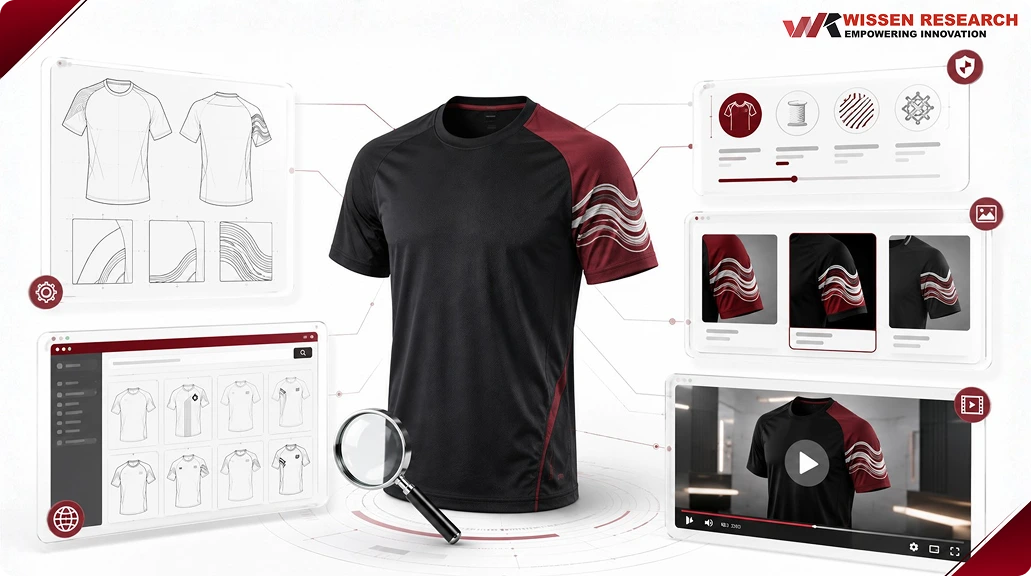
T-Shirt Design Patent Invalidation Case Study | Prior Art

What If a Product Launch Video Could Invalidate a T-Shirt Design Patent?

Expanding beyond conventional design searches uncovered the missing public visual evidence that transformed a t-shirt design patent invalidation investigation.

Type Invalidation Search
Industry Apparel & Sportswear
Published 28 July, 2026
T-shirt design patent image

The Client's Challenge

A client sought support in evaluating the validity of a design patent covering the ornamental appearance of a t-shirt featuring a distinctive wave-pattern design integrated into its half sleeves. Unlike utility patents, where novelty is often established through technical functionality, design patents are assessed based on the overall visual impression created by the claimed ornamental features.

The objective was therefore not only to conduct a comprehensive design patent search but also to determine whether broader public disclosures could provide stronger evidence regarding the originality of the claimed visual design.
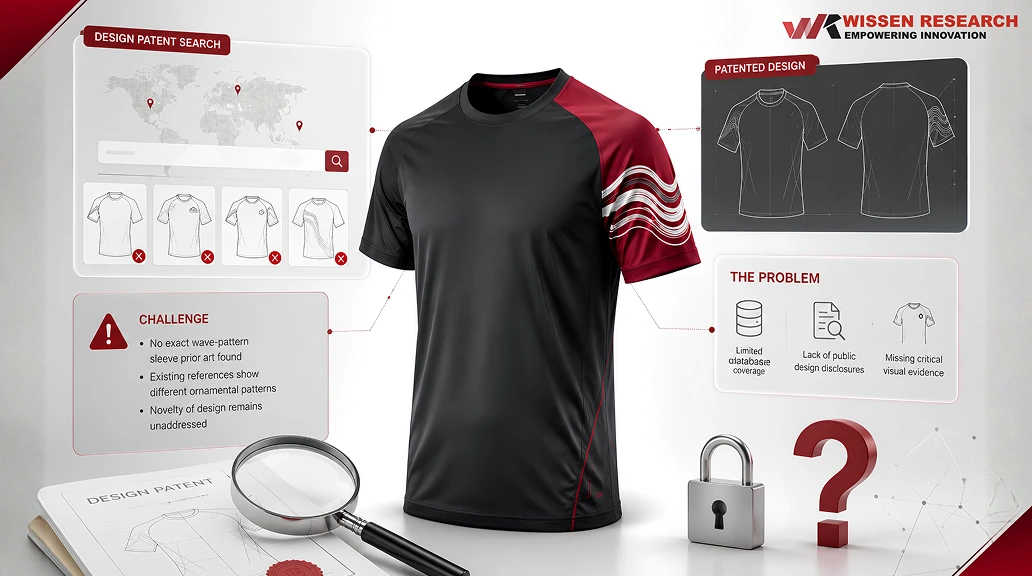
T-shirt design patent post

Throughout the investigation, particular attention was given to ornamental characteristics defining the claimed design, including:

    • Wave-shaped striping incorporated into the half sleeves.
    • Placement and continuity of the ornamental sleeve pattern.
    • Overall visual impression created by the sleeve design.
    • Similarity of decorative features across previously disclosed apparel designs.
    • Public availability of comparable designs before the relevant patent timeline.
    • Identification of independently verifiable visual evidence supporting prior public disclosure.
Objective icon
CLIENT’S OBJECTIVE

Identify prior art capable of challenging the novelty of a patented t-shirt half-sleeve wave design by uncovering earlier public design disclosures.

Clients come to us for answers.
They leave with opportunities they didn’t know existed.

Our experts help organizations uncover insights, opportunities and strategic directions that traditional approaches often miss.

Wissen's Out-of-the-Box Approach:

Looking Beyond Design Databases to Find Public Visual Evidence

  • The initial investigation established that conventional design patent databases and non-patent literature contained numerous apparel designs with decorative sleeve elements. However, despite extensive searching, none disclosed the distinctive wave-pattern ornamentation on half sleeves that defined the subject patent.
  • Rather than concluding that no stronger prior art existed, the investigation shifted to a broader question: If the design had existed before the patent, where would consumers have seen it?
  • The investigation included:
  • Official product showcase videos.
  • Brand promotional campaigns.
  • Publicly released apparel demonstrations.
  • Historical product presentation videos.
  • Commercial visual marketing material.

Identifying Relevant Public Design Evidence

  • A structured review of publicly available product showcases was conducted across leading sportswear brands known for introducing new apparel collections through digital marketing campaigns.

  • The discovery significantly strengthened the investigation by providing visual evidence that directly addressed the primary ornamental feature of the claimed design.

Our Methodology

Traditional Search Limitations
Product Design Characterization
Global Design Prior Art Investigation
Investigation Gap Assessment
Public Visual Evidence Investigation
Visual Comparison & Validation
Comprehensive Prior Art Assessment
Traditional Search Limitations
  • Partial ornamental design similarities
  • Missing wave-pattern sleeve designs
  • Limited public design coverage
  • No matching visual disclosure
Product Design Characterization
  • Analyze claimed design features
  • Identify visual design elements
  • Develop search keywords
  • Define design classifications
Global Design Prior Art Investigation
  • Search global design databases
  • Review registered design references
  • Compare ornamental sleeve patterns
  • Screen visually similar designs
Investigation Gap Assessment
  • Evaluate identified references
  • Identify missing design features
  • Assess novelty gaps
  • Expand investigation scope
Public Visual Evidence Investigation
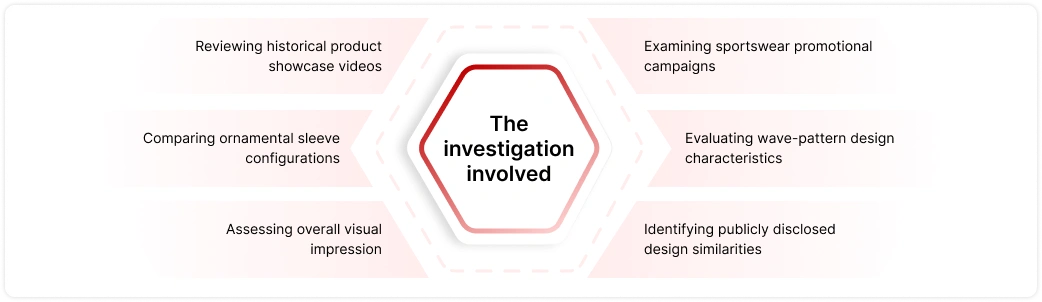
  • Review historical product videos
  • Examine brand promotional materials
  • Analyze public product showcases
  • Identify matching visual designs
Visual Comparison & Validation
  • Compare overall visual impression
  • Evaluate ornamental similarities
  • Validate public design disclosures
  • Corroborate visual evidence
Comprehensive Prior Art Assessment
  • Consolidate supporting references
  • Prepare comparative analysis
  • Document investigation findings
  • Deliver structured prior art report
Outcome

Public visual evidence identified, strengthening the client’s design patent invalidation strategy.

Visual Design Investigation Methodology

The investigation focused on product showcase videos and promotional material released by leading sportswear manufacturers before the relevant patent timeline, involving:

Through this investigation, a publicly available product video was identified featuring a t-shirt with wave-pattern ornamentation on its half sleeves.

Technical Challenges Addressed

Challenge 1: Identifying Novelty Among Visually Similar Sleeve Designs

A significant challenge involved determining whether previously disclosed sportswear designs genuinely anticipated the claimed ornamental appearance or merely shared general decorative characteristics.

Solution

Rather than relying on broad visual similarities, the investigation focused on the distinguishing ornamental characteristics that shaped the overall visual impression of the design.

Each reference was evaluated for:
  • Pattern geometry.
  • Sleeve placement.
  • Ornamentation continuity.
  • Visual flow.
  • Overall appearance.

The analysis established a clear distinction between general decorative sleeve treatments and the specific visual characteristics requiring further investigation.

Challenge 2: Expanding Prior Art Beyond Conventional Design Repositories

After extensive searching, no registered design reference disclosed the claimed wave-pattern half-sleeve configuration. Limiting the investigation to traditional intellectual property resources risked leaving a significant evidentiary gap despite the possibility that comparable products had already been publicly marketed.

Solution

During the review of publicly available product showcase videos, one reference disclosed a t-shirt incorporating wave-shaped ornamentation on its half sleeves that closely corresponded to the principal visual characteristic of the claimed design.

The investigation revealed:
  • Historical product video evidence
  • Wave-pattern half-sleeve ornamentation
  • Pre-existing public design disclosure
  • Matching overall visual impression
  • Independently verifiable prior art

This discovery addressed the critical gap identified during the earlier investigation and demonstrated the value of incorporating broader public visual evidence into structured design patent searches.

Results & Business Impact

The investigation successfully expanded the scope of conventional design patent searching by incorporating publicly available visual evidence into the prior art assessment.

Key Outcomes

    • Conducted a comprehensive design prior art investigation across multiple international design repositories.
    • Identified numerous visually similar apparel designs featuring decorative sleeve patterns.
    • Established that conventional references did not disclose the claimed wave-pattern half-sleeve ornamentation.
    • Expanded the investigation beyond registered design databases to publicly available commercial evidence.
    • Discovered a historical product video disclosing a comparable ornamental sleeve design.
Strategic Business Impact

By incorporating these public commercial disclosures into a structured search strategy, organizations can:

  • Improve prior art coverage for design patent investigations.
  • Reduce the likelihood of overlooking relevant public disclosures.
  • Develop stronger evidence supporting novelty assessments.
  • Increase confidence in litigation, licensing, and freedom-to-operate decisions.
  • Make more informed intellectual property strategy decisions based on broader evidence.

The project illustrates how adapting the investigation methodology to reflect real-world product commercialization can significantly improve the quality and completeness of design patent research.

Looking Beyond Traditional Design Searches?

Our team combines structured design searching with public evidence analysis to support design patent invalidation, freedom-to-operate studies and competitive intelligence.