
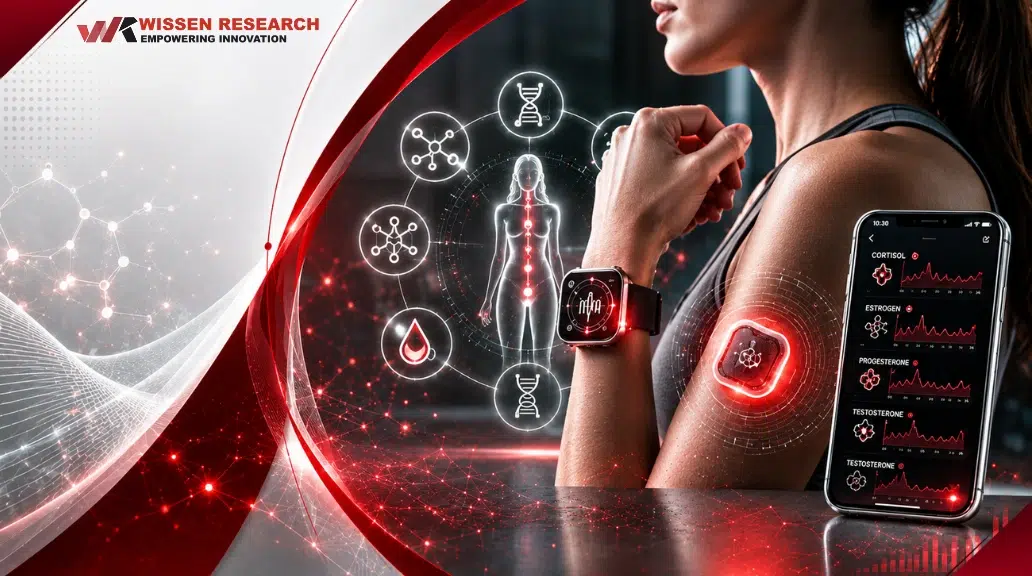
A health-technology company was evaluating whether to enter the growing wearable hormone-monitoring market. While cortisol and hormone tracking were gaining attention, the client faced a major challenge: it was difficult to distinguish genuine hormone-sensing technologies from products using similar language for general wellness purposes. The client also needed to understand which technologies were mature enough to invest in, which were still years away from commercialization, and which consumer segments offered the strongest opportunity.
PROBLEM STATEMENT
The Client's Challenge
Three key challenges emerged:
- Unclear clinical validation: Many wearables claim to track stress or cortisol, but only a limited number have published evidence showing that their readings correspond with established blood-based measurements.
- Uncertain technology maturity: The market includes technologies ranging from commercially available sweat sensors to early-stage concepts such as smart contact lenses and mouthguard-based sensors.
- A missed market opportunity: Most companies were targeting the growing wellness and stress-management market, while potentially larger opportunities in hormonal health remained relatively underserved.

CLIENT'S OBJECTIVE
The objective was to build a clear framework that could help the client:
- Separate clinically supported hormone-sensing technologies from wellness-focused products.
- Understand which technologies were ready for near-term investment and which required longer-term development.
- Identify companies with strong sensing technology and intellectual property.
- Find underserved consumer segments with meaningful commercial potential.
- Determine where to invest, partner, acquire, or wait.
THE TRADITIONAL APPROACH
A Competitor Feature List
The obvious approach would have been to identify wearable products claiming to monitor hormones or cortisol and compare their:
Features
Form factors
Prices
Accuracy claims
Target users
Market Positioning
However, this produced a long list of products without answering the questions that mattered most to the client.
A feature comparison could not show:

- Which claims were supported by clinical evidence.

- Which sensing technologies were commercially ready.

- Which technologies were still at an early research stage.

- Whether the market opportunity was immediate or several years away.

- Which underserved consumer groups could represent the next major opportunity.
The result was technically informative, but not useful for making an investment decision.
Outcome of this approach: A list of devices that all sound similar — technically accurate, but strategically useless. It couldn’t tell the client which claims were backed by real clinical evidence and which were sweat-patch wellness products borrowing the same language. It also couldn’t answer the client’s most pressing question: was there a genuine, near-term window opening in this market, or was this still years away from being investable?
OUR APPROACH
Multi-Dimensional Technology & Market Intelligence
- Instead of creating another competitor list, we developed an evidence-based framework combining technology maturity, clinical validation, patents, competitive positioning, and consumer demand.
- Ranked sensing technologies based on their actual development stage.
- Verified hormone-tracking claims against available clinical evidence.
- Reviewed patents to understand the strength of underlying technologies.
- Identified important clinical milestones that could accelerate market adoption.
- Analyzed consumer segments to identify opportunities that competitors were overlooking.
Our Methodology
Sensing Technology Landscape

- We mapped the major technologies being developed for wearable hormone monitoring, including Sweat patches, Interstitial-fluid sensors, Smart contact lenses, Textile-based sensors, Face-mask sensors, Smart mouthguards.
- Each technology was assessed using a Technology Readiness Level (TRL) framework to determine whether it was commercially deployable, approaching commercialization, or still at the research stage.
- This helped separate near-term investment opportunities from longer-term technology bets.
Clinical Validation

- We reviewed available clinical evidence and compared company claims with actual test results.
- Rather than accepting claims such as “continuous cortisol monitoring,” we looked for evidence showing whether wearable readings matched established laboratory measurements, such as LC-MS/MS blood measurements.
- Companies were then grouped according to the strength of their clinical evidence.
Patent & IP Analysis

We reviewed relevant patent filings covering hormone-sensing technologies, including technologies based on aptamers and other sensing chemistries.
This helped assess:
- How differentiated the technology was.
- How strong the company’s IP position appeared.
- Where opportunities remained for new entrants.
- Which technologies could be attractive for licensing, partnerships, or acquisition.
Competitive Positioning

We compared specialist startups with established wearable companies based on their actual sensing capabilities rather than brand size or market presence.
This helped identify companies with:
- Proprietary sensing technology.
- Strong clinical evidence.
- Relevant IP.
- Partnership or licensing potential.
Technical Challenges Addressed
Challenge 1: Which Hormone-Tracking Claims Can Be Trusted?
Many products in the market use terms such as “cortisol tracking” or “hormone monitoring,” but the strength of supporting evidence varies considerably.
Our Solution
We compared company claims with published clinical evidence.For example, Adaptyx Biosciences’ June 2026 data reported continuous, multi-day cortisol measurements that showed agreement with blood-based measurements, along with a sub-1 nanomolar limit of detection and more than 400 hours of monitoring data supporting an FDA submission pathway. We therefore separated technologies with meaningful clinical evidence from commercially available wellness products without comparable validation.
This gave the client a clearer view of which technologies could support serious healthcare applications and which remained primarily wellness-focused.
Challenge 2: Where Is the Real Market Opportunity?
Most companies in the category were focused on stress management and wellness optimization. However, consumer interest in these areas does not necessarily represent the largest long-term opportunity.
Our Solution
We developed a consumer-segmentation framework and assessed different populations independently.This highlighted an underserved opportunity around hormonal transitions, including:
- Perimenopause
- Menopause
- Fertility care
Our analysis identified this as a $600 billion market opportunity affecting approximately 1.2 billion women by 2030, while only around 7% of femtech startups were focused on this area.
Early commercial activity also supported the opportunity. One company in the competitive landscape had secured $3 million in signed letters of intent from IVF clinics, suggesting that demand extends beyond consumer wellness and into clinical applications.
RESULTS & BUSINESS IMPACT
Key Outcomes
-

A clear distinction between clinically supported hormone-sensing technologies and wellness-focused products.
-
A technology maturity framework showing which sensing approaches are closer to commercialization and which remain longer-term bets.
-
Identification of an important clinical milestone involving continuous, blood-validated cortisol monitoring.
-
Identification of an underserved hormonal-health market opportunity.
-
A competitive landscape highlighting potential partnership, licensing, and acquisition targets.
Strategic Business Impact
The analysis helped the client move from “Who is in the market?” to “Where should we act?”
It provided:
- A prioritized technology-investment roadmap.
- Early visibility into an underserved consumer segment.
- A clearer understanding of which technology claims were clinically defensible.
- A view of market timing based on clinical progress rather than consumer buzz alone.
- A framework for identifying potential technology and partnership targets.
CONCLUSION & IMPLICATIONS
A conventional competitor analysis can show that the wearable hormone market is growing, but it cannot tell a company which technologies are genuinely validated, which are ready for commercialization, or where the next major opportunity may emerge.By combining clinical evidence, technology maturity, patent analysis, competitive intelligence, and consumer segmentation, we turned a crowded and uncertain market into a clear, decision-ready roadmap. The analysis highlighted four key lessons:
Look beyond marketing claims and verify the evidence behind a technology.
Measure technology readiness, rather than assuming that market buzz means commercial readiness.
Treat major clinical milestones as potential market-timing signals.
Look beyond the most visible consumer segment to identify underserved markets with stronger long-term potential.