
Patent Invalidation Search for Medical Device Prior Art

Can a Protective Housing Disclosure Expose a Gap in a Medical Device Patent?

A structured invalidation search for a T-shaped pelvic-positioning device uncovered complementary prior art on sensor configuration and protective housing providing a potential basis for a broader validity challenge.

Case Study Type Patent Invalidation Search
Industry Medical Devices
Publication Date October 14, 2026
hip replacement image

The Client's Challenge

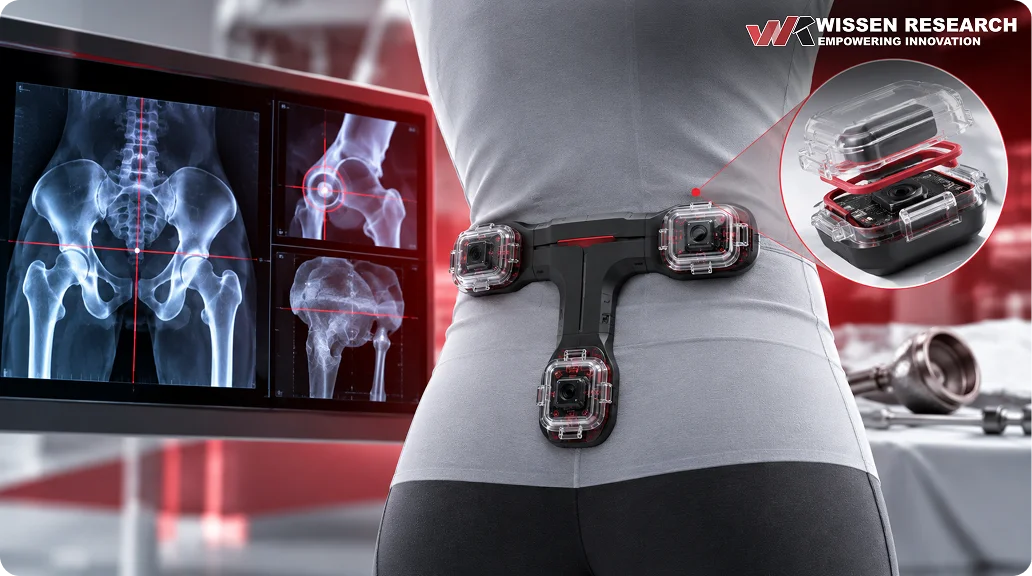
A client sought an invalidation search for a patent directed to a T-shaped, skin-mounted device intended to assist pelvic positioning during hip replacement surgery.

The device was designed to be placed on the patient’s back and sacrum, providing a reference for pelvic positioning during the procedure. Its architecture incorporated a T-shaped arrangement supporting up to three sensors. The sensors were enclosed in protective housings intended to safeguard the electronics while preserving the accuracy of the positioning measurements.
hip replacement challenge image

The patent claims primarily covered:

    • A T-shaped, skin-mounted device configured to provide a reference for pelvic positioning during hip replacement surgery.
    • A sensor arrangement mounted on the T-shaped structure to capture positioning data from the patient’s back and sacrum.
    • A waterproof housing enclosing the sensors to protect the electronic components while maintaining pelvic-positioning accuracy.
    • Integration of the sensor-equipped device with surgical instrumentation, including an acetabular cup introducer.
    • A multi-sensor configuration supporting the collection of pelvic-positioning information to assist the surgeon during hip replacement procedures.
Objective icon
CLIENT’S OBJECTIVE

The objective was to identify relevant prior art that could support a challenge to the subject patent’s validity.

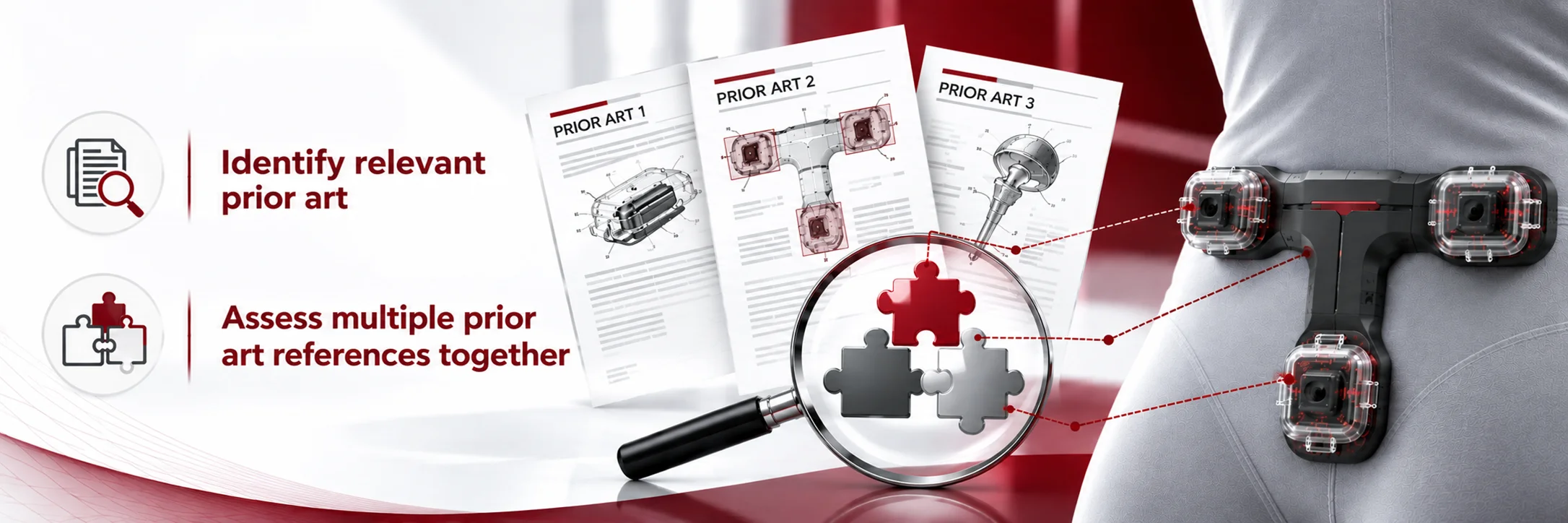
Assess whether multiple prior art references, when considered together, could establish that the claimed technical combination would have been obvious to a person skilled in the art.

Clients come to us for answers.
They leave with opportunities they didn’t know existed.

Our experts help organizations uncover insights, opportunities and strategic directions that traditional approaches often miss.

Wissen’s Out-of-the-Box Approach:

Feature-Driven Prior Art Search Through Complementary Technical Disclosures

  • Recognizing the limitations of conventional feature-based searching, the investigation evolved beyond identifying prior art that described the complete T-shaped, skin-mounted pelvic-positioning device.
  • To develop a broader and more technically grounded invalidity assessment, the search strategy was expanded to examine individual technical features across related medical device technologies, particularly the sensor-protection housing.

Identifying Relevant Prior Art

  • A focused investigation was conducted to identify earlier disclosures addressing the principal features of the subject patent.

  • However, the initial references did not explicitly establish the claimed protective housing feature in the required technical context.

  • To address this gap, the investigation broadened beyond the specific T-shaped configuration to examine hip-replacement devices incorporating sensor-protection housings, irrespective of their configuration or sensor operation.

Our Methodology

Patent and Prosecution History Analysis
Technical Feature Identification
Comprehensive Keyword and Classification Search
Assignee, Inventor, and Citation-Based Search
Targeted Search for Protective Sensor Housings
Claim Mapping and Complementary Reference Analysis
Evidence Assessment and Invalidity Report Preparation
Patent and Prosecution History Analysis
  • Review the granted claims, patent specification, drawings, and notice of allowance.
  • Examine office actions, examiner-cited references, and applicant arguments.
Technical Feature Identification
  • Identify the T-shaped skin-mounted sensor configuration and pelvic-positioning functionality.
  • Isolate the protective housing feature as a key technical aspect requiring further investigation.
Comprehensive Keyword and Classification Search
  • Search relevant keywords, synonyms, and technical equivalents.
  • Apply IPC, CPC, US classification and F-term search strategies.
Assignee, Inventor, and Citation-Based Search
  • Identify relevant disclosures through assignee and inventor searches.
  • Expand the search using citation analysis, similarity searches, and related technical references.
Targeted Search for Protective Sensor Housings
  • Broaden the search beyond the specific T-shaped device configuration.
  • Identify hip-replacement technologies disclosing housing structures that cover and protect sensors.
Claim Mapping and Complementary Reference Analysis
  • Map the shortlisted references against individual claim limitations.
  • Assess the complementary disclosures relating to device configuration and sensor protection.
Evidence Assessment and Invalidity Report Preparation
  • Compile claim charts, text mappings, and summaries of relevant prior art.
  • Document disclosure gaps and assess the potential for a combination-based invalidity argument.
Outcome:

Identification of complementary prior art addressing the T-shaped pelvic-positioning configuration and protective sensor housing.

Prior Art Search Methodology

The investigation involved a structured patent invalidation search to identify relevant prior art addressing the claimed T-shaped, skin-mounted pelvic-positioning device and its sensor-protection mechanism.

hip replacement methodology image

By broadening the search to include hip-replacement devices incorporating sensor-protection housings, the investigation identified an additional reference disclosing a housing body designed to cover and protect a sensor.

The findings were consolidated into claim charts, text mappings, and reference summaries, providing a structured basis for evaluating whether the complementary technical disclosures could support a potential patent invalidity argument.

Technical Challenges Addressed Through Prior Art Analysis

Challenge 1: Identifying Prior Art for the T-Shaped Pelvic-Positioning Device

One of the key challenges involved identifying earlier disclosures of a T-shaped, skin-mounted device designed to provide a reliable pelvic-positioning reference during hip replacement surgery, particularly for patients with higher BMI.

Solution

A structured prior art search was conducted using keyword combinations, patent classifications, assignee and inventor searches and citation analysis across patent and non-patent databases. The investigation identified references D2 and D3 that addressed aspects of the T-shaped sensor configuration and its application in pelvic positioning.

The analysis revealed:
  • T-shaped, skin-mounted device configurations for pelvic positioning.
  • Sensor arrangements designed to provide positioning information to the surgeon.
  • Application of the device in hip replacement procedures.
  • Integration of positioning components with surgical instrumentation.

These findings established relevant prior art for assessing the device configuration and its intended surgical application against the subject patent claims.

Challenge 2: Identifying Prior Art for the Protective Sensor Housing

Another important challenge involved determining whether earlier hip replacement technologies disclosed a housing designed to cover and protect sensor components while maintaining their intended functionality.

Solution

Since the initially identified references did not explicitly establish the protective housing feature in the required technical context, the search strategy was broadened to examine hip replacement devices incorporating sensor-protection housings, irrespective of their configuration or specific sensor operation. This approach identified reference D1, which disclosed a housing body covering and protecting a sensor.

The analysis revealed:
  • A housing body designed to enclose and protect sensor components.
  • A protective structure associated with a sensor-equipped hip replacement device.
  • A complementary technical disclosure relevant to the sensor-housing limitation of the subject patent.

These findings provided an additional technical reference for evaluating the claimed protective housing feature alongside the disclosures concerning the T-shaped pelvic-positioning device.

Results & Business Impact

The investigation identified complementary prior art references addressing the T-shaped, skin-mounted pelvic-positioning device and the protective sensor housing. The findings established a potential pathway for challenging the subject patent through a combination-based invalidity argument.

Key Outcomes

  • Key outcome Icon

    Identification of relevant prior art addressing the T-shaped sensor configuration for pelvic positioning during hip replacement surgery.

  • Key outcome Icon

    Discovery of a reference disclosing a protective housing body covering and protecting the sensor.

  • Key outcome Icon

    Identification of technical disclosure gaps in the available prior art concerning the claimed sensor-protection features.

  • Key outcome Icon

    Development of claim charts, text mappings and reference summaries to support a structured assessment of patent validity.

  • Key outcome Icon

    Establishment of a potential multi-reference invalidation strategy by evaluating complementary technical disclosures.

Strategic Business Impact

By expanding the investigation beyond the complete device configuration to examine individual technical features, the study provided:

  • Broader prior art coverage.
  • Clearer identification of disclosure gaps.
  • Stronger support for potential invalidity arguments.
  • Improved claim-level evidence mapping.
  • A structured basis for further validity assessment.

The investigation demonstrated how an adaptive, feature-driven search strategy can uncover complementary technical disclosures that may remain unidentified when prior art research focuses exclusively on the overall device architecture.

Could a Focused Prior Art Search Change Your Patent Strategy?

Our team helps clients investigate complex patent claims, identify relevant technical disclosures and organize evidence for informed validity assessments.