
Adeno- Associated Virus and Cell Maintenance and Transfection Automation - Wissen Research

How Can Prior Art Mapping Reveal Emerging Adeno-Associated Virus Manufacturing Technologies?

A prior art landscape mapped AI, robotics and imaging technologies shaping automated viral vector manufacturing and identified key innovations across cell culture automation.

Case Study Type Prior Art Search
Industry Biotechnology
Publication Date August 21, 2026

The Client’s Challenge

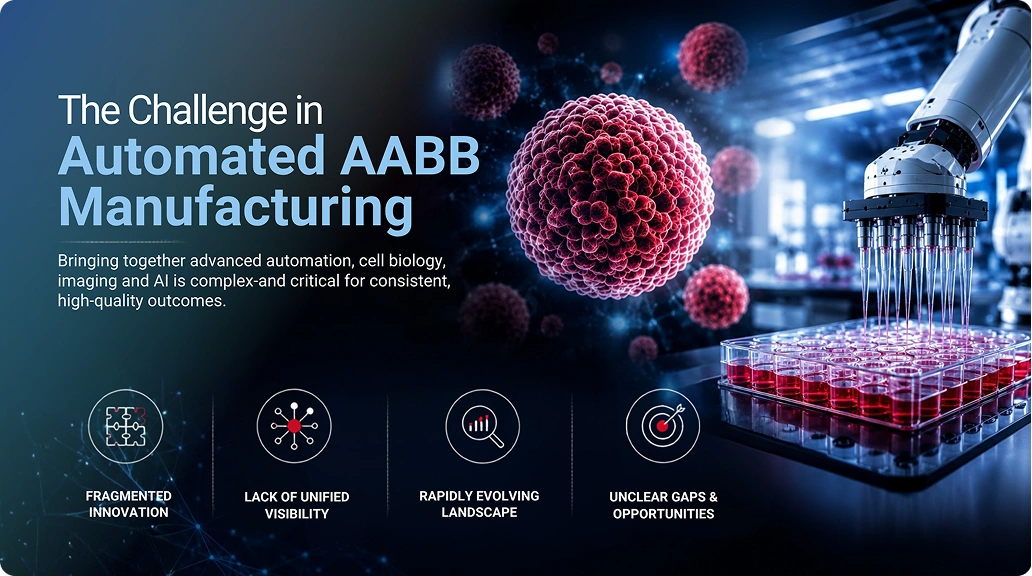
Adeno-associated viruses (AAVs) have become an important delivery platform in gene therapy applications due to their ability to transport genetic material into targeted cells. The primary objective of the landscape investigation was to identify the existing technology ecosystem surrounding automated AAV production and determine how closely available patent and non-patent literature aligned with the integrated system concept.

The investigated technology focused on an advanced automated AAV manufacturing workflow integrating sterile cell culture environments, robotic handling systems, imaging-based monitoring, and artificial intelligence-driven process optimization.

The technology landscape primarily covered:

    • Automated manufacturing systems for adeno-associated virus (AAV) production using integrated robotic and computational workflows.
    • Sterile incubation environments designed for automated maintenance and controlled cultivation of cell cultures.
    • Vision-based monitoring systems for continuously capturing and analyzing cell culture conditions.
    • Artificial intelligence and machine learning approaches for evaluating biological images, determining cell confluency and assessing growth characteristics.
    • Integration of biological processing, laboratory automation, imaging and AI-based decision-making to enable scalable and reproducible viral vector manufacturing.
Objective icon
CLIENT’S OBJECTIVE

Identify key technology disclosures across patents and scientific literature while mapping individual system components

Evaluate technology gaps and emerging opportunities within automated viral vector production.

Clients come to us for answers.
They leave with opportunities they didn’t know existed.

Our experts help organizations uncover insights, opportunities and strategic directions that traditional approaches often miss.

Wissen’s Out-of-the-Box Approach:

Technology Convergence Mapping Across Automated Bioprocessing Systems

  • Recognizing the limitations of conventional AAV-focused prior art searching, the investigation evolved beyond searching only for direct disclosures related to automated viral manufacturing.
  • To enable a broader and more technically grounded understanding of the innovation landscape, the analysis expanded beyond individual AAV production references and the investigation focused on identifying technologies that were:
  • Developed for automated biological processing workflows.
  • Applicable to scalable cell culture and viral manufacturing environments.
  • Demonstrative of intelligent monitoring and optimization capabilities.

Identifying Relevant Technology Prior Art

  • A focused technical investigation was conducted across biotechnology automation platforms, robotic laboratory systems and AI-enabled biological analysis technologies.

  • However, direct disclosures combining automated AAV manufacturing with robotic handling, continuous imaging and AI-driven optimization were limited.

To overcome the limitation of fragmented disclosures, the investigation correlated individual technology components across patent and non-patent literature to understand how separate advancements contribute toward intelligent automated viral manufacturing workflows.

Our Methodology

Traditional Search Limitations
Technology Element Identification
Patent and Literature Search
AI-Based Image Analysis Investigation
Robotic System Evaluation
Technology Correlation and Mapping
Landscape Development and Insights
Traditional Search Limitations
  • Direct AAV automation references were limited
  • Technology disclosures existed across domains
  • Complete system integration was rarely disclosed
Technology Element Identification
  • Decompose automated manufacturing workflow
  • Identify core functional components
  • Analyze cell culture automation elements
Patent and Literature Search
  • Search patent and scientific databases
  • Apply keywords and classifications
  • Review relevant technical disclosures
AI-Based Image Analysis Investigation
  • Identify AI-driven image processing
  • Analyze cell confluency detection
  • Evaluate growth prediction methods
Robotic System Evaluation
  • Analyze automated handling systems
  • Review robotic culture management
  • Assess laboratory workflow automation
Technology Correlation and Mapping
  • Map disclosed technology elements
  • Connect fragmented prior art
  • Identify technology convergence patterns
Landscape Development and Insights
  • Consolidate relevant technology disclosures
  • Identify innovation trends and gaps
  • Develop comprehensive technology landscape
Outcome

A comprehensive prior art landscape mapping AI, robotics, imaging and automated cell culture technologies providing strategic insights into emerging viral vector manufacturing automation approaches.

Technical Challenges Addressed Through Prior Art Landscape Analysis

Challenge 1: Identifying Automated Cell Culture Systems Capable of Supporting High-Throughput Biological Manufacturing

Could existing technologies automate cell maintenance processes required for viral manufacturing by reducing manual intervention and enabling controlled biological growth environments?

Solution

The investigation expanded beyond virus-specific production references and analyzed automated cell manufacturing systems used across biotechnology applications.

The analysis identified prior art describing:
  • Sterile incubation chambers
  • Controlled environmental parameters
  • Automated cell handling mechanisms
  • Robotic transfer of biological containers
  • Computer-controlled workflow execution

These systems demonstrated how laboratory operations traditionally dependent on manual handling could be converted into repeatable automated workflows.

The findings established that automated cell maintenance and robotic laboratory operations were already developing technology areas relevant to future viral vector manufacturing platforms.

Challenge 2: Determining Whether AI Could Analyze Cell Culture Images for Process Optimization

Could artificial intelligence and machine learning techniques evaluate biological images to determine cell growth conditions and support automated manufacturing decisions?

Solution

Initial searches identified multiple imaging-based cell monitoring systems. However, determining whether these systems incorporated intelligent analysis required additional investigation into AI-based biological image processing.

The analysis revealed approaches where AI models could assist in:
  • Determining cell density
  • Evaluating morphological characteristics
  • Predicting optimal processing conditions
  • Supporting automated biological decision-making

AI-assisted image analysis is increasingly being explored as part of automated cell manufacturing workflows, where imaging data can be used to guide culture decisions rather than relying solely on manual observation.

Results & Business Impact

The final investigation successfully developed a comprehensive prior art landscape identifying key technologies contributing to automated viral vector manufacturing through a structured analysis of biotechnology, robotics, imaging and artificial intelligence domains.

Key Outcomes

  • Key outcome Icon

    Identified key patents and scientific references across automated cell culture, robotics, imaging, and AI-based analysis.

  • Key outcome Icon

    Mapped fragmented disclosures contributing to automated viral vector manufacturing workflows and technology evolution.

  • Key outcome Icon

    Established relationships between cell maintenance, robotics, computer vision, and process optimization technologies.

  • Key outcome Icon

    Identified emerging trends in intelligent bioprocess automation and high-throughput biological manufacturing.

  • Key outcome Icon

    Improved understanding of technology maturity, integration challenges, and innovation opportunities in automated production systems.

Strategic Business Impact

By expanding beyond conventional AAV-focused searches and incorporating cross-domain technology analysis, the investigation provided:

  • Broader visibility into the automated bioprocessing technology ecosystem.
  • Improved understanding of competitive technology directions.
  • Identification of potential innovation gaps and differentiation opportunities.
  • Strategic insights for future research and development planning.
  • Enhanced decision-making through structured mapping of emerging technologies.

The approach demonstrated how combining patent intelligence with scientific literature analysis can reveal technology relationships that may remain hidden when evaluated through a single technical domain.

Need Strategic Visibility Into Emerging Biotechnology Technologies?

Our team helps organizations uncover technology trends, competitive intelligence and innovation opportunities through structured patent landscapes and technical research.