Prior Art Search Invalidates Active Rectifier Patent

What Happens When an Active Rectifier Patent’s Novel Control Architecture Appears in Prior Art?

A targeted invalidation search traced synchronization control and level-shifting techniques through patent and non-patent literature to uncover earlier active rectifier implementations.

Type Invalidation Search
Industry Semiconductor
Published September 04, 2026
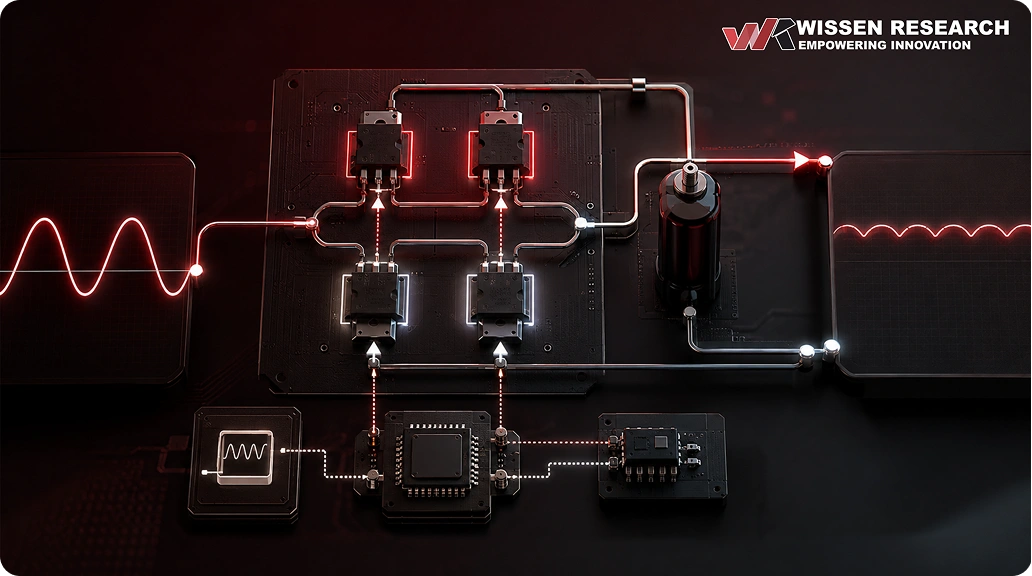
Active rectifier circuit image

The Client’s Challenge

A client sought support in invalidating a patent related to an active rectifier, an AC-to-DC conversion circuit designed to improve efficiency by replacing conventional diode-based rectification with actively controlled semiconductor switches.

The subject patent described a switching architecture in which four switches controlled current flow according to the polarity of the incoming AC signal. The first and fourth switches operated during the negative AC voltage cycle while the second and third switches operated during the positive cycle, directing the resulting current toward a rectifying capacitor.
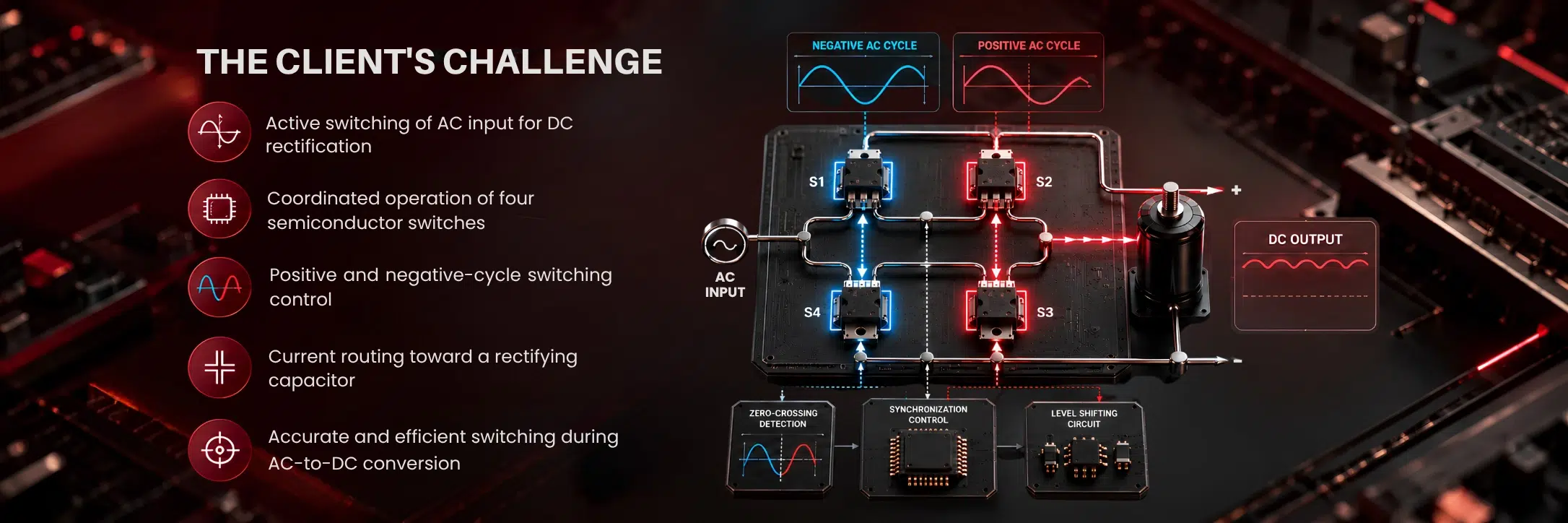
Active rectifier challenge image

The investigation focused on the technical concepts represented by the claimed architecture:

    • Active switching of an AC input for DC rectification
    • Coordinated operation of four semiconductor switches
    • Positive- and negative-cycle switching control
    • Current routing toward a rectifying capacitor
    • Accurate and efficient switching during AC-to-DC conversion
Objective icon
CLIENT’S OBJECTIVE

Identify prior art capable of challenging the validity of the subject patent.

Determining whether the patent’s claimed combination of active rectification, synchronization control and level-shifting circuitry had already been disclosed in earlier technical systems.

Had earlier technology already addressed the same switching-control problems through substantially the same circuit architecture?

Clients come to us for answers.
They leave with opportunities they didn’t know existed.

Our experts help organizations uncover insights, opportunities and strategic directions that traditional approaches often miss.

Wissen’s Out-of-the-Box Approach:

Targeted Prior Art Through Circuit Architecture Analysis

  • Recognizing the limitations of conventional literature-based searching, the strategy evolved beyond searching individual circuit features to identify prior art based on the functional relationships within the active rectifier architecture.
  • To enable a more focused assessment of prior art evidence, the investigation expanded beyond broad keyword searches to include technical disclosures that were:
  • Related to active rectifier architectures
  • Directed to synchronized switch control
  • Addressing comparator delay during AC zero-crossing detection

Identifying Relevant Prior Art

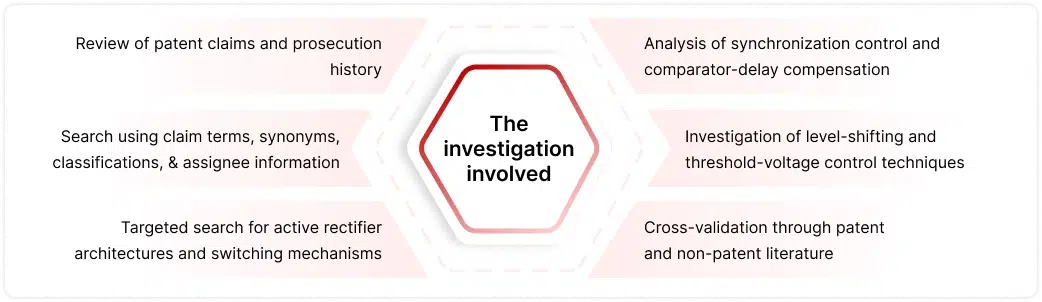
  • A focused technical investigation was conducted on patents and non-patent literature describing active rectifier systems and their associated control mechanisms.

  • However, individual disclosures did not always present these features in the same terminology or circuit context as the subject patent.

  • To overcome this limitation, the search strategy was refined around the underlying circuit architecture and the technical relationships between the claimed control functions.

Our Methodology

Traditional Search Limitations
Patent & Prosecution History Analysis
Targeted Patent Search
Synchronization & Level-Shifting Analysis
Non-Patent Literature Search
Technical Prior Art Correlation
Invalidation Assessment
Traditional Search Limitations
  • Fragmented disclosures across references
  • Different terminology for similar circuit functions
  • Limited architectural correlation
Patent & Prosecution History Analysis
  • Analyze claim scope and technical features
  • Identify potential novelty points
  • Extract key circuit terminology
Targeted Patent Search
  • Use technical synonyms and claim concepts
  • Apply classification codes and assignee information
  • Search combinations of key circuit functions
Synchronization & Level-Shifting Analysis
  • Analyze zero-crossing synchronization
  • Identify comparator-delay compensation
  • Examine level-shifting and threshold-voltage control
Non-Patent Literature Search
  • Review technical articles and research papers
  • Identify earlier active rectifier implementations
  • Correlate technical disclosures with claim elements
Technical Prior Art Correlation
  • Map switching and rectification functions
  • Correlate synchronization and level-shifting mechanisms
  • Assess technical overlap with the patent claims
Invalidation Assessment
  • Establish earlier disclosure of key technical features
  • Assess novelty implications
  • Develop a technically supported invalidation position
Outcome:

Earlier patent and non-patent disclosures were identified that demonstrated the claimed active rectifier architecture and its key synchronization and level-shifting techniques, supporting a strong patent invalidation position.

Prior Art Search Methodology

The investigation focused on patent publications and non-patent literature containing disclosures of active rectifier architectures and associated switching-control techniques relevant to the subject patent.

Active rectifier methodology image

The targeted search revealed earlier technical disclosures addressing active rectification, synchronized switching, comparator-delay compensation and level-shifting techniques for controlled semiconductor switches.

Most importantly, the findings demonstrated that the core technical concepts underlying the claimed active rectifier had already been addressed in earlier systems, providing strong technical support for challenging the patent’s novelty and validity.

Technical Challenges Addressed Through Prior Art Analysis

Challenge 1: Identifying the Claimed Switching Architecture

A key technical question was whether earlier active rectifier systems had already implemented the claimed arrangement of actively controlled switches operating according to the positive and negative AC cycles.

Solution

The investigation examined prior art covering active AC-to-DC conversion and analyzed the switching sequence, current paths and interaction with the rectifying capacitor. The analysis identified earlier active rectifier implementations in which controlled semiconductor switches managed current flow during respective AC cycles.

The findings revealed:
  • Positive-cycle switch operation
  • Negative-cycle switch operation
  • Controlled current paths
  • Rectifying capacitor integration

These disclosures demonstrated that the fundamental switching architecture underlying the claimed active rectifier had been addressed in earlier technology.

Challenge 2: Establishing Synchronization and Level-Shifting Techniques

Another key technical question was whether the synchronization control and level-shifting mechanisms claimed for accurate switch operation had already been disclosed in prior technology.

Solution

The search was refined to target the specific relationship between AC zero-crossing detection, comparator-delay compensation, and voltage-level adjustment for semiconductor switch control.

The investigation identified prior disclosures addressing:
  • AC zero-crossing synchronization
  • Comparator-delay compensation
  • Switch-control timing
  • Threshold-voltage adjustment

These findings demonstrated that the control techniques used to improve switching accuracy and accommodate voltage thresholds were also present in earlier technical solutions.

Results & Business Impact

The investigation ultimately identified earlier systems that addressed the principal technical concepts underlying the subject patent’s active rectifier architecture.

Key Outcomes

  • Key outcome Icon

    Identified prior technology implementing active AC-to-DC rectification using controlled semiconductor switches.

  • Key outcome Icon

    Established earlier approaches to polarity-dependent switching during AC cycles.

  • Key outcome Icon

    Identified prior approaches addressing synchronization and switching timing associated with AC zero-crossing detection.

  • Key outcome Icon

    Identified level-shifting techniques relevant to semiconductor switch control and threshold-voltage requirements.

  • Key outcome Icon

    Expanded the evidence base beyond conventional patent searching into non-patent technical literature.

  • Key outcome Icon

    Provided technically supported evidence for challenging the patent’s validity.

Strategic Business Impact

The project demonstrated why invalidation searches for complex electronics patents cannot always be reduced to keyword matching. A search strategy built around those relationships can provide several advantages:

  • More precise prior-art identification by targeting technical interactions.
  • Broader coverage through alternative terminology and non-patent literature.
  • Improved technical confidence through correlation of circuit-level concepts.
  • Earlier identification of invalidation opportunities where conventional searches produce only partial matches.

A reference that merely contains an active rectifier may have limited value. A reference that demonstrates how the rectifier’s switching, synchronization and voltage-level mechanisms work together can provide substantially more meaningful insight into the validity of the claimed architecture.

Could Earlier Technology Challenge a Complex Electronics Patent?

Our team combines patent research with technical analysis to uncover prior-art evidence across complex circuit architectures, semiconductor technologies and emerging electronics systems.