Medical Device Patentability Search: Endoscope Case Study

What Happens When the Search for an Endoscope Patent Moves Beyond the Endoscope Itself?

A structured patentability investigation examined how device identification, base-station connectivity, manufacturing data, safety management and hospital inventory monitoring intersected across patent and non-patent literature.

Type Patentability Search
Industry Medical Devices
Published September 22, 2026
medical endoscope image

The Client’s Challenge

The client sought to assess the patentability of a medical endoscope system incorporating a machine-readable identification mechanism. At first glance, the individual components of the system appeared relatively straightforward to investigate. Medical endoscopes, machine-readable serial numbers, RFID tags, barcodes and QR codes were all established technologies. The real challenge was determining whether earlier technical disclosures addressed the complete functional combination.

The proposed system extended beyond device identification. The identified endoscope was designed to interact with a base station computer, enabling access to manufacturing-related information, supporting product safety and recall activities and monitoring device availability or stock levels within a hospital environment.
medical endoscope patentability image

The investigation focused on the technical concepts represented by the proposed system:

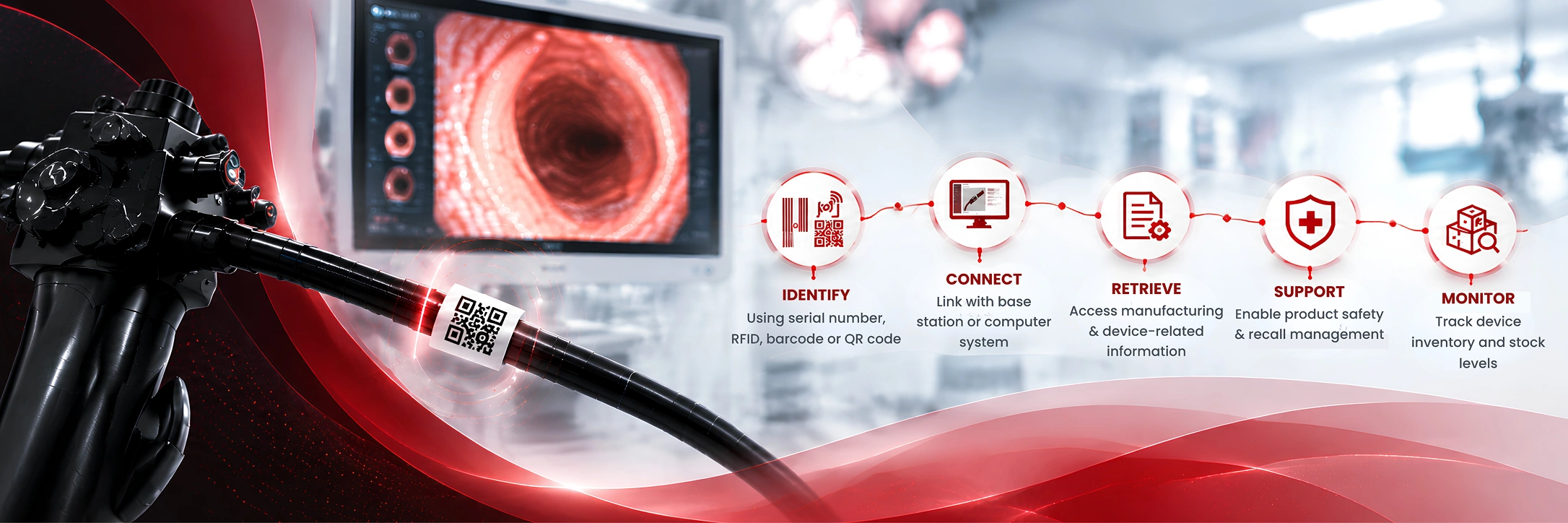
    • Medical endoscope incorporating a machine-readable identifier
    • Identification using a serial number, RFID tag, barcode or QR code
    • Connection between the endoscope and a base station or computer system
    • Retrieval of manufacturing or device-related information
    • Support for product safety and recall management
    • Detection or monitoring of medical device inventory and stock levels
    • Device tracking and management within a hospital environment
Objective icon
CLIENT’S OBJECTIVE

To conduct a structured patentability investigation to identify patent and non-patent literature relevant to the proposed connected medical device management system, with a focus on system-level disclosures covering device identification, connectivity, access to device information, safety/recall support, and inventory monitoring.

Clients come to us for answers.
They leave with opportunities they didn’t know existed.

Our experts help organizations uncover insights, opportunities and strategic directions that traditional approaches often miss.

Wissen’s Out-of-the-Box Approach:

Targeted Prior Art Through System-Level Functionality Analysis

  • The strategy shifted from device-centric searches to identifying prior art based on functional relationships within the connected medical device system.
  • The investigation also expanded beyond broad endoscope and machine-readable identifier searches to focus on technical disclosures that were:
  • Medical device identification and tracking
  • Device connectivity and information access
  • Safety management and inventory monitoring

Identifying Relevant Prior Art

  • Investigated patent and non-patent literature covering medical devices, endoscope systems, device identification, and connected healthcare management.

  • Disclosures varied in terminology and medical context, with some addressing only specific system functions.

  • References covered endoscope identification, traceability, manufacturing information, safety management, and hospital inventory.

  • The search was refined around system functionality and relationships between identification, connectivity, information access, safety, and inventory monitoring.

Our Methodology

Traditional Search Limitations
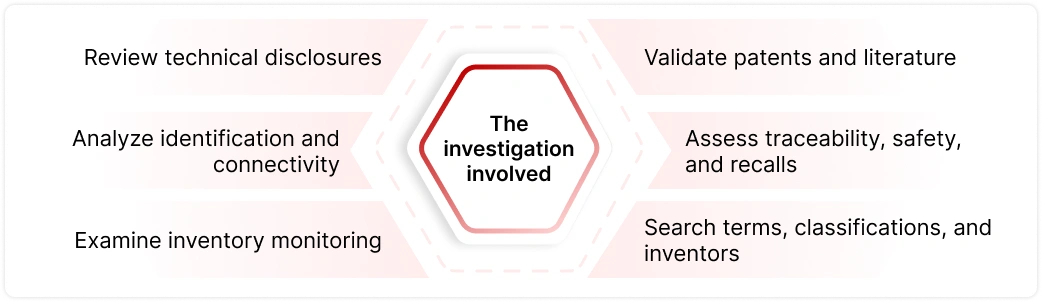
Technical Disclosure Analysis
Targeted Patent Search
Device Identification & Connectivity Analysis
Safety & Inventory Analysis
Citation & Literature Analysis
Prior Art Correlation & Assessment
Traditional Search Limitations
  • Fragmented technical feature disclosures
  • Inconsistent technical terminology
  • Limited system-level visibility
Technical Disclosure Analysis
  • Analyze proposed endoscope system
  • Identify key system functions
  • Extract relevant technical terminology
  • Separate components and relationships
Targeted Patent Search
  • Apply keywords and synonyms
  • Use patent classifications
  • Search assignees and inventors
  • Combine technical functions
Device Identification & Connectivity Analysis
  • Analyze identification mechanisms
  • Examine device recognition methods
  • Study system connectivity interactions
  • Assess information access capabilities
Safety & Inventory Analysis
  • Analyze safety-related functions
  • Examine recall management concepts
  • Identify inventory monitoring methods
  • Assess operational relationships
Citation & Literature Analysis
  • Review patent citations
  • Identify related patent families
  • Explore adjacent technologies
  • Analyze technical literature
Prior Art Correlation & Assessment
  • Map technical features
  • Compare system functionalities
  • Evaluate combined disclosures
  • Identify relevant references
Outcome:

The investigation identified relevant patent and non-patent disclosures covering device identification, system connectivity, information access, safety functionality, and inventory management.

Prior Art Search Methodology

The investigation focused on patent and non-patent literature covering connected medical devices, machine-readable identification, device information management, and hospital operations.

medical endoscope methodology

The targeted search identified prior disclosures covering connected medical devices and relevant system-level functions, including device identification, information access, safety management, and inventory monitoring.

Searching functional relationships between the device and connected system was more effective than focusing only on the endoscope and identification mechanism, enabling identification of prior art covering the broader technical concepts.

Technical Challenges Addressed Through Prior Art Analysis

Challenge 1: Identifying the Complete Connected Medical Device System

The key question was whether earlier medical device systems combined a machine-readable identifier with computer or base-station connectivity. While endoscopes with serial numbers, RFID, barcodes, or QR codes were common, the challenge was determining whether the identifier enabled information access and device management after connection.

Solution

The investigation expanded beyond specific endoscopes to prior art linking machine-readable medical device identification with external system connectivity, including computers, readers, workstations, and base stations.

The findings revealed:
  • Machine-readable medical device identification
  • Device recognition via serial numbers, RFID, barcodes, or similar identifiers
  • Connectivity with external computer systems
  • Information retrieval and system-level device management

These disclosures demonstrated that the investigation needed to focus beyond the physical endoscope and examine how device identification operated within a connected medical device environment.

Challenge 2: Establishing the Relationship Between System Connectivity and Operational Management

Another key question was whether prior systems used medical device–system connectivity for manufacturing information, safety, recalls, and hospital inventory management. The challenge was that these functions used varied terminology and spanned multiple technical domains.

Solution

The search focused on the relationship between device recognition, connectivity, information access, and operational management. It expanded beyond endoscopes to medical device tracking, traceability, information management, safety, recalls, and hospital inventory monitoring.

The investigation identified prior disclosures addressing:
  • Access to device and manufacturing information
  • Medical device traceability and tracking
  • Product safety and device management
  • Inventory monitoring and prevention of inappropriate reuse

These findings demonstrated that relevant system-level functions could be found outside conventional endoscope terminology and that the relationship between the connected device and the management system was critical to the prior art investigation.

Results & Business Impact

The investigation ultimately identified prior art relevant to the principal technical concepts underlying the proposed connected medical endoscope system.

Key Outcomes

  • Key outcome Icon

    Identified prior art on machine-readable medical device identification and system connectivity.

  • Key outcome Icon

    Found disclosures covering device and manufacturing information access.

  • Key outcome Icon

    Identified prior art on medical device tracking, safety, and management.

  • Key outcome Icon

    Found disclosures on hospital inventory and stock-level monitoring.

  • Key outcome Icon

    Distinguished individual-feature disclosures from system-level combinations.

  • Key outcome Icon

    Established a structured evidence base for assessing patentability.

Strategic Business Impact

Patentability searches for connected medical technologies should assess functional relationships across device identification, connectivity, information management, safety, and hospital operations, rather than focusing solely on individual components or the final product.

  • Precise system-level prior art identification
  • Broader search across technical domains
  • Structured feature correlation analysis
  • Faster identification of relevant prior art
  • Clear component and interaction distinction

A reference disclosing only an endoscope with an identifier may have limited relevance, whereas a reference demonstrating interaction between an identified medical device and an external system for information access, device management, or inventory monitoring provides more meaningful insight into the patentability of the proposed technology.

Could Earlier Technology Affect Patentability?

Our team combines patent research and technical analysis across medical devices, identification, connected healthcare and inventory management.