
Diabetes App Patent Risk: FTO Search Case Study

Could an FTO Search Reveal Patent Risks Hidden Within a Diabetes Management Application?

A feature-level FTO investigation examined active US and EP patent rights covering diabetes monitoring, data processing, ISF integration, and correction-dose management.

Type Freedom to Operate (FTO) Search
Industry Healthcare
Published September 25, 2026
diabetes management image

The Client's Challenge

The client was developing a Diabetes Management Application and required patent risk assessment in the US and EP jurisdictions. The technology involved diabetes sensors/insulin pens, data processing, advanced metrics, real-time feedback, ISF data integration, and correction-dose adjustment.

Due to a crowded patent landscape, the analysis focused on identifying active patent and pending application claims relevant to the client’s specific product features rather than relying on broad technical similarities.

novel diabetes management image

The investigation focused on the technical concepts represented by the proposed product:

    • Diabetes monitoring and management systems
    • Diabetes sensors and insulin delivery devices
    • Health data collection, processing and analysis
    • Advanced diabetes metrics, estimation and insights
    • Real-time feedback, ISF integration, dose adjustment and remote interfaces
Objective icon
CLIENT'S OBJECTIVE

To identify active US and EP patent claims potentially overlapping with the Diabetes Management Application.

Evaluation of individual product features and prioritizing relevant references for FTO assessment.

Clients come to us for answers.
They leave with opportunities they didn’t know existed.

Our experts help organizations uncover insights, opportunities and strategic directions that traditional approaches often miss.

Wissen’s Out-of-the-Box Approach:

Targeted FTO Analysis Through Feature-Level Patent Mapping

  • Recognizing the limitations of broad technology-based searches, the FTO strategy shifted toward feature-level analysis to identify patent risks linked to specific product functionalities.
  • The investigation focused on active patents and pending applications covering:
  • Diabetes monitoring, sensors and data processing
  • Real-time metrics, feedback and dose adjustment
  • ISF integration and remote management functionality

Identifying Relevant Patent Rights

  • A focused FTO investigation was conducted across active patent publications and pending applications in the US and EP jurisdictions, covering diabetes management technologies, healthcare applications, sensors and data-driven treatment systems.

  • However, potentially relevant patent rights did not always describe similar product functionality using the same terminology or technical architecture.

  • To overcome this limitation, the search strategy was refined around individual product features and claim scope rather than relying only on brand diabetes-management terminology.

Our Methodology

Traditional Search Challenges
Product Feature Decomposition
Targeted Patent Search Strategy
Patent Landscape & Assignee Analysis
Citation & Family Expansion
Specialized Feature Analysis
Claim-Level FTO Assessment
Traditional Search Challenges
  • High volume of diabetes-related patents
  • Overlapping product features and claims
  • Inconsistent technical terminology
Product Feature Decomposition
  • Identify key hardware and software elements
  • Break product into individual technical features
  • Define feature-specific search objectives
  • Extract relevant technical keywords
Targeted Patent Search Strategy
  • Use feature keywords and synonyms
  • Apply IPC/CPC classifications
  • Focus on active US and EP rights
  • Filter by legal status
Patent Landscape & Assignee Analysis
  • Identify key technology developers
  • Analyze patent portfolios and families
  • Expand search using classifications
  • Map related technologies
Citation & Family Expansion
  • Review backward and forward citations
  • Identify related applications and continuations
  • Expand beyond initial search results
Specialized Feature Analysis
  • Search ISF data integration technologies
  • Analyze correction-dose adjustment functions
  • Review remote server and interface solutions
  • Identify feature-specific patents
Claim-Level FTO Assessment
  • Compare product features with claims
  • Evaluate independent claim overlap
  • Identify additional claim limitations
  • Categorize patents by FTO relevance
Outcome:

The FTO analysis identified relevant active patents and pending applications, mapped product features against patent claims, and highlighted potential overlaps, related technologies, and commercialization risks.

FTO Investigation Methodology

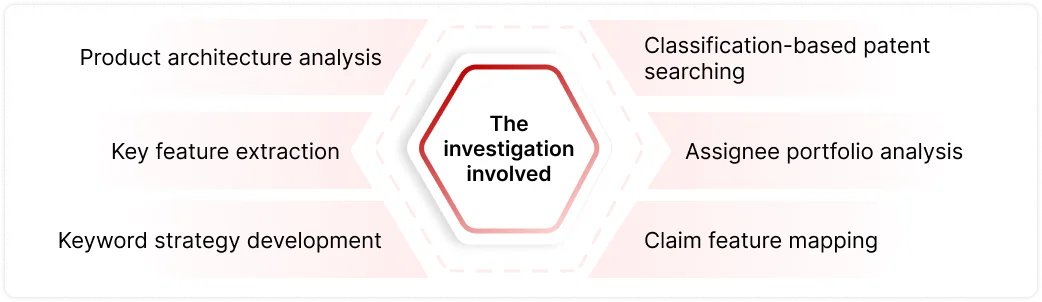
The FTO investigation involved a structured patent analysis methodology designed to identify relevant patent references associated with the Diabetes Management Application.

novel diabetes management methodology

The investigation further incorporated targeted assignee and classification-based searches to identify patent references that were not captured through conventional keyword searching.

The final investigation identified twenty relevant patent references with independent claims aligned with the major product features, including references covering key elements of the subject Diabetes Management Application.

Technical Challenges Addressed

Challenge 1: Identifying Patent Rights Relevant to the Product Features

A key FTO challenge was identifying patents covering the specific functionalities of the Diabetes Management Application, including monitoring, sensor data processing, advanced metrics, real-time feedback, ISF integration, and correction-dose adjustment, while distinguishing them from broadly related diabetes technologies.

Solution

The investigation decomposed the product into individual technical features and developed targeted search strategies for each functionality. The analysis focused on active US and EP patent rights covering diabetes monitoring systems, data processing approaches, treatment adjustment mechanisms and remote healthcare interfaces.

The investigation identified:
  • Patent rights related to diabetes monitoring and management systems
  • Sensor-based health data collection technologies
  • Data processing and diabetes metric calculation approaches
  • Real-time feedback and treatment-support functionality
  • ISF data integration and correction-dose adjustment concepts

These findings enabled a feature-level understanding of potential patent exposure associated with the product.

Challenge 2: Distinguishing Relevant Patent Claims From Partial Technical Similarity

Another key FTO challenge was distinguishing patents posing potential risks from those only disclosing related diabetes-management concepts, as many identified references included additional claim elements, different architectures, or functionalities beyond the proposed product.

Solution

The investigation focused on claim-level analysis of shortlisted patents by comparing independent claims against the product features to assess alignment. References were categorized based on their relevance, including claims directly covering product features, references with additional claim limitations, and related technologies with limited FTO significance.

The investigation identified:
  • Active patents and pending applications requiring detailed FTO review
  • Claim elements overlapping with specific product functionalities
  • Additional limitations affecting the relevance of identified references
  • Related patent references providing broader technology context

This claim-focused assessment helped distinguish potential patent exposure from general technology similarity.

Results & Business Impact

The investigation identified active patents and pending applications relevant to the Diabetes Management Application’s key features, providing a structured assessment of potential patent risks through feature-specific searches and claim-level analysis.

Key Outcomes

  • Key outcome Icon

    Identified active US and EP patent rights related to diabetes management.

  • Key outcome Icon

    Assessed patents covering key product features.

  • Key outcome Icon

    Differentiated direct claim relevance from technical similarity.

  • Key outcome Icon

    Developed targeted searches for ISF integration and correction-dose adjustment.

  • Key outcome Icon

    Leveraged classification, assignee, and citation analysis for broader coverage.

  • Key outcome Icon

    Delivered a structured FTO assessment for commercialization support.

Strategic Business Impact

The project highlighted that FTO analysis for healthcare applications requires more than identifying similar technologies. A feature-based FTO approach provides:

  • More accurate identification of potential patent risks.
  • Better understanding of claim scope and product overlap.
  • Reduced uncertainty before commercialization.
  • Improved visibility into competitive patent activity.

A reference that broadly discusses diabetes management may provide limited FTO insight. A patent whose claims specifically align with implemented product features requires deeper evaluation.

Could Patent Risks Affect Diabetes Application Commercialization?

Our team combines patent research and technical analysis to identify patent risks in healthcare and digital health technologies.