Source Code Analysis Uncovers AI Patent Infringement

Could Source Code Reveal Infringement Hidden Behind Imperfect AI Object Detection?

Source-code analysis revealed how an AI object-detection system generated and refined bounding boxes, enabling a detailed comparison with the client’s patented detection method.

Type Patent Infringement
Industry Artificial Intelligence
Published 03-09-2026
AI based object detection image

The Client’s Challenge

A client sought support in investigating potential infringement of a patent covering an AI-based object-detection method.

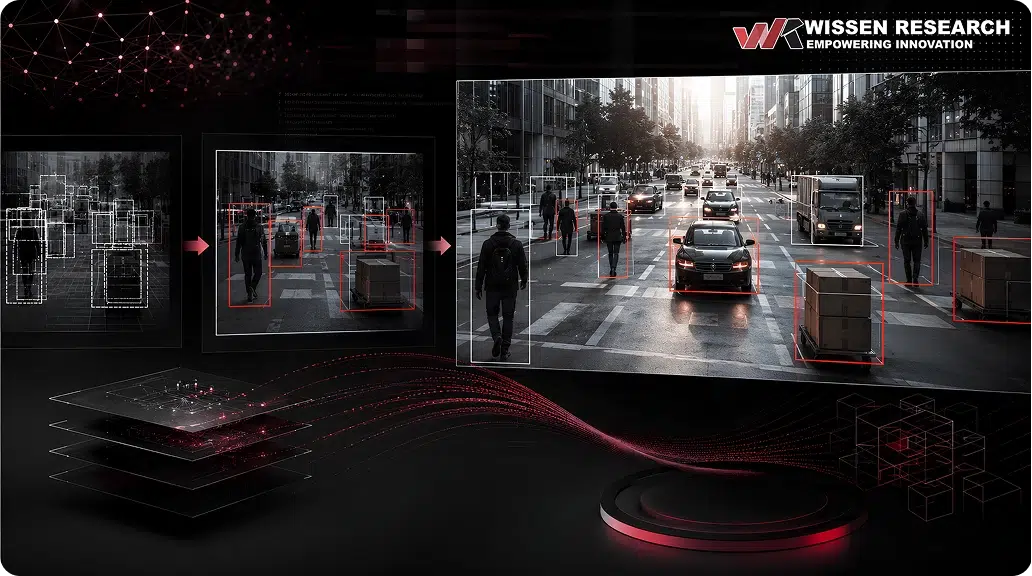
The patented technology uses neural networks to analyze images, identify objects, generate bounding boxes around detected objects, and classify those objects into categories such as people, vehicles, or other predefined classes.

A key aspect of the invention was the ability to refine the generated bounding boxes so that they more accurately corresponded to the detected objects. This refinement was important because object localization directly affects the reliability of the overall detection process.

The client’s objective was to determine whether another company’s commercial technology implemented the same patented approach.

AI based object detection photo

The investigation focused on the technical functionality associated with:

    • Image analysis using AI/neural-network-based object detection.
    • Identification of multiple objects within an image.
    • Generation of bounding boxes around detected objects.
    • Classification of detected objects into corresponding categories.
    • Refinement or adjustment of bounding boxes to improve object localization.
Objective icon
CLIENT’S OBJECTIVE

Determine whether the accused product implemented the technical features covered by the client’s patented AI-based object-detection method.

The investigation required more than demonstrating similar product functionality.

The objective was to establish whether the underlying technical implementation corresponded to the patented approach.

Clients come to us for answers.
They leave with opportunities they didn’t know existed.

Our experts help organizations uncover insights, opportunities and strategic directions that traditional approaches often miss.

Wissen’s Out-of-the-Box Approach:

Source Code as the Missing Technical Evidence

  • Recognizing the limitations of product-level investigation, the strategy evolved beyond publicly observable functionality to examine the underlying implementation of the accused technology.
  • To enable a more technically grounded infringement assessment, the investigation expanded to include source-code analysis of the relevant product, focusing on the implementation of the patented object-detection workflow.

Identifying Relevant Product Prior Art

  • A focused technical investigation was conducted on commercially available AI-enabled products demonstrating object detection and classification functionality.

  • One smart home security product emerged as a particularly relevant candidate because its publicly observable functionality included advanced people and package detection using bounding boxes.

  • However, publicly available product information did not sufficiently disclose the internal processing used to generate and refine those bounding boxes.

  • To overcome this limitation, source-code analysis was performed on the identified product.

Our Methodology

Traditional Investigation Limitations
Identification of Relevant Accused Technology
Source Code Acquisition and Review
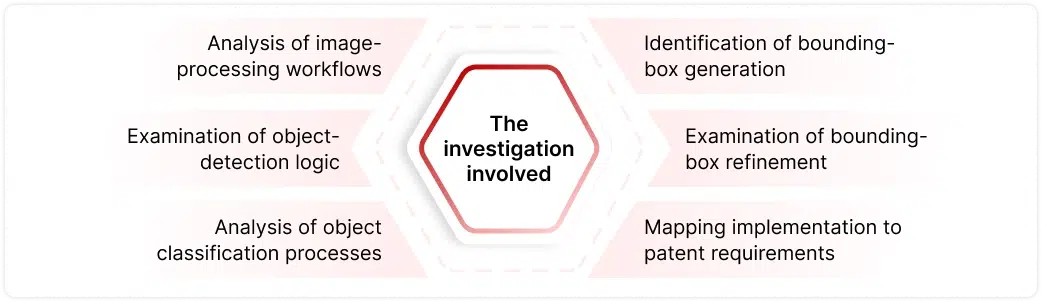
Object-Detection Workflow Analysis
Bounding-Box Refinement Analysis
Patent-to-Implementation Mapping
Technical Infringement Assessment
Traditional Investigation Limitations
  • Product-level evidence limitations
  • Hidden bounding-box implementation
  • Unobservable refinement logic
  • Limited internal processing visibility
Identification of Relevant Accused Technology
  • Screen AI-enabled products
  • Evaluate detection functionality
  • Prioritize bounding-box systems
Source Code Acquisition and Review
  • Obtain available source code
  • Examine object-detection logic
  • Identify relevant processing modules
Object-Detection Workflow Analysis
  • Trace image-processing operations
  • Identify object detection
  • Analyze object classification
  • Examine bounding-box generation
Bounding-Box Refinement Analysis
  • Trace bounding-box processing
  • Evaluate refinement logic
  • Analyze coordinate adjustments
  • Compare patented refinement approach
Patent-to-Implementation Mapping
  • Map source-code functionality
  • Compare patent requirements
  • Analyze technical correspondence
  • Document implementation-level evidence
Technical Infringement Assessment
  • Establish technical correspondence
  • Corroborate product behavior
  • Develop infringement evidence
Outcome:

Source-code analysis established that the accused product’s bounding-box generation and refinement process closely corresponded to the patented method, providing strong technical evidence of potential infringement.

Reverse Engineering Methodology

The source-code analysis focused on the internal implementation of the accused product’s AI-based object-detection workflow to determine whether the patented bounding-box refinement process was implemented.

AI-based object detection methodology image

The source-code analysis revealed implementation-level evidence corresponding to the patented object-detection workflow, particularly the generation, evaluation and refinement of bounding boxes.

Most importantly, the findings established a technical connection between the product’s internal processing and the specific functionality covered by the client’s patent, strengthening the basis for the infringement assessment.

Technical Challenges Addressed

Challenge 1: Determining How Bounding Boxes Were Generated

The first technical question was whether the accused product merely displayed bounding boxes or whether its underlying implementation generated those boxes through a process relevant to the client’s patent.

Solution

Source-code analysis was used to trace the object-detection workflow from image processing through bounding-box generation.

The analysis revealed:
  • Image preprocessing workflows
  • Object detection processing logic
  • Bounding-box generation mechanisms
  • Detection coordinate processing
  • Object localization parameters

The findings established implementation-level evidence corresponding to the object-detection and bounding-box generation aspects of the patented technology.

Challenge 2: Establishing Correspondence Between Product Implementation and Patent Requirements

Even after identifying object detection and bounding-box refinement functionality, the investigation needed to determine whether the overall implementation corresponded to the technical method claimed by the client’s patent.

Solution

The identified source-code operations were compared against the relevant patent requirements.

The analysis revealed:
  • Bounding-box refinement mechanisms
  • Object classification processes
  • Sequential processing relationships
  • Patent limitation correspondence
  • Implementation-level technical evidence

This implementation-level comparison demonstrated substantial correspondence between the accused product’s processing approach and the patented object-detection method.

Results & Business Impact

The analysis revealed that the accused product’s object-detection workflow included processing associated with generating, evaluating, and refining bounding boxes in a manner closely corresponding to the client’s patented method.

Key Outcomes

  • Key outcome Icon

    Identification of a commercially available AI-based object-detection product relevant to the patent investigation.

  • Key outcome Icon

    Establishment of implementation-level evidence through source-code analysis.

  • Key outcome Icon

    Identification of object-detection and bounding-box generation workflows.

  • Key outcome Icon

    Identification of processing associated with bounding-box refinement.

  • Key outcome Icon

    Technical comparison of the implementation against the client’s patented method.

  • Key outcome Icon

    Development of evidence supporting the client’s patent enforcement strategy.

Strategic Business Impact

By moving beyond conventional product-level comparison and incorporating source-code analysis, the investigation provided:

  • Stronger technical support for infringement assessment
  • Improved visibility into proprietary implementation details
  • Greater confidence in mapping product functionality to patent requirements
  • More focused evidence for potential licensing or enforcement discussions
  • Broader investigative coverage beyond publicly observable product behavior

The approach demonstrated how combining patent claim analysis with implementation-level software investigation can uncover technical evidence that may remain inaccessible through conventional product research alone.

Need Support for Complex AI Patent Investigations?

Our team combines patent analysis and technical investigation to resolve complex AI, software and computer-vision infringement questions.