Case Study: Global Sunscreen Regulatory Divergence - Wissen Research

What If a 20-Year Regulatory Gap Was Actually a Market Opportunity?

Wissen decoded the structural divergence between US and international sunscreen regulation, turning a two-decade UV filter approval lag into a first-mover market-access roadmap for a global beauty brand.

Type Regulatory and Technology Intelligence
Industry Beauty & Personal Care
Published July 09, 2026

The Client's Challenge

A beauty brand competing across US, European, and Asian markets came to Wissen with a strategic blind spot: it knew its US-formulated sunscreens performed differently from its EU and Korean counterparts, but it didn’t know why the gap existed, how large the commercial cost of that gap really was, or which of the technologies unavailable to it were worth fighting for regulatory access to versus simply monitoring.

 

The client was navigating three compounding pressures simultaneously:

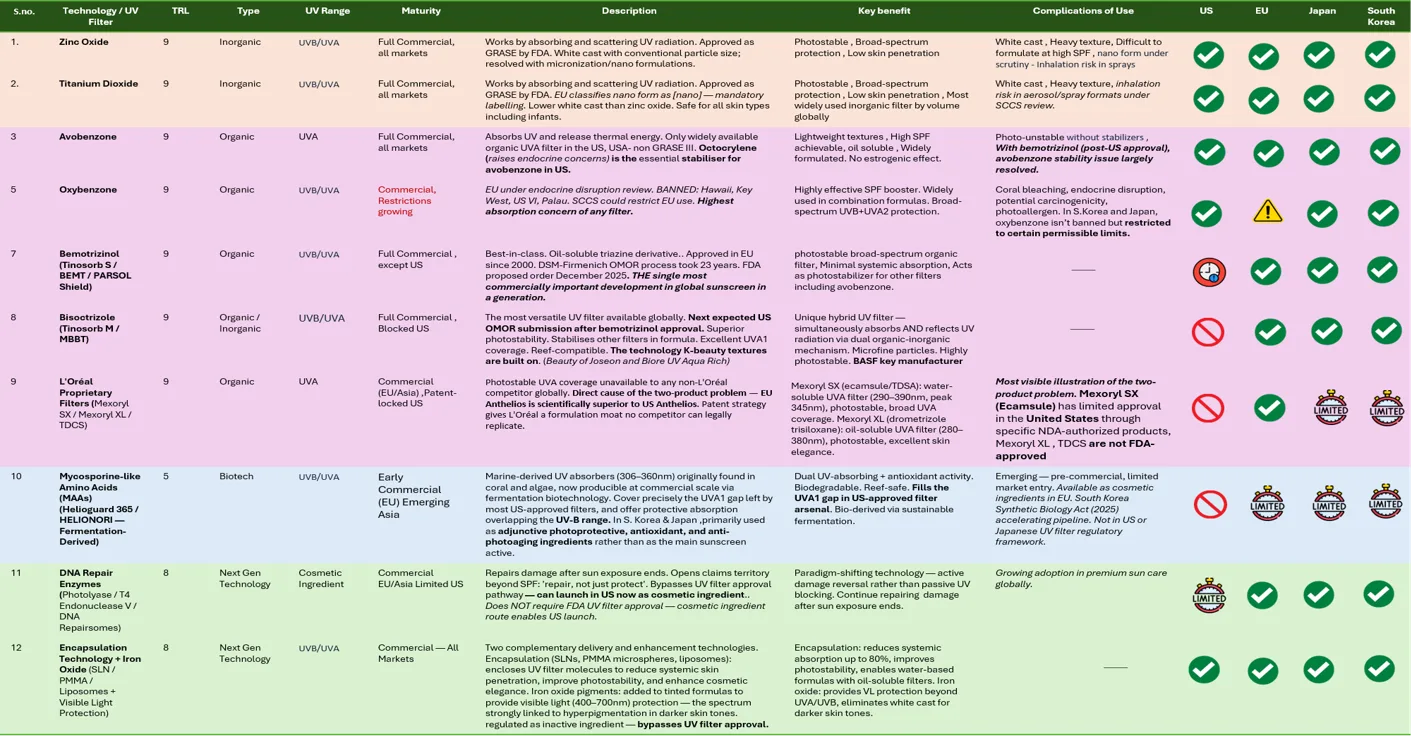
    • An innovation deficit — sixteen advanced UV filters proven and approved in the EU, Japan, and South Korea, including Tinosorb S (bemotrizinol), Tinosorb M (bisoctrizole), Mexoryl XL, and Uvinul A Plus, remained unapproved by the FDA after more than two decades, leaving US formulators dependent on older, less photostable filter systems.
    • A compliance exposure the client couldn’t yet quantify — public data suggested a significant share of top-selling US sunscreens contained undisclosed, FDA-unapproved UV-absorbing ingredients (“sunscreen doping”), and the client needed to know whether it was formulating in a legal gray zone without realizing it.
    • A consumer-trust erosion pattern — informed consumers were increasingly importing European and Korean sunscreens rather than buying domestic product, and the client had no framework for estimating how much premium, brand-loyal revenue this represented.
CLIENT’S OBJECTIVE

Build a decision-ready framework for prioritizing UV filter R&D and regulatory investment — distinguishing technologies worth pursuing now from those only worth monitoring — and quantify the strategic window created by any near-term FDA approval before competitors could react to it.

Clients come to us for answers.

They leave with opportunities they didn’t know existed.

Our experts help organizations uncover insights, opportunities and strategic directions that traditional approaches often miss.

Wissen's Approach: Multi-Dimensional Regulatory & Technology Intelligence

  • Recognizing that a static gap list wouldn't serve the client's actual decision — where to put R&D and regulatory dollars, and how urgently — Wissen built a five-stream intelligence framework combining primary regulatory analysis, technology maturity scoring, and commercial-exclusivity timing analysis.
  • Traced the approval mechanism, not just the outcome
  • Scored technologies on defensibility, not just status
  • Turned a single approval into a timed opportunity
  • Quantified a risk the industry only discussed anecdotally

Closing the Gap: Multi-Source Performance Validation

  • Peer-reviewed photostability and UVA-efficacy studies (Scopus, Web of Science, ScienceDirect, PubMed) filled in what regulatory filings couldn’t — actual performance data, not just approval status.

  • Independent testing and industry intelligence (Mintel, Euromonitor, In-Cosmetics Global) corroborated lab findings against real-world formulation outcomes.

  • Each filter was then scored across the five-dimension Technology Maturity Assessment, turning fragmented evidence into one ranked, decision-ready comparison.

  • Where science and regulatory status pointed different ways, we flagged it rather than smoothing it over — giving the client an honest read on both merit and feasibility.

Our Methodology

Primary Regulatory Source Mapping
Approval-Pathway Mechanism Analysis
Technology Maturity Assessment
Commercial Exclusivity Window Analysis
Compliance Risk Quantification
Primary Regulatory Source Mapping
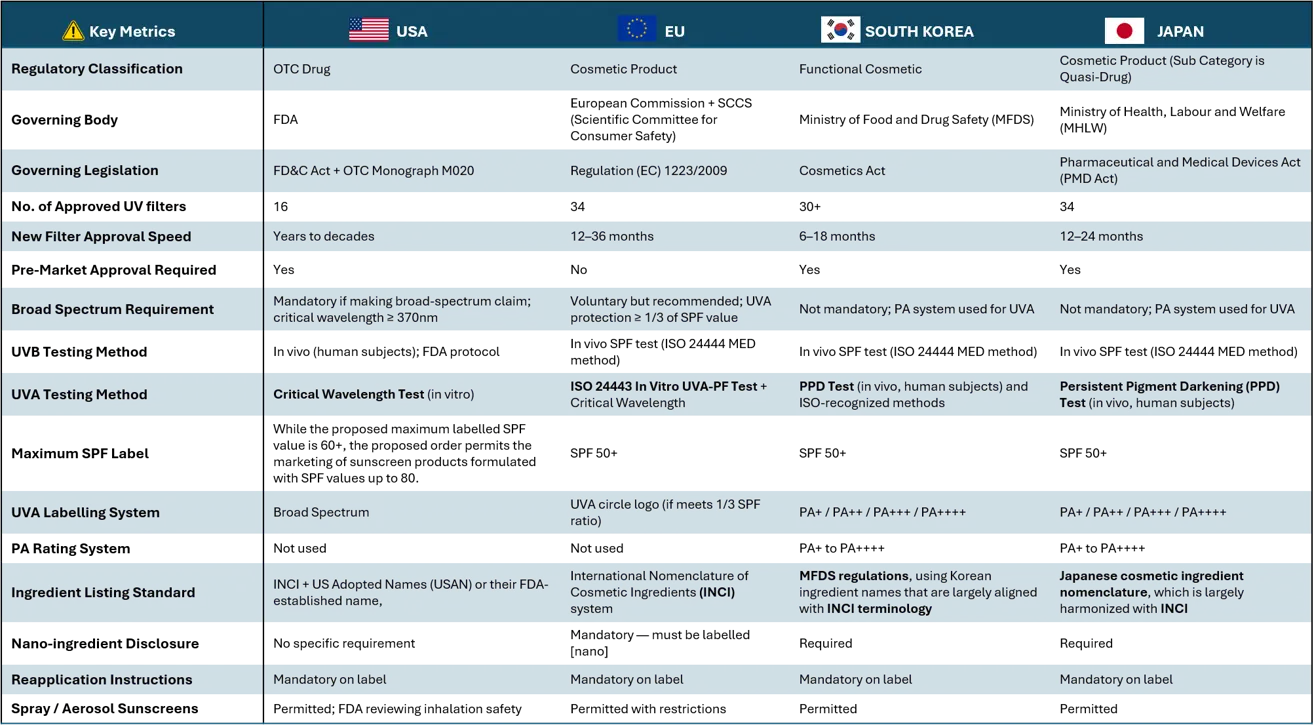
  • Directly reviewed FDA OTC monograph documentation and the Federal Register
  • Analyzed EU Regulation (EC) No. 1223/2009 and the CosIng ingredient database
  • Reviewed guidance frameworks from Japan’s MHLW and South Korea’s MFDS
  • Established not just what each market approves, but how fast each approval process can move
Approval-Pathway Mechanism Analysis
  • Traced the specific OMOR pathway behind the Bemotrizinol (BEMT) approval
  • Identified why this filter cleared when fifteen others remain pending
  • Used the mechanism to infer which filters could plausibly follow next
Technology Maturity Assessment
  • Scored each candidate filter across five dimensions: UVA/UVB coverage, photostability, cosmetic compatibility, environmental/safety credentials, and approval status
  • Replaced a flat gap list with a ranked, decision-ready investment framework
Commercial Exclusivity Window Analysis
  • Modeled the competitive runway created specifically by the BEMT approval
  • Identified an 18-month window for first-moving brands and suppliers to build formulation and market advantage before competitors caught up
Compliance Risk Quantification
  • Cross-referenced top-selling US product listings against FDA-approved active-ingredient lists
  • Converted an anecdotal industry concern (“sunscreen doping”) into a measurable, citable risk figure
OUTCOME:

This multi-source methodology transformed a static 16-filter gap list into a ranked, time-sensitive investment roadmap — anchored by a quantified 18-month first-mover window and a measurable compliance risk figure.

Technical Challenges Addressed

Challenge 1: Innovation Deficit

Regulatory barriers and limited access to advanced UV filters have constrained sunscreen innovation and product competitiveness in the US market.

Solution

Conducted a comparative analysis of sunscreen regulatory frameworks across the United States, European Union, Japan, and South Korea to identify approval pathways, regulatory gaps, and access to advanced UV filter technologies. Complemented this with a technology maturity assessment to evaluate filter performance, safety, photostability, commercial readiness, and formulation suitability, enabling informed R&D and product development decisions.

Challenge 2: Separating Near-Term Opportunity from Long-Term Speculation

Growing compliance risks and evolving consumer expectations have increased pressure on brands to deliver safe, effective, and globally competitive sunscreen formulations.

Solution

Evaluated advanced UV filter technologies and emerging sunscreen innovation trends—including SPF-skincare hybrids, tinted mineral SPF, microbiome-friendly formulations, waterless formats, and K-Beauty textures—to identify commercially viable opportunities. The assessment provided a strategic roadmap for strengthening regulatory compliance, mitigating formulation risks, and aligning future product portfolios with global market trends.

Results & Business Impact

Key Outcomes

  • A clear, mechanism-level understanding of why the US lags the EU, Japan, and South Korea in UV filter approvals — not just that it does.

  • Identification of the BEMT approval’s 18-month exclusivity window as an actionable, time-boxed first-mover opportunity.

  • A decision-ready Technology Maturity Assessment ranking all sixteen pending filters by invest/monitor priority.

  • A quantified compliance risk figure (48.3% doping prevalence in top-selling US products) the client could act on directly.

  • Five forward-looking sub-trends — SPF-skincare hybrids, tinted mineral SPF, microbiome-friendly SPF, waterless/solid formats, and K-beauty texture innovation — identified for longer-horizon product development planning.

Strategic Business Impact

By moving beyond a static regulatory gap list to a mechanism-driven, timing-aware intelligence framework, the engagement delivered:

  • A prioritized R&D and regulatory-investment roadmap instead of an undifferentiated wish list
  • Early visibility into a first-mover commercial window competitors had not yet identified
  • A quantified, defensible view of category-wide compliance risk
  • Cross-market formulation guidance grounded in primary regulatory sources, not aggregator summaries
  • A forward-looking innovation watchlist to guide product development beyond the immediate regulatory question