Patent Infringement Case Study Using Reverse Engineering

Could Live Network Traffic Reveal Hidden Evidence of Media Streaming Patent Infringement?

By reconstructing live media streaming sessions through controlled network traffic analysis, the investigation identified protocol behavior, adaptive bitrate workflows and segmented media delivery that supported patent infringement assessment.

Case Study Type Patent Infringement
Industry / Domain Media & Entertainment
Publication Date 14 July 2026
Estimated Reading Time 8–10 Minutes
streaming media player​

The Client's Challenge

A client operating in the Media & Entertainment industry sought technical support for a patent infringement investigation involving media streaming technology. The patent under evaluation related to mechanisms governing media streaming, segmented content delivery and adaptive bitrate streaming (ABR), where multimedia content is transmitted in smaller segments to enable uninterrupted playback under varying network conditions.

Although media streaming protocols are widely adopted across commercial platforms, implementation details are rarely disclosed beyond high-level architectural descriptions. Public documentation typically explains protocol specifications and streaming concepts but provides limited visibility into how individual streaming services implement media segmentation, bitrate adaptation, and communication workflows during live content delivery.

This created a significant technical challenge. Establishing infringement required evidence describing how a commercial streaming service behaved during runtime rather than relying solely on documentation describing intended protocol behavior.

Consequently, the investigation focused on reconstructing the actual streaming workflow through direct observation of network communication between the client application and streaming infrastructure.
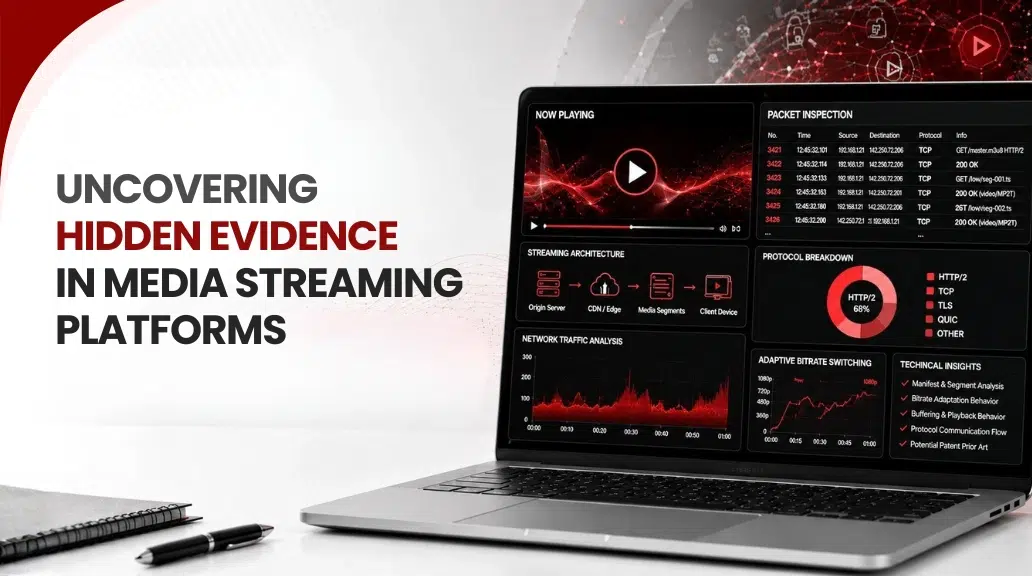
Media streaming platform image

The investigation focused on identifying technical evidence associated with:

    • Media streaming protocol identification
    • HTTP request and response workflows during content delivery
    • Adaptive bitrate streaming (ABR) behavior
    • Segmented audio and video delivery
    • Runtime communication between streaming clients and servers
    • Bitrate information associated with individual media segments
    • Network interactions potentially corresponding to patented streaming functionality
limitations icon
Client’s Objective

The primary objective was to determine whether commercially deployed media streaming services implemented functionality corresponding to the subject patent.

Clients come to us for answers.

They leave with opportunities they didn’t know existed.

Our experts help organizations uncover insights, opportunities and strategic directions that traditional approaches often miss.

Wissen's Out-of-the-Box Approach

Reverse Engineering Through Network Packet Analysis

  • Recognizing the limitations of conventional literature-based investigations, the analysis evolved beyond publicly available documentation and protocol specifications.
  • Rather than relying solely on how media streaming protocols were designed to operate, the investigation focused on how a commercial streaming platform actually behaved during live content delivery. The objective shifted from reviewing documentation to reconstructing implementation-level workflows through controlled observation of network communication exchanged between the client application and streaming infrastructure.
  • To enable this broader investigation, reverse engineering through live network packet analysis was performed to identify runtime implementation evidence associated with:
  • HTTP communication workflows
  • Streaming manifest retrieval
  • Segmented media delivery
  • Adaptive Bitrate Streaming (ABR)
  • Client-server communication behavior
  • Runtime protocol implementation

Identifying Relevant Runtime Evidence

  • A controlled testing environment was established to isolate network communication generated exclusively by the target streaming application during media playback.

  • Rather than examining individual packets independently, captured traffic was reconstructed into complete streaming sessions, enabling the investigation to observe protocol interactions governing manifest retrieval, media segment delivery, bitrate adaptation and continuous playback.

  • This protocol-level investigation exposed implementation characteristics that could not be identified through conventional documentation review.

Our Methodology

Traditional Investigation Limitations
Identification of Target Streaming Platform
Live Network Traffic Capture
Protocol & Streaming Workflow Reconstruction
Claim Mapping & Standards Correlation
Implementation-Level Evidence Generation
Traditional Investigation Limitations
  • Public documentation explains protocol specifications
  • Runtime implementation remains largely undisclosed
  • Limited visibility into client-server communication
  • Insufficient implementation evidence for claim mapping
Identification of Target Streaming Platform
  • Identify commercially deployed streaming platforms
  • Select platforms relevant to the patented technology
  • Define controlled streaming scenarios for investigation
Live Network Traffic Capture
  • Capture network traffic during controlled media playback
  • Record HTTP requests, responses, and protocol exchanges
  • Preserve runtime communication for detailed analysis
Protocol & Streaming Workflow Reconstruction
  • Reconstruct streaming sessions from captured traffic
  • Analyze manifests, media segments, and HTTP workflows
  • Identify client-server communication behavior
Claim Mapping & Standards Correlation
  • Correlate observed behavior with streaming standards
  • Map implementation evidence to patent claim limitations
  • Validate findings using independent technical references
Implementation-Level Evidence Generation
  • Generate reproducible technical evidence
  • Support detailed patent infringement assessment
  • Strengthen implementation-level claim mapping
Outcome

Implementation-level evidence reconstructed from live streaming behavior, validated through protocol analysis and industry standards, supporting a technically grounded patent infringement assessment.

Reverse Engineering Methodology

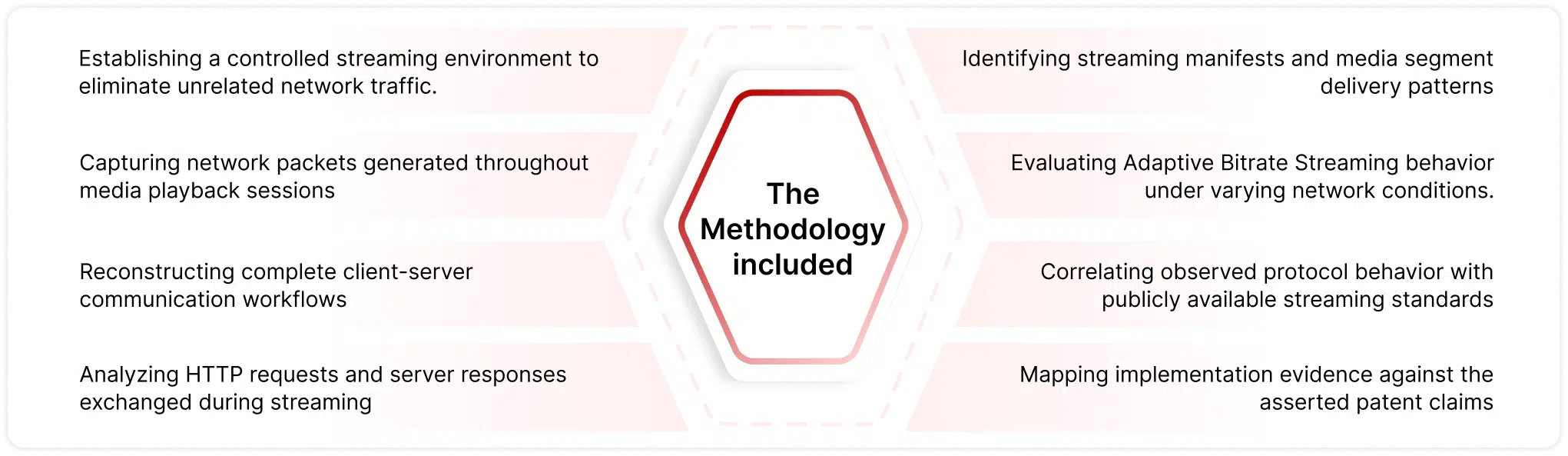
To ensure technical accuracy and reproducibility, the investigation followed a structured reverse engineering workflow that combined packet-level analysis with standards-based validation.

Reverse-Engineering-Methodology chart

This systematic approach generated implementation-level technical evidence capable of supporting a substantially stronger infringement assessment than documentation-based investigations alone.

Technical Challenges Addressed Through Protocol-Level Reverse Engineering

Challenge 1: Reconstructing the Media Streaming Communication Workflow

One of the primary technical challenges was determining how the target streaming platform established and managed communication between the client application and streaming servers during media playback.

Solution

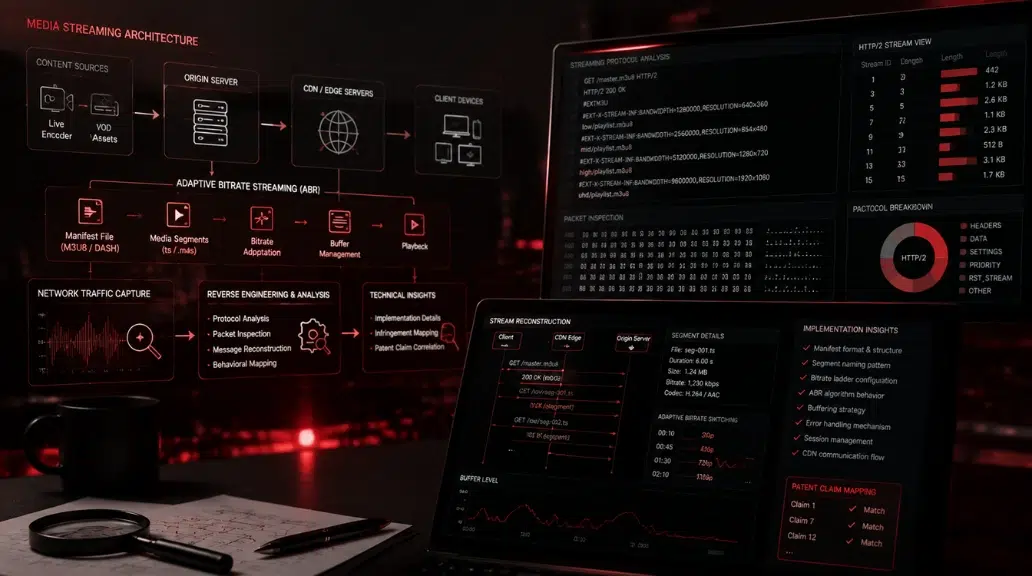
Live network traffic analysis enabled reconstruction of the complete communication workflow generated during media playback. The captured traffic was analyzed to identify protocol interactions, request-response sequences and content delivery workflows between the streaming client and server infrastructure.

The analysis revealed:
  • Streaming session establishment workflows between client and server.
  • Manifest retrieval and interpretation processes.
  • HTTP request and response sequences associated with media delivery.
  • Sequential media segment requests during playback.
  • Client-server communication patterns supporting continuous streaming.

These findings provided implementation-level visibility into the actual streaming workflow and supported evaluation of patent claim limitations associated with media delivery architecture.

Challenge 2: Identifying Adaptive Bitrate Streaming Implementation Behavior

Another important technical challenge involved determining whether the target streaming platform implemented Adaptive Bitrate Streaming (ABR) mechanisms corresponding to the patented technology.

Solution

The investigation analyzed streaming manifests, media segment requests and network communication patterns generated during playback sessions to identify adaptive streaming behavior.

The analysis revealed:
  • Multiple bitrate representations available within streaming manifests.
  • Media segment requests corresponding to different quality levels.
  • Runtime bitrate transition behavior during playback.
  • Client-driven media quality selection workflows.
  • HTTP communication patterns associated with adaptive content delivery.

These observations provided technical evidence demonstrating how adaptive media delivery functionality was implemented during actual streaming sessions.

Results & Business Impact

The investigation successfully demonstrated how protocol-level reverse engineering can strengthen software patent infringement assessments by revealing implementation-specific behavior that remains inaccessible through conventional documentation-based analysis.

Key Outcomes

    • Reconstruction of live streaming communication workflows between client applications and streaming infrastructure.
    • Identification of HTTP-based media delivery behavior and segmented content transmission mechanisms.
    • Demonstration of Adaptive Bitrate Streaming (ABR) implementation through runtime network observations.
    • Visibility into implementation details unavailable through public documentation alone.
    • Validation of streaming protocol behavior through independent technical references and standards correlation.
    • Generation of reproducible technical evidence supporting detailed patent claim mapping.
    • Improved technical confidence in evaluating potential infringement scenarios involving proprietary streaming systems.
Strategic Business Impact

By expanding the investigation beyond traditional documentary analysis and incorporating protocol-level reverse engineering, the investigation enabled:

  • Stronger technical support for patent infringement assessment.
  • Increased confidence during licensing and enforcement evaluations.
  • Reduced uncertainty associated with implementation assumptions.
  • Improved claim mapping through runtime-generated evidence.
  • Better technical due diligence for media streaming technologies.

The approach demonstrates that analyzing software behavior at the protocol level can reveal implementation evidence that remains hidden within proprietary architectures, providing a valuable complement to conventional patent analysis methodologies.

Reverse Engineering Methodology & Compliance Statement

  • The reverse engineering activities described in this case study were conducted exclusively to observe publicly accessible software behavior relevant to patent infringement assessment.

  • The investigation relied on passive observation of network communication generated during normal operation of commercially available streaming platforms.

  • Key compliance principles included:

Analysis limited to publicly accessible streaming applications and services.
Observation restricted to client-side network communication.
No modification of software binaries or application behavior.
No access to confidential source code or proprietary backend systems.
No circumvention of authentication, encryption, or security mechanisms.
Correlation of observed behavior with publicly available technical standards and protocol specifications.
Independent validation through reproducible network traffic analysis.
Patent Infringement Search | Reverse Engineering | Media & Entertainment

Need Support for Complex Software Patent Investigations?

Our team specializes in system prior art, reverse engineering analysis and high-confidence invalidation research for the most complex patent claims.