

A client sought support in invalidating a patent related to centralized communication platforms enabling seamless audio/video (A/V) communication functionality without requiring users to switch between applications.
The subject patent described a system architecture in which an existing application (parent application) integrates with an additional functional component (child component) that provides communication services such as audio and video calling. The claimed invention focused on enabling communication functionality within the existing application environment while maintaining a seamless user experience.
Problem Statement
The Client’s Challenge
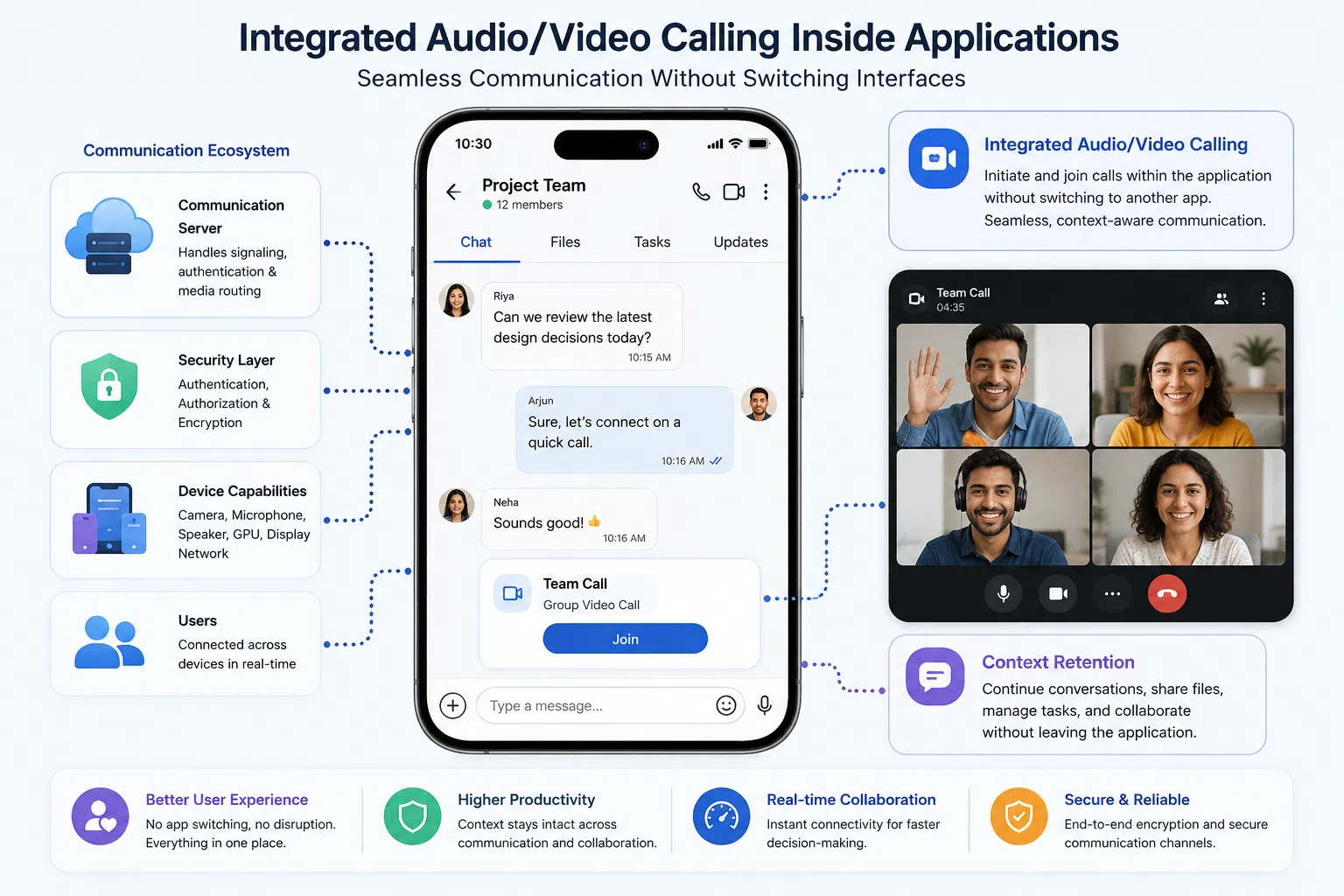
The patent claims primarily covered:
- Access by a parent application to functionalities implemented within a child functional component.
- Capability determination by the child component to verify whether the parent application could support rendering operations.
- Connection establishment with external communication servers by the child component on behalf of the parent application.
- Provision of communication services by the child functional component to the parent application.
- Seamless execution of communication services including connection establishment, capability checks, and service delivery communication workflows without requiring application switching.

CLIENT’S OBJECTIVE
Identify single-reference prior art for Section 102 anticipation – a significantly higher standard than obviousness under Section 103.
A single reference must disclose every claimed element – fragmented literature evidence does not suffice.
Higher bar than §103 - all elements must exist in one single reference
Traditional Prior Art Search Approach
The investigation initially followed a traditional prior art search methodology commonly used in patent invalidation projects. The search focused on identifying disclosures across standard documentary sources, including:
Conventional Investigation Strategy
Patent databases
Academic publications
Technical whitepapers
Product manuals
Developer documentation
Communication platform architecture references
The search identified several references disclosing centralized communication systems and integrated A/V communication functionality similar to the subject patent claims. However, these disclosures were fragmented across multiple references.
Traditional Prior Art Search Workflow

keyword Search
- Define search terms & synonyms
- Use keywords, CPC/IPC classes, and boolean operators
- Run searches in multiple patent databases

Patent Screening
- Review search results
- Filter based on relevance (Title, Abstract, Claims)
- Exclude non-relevant patents

Documentation Review
- Analyze full text of relevant patents and documents
- Extract key technical teachings and disclosures
- Note important paragraphs, figures, and embodiments

Multi-Reference Mapping
- Map disclosure across multiple references
- Identify complementary teachings
- Build a combination of references to cover gaps
Obviousness Analysis
- Evaluate if the combination would have been obvious
- Apply legal tests (e.g., KSR, Graham Factors)
- Prepare reasoned obviousness conclusion
Outcome: Identify a combination of references that collectively render the claimed invention obvious (Section 103).
While the identified references collectively supported an obviousness-based invalidation approach, none independently disclosed all claim limitations within a single enabling reference.
Limitations of Traditional Approaches
- Public technical documentation lacked sufficient implementation-level detail.
- Internal workflows of proprietary software systems were not fully disclosed.
- Functional interactions between software modules remained partially undocumented.
- Multiple references were required to reconstruct the complete claimed architecture.
- The available evidence was stronger for Section 103 obviousness arguments than for Section 102 anticipation.
As a result, relying exclusively on conventional documentary prior art risked limiting the strength and efficiency of the invalidation strategy.
Wissen’s Out-of-the-Box Approach:
System Prior Art Through Reverse Engineering
- Recognizing the limitations of conventional literature-based searching, the strategy evolved beyond traditional documentary prior art analysis.
- To enable a broader and more technically grounded assessment of prior art evidence, the investigation expanded beyond a sole focus on published literature to include a system prior art analysis of real-world software systems that were:
- Publicly available before the patent priority date
- Commercially released and widely used
- Demonstrative of the claimed functionality in practical implementation
Identifying Relevant System Prior Art
-
A focused technical investigation was conducted on communication software platforms released prior to the patent’s priority date.
-
However, publicly available documentation alone did not sufficiently disclose the internal implementation details required to address all claim limitations.
The analysis identified earlier versions of:



as potentially relevant system prior art candidates.
To overcome this limitation, static reverse engineering analysis was performed on publicly available Android application packages (APKs).
Our Methodology
Traditional Search Limitations

- Conventional literature search yields fragmented disclosures
- Lack of implementation details in public documents
- Multiple references needed
- Stronger for obviousness (§103), not anticipation (§102)
Identification of Real-World Software Systems

- Identify software systems released before priority date
- Focus on commercially available and widely used applications
- Evaluate relevance based on functionality and features
APK Acquisition and Static Decompilation

- Obtain publicly available APK files (pre-priority date)
- Perform static decompilation
- Extract source code, resources, and configuration files
Source Code Level Functional Analysis

- Analyze architecture, modules, and workflows
- Identify implementation of key functionalities
- Examine inter-component communication and logic
Claim Mapping Against System Features

- Map identified functionalities to claim limitations
- Establish how each claim element is met in the system
- Document detailed claim charts and evidence
Independent Public Evidence Corroboration

- Collect independent public evidence
- Use release notes, user demos, documentation, videos, forums, etc.
- Verify public availability before priority date
Single-Reference Anticipation Support

- All claim elements disclosed within a single system
- Strong support for §102 anticipation
- Robust, verifiable, litigation-ready evidence
Reverse Engineering Methodology
The APK files corresponding to software versions released prior to the patent filing date were obtained from publicly accessible repositories.
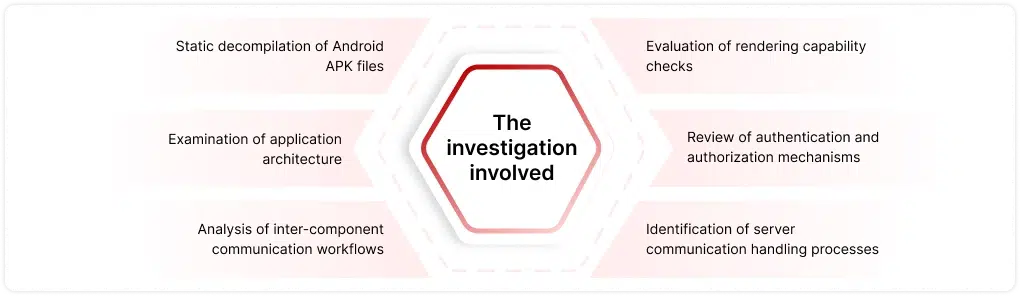
The reverse-engineered analysis revealed that the relevant communication functionalities were already implemented and publicly accessible before the subject patent’s priority date.
Most importantly, the findings demonstrated that the identified software systems collectively disclosed all major claim elements within a single software ecosystem, strengthening the invalidation position under a Section 102 anticipation framework.
Evidence Collection and Validation
To establish reliability and public accessibility of the identified system prior art, multiple independent evidence sources were collected and cross-validated, including:
 Archived APK files with verifiable release timelines
 Public release notes and technical references
Developer documentation
Public release notes and technical references
Developer documentation
 Archived user demonstrations and walkthrough videos
 Publicly available feature discussions and implementation references
This multi-source validation approach ensured that the prior art evidence was technically reproducible, historically verifiable, and legally supportable.
Technical Challenges Addressed Through System Prior Art Analysis
Challenge 1: Authorization and Authentication Between Functional Components
One of the key technical questions involved was determining whether the child functional component authenticated and authorized the parent application before enabling communication functionality such as video calling.
Solution
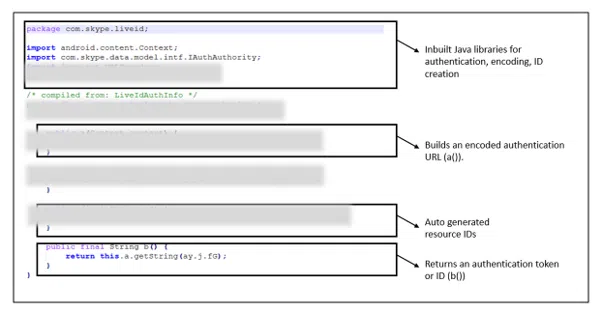
Static analysis of decompiled Skype Android application packages identified implementation of authentication and authorization workflows using Java built-in libraries and system-level communication mechanisms.
The analysis revealed:
- User authentication workflows
- Encoding and credential handling processes
- Unique user identifier management
- Controlled access to communication functionality
These findings demonstrated that access control mechanisms between functional components were already implemented in the identified system prior art prior to the patent’s filing date.
Challenge 2: Capability Verification of the Parent Application
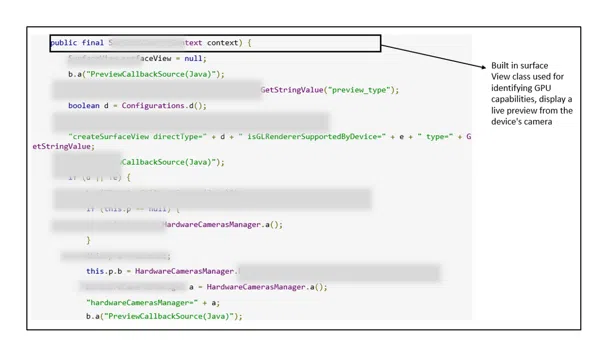
Another important challenge involved determining whether the child functional component verifies the parent application’s capability like “Camera, GPU, Display” capabilities to support communication rendering operations without requiring application switching.
Solution
Examination by the child functional block identified implementation of compatibility and hardware capability checks through evaluation of GPU capabilities, camera availability and display properties. Analysis further identified use of Android SurfaceView components to determine supported camera features and enable rendering of communication functionality within the parent application.
The analysis revealed:
- Device GPU capability verification
- Camera hardware availability verification
- Mobile Display pixel capability verification to present video calling.
These mechanisms enabled the communication component to dynamically determine whether the application and device environment could support seamless communication rendering within the parent application interface.
The identified workflows directly addressed the corresponding patent claim limitations.
Results & Business Impact
The final investigation successfully identified system prior art capable of addressing the subject patent claims through a technically supported and independently verifiable approach.
Key Outcomes
-

Identification of publicly accessible pre-priority date software systems implementing the claimed functionality.
-
Establishment of a stronger Section 102 anticipation-based invalidation position.
-
Successful demonstration of communication workflows through source code level evidence.
-
Validation of internal functional architecture absent from traditional documentation sources.
-
Strengthened client confidence through technically reproducible evidence.
Strategic Business Impact
By moving beyond conventional literature searching and incorporating system-level reverse engineering analysis, the investigation provided:
- Stronger patent invalidation support
- Reduced litigation and enforcement risk
- Improved technical confidence in prior art positioning
- Faster identification of enabling evidence
- Broader prior art coverage beyond published literature
The approach demonstrated how combining software reverse engineering with independent public evidence can uncover highly relevant prior art that may remain undiscovered through conventional search methodologies alone.
Conclusion & Implications
This case study highlights the importance of adopting broader and more adaptive prior art investigation strategies in software patent invalidation projects.
Traditional documentary searching remains valuable for identifying foundational disclosures; however, modern software systems frequently implement commercially deployed functionalities that are not comprehensively documented in public literature.
By expanding the investigation into system prior art analysis and static reverse engineering of publicly available software applications, the project successfully identified enabling evidence capable of addressing all major patent claim limitations.
The project demonstrated how structured reverse engineering methodologies can significantly strengthen patent invalidation strategies while maintaining compliance, reproducibility and evidentiary reliability.
The investigation also reinforced the importance of:
Looking beyond conventional prior art databases
Combining technical analysis with legal strategy
Validating findings through independent public evidence
Approaching software prior art from a system architecture perspective
Reverse-Engineering Methodology & Compliance Statement
The software analysis described in this case study was conducted solely for the purpose of identifying and evaluating publicly accessible technical features relevant to prior art assessment.
The examination was limited to static analysis techniques applied to publicly available versions of Skype Android application packages (APKs) released prior to the subject patent’s priority date.
Key compliance principles included:
Analysis restricted to publicly accessible software artifacts
No access to protected servers or confidential systems
No circumvention of security mechanisms
No software modification or redistribution
No interaction with proprietary backend infrastructure
Independent corroboration using publicly available sources