
Energy Harvesting Technology Landscape: SOA Patent Search

Can Patent and Scientific Literature Analysis Uncover Emerging Trends Across Energy Harvesting Technologies?

A structured state-of-art investigation combining patent intelligence, scientific literature analysis, and technology taxonomy mapping to understand global advancements across diverse energy harvesting domains.

Case Study Type State-of-Art (SOA) Search
Industry Clean Energy
Publication Date September 16, 2026
Energy harvesting cycle image

The Client’s Challenge

Energy harvesting technologies are becoming increasingly important as industries explore alternatives to conventional power sources for autonomous and low-power electronic systems. From powering distributed sensors and wearable devices to enabling self-sustaining monitoring systems, energy harvesting approaches are expanding across multiple technological domains.

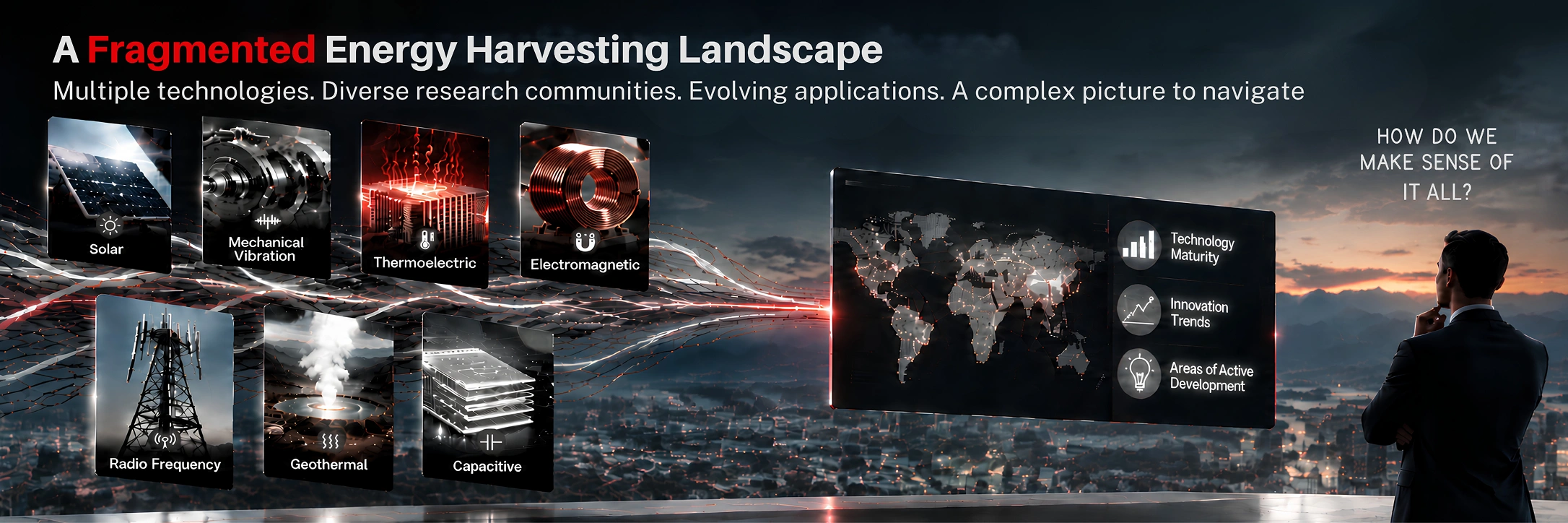
However, the energy harvesting landscape is highly fragmented. Different mechanisms including piezoelectric, thermoelectric, solar, electromagnetic, radio frequency, geothermal, capacitive and mechanical vibration-based harvesting have evolved independently across research communities and industrial applications. This diversity creates challenges in understanding technology maturity, innovation trends and areas of active development.
energy harvesting landscape image

The objective of the investigation was to establish a structured understanding of:

    • Major energy harvesting technology categories.
    • Key technical approaches within each category.
    • Patent and research activity across different harvesting mechanisms.
    • Relevant technological developments disclosed through patents and scientific literature.
Objective icon
CLIENT’S OBJECTIVE

Develop a comprehensive understanding of the global energy harvesting technology landscape through a structured State-of-Art (SOA) investigation.

The objective was to identify relevant technological developments, innovation trends, and key technical approaches across different energy harvesting domains through analysis of global patents and non-patent literature.

Clients come to us for answers.
They leave with opportunities they didn’t know existed.

Our experts help organizations uncover insights, opportunities and strategic directions that traditional approaches often miss.

Wissen’s Out-of-the-Box Approach:

Technology Intelligence Through Taxonomy-Driven Landscape Analysis

  • Recognizing the limitations of conventional search methodologies, the investigation evolved beyond simple patent and literature identification.
  • To develop a meaningful understanding of the energy harvesting landscape, the analysis expanded from document collection to a structured technology intelligence approach. The investigation focused on developing a technology framework that could classify innovations based on:
  • Different energy sources and harvesting mechanisms
  • Relevant patent and scientific literature disclosures
  • Relationships between emerging technology segments

Identifying Technology Patterns Through Integrated Patent and Literature Analysis

  • The identified references were further analyzed and arranged according to their relevance to energy harvesting type, key technological area, technical features disclosed and level of alignment with the defined search scope.

  • This structured mapping approach transformed fragmented patent and literature disclosures into an organized technology intelligence framework, providing a clearer understanding of developments across the energy harvesting ecosystem.

Our Methodology

Technology Domain Analysis
Keyword & Classification Strategy Development
Global Patent & Literature Search
Technology Taxonomy Development
Patent & Literature Screening
Feature-Based Technology Mapping
Landscape Report Development
Technology Domain Analysis
  • Study energy harvesting technology principles
  • Identify major harvesting mechanisms and approaches
  • Analyze evolving technology trends globally
Keyword & Classification Strategy Development
  • Extract technical keywords and synonyms
  • Identify relevant IPC/CPC classifications
  • Develop comprehensive search strategies
Global Patent & Literature Search
  • Search worldwide patent databases and literature
  • Identify relevant technical disclosures
  • Review documents for technology relevance
Technology Taxonomy Development
  • Classify technologies by energy sources
  • Organize harvesting approaches into categories
  • Create structured technology landscape framework
Patent & Literature Screening
  • Evaluate documents based on relevance
  • Extract key technical information
  • Prioritize significant technology disclosures
Feature-Based Technology Mapping
  • Map references against key features
  • Analyze technology implementation approaches
  • Identify innovation patterns across segments
Landscape Report Development
  • Consolidate findings into structured insights
  • Document search methodology and references
  • Prepare comprehensive technology intelligence report
Outcome:

A structured energy harvesting technology landscape was developed by mapping global patent and literature insights across key technological domains.

Technology Landscape Investigation Methodology

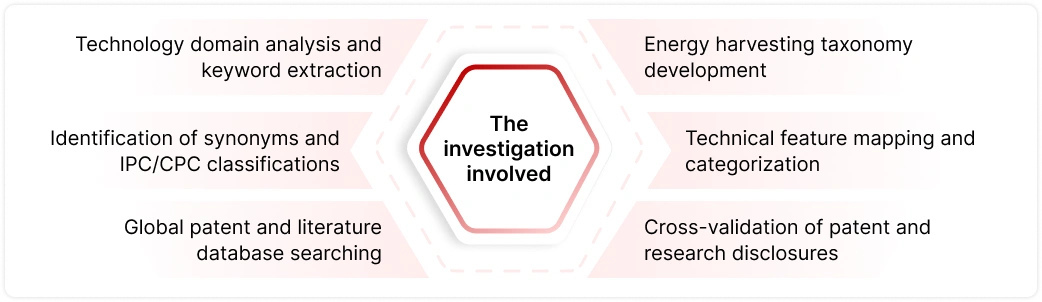
The energy harvesting state-of-art analysis was conducted through a structured technology intelligence approach to identify, classify and evaluate publicly available technical developments across diverse energy harvesting domains.

energy harvesting methodology

The investigation involved systematic analysis of patent and non-patent literature to establish a comprehensive understanding of energy harvesting technology evolution.

The methodology combined multiple search strategies, including keyword-based searching, classification-based searching and technology-based categorization. Relevant disclosures were analyzed enabling the creation of a structured technology landscape covering key energy harvesting approaches and emerging innovation areas.

Technical Challenges Addressed Through Energy Harvesting Technology Intelligence Analysis

Challenge 1: How Can Relevant Innovations Be Identified Despite Terminology Variations Across Technology Domains?

Energy harvesting technologies are developed across different industries and research communities where similar concepts may be described using different technical terminology. A major challenge involved ensuring that relevant patent and scientific disclosures were identified despite variations in keywords, technical expressions and classification approaches.

Solution

A multi-layered search strategy was implemented by combining technology-specific keywords, synonym expansion, IPC/CPC classification searches and keyword and classification combinations. The investigation evaluated multiple search approaches across patent databases to capture relevant disclosures representing different energy harvesting mechanisms and implementation approaches.

The analysis revealed:
  • Broader coverage of energy harvesting terminology.
  • Identification of relevant disclosures across different technical fields.
  • Improved search accuracy through combined keyword and classification strategies.

These findings ensured that the technology landscape represented a wider range of energy harvesting developments beyond direct keyword matches.

Challenge 2: How Can Patent and Scientific Literature Be Converted Into Actionable Technology Intelligence?

A technology landscape requires more than identifying relevant documents. The key challenge was transforming individual patent references and research publications into meaningful insights about technology trends and innovation directions.

Solution

The identified patent and non-patent literature references were analyzed and mapped according to energy harvesting type, key technological areas, technical features and relevance to specific technology segments. The analysis established connections between different disclosures and organized them according to their contribution to the broader energy harvesting ecosystem.

The analysis revealed:
  • 55 relevant patent references.
  • 10 relevant non-patent literature references.
  • Technology mapping across major energy harvesting domains.

The resulting intelligence framework transformed fragmented technical information into a structured technology landscape enabling a clearer understanding of innovation patterns across energy harvesting technologies.

Results & Business Impact

The final investigation successfully transformed a fragmented energy harvesting technology landscape into a structured technology intelligence framework through systematic analysis of global patents and non-patent literature.

Key Outcomes

  • Key outcome Icon

    Establishment of a structured technology taxonomy to classify and analyze diverse energy harvesting innovations.

  • Key outcome Icon

    Analysis of 55 patent references and 10 non-patent literature references aligned with key technical features and technology categories.

  • Key outcome Icon

    Mapping of technical disclosures from patents and scientific literature to understand innovation patterns across different harvesting approaches.

  • Key outcome Icon

    Development of a consolidated technology landscape providing improved visibility into emerging energy harvesting technologies and research directions.

Strategic Business Impact

By moving beyond conventional document identification and incorporating taxonomy-driven technology analysis, the investigation enabled:

  • Improved visibility into technology evolution and innovation trends.
  • Identification of key energy harvesting technology clusters and development areas.
  • Better understanding of terminology variations across different technical fields.
  • Broader technology coverage through combined analysis of patent and scientific literature.

The investigation demonstrated how systematic state-of-art analysis can convert fragmented technical information into actionable technology intelligence helping organizations make informed decisions in rapidly evolving technology areas.

Need Visibility into Emerging Technology Landscapes?

Our team combines technical research, patent intelligence and structured analysis to uncover technology trends and patterns across emerging technology domains.