Pick up almost anything in your kitchen, your medicine cabinet, or your closet, and there’s a good chance a small black-and-white square is staring back at you. For most of the last decade, that square did one job: point your phone at a website. Harmless. Forgettable. Easy to ignore.
That era is ending.
Behind that same square, a quiet infrastructure shift is now underway – one that regulators, retailers, and a handful of fast moving technology providers are racing to build before the rest of the market realizes it’s happening. By the time it’s fully in place, the QR code on a bottle of shampoo or a car battery won’t just be a link. It will be a passport, a fingerprint, and a compliance record, all at once.
Here’s what’s forcing the issue: Regulation, not marketing budgets, is now writing the roadmap.
In the United States, pharmaceutical supply chains have already crossed the line — full serialized, item-level tracking is now the baseline requirement, not the ambition. Food companies have a harder deadline bearing down: 2028, after a 30-month delay that bought the industry time it can’t afford to waste. And in Europe, the Digital Product Passport is rolling out category by category through 2030, turning “where did this come from, and where does it go when I’m done with it” from a nice-to-have into a legal requirement.
Layer on top of that a genuinely global infrastructure shift — GS1’s Sunrise 2027 initiative and the picture sharpens further. Retail checkout scanners in dozens of countries are being upgraded, right now, to finally read the same rich 2D codes that have sat underused on packaging for years. When that lands, the QR code stops being a bonus feature next to the “real” barcode. It becomes the barcode.
Translation for anyone still on the fence: the infrastructure your customers will expect tomorrow is being built today, whether you’re part of it or not.
If you’ve been holding off on traceability because it sounded like “another blockchain thing,” here’s the plot twist: it mostly isn’t.
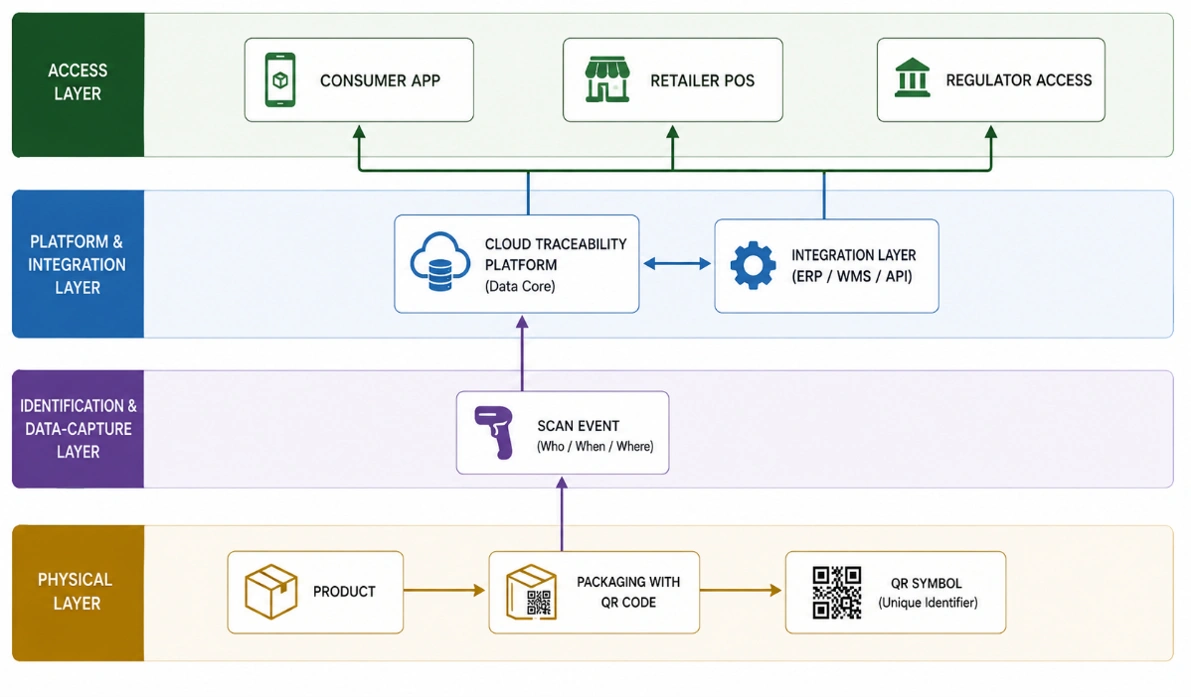
Across the companies actually shipping products with this technology today, blockchain shows up as a supporting actor, not the star. Even providers publicly associated with blockchain-based authentication report it makes up a small fraction of what they actually sell. The real work — the part moving billions of items through real supply chains right now — is happening through far less exotic means: cloud platforms, open standards, and a QR code doing what it was always good at, quietly and reliably.
That’s good news if you’ve been intimidated by the hype. The bar to entry is lower than the noise suggests.
What’s striking about this space right now isn’t consolidation — it’s the opposite. No single company owns it. The patent landscape is scattered across specialist firms, industrial giants, and a handful of digital-identity players who’ve quietly built outsized footprints. Some of the biggest names in the room — the ones already tracking billions of individual items for brands like Walmart, adidas, and Levi’s, or powering the world’s first full-scale battery passport for a major automaker got there not by inventing something radically new, but by being early and consistent.
That’s the real opportunity hiding in this market: it still rewards being early.
Authentication specialists are carving out defensible niches protecting luxury goods and pharmaceuticals from counterfeits. Vertical compliance players have made themselves indispensable to an entire industry simply by being fluent in one regulation better than anyone else. And the platforms that got carrier-agnostic architecture right early — treating QR, RFID, and NFC as interchangeable tools rather than picking a side, are the ones now showing up across the widest range of use cases.
The intelligence layer is wide open. Every other part of the stack — the codes, the standards, the cloud databases, the integrations is mature, proven, unglamorous infrastructure. But turning the flood of data those systems generate into genuine foresight — anomaly detection, fraud pattern recognition, predictive supply-chain intelligence is still, by most honest accounts, in its early days. Vendors talk about it. Few can prove it at scale yet.
For a brand deciding where to place its next bet, that’s the signal worth paying attention to. The identification problem is solved. The differentiation battle of the next few years will be fought over what you do with the data once the scan happens.
Every deadline in this space shares the same shape: far enough away to feel optional, close enough that waiting is a decision with a cost. The brands already integrated with open standards like GS1 Digital Link won’t be scrambling when 2D barcodes become the retail default. The ones treating today’s compliance requirement as tomorrow’s competitive infrastructure — rather than a box to check, will be the ones consumers trust when “where did this actually come from” stops being a curiosity and starts being the question that decides the sale.
The code on the box was never really about the link. It was always about the trust on the other end of it. That part just got a lot more real.