How SPARTA Simplifies Standard Essential Patent (SEP) Research: A Practical Workflow Guide
Standard Essential Patents (SEPs) play a critical role in technologies built on global standards, including 3GPP, ETSI, IEEE, QI, Bluetooth or ITU, connected vehicles and advanced semiconductor systems.
These patents influence technology licensing, portfolio valuation, competitive intelligence and innovation strategy. However, identifying and analyzing SEPs requires a deeper approach than conventional patent searching.
A patent may appear relevant to a technology area, but relevance alone does not establish whether it is essential to implementing a technical standard. IP Professionals must establish connections between:
Traditionally, this requires navigating multiple patent databases, standards repositories and technical document archives.
SPARTA (Standards Prior Art & SEP Analyzer) helps simplify this process by bringing patent intelligence, standards information, technical documentation and SEP research capabilities together within a structured environment.
This guide explains the Standard Essential Patents (SEP) research workflow and how an integrated approach can improve efficiency and consistency in standard essential patent analysis.
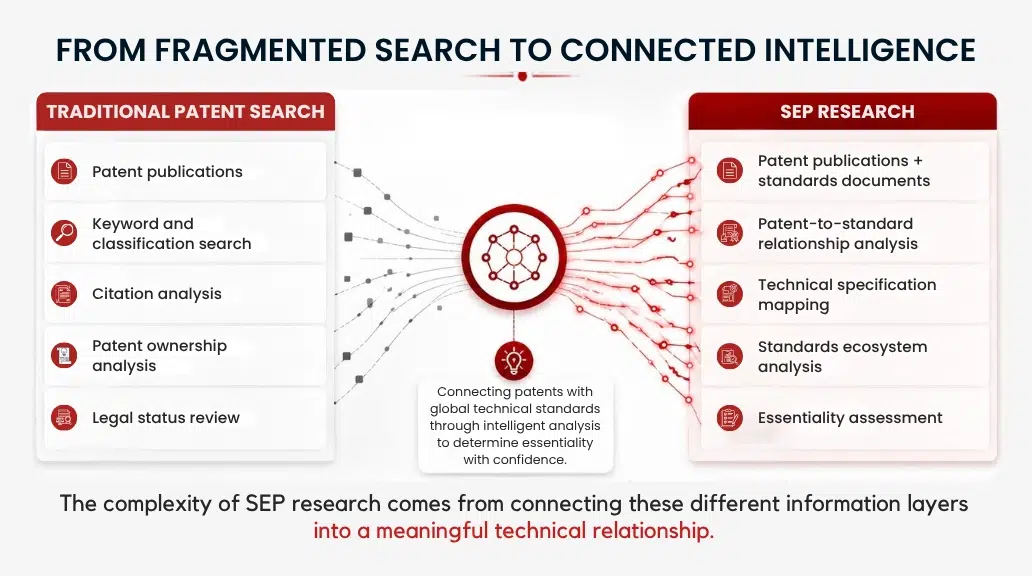
Why SEP Research Is Different from Traditional Patent Searching
Traditional patent searches typically focus on:
SEP research requires an additional layer: understanding how a patented invention relates to mandatory technical requirements defined by a standard.
For example, a patent related to wireless communication may appear highly relevant to 5G technology, but relevance alone does not establish essentiality. IP Professionals must determine whether the patented technology corresponds to mandatory requirements of the applicable standard and whether implementing those requirements would necessarily practice the patent claims.
The Standard Essential Patent Research Workflow
A structured SEP analysis generally follows five key stages:
SEP research typically begins with a patent, patent family, product feature or technology concept.
Researchers may start with:
Understanding the invention scope provides the foundation for identifying potentially relevant standards.
Once the technology area is understood, researchers identify the relevant Standard Development Organizations (SDOs).
Depending on the technology domain, this may include:
Selecting the appropriate standards ecosystem helps narrow the analysis and focus on relevant technical specifications.
The next step involves reviewing technical specifications to understand how a technology feature is defined within a standard.
Researchers analyze:
The objective is to determine whether the patented technology relates to mandatory aspects of the standard.
Standards are developed through extensive technical discussions involving multiple organizations and contributors.
Meeting contributions and technical documents provide valuable context about:
Reviewing this information helps researchers better understand how technologies became part of a standard.
The final stage involves evaluating the relationship between patent claims and standard requirements.
This analysis supports:
Challenges in Manual SEP Research
Although the SEP workflow is well-defined, performing this analysis manually can become challenging.
Patent documents, technical specifications, meeting contributions and declaration information are often available across different platforms. Researchers need to connect information from multiple sources before reaching meaningful conclusions.
Technology standards continuously evolve through new releases and revisions. A patent may relate to a particular version, feature, or implementation requirement, making standards version tracking essential.
SEP analysis requires knowledge across multiple disciplines:
Patent analysis
Standards analysis
Manual SEP analysis can become increasingly time-consuming when evaluating:
How SPARTA Supports a More Efficient SEP Research Workflow
SEP analysis becomes more effective when patent and standards information can be explored through a connected workflow.
SPARTA provides a unified environment where researchers can navigate relevant patent information, standards documents, standards meeting information, technical contributions and SEP-related insights.
Researchers can begin their analysis using:
This allows flexibility depending on the available starting point.
SEP research often requires reviewing multiple standards organizations. SPARTA helps researchers explore standards intelligence across major technology ecosystems, enabling more structured research without repeatedly switching between disconnected sources.
Understanding SEP relevance requires more than reviewing patent abstracts. IP Professionals can examine technical documentation that provides insight into:
Organize Patent-to-Standard Analysis
The relationship between a patent and a standard often requires reviewing multiple technical factors.
SPARTA helps organize relevant information to support:
While expert review remains essential for formal legal opinions, a structured workflow can significantly improve preliminary research efficiency.
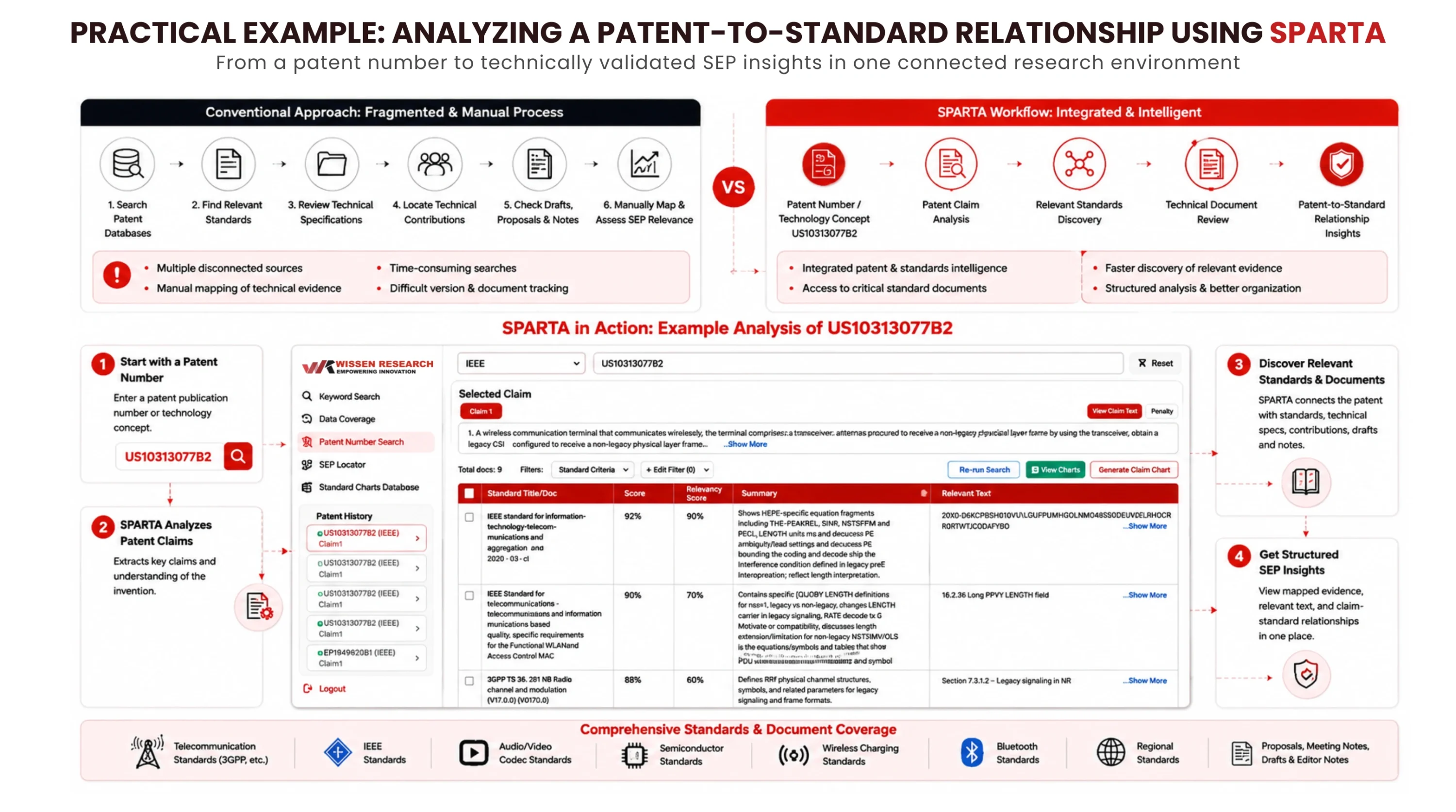
Practical Example: Analyzing a Patent-to-Standard Relationship Using SPARTA
A key challenge in SEP research is connecting a patent with the technical requirements defined in industry standards.
For example, an analyst evaluating US10313077B2 would traditionally need to search across patent databases, standards repositories, technical contributions and related documentation before understanding the technology-standard relationship.
SPARTA simplifies this workflow by enabling researchers to begin with a patent number or technology concept and explore relevant standards information, technical documents and supporting evidence within a connected environment.
By bringing together patent intelligence and standards intelligence, SPARTA helps reduce manual searching, improve research organization and accelerate identification of relevant technical information.
Best Practices for Effective SEP Research
Organizations can improve SEP analysis by following a structured approach:
Clearly identify the technology area, patent portfolio, or standard ecosystem before beginning research.
Patent information alone is not sufficient. Standards documents and technical contributions provide additional context.
Review relevant releases to understand how technology requirements change over time.
Meeting documents can provide valuable insight into technology development.
Structured records improve transparency for licensing, portfolio management, and strategic decisions.
Standard Essential Patent research is not simply about finding patents related to a technology. It requires understanding how patented inventions connect with technical standards and implementation requirements.
As industries continue to adopt advanced technologies such as 5G, Wi-Fi, IoT and semiconductor innovations, the ability to efficiently analyze patent-to-standard relationships becomes increasingly valuable.
By connecting patent intelligence and standards research in one environment, SPARTA enables IP professionals and technology researchers to approach SEP analysis with greater structure, efficiency and clarity.
Explore a Smarter Way to Analyze Standard Essential Patents
SEP research demands connecting patents, standards, technical evolution, and innovation insights.
SPARTA unifies these intelligence layers into one powerful research environment.
Frequently Asked Questions (FAQs)
No. Patent information alone is not sufficient for SEP analysis. Researchers need access to relevant standards specifications, technical contributions and related documents to understand the connection between a patent and a standard.
No. A SEP declaration indicates that a patent holder considers a patent potentially relevant to a standard, but technical analysis is required to evaluate its relationship with the standard requirements.
Yes. SPARTA supports research across multiple standards ecosystems, including telecom, IEEE, audio/video codecs, semiconductor technologies, wireless charging, Bluetooth and regional standards.
Yes. SPARTA helps researchers organize patent and standards information within a structured workflow, making it easier to analyze multiple patents across complex technology landscapes.
SPARTA is useful for IP professionals, patent analysts, licensing teams, R&D teams, and technology intelligence groups involved in standards research, patent portfolio analysis and SEP-related activities.
The Best Decisions Start With Better Intelligence.
Connect the dots across technology, markets, competition and innovation with research designed to support strategic decision-making.