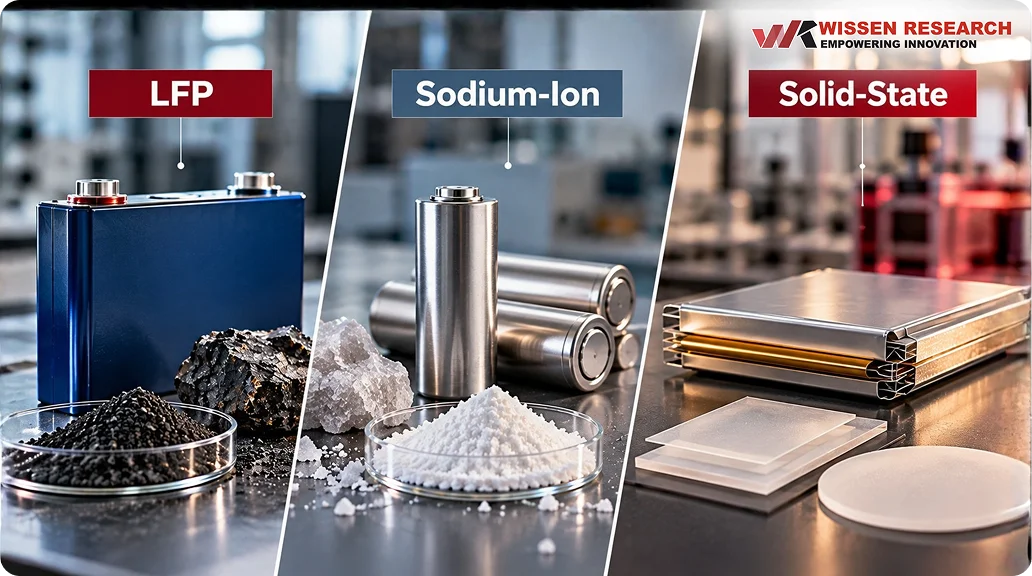
For years, battery development focused on storing more energy in less space. Higher energy density promised longer electric-vehicle (EV) range, smaller battery packs and better performance. Today, the industry is pursuing a broader set of objectives: lower costs, more resilient supply chains, longer service life, improved safety and manufacturing processes that can scale.
Recent developments illustrate this shift. Lithium iron phosphate (LFP) accounted for more than 55% of global EV battery deployment in 2025, according to the International Energy Agency (IEA). In April 2026, CATL and HyperStrong announced a three-year cooperation agreement covering 60 GWh of sodium-ion batteries for energy storage. Meanwhile, solid-state battery developers continue to work toward commercial production with ProLogium announcing a major manufacturing milestone in September 2026.
These developments represent three different paths for battery innovation. LFP is extending an established chemistry through material and pack-level improvements. Sodium-ion is developing as an alternative for applications where material diversification and operating conditions may outweigh maximum energy density. Solid-state batteries are pursuing a different cell architecture with the potential to improve energy density, particularly when paired with lithium-metal anodes.
The distinction matters because no single technology is likely to meet every storage requirement. An electric car, a grid-scale storage installation and an industrial battery system have different priorities. Their technology choices depend on the balance between energy density, cost, operating conditions, safety and expected service life.
For R&D teams, IP professionals and business leaders, the more important question now is where each technology is gaining ground, which technical problems remain unresolved, who is developing the solutions and how those developments are changing the innovation and patent landscape.
LFP, sodium-ion and solid-state batteries are often discussed together as next-generation battery technologies. However, they differ in chemistry, architecture, maturity and the applications they are best suited to serve.
| Technology | Competitive advantage | Main innovation priorities | Most relevant applications |
| LFP | Established manufacturing scale, cost competitiveness and cycle-life potential | Cathode improvements, pack integration, charging performance and manufacturing efficiency | Mainstream EVs, commercial vehicles and stationary storage |
| Sodium-ion | Potential material diversification and strong low-temperature performance in selected designs | Cathodes, hard-carbon anodes, electrolytes, cell formation and cost reduction | Grid storage, selected low-cost EVs, two- and three-wheelers and industrial equipment |
| Solid-state | Potential for higher energy density and lithium-metal integration | Solid electrolytes, interfaces, electrode coatings, pressure management and scalable manufacturing | Initially, applications where performance gains can justify higher cost and engineering complexity |
Note: These are broad technology-level characteristics, not guaranteed product specifications. Performance depends on the cell design, chemistry, operating conditions and system architecture.
The IEA’s Global EV Outlook 2026 provides useful context for this comparison: it reports that current sodium-ion cells can reach approximately 175 Wh/kg, compared with up to 205 Wh/kg for the latest LFP cells and 265 Wh/kg for nickel-manganese-cobalt (NMC) cells. These are reported technology-level figures, not specifications that apply to every product.
The application determines which trade-offs are acceptable. LFP is attractive where cost and established supply chains matter. Sodium-ion may suit applications where low-temperature performance and material diversification are valuable. Solid-state batteries are being developed for applications that can justify the cost and engineering effort required to achieve their potential performance advantages.
The implication is straightforward: technology selection is becoming more application-specific, while the innovation challenge is shifting toward delivering the right combination of performance, cost, safety and manufacturability.
From pilot projects to commercial commitments: What recent developments reveal
The most useful way to assess emerging battery technologies is to look beyond laboratory results. Manufacturing investment, supply agreements, demonstration projects and customer adoption provide different signals of commercial readiness.
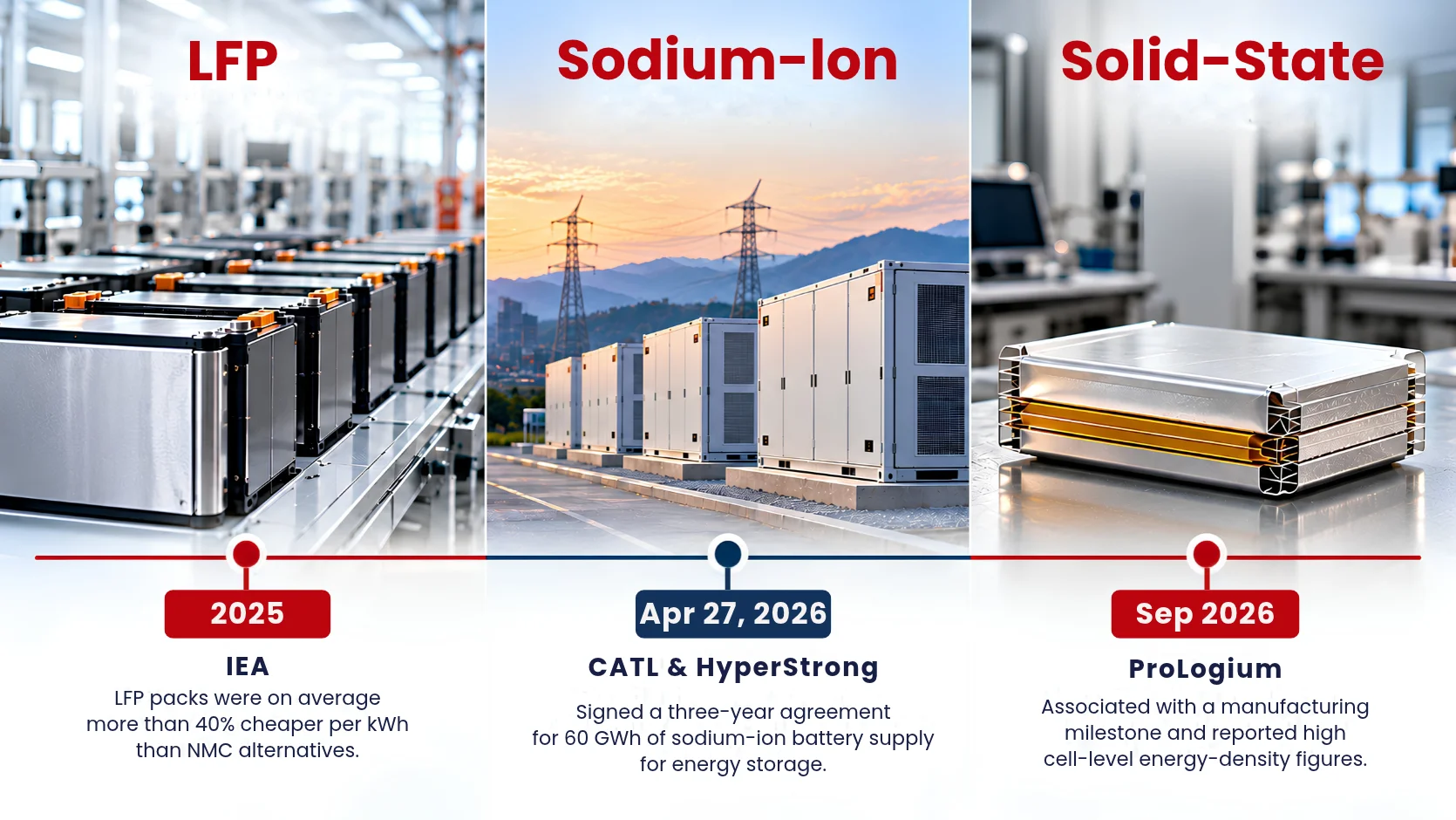
The key lesson across all three technologies is that commercial maturity must be assessed through evidence of repeatability and scale, not laboratory performance or announcement headlines alone.
How Patent Landscape is changing?
As battery technologies approach commercialization, patent competition extends beyond discovering new electrode materials. Companies also seek protection for the solutions that make those materials compatible, stable, manufacturable and reliable within a complete cell and battery system.
A 2024 review by Karkar and colleagues examined the industrial and intellectual-property landscape of solid-state batteries, focusing on solid-electrolyte chemistries and patent activity. It identified substantial portfolios associated with companies including Toyota, Samsung and LG.
A 2026 study by Hu and colleagues combined bibliometric and patent analysis to examine sodium-ion battery development. Its findings describe a shift from material-level investigation toward system-level optimization and application-oriented commercialization.
These studies help establish the context, but a rigorous comparison of current patent competition across LFP, sodium-ion and solid-state technologies would require a dedicated search using consistent definitions, patent-family consolidation and legal-status review.
Several innovation patterns deserve attention.
Research and patent analysis increasingly need to examine protective coatings, interlayers, composite electrolytes and electrode-electrolyte compatibility. These are important areas because a promising electrolyte must remain stable when integrated with electrodes and subjected to repeated cycling.
Sodium-ion research covers cathodes, hard-carbon anodes, electrolytes and cell design. A 2026 review integrating bibliometric and patent analysis found that research priorities have evolved from material-level investigations toward broader system optimization and commercialization.
LFP demonstrates why established technologies remain important innovation targets. Improvements to cathode composition, electrode design, manufacturing processes, pack integration and charging performance can deliver commercially meaningful gains without requiring a completely new battery platform.
Battery performance and safety also depend on cooling architecture, temperature monitoring, thermal barriers, propagation control and pack design. These technologies may be relevant across multiple chemistries, even when their implementation differs between conventional lithium-ion and solid-state systems.
As developers scale production, processing conditions, electrode fabrication, cell assembly, quality control and formation procedures become increasingly important. A battery chemistry may attract significant research interest without any one company controlling the entire technology stack. Conversely, a focused patent portfolio may cover a critical manufacturing step that affects production yield or reliability.
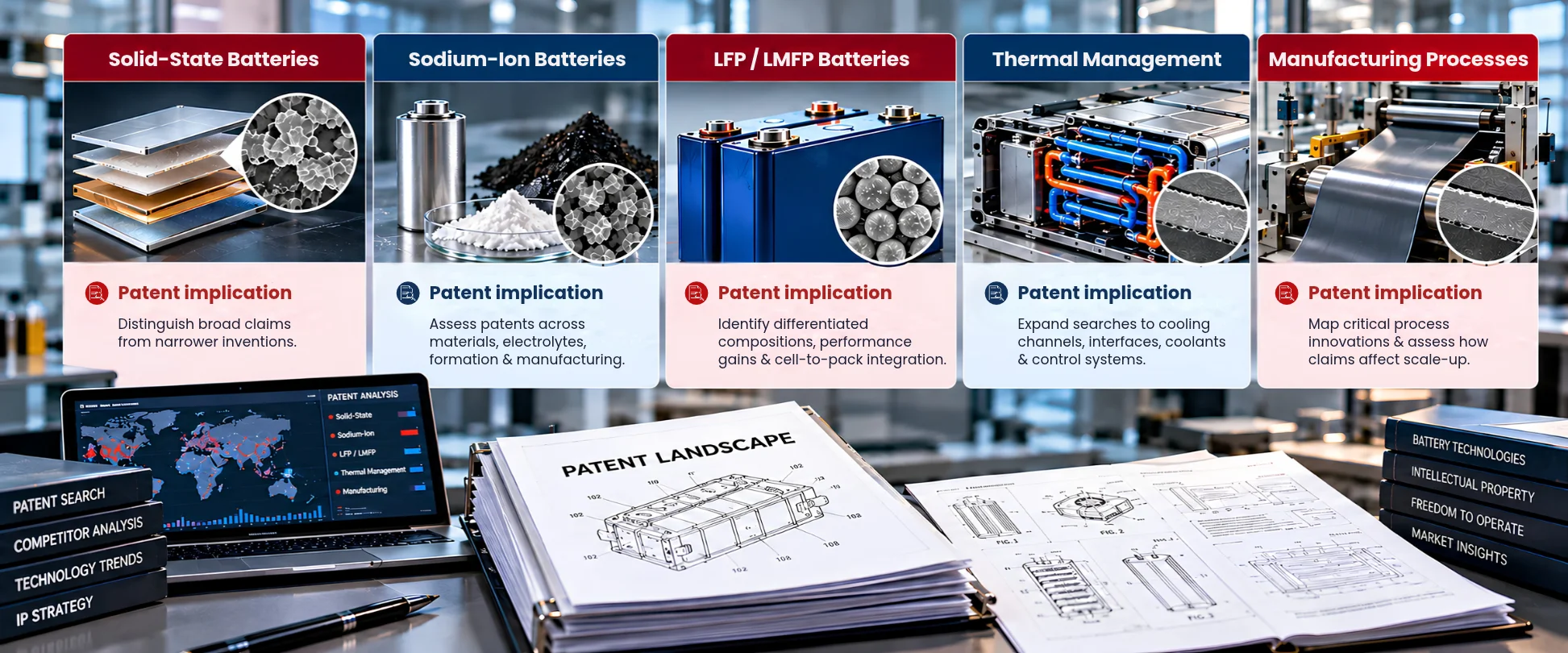
Patent analysis should therefore connect three questions: what problem is being solved, what technical approach is claimed and how important is that solution to a commercially viable battery?
A relevant example is Wissen Research’s Energy Harvesting Technology Landscape: A Patent and Literature State-of-Art Study, which demonstrates how patent and scientific literature analysis can map emerging technologies, identify innovation trends and support strategic R&D and IP decisions.
Electrolytes: Improving the materials between the electrodes
Electrolytes are becoming an important part of the battery innovation story because they influence ion transport, interfacial stability, charging behaviour and degradation.
In conventional lithium-ion batteries, the liquid electrolyte must support ion movement while remaining compatible with both electrodes. Faster charging, higher-voltage cathodes, silicon-containing anodes and low-temperature operation place increasingly demanding requirements on electrolyte formulations.
A 2025 review by Zhao and colleagues examines low-temperature electrolyte limitations, including reduced ionic conductivity, slower charge-transfer reactions, restricted lithium-ion transport across interfacial layers and the risk of lithium dendrite formation. It discusses approaches involving salt chemistry, solvent selection, additives and gel-polymer composite systems.
This is relevant to commercial battery development because improving electrolyte performance may extend the capabilities of existing cell designs without requiring a complete change of chemistry.
However, electrolyte improvements are formulation-specific. Lithium bis(fluorosulfonyl)imide (LiFSI), for example, is being investigated for its potential benefits in selected systems, but it should not be described as universally superior to lithium hexafluorophosphate (LiPF₆). Performance depends on the solvent system, concentration, electrode materials, operating voltage and test conditions.
Solid-state batteries introduce a related but different challenge. Instead of optimizing a liquid electrolyte, developers must manage the contact and compatibility between solid materials. This connects electrolyte research directly to the patent trends discussed earlier: composition, coatings, interlayers and processing can be as important as the electrolyte’s properties in isolation.
For technology developers, the opportunity lies in identifying which formulation or interface improvements solve a measurable performance limitation and whether the improvement can be reproduced under practical operating conditions.
Thermal management: Safety, regulation and system design
Thermal management extends battery innovation beyond the cell itself. Heat influences charging performance, degradation and service life, while certain failure conditions can trigger thermal runaway and propagate to neighbouring cells.
China’s GB 38031-2025 electric-vehicle traction-battery safety standard took effect on July 1, 2026. The official standards record confirms the standard and its implementation date. Its detailed testing and compliance requirements should be taken from the official document rather than reduced to a single headline figure.
A 2025 review in Renewable and Sustainable Energy Reviews examines immersion cooling, coolant selection, thermal-runaway mitigation, system integration and economic considerations. The research highlights both the potential of direct-contact dielectric cooling and the engineering challenges that must be addressed before it can be deployed effectively.
These technologies address different needs. Active cooling removes heat during operation, while insulation and other passive measures can slow heat transfer between cells. Their effectiveness depends on the cell format, system design, coolant properties and failure conditions. No single cooling method eliminates all battery safety risks.
This has two important implications for innovation.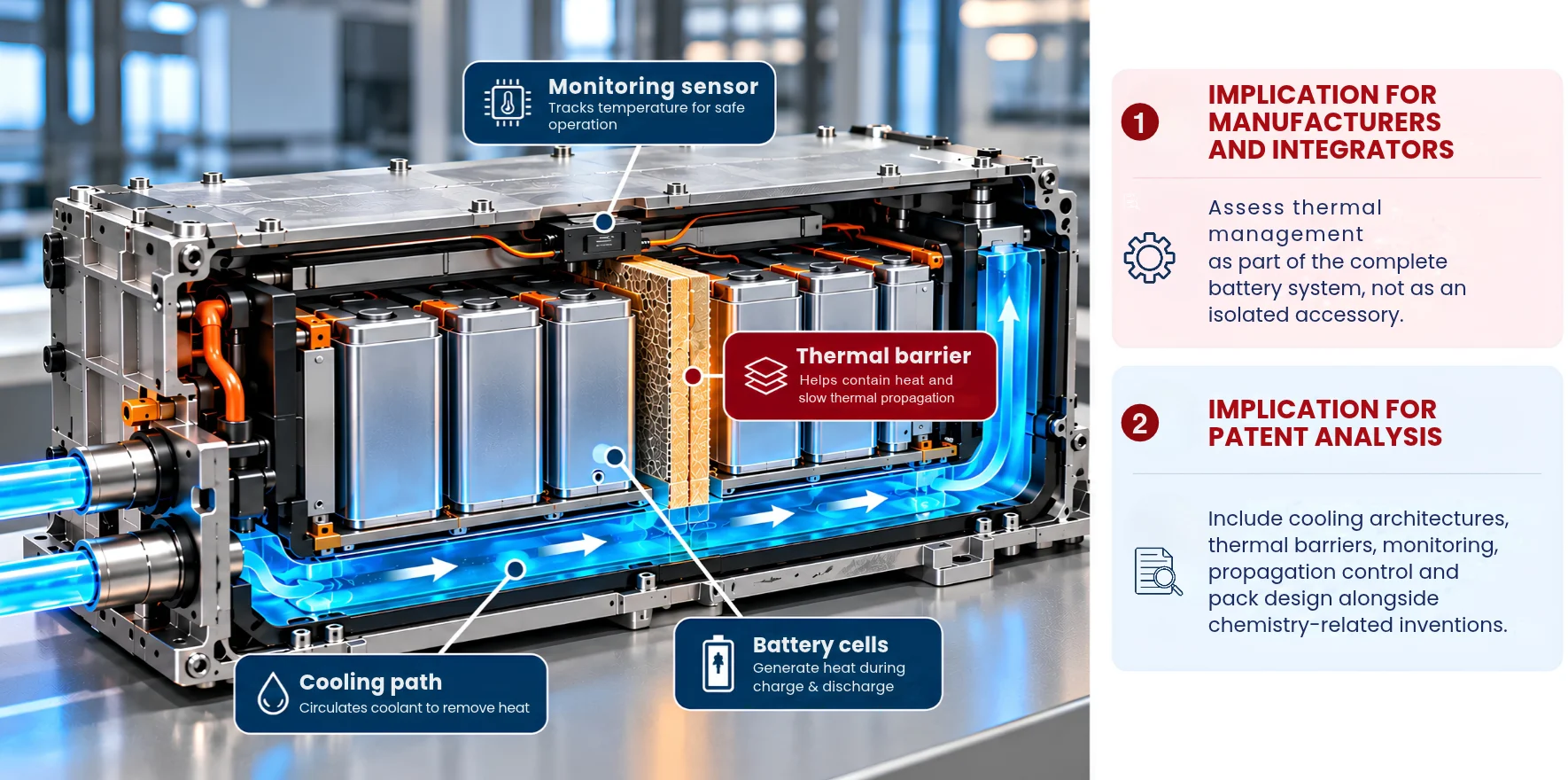
What these developments mean for industry decision-makers?
Automotive Manufacturers
Compare chemistry choices against vehicle range, charging requirements, pack design, safety, supply availability and total system cost. Solid-state announcements should be assessed against qualification and production evidence, not cell-level specifications alone.
Industry and Business Leaders
Track manufacturing investment, supply agreements, production yields, partnerships and customer adoption. The key question is where a technology can create an advantage that is commercially defensible.
IP Professionals
Monitor patent ownership, claim scope, legal status, geographic coverage and potential freedom-to-operate risks. Pay particular attention to interface materials, electrolyte formulations, cell architecture and manufacturing processes.
R&D Heads and Innovation Leaders
Combine patent analysis with scientific literature and experimental evidence to identify unresolved technical problems, promising approaches and opportunities for collaboration or further development.
Technology Experts
Compare performance using consistent test conditions and clearly defined system boundaries. Distinguish cell-level energy density from pack-level performance and laboratory results from independently validated commercial products.
The battery industry is unlikely to converge on one chemistry for every application. LFP is benefiting from established manufacturing scale and continued engineering improvements. Sodium-ion is advancing through commercial commitments and application-specific development. Solid-state batteries are pursuing higher performance while developers work through the technical and manufacturing challenges that determine their commercial prospects.
At the same time, electrolyte research and thermal management are becoming increasingly important to how battery systems perform in practice. These areas also create new opportunities for patent protection and competition beyond the traditional focus on electrode materials.
The patent landscape will need to be interpreted accordingly. Filing activity can reveal where companies are investing in technical solutions, but it must be combined with claim analysis, legal-status review, scientific evidence and commercialization data to establish what those developments mean.
For R&D teams, the priority is to identify which technical barriers remain unresolved and which solutions are likely to offer measurable gains. For IP professionals, it is to understand how emerging inventions fit within existing portfolios and where important claims may affect product development. For business leaders, it is to determine which technologies are becoming viable for particular applications and what evidence supports that assessment.
The next phase of battery innovation will be shaped not just by what a chemistry can achieve but by how reliably, safely and economically that performance can be delivered at scale.
That is where technology research and patent intelligence can make a practical difference: connecting emerging inventions with the evidence needed to evaluate their technical significance, commercial potential and competitive position.
Explore a Smarter Way to Analyze Battery Patents
Understanding battery innovation requires connecting patent activity, technical advancements and competitive developments. Wissen Research helps uncover key players, emerging innovation areas and strategic opportunities across battery technologies.