
If you want to understand where biomedical polymers are actually headed, stop looking for a new plastic. Nobody’s about to invent one. Start looking instead at what companies are doing with the ones that have been sitting on the shelf since the 1990s because that’s where almost every real advance in this space is actually happening.
The plastic nobody’s replacing — just reshaping
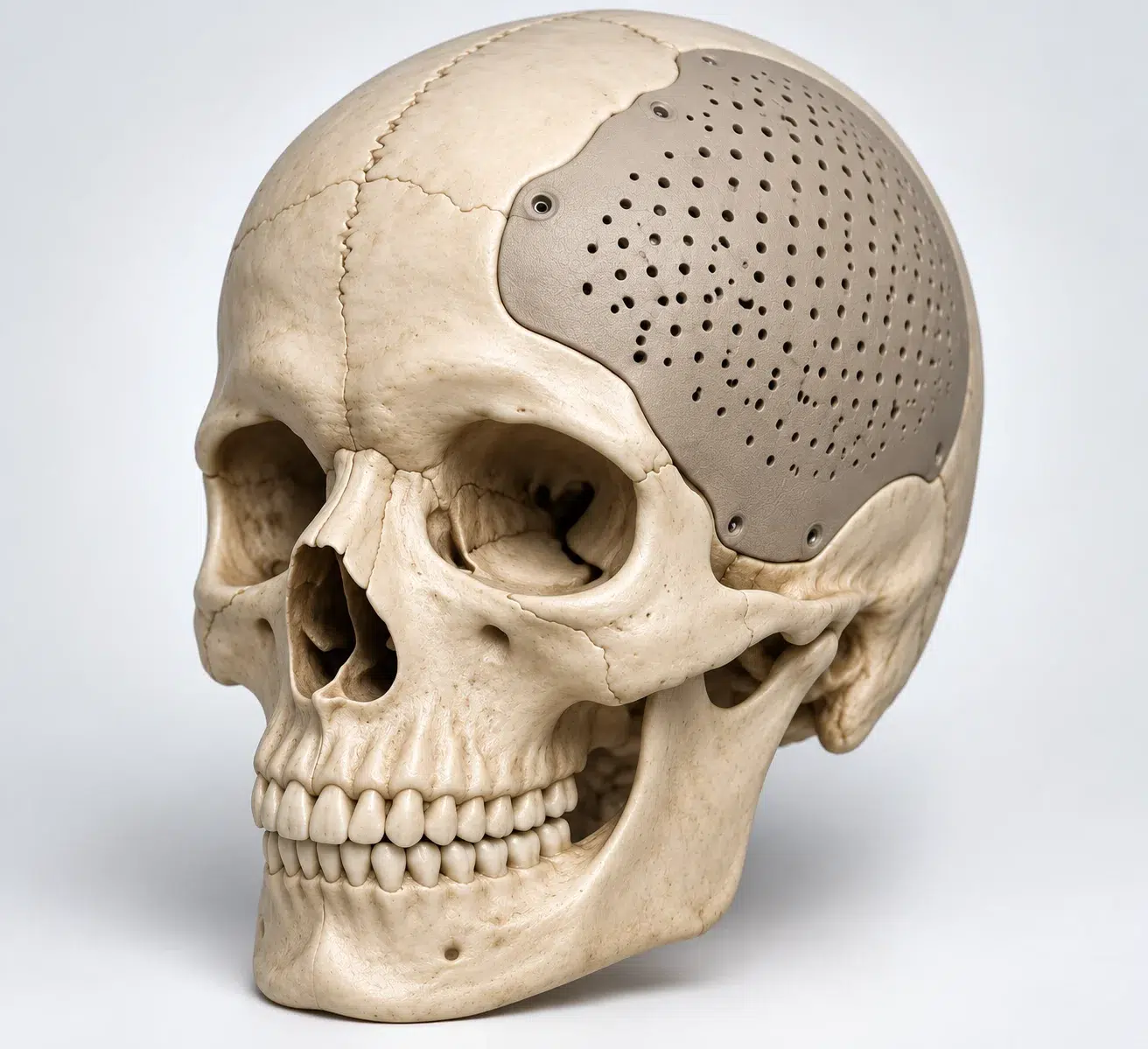
In April 2024, 3D Systems got FDA clearance for the first 3D-printed PEEK skull implant. That sounds like a materials breakthrough. It isn’t one.
The polymer behind it — Evonik’s VESTAKEEP® PEEK is chemically the same PEEK that’s been in spinal implants since the late 1990s. Victrex/Invibio’s implantable PEEK alone has gone into more than 15 million devices over 20-plus years. Nothing about the chemistry changed in 2024. What changed was not the material, but the process: a printer transformed a material with two decades of clinical history into patient-specific devices, replacing traditional machining from a solid block. Before the US clearance even landed, the workflow had already been used in close to 40 cranioplasty cases in Europe.
That’s the pattern worth remembering before you read anything else in this space: the real competitive battle in mature biomedical polymers has quietly shifted from what the material is to how you shape it.
Same polymer, opposite fates
Here’s the part of this story most people miss entirely because it involves the same company making the same kind of bet twice, with opposite results.
In April 2024, Abbott’s Esprit BTK – A dissolving polymer scaffold, designed to temporarily support below the knee arteries before naturally resorbing, was approved by the FDA. The trial behind it showed the device beating the standard treatment head on: at one year, 74% of patients avoided amputation, vessel blockage, or a repeat procedure, versus 44% on standard balloon angioplasty.
Now rewind eight years. Abbott had already tried this once before — in coronary arteries, not leg arteries with a device called Absorb, using a closely related dissolving-polymer approach. It was approved in 2016. It was pulled from the US market in 2017, after data showed it caused more blood clots than a standard metal stent.
Same underlying idea. Same company. Opposite outcome. Not because the science changed, but because the anatomy did. A dissolving implant is not automatically an upgrade over a permanent one. It’s a design choice that only works when the anatomy cooperates.
The real competition isn’t chemistry — it’s purity
Ask who’s winning in drug-delivery polymers, and the honest answer is: the company selling the cleanest version of a molecule everyone already has access to.
The polyester chemistry behind long-acting injectable drugs, the kind used in depot medications lasting weeks to months is decades old and largely unprotected by patent. What suppliers like Evonik and Corbion actually compete on today is impurity control: lower residual monomer, tighter batch consistency, cleaner catalyst removal. A new entrant trying to out-invent this chemistry is solving a problem nobody’s paying for. The customer isn’t shopping for a new molecule. They’re shopping for a cleaner one.
The name hiding two different technologies
If a pitch deck says “hydrogel technology” without qualifying it further, ask what they actually mean because the word is doing a lot of hiding.
Wound-care hydrogels have been commercially proven and unremarkable for decades. Injectable and 3D-bioprinted hydrogels, sharing the exact same name are still mostly confined to research labs. Treating them as one maturity category is a fast way to badly misjudge a technology’s readiness.
The single point of failure sitting under the industry’s biggest recent win
Here’s an uncomfortable detail buried under the most celebrated development in this whole space: 3D Systems’ FDA-cleared PEEK implant workflow runs on exactly one material, from exactly one supplier. If Evonik’s VESTAKEEP grade has a supply disruption, quality issue, or pricing shift, the downstream effect lands directly on the single most significant additive-manufacturing milestone this industry has produced in years.
The claim nobody’s made yet
Every major polymer supplier talks about sustainable or bio-based materials. Not one publishes environmental data specific to the medical-grade version of that same material which requires far more solvent-intensive purification than its commodity-plastic cousin. That’s not a minor gap. It’s a genuinely open claim sitting on the table, waiting for whoever verifies it first.
The barrier that isn’t about performance at all
Carbon-based nanocomposites — graphene, carbon nanotubes outperform the hydroxyapatite composites already used in commercial implants on several measures. So why aren’t they in products yet? Not because the material underperforms. Because nobody yet knows, with confidence, how the human body clears carbon nanomaterials over years of exposure. That’s a fundamentally different, slower kind of barrier than a typical “still scaling up” technology gap.
What this actually means for the next 18 months
None of this is a call to chase a new molecule. It’s the opposite. The evidence here points one direction consistently: the strongest, lowest-risk opportunities in biomedical polymers right now come from pairing materials that already have decades of safety data behind them with newer manufacturing methods, not from betting on unproven chemistry. The companies moving fastest aren’t the ones inventing new plastics. They’re the ones getting FDA clearance for smarter ways to shape the old ones.