
Graphene Market
Global Industry analysis, Size, Share, Growth, Trends, and Forecast 2026-2031
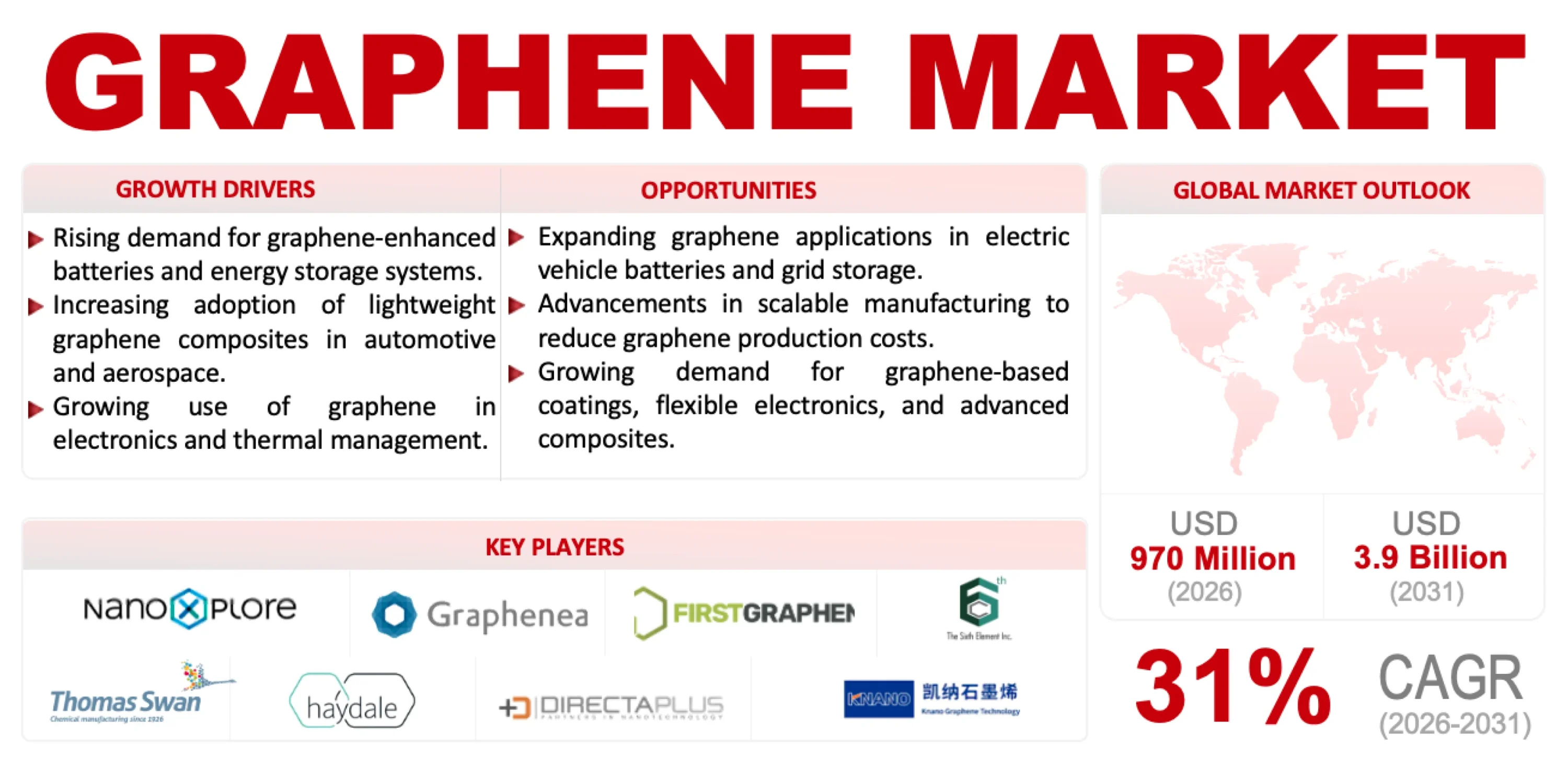
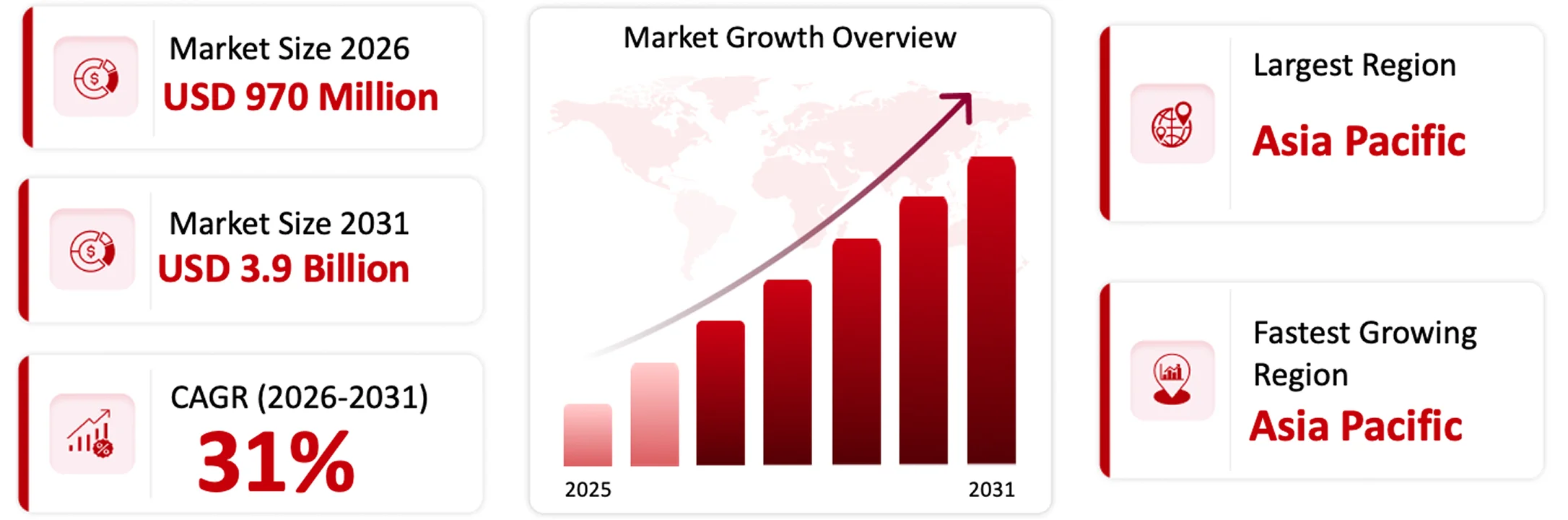
The market is projected to reach USD 3.9 billion by 2031, growing at a CAGR of 31 % during the forecast period (2026-2031).
| Market Size (2026) | Forecast (2031) | CAGR (2026–2031) | Leading Region | Fastest Growing Region |
|---|---|---|---|---|
| USD 970 Million | USD 3.9 Billion | 31 % | Asia-Pacific | Asia-Pacific |
Summarize this report with:



Graphene Market Overview
“In my view the global graphene market is transitioning from research-led development toward targeted industrial commercialization, driven by advances in scalable production, material processing, and application-specific formulations. Demand is emerging across energy storage, composites, electronics, thermal management, and protective coatings, where graphene can improve conductivity, mechanical strength, durability, or weight efficiency. Graphene nanoplatelets, graphene oxide, reduced graphene oxide, and chemical vapour deposition films serve distinct requirements, shaping differentiated supply chains. However, commercial expansion depends on consistent material quality, competitive production costs, standardized characterization, and demonstrated performance in end-use environments. Consequently, suppliers increasingly prioritize scalable manufacturing and customer-specific integration over laboratory performance alone”
– Mayur Jain, Research Consultant, Wissen Research
The market is estimated to be USD 970 Million in 2026 and is projected to reach USD 3.9 billion by 2031, growing at a CAGR of 31 % during the forecast period (2026-2031).
Technology Overview
Graphene is a two-dimensional carbon nanomaterial comprising a single layer of carbon atoms arranged in a hexagonal lattice, offering high electrical and thermal conductivity, mechanical strength, flexibility, and a large surface area. Commercial production technologies include mechanical and liquid-phase exfoliation, chemical oxidation followed by reduction, chemical vapour deposition (CVD), and epitaxial growth. Each method produces materials with different characteristics, influencing suitability for specific applications. CVD supports high-quality films for electronics, while graphene oxide and reduced graphene oxide enable applications in coatings, composites, and energy storage. Manufacturing priorities include improving production yields, controlling defects, ensuring batch consistency, and reducing costs for industrial-scale adoption.
Key Growth Drivers
- Growing demand for high-capacity lithium-ion batteries is driving graphene adoption in silicon-based anodes to improve electrical conductivity, manage electrode expansion, and enhance cycle-life performance.
- Increasing demand for lightweight, high-strength materials in automotive and aerospace manufacturing is encouraging graphene integration into composites to improve mechanical performance and component durability.
- Rising corrosion-related maintenance costs across industrial infrastructure are driving interest in graphene-enhanced protective coatings that can improve barrier performance and extend equipment service life.
- Increasing heat generation in compact electronic devices is accelerating demand for graphene-based thermal management materials that facilitate heat dissipation and support reliable electronic component performance.
- Growing requirements for rapid energy delivery and frequent charging cycles are supporting graphene integration into supercapacitors used in regenerative braking, power backup, and industrial energy management
- Advancements in scalable graphene production technologies are improving material consistency and manufacturing efficiency, helping suppliers address industrial qualification requirements and expand commercial applications
Graphene Market Key Highlights
Need deeper insights on this market?
Get full report access with detailed forecasts, competitive analysis, and segmentation.
Graphene Market Trends
The global graphene market is evolving toward application-specific materials, scalable manufacturing, and commercially validated end uses. Key trends include increasing development of graphene-enhanced battery electrodes, conductive inks, thermal management films, anti-corrosion coatings, and polymer composites. Manufacturers are refining liquid-phase exfoliation and chemical vapour deposition to improve production consistency, yield, and cost efficiency. Graphene oxide and reduced graphene oxide are gaining attention for applications where dispersion and functionalization are important. Another significant trend is the development of graphene-based inks and coatings for flexible electronics and sensors. Industry participants are also prioritizing material standardization, quality characterization, and partnerships with end users to accelerate commercialization. Recent industry research also highlights a growing emphasis on standardized characterization, traceable quality specifications, lower-cost production, and application-led commercialization, as inconsistent material properties remain barriers to wider industrial adoption.
Industrial-Scale Graphene Manufacturing and Cost Optimization
The graphene market is increasingly shifting from small-batch production toward industrial-scale manufacturing, as suppliers seek to improve material availability, production consistency, and commercial viability. This transition is supported by measurable capacity expansions. In March 2026, Black Swan Graphene Inc. (Canada) completed an expansion at its UK facility, increasing its graphene nanoplatelet production capacity from 40 tonnes to more than 140 tonnes annually. The company attributed the expansion to commercial agreements, strategic partnerships, and a growing sales pipeline.
Similarly, in July 2026, Graphene Manufacturing Group Ltd. (Australia) started up its second-generation graphene production plant, designed to produce up to 10 tonnes annually following optimization. The company reported capital costs were tracking at or below its planned AUD 2.3 million.
These developments indicate that suppliers are investing in scalable processes and production infrastructure. For customers, greater manufacturing capacity could improve supply reliability and support qualification of graphene-enhanced products for larger-volume industrial applications.
Development of Graphene-Based Batteries and Energy Storage Technologies
Energy storage is an important application area for graphene, with developers investigating its potential in electrode materials and alternative battery chemistries to improve charging speed, energy density, and operational performance. A notable development occurred in April 2026, when Graphene Manufacturing Group Ltd. (Australia), working with the University of Queensland and supported by Rio Tinto, reported progress in its graphene aluminium-ion battery technology. The company stated that its battery cells had doubled their energy density while retaining a six-minute charging capability.
This development highlights continued efforts to translate graphene’s electrical properties into functional energy storage systems. However, the reported performance represents technology-development progress rather than evidence of widespread commercial deployment. The commercial opportunity will depend on independent validation, cycle life, manufacturing scalability, production economics, and customer qualification. For graphene suppliers, battery development creates opportunities to supply specialized materials and collaborate with battery developers. Successful commercialization could expand graphene consumption beyond established uses in composites and coatings, although adoption timelines will vary by chemistry and end-use requirements.
Key Players in the Graphene Market
Leading companies in the global graphene market are focusing on graphene nanoplatelets, graphene oxide, reduced graphene oxide, chemical vapour deposition (CVD) graphene, functionalized graphene materials, and application-specific formulations. Competition is shaped by production scalability, material purity and consistency, intellectual property, manufacturing costs, customer qualification, and the ability to integrate graphene into batteries, composites, coatings, electronics, and thermal management applications.








Strategic Activities Within the Graphene Market
First Graphene Limited (Australia) signed a three-year development and commercialization agreement with Aeropreg to develop graphene-enhanced carbon-fibre prepreg. The collaboration combines PureGRAPH additives with Aeropreg’s composite manufacturing capabilities, targeting aerospace, automotive, marine and sporting-goods applications through its established sales channels. (October 2026)
NanoXplore Inc. (Canada) qualified, alongside its subsidiary VoltaXplore, as a supplier under Canada’s Defence Drone Initiative Marketplace. The qualification covers graphene-enhanced composite components and lithium-ion battery cells, creating opportunities to supply lightweight structural materials and advanced energy-storage technologies for defence drones and autonomous systems.
Haydale plc (U.K.) advanced its graphene-enabled Super-Efficient Thermal Transfer Fluid (SETTF) for data-centre cooling, demonstrating approximately 28% higher thermal conductivity than baseline inhibited glycol coolant. Commercial agreements with Liquitherm and Levidian established a route to market, with discussions underway with data-centre operators representing approximately 200 MW of capacity.
First Graphene Limited (Australia) signed a memorandum of understanding with China’s The Sixth Element to distribute its PureGRAPH CEM graphene-based cement additive. The agreement targets China’s cement and concrete industry, with potential local manufacturing through a future joint venture or licensing arrangement linked to sales milestones, expanding graphene’s construction-materials applications.
Graphene Market Insights
The global graphene market is evolving from research-oriented material development toward industrial commercialization, with growth increasingly linked to the successful integration of graphene into existing products. Demand is emerging across polymer composites, concrete, protective coatings, batteries, lubricants, electronics, and thermal management. Manufacturers are working to overcome persistent barriers, including inconsistent material quality, dispersion difficulties, production costs, and limited end-user qualification. Commercial expansion is also reflected in production investments: in March 2026, Black Swan Graphene Inc. (Canada) expanded its U.K. facility’s annual graphene nanoplatelet capacity from 40 tonnes to more than 140 tonnes. Such investments indicate increasing efforts to match manufacturing capabilities with customer requirements, although capacity expansion alone does not establish overall market growth or utilization.
Graphene is used across applications requiring improved electrical conductivity, thermal transfer, mechanical strength, barrier properties, or surface functionality. Graphene nanoplatelets are incorporated into polymers, concrete, composites, and coatings, while graphene oxide and reduced graphene oxide are investigated for membranes, sensors, conductive films, and functional materials. Chemical vapour deposition graphene is relevant to electronics and applications requiring thin, high-quality films. Energy storage is another development area, with graphene explored in battery electrodes and supercapacitors. Industrial applications also include lubricant additives and thermal management materials. The commercial relevance of each product depends on graphene grade, dispersion, loading concentration, processing compatibility, and demonstrated performance under actual operating conditions.
Opportunities are emerging in graphene-enhanced construction materials, industrial coatings, energy storage, and polymer masterbatches, where relatively small additions may improve selected material properties. Manufacturers can pursue application-specific formulations that integrate with customers’ existing production processes rather than requiring entirely new manufacturing systems. Industrial partnerships and customer-led product development can also accelerate qualification. For example, Black Swan Graphene Inc. (Canada) increased its annual graphene nanoplatelet production capacity to more than 140 tonnes in March 2026, citing commercial agreements and partnerships across polymers, concrete, and advanced composites. This development highlights opportunities in applications beyond laboratory research. Additional potential exists in flexible electronics, sensors, and advanced battery materials, although commercial success depends on validated performance, cost competitiveness, repeatable quality, and end-user adoption.
The graphene market faces commercialization barriers associated with inconsistent material characteristics, production costs, dispersion, and the difficulty of demonstrating reproducible improvements in finished products. Graphene grades differ in layer count, lateral dimensions, defect density, purity, and surface chemistry, making direct comparisons between suppliers challenging. Manufacturers must also determine suitable loading levels and processing conditions for each application without compromising other material properties. For example, graphene that performs well in laboratory-scale electrical tests may not deliver equivalent benefits when incorporated into a polymer or coating. Scale-up introduces additional challenges involving yield, quality control, and production economics. These constraints can lengthen customer qualification cycles and delay adoption, particularly in highly regulated or performance-critical applications. Standardized characterization, application-specific testing, and reliable supply are therefore central to market development.
Asia-Pacific is an important region for graphene manufacturing and potential downstream adoption, supported by its electronics, battery, automotive, construction, and advanced-materials industries. China has an established role in graphene production and research, while Japan and South Korea offer application opportunities linked to electronics, energy storage, and functional materials. India also presents potential demand across construction materials, coatings, polymers, and industrial applications. However, regional demand should be assessed through verified production capacity, commercial product adoption, customer qualification, and industrial investment rather than manufacturing announcements alone. The European Commission’s Graphene Flagship has also supported collaboration across graphene production, batteries, electronics, automotive, and aerospace applications, illustrating that commercialization activity extends beyond Asia-Pacific. The region with the fastest growth should be identified only after comparing consistent, verifiable regional demand or adoption data
Graphene Market Dynamics
Drivers: Increasing Industrial Adoption of Graphene-Enhanced Materials
- Graphene adoption is supported by manufacturers seeking to improve the performance of existing polymers, concrete, and advanced composites without redesigning entire production systems.
- In March 2026, Black Swan Graphene Inc. (Canada) completed an expansion at its U.K. facility, increasing annual graphene nanoplatelet production capacity from 40 tonnes to more than 140 tonnes, a greater than threefold increase.
- The upgraded facility uses high-shear liquid-phase exfoliation and can achieve industrial flow rates of up to 22,000 litres per hour, supporting higher-volume production.
- The company linked its expansion to commercial agreements, strategic partnerships, and an expanding sales pipeline across polymers, concrete, and advanced composites.
- Market implication: Industrial demand for graphene-enhanced materials can increase as manufacturers move from laboratory testing to repeatable production. However, expanded capacity is evidence of supplier investment, not proof of equivalent growth in total market consumption.
Opportunities: Graphene-Enhanced Polymer Masterbatches and Composite Materials
- Graphene-enhanced masterbatches offer a practical route for integrating graphene into existing polymer-processing operations, including compounding and plastics manufacturing.
- In June 2025, Black Swan Graphene Inc. (Canada) reported that its production expansion was intended to support commercial opportunities across polymers, concrete, and advanced composites, including customer-specific development programmes.
- Masterbatch formulations can help incorporate graphene into a host polymer, making dispersion, processing compatibility, and the required additive concentration important factors in product development.
- Potential end uses include conductive plastics, mechanically reinforced components, and materials with improved barrier or thermal properties, depending on the graphene grade and formulation.
- Market implication: Suppliers that demonstrate measurable performance improvements at commercially viable graphene loadings could secure repeat orders from polymer compounders and component manufacturers. Qualification should be based on application-specific testing, production consistency, and total formulation cost.
Challenges: Inconsistent Material Characterization and Quality Standardization
- Graphene products can differ in layer count, flake dimensions, defect levels, chemical composition, and surface properties, making material-to-material comparisons difficult.
- In July 2025, the International Organization for Standardization (ISO) published ISO/TS 9651:2025, establishing a classification framework for graphene-related two-dimensional materials, including relevant characteristics, measurement methods, and technical data-sheet guidance.
- The need for standardized characterization remains significant because graphene’s production method affects its structural properties and, consequently, its performance in finished products.
- A 2026 review in New Carbon Materials examined standardized measurement of graphene-based materials, including layer count, defects, functional groups, elemental composition, sheet resistance, and carrier mobility.
- Market implication: Differences in material specifications can increase customer testing, supplier qualification time, and quality-control costs. Producers that provide reliable characterization data and consistent batch specifications can improve buyer confidence and reduce adoption barriers.
Technology and Market Insights
Technological innovation in the graphene market is shifting toward scalable production, application-specific material engineering, and integration into industrial products. Manufacturers are refining liquid-phase exfoliation, chemical vapour deposition (CVD), and graphene oxide reduction to improve material consistency, production efficiency, and suitability for different applications. Research and commercialization efforts increasingly target graphene-enhanced batteries, polymer composites, protective coatings, concrete, conductive inks, and thermal management materials. Standardized characterization is also becoming important because layer count, flake dimensions, defects, and surface chemistry influence performance. These developments are encouraging suppliers to collaborate with downstream manufacturers and develop customized formulations, although production costs, dispersion challenges, reproducibility, and end-user qualification remain important barriers to wider adoption.
Technology Scope and Products
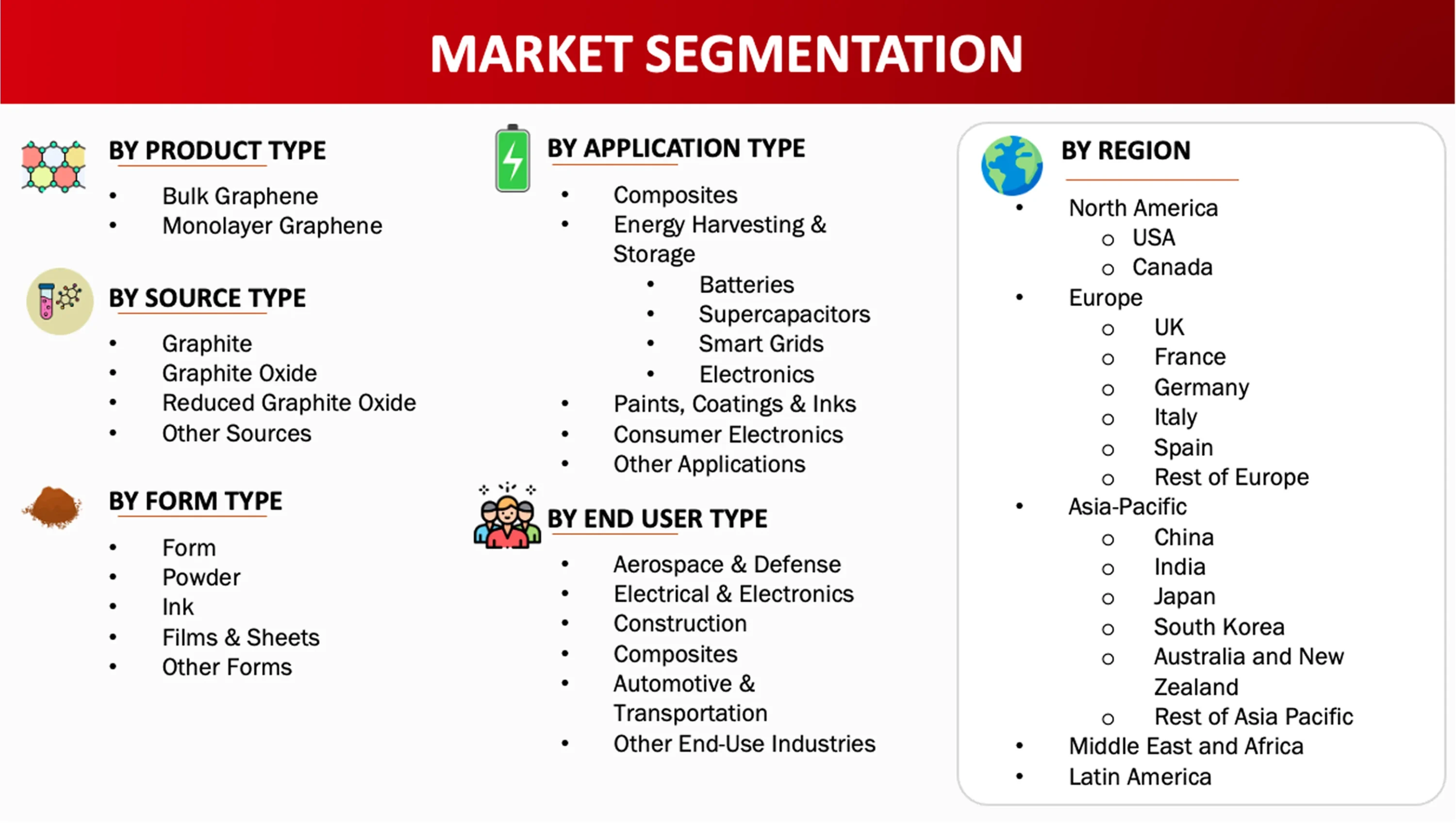
Graphene Market Segmentation
Want detailed insights from this report?
Competitive Landscape and Market Segments Insights
- Competition is fragmented across specialized material suppliers. The market includes graphene nanoplatelet producers, graphene oxide suppliers, CVD film manufacturers, and advanced-materials companies. Their differing product specifications and application focus limit direct comparability and create competition across distinct technology niches.
- Product quality and material consistency differentiate suppliers. Companies compete on layer count, flake dimensions, defect density, purity, and dispersion characteristics. These properties influence downstream performance, making reliable technical specifications and reproducible batch quality important competitive factors for industrial customers.
- Production economics influence competitive positioning. Manufacturers using scalable exfoliation processes compete on throughput, yield, energy consumption, and production costs, while CVD suppliers address applications requiring high-quality graphene films. Manufacturing economics therefore vary significantly by product category and intended use.
- Competition differs substantially by end-use application. Suppliers serving research laboratories compete on material specifications and technical support, whereas industrial suppliers must demonstrate processing compatibility and repeatable performance. Companies such as Nano Xplore Inc. (Canada) and Graphene S.A. (Spain) address different product and customer requirements.
- Technical differentiation extends beyond graphene purity. Suppliers are differentiated by functionalization, dispersion quality, surface chemistry, and compatibility with host materials. These characteristics affect whether graphene can be incorporated into polymers, coatings, or other matrices without compromising processing efficiency or finished-product performance.
- Standardization is becoming an important competitive factor. The International Organization for Standardization (ISO) published ISO/TS 9651:2025 in July 2025, establishing a classification framework and measurement methods for graphene-related two-dimensional materials. Suppliers able to provide comparable specifications and reliable characterization data can improve customer assessment and qualification.
Bulk graphene held the leading position by product type in 2025, supported by its suitability for large-volume industrial applications, established production methods, and availability in powder and nanoplatelet forms.
-
Industrial-scale production capacity: NanoXplore Inc. (Canada) has an annual graphene powder production capacity of up to 5,000 metric tonnes, supporting bulk graphene supply for applications requiring high material volumes.
-
Established commercial supply: Xiamen Knano Graphene Technology Co., Ltd. (China) reports annual graphene powder production capacity of at least 500 tonnes, supporting commercial availability for industrial applications.
-
Expanding production capacity: Black Swan Graphene Inc. (Canada) increased its graphene nanoplatelet production capacity from 40 tonnes to more than 140 tonnes annually in 2026, strengthening its ability to serve growing industrial demand.
-
Scalability and cost advantages: Graphite-derived graphene materials benefit from established production processes and scalable manufacturing, supporting their use in industrial applications where material costs and consistent supply influence adoption. (Source: C — Journal of Carbon Research, 2026).
Graphite held the largest share by source in 2025, supported by established processing routes, commercial availability, and its suitability for producing multiple graphene-related materials.
-
Concentrated raw material supply: China accounted for an estimated 82% of global natural graphite production in 2025, highlighting its importance in the upstream supply chain for graphite-derived graphene. (Source: USGS, 2026)
-
Established production pathways: Graphite can be processed through exfoliation to produce graphene nanoplatelets or chemically oxidized to produce graphene oxide, which can subsequently be reduced to obtain reduced graphene oxide.
-
Scalable manufacturing processes: Established graphite-processing technologies enable manufacturers to produce graphene-related materials at commercial scale, supporting applications that require consistent material availability and cost-effective production.
-
Broad commercial applications: Graphite-derived graphene materials are supplied in powder and dispersion forms for use in composites, coatings, conductive materials, and energy storage technologies. (Source: C — Journal of Carbon Research, 2026).
Asia-Pacific held the largest regional share in 2025, supported by China’s extensive graphene manufacturing base, established graphite supply chain, and industrial processing capabilities, alongside advanced graphene film production in South Korea.
-
Concentration of manufacturing capacity: China hosts multiple commercial graphene producers, including The Sixth Element and Xiamen Knano Graphene Technology, supporting regional supply of graphene powders and related materials.
-
Expansion of graphene film manufacturing: Graphene Square Inc. opened a new facility in Pohang, South Korea, in November 2025, with an annual production capacity of 300,000 square metres of chemical vapour deposition graphene films.
-
Established industrial-scale powder production: Xiamen Knano Graphene Technology Co., Ltd. (China) reports annual graphene powder production capacity of at least 500 tonnes, strengthening the region’s capacity to supply bulk graphene materials.
-
Strong industrial production ecosystem: China’s established graphite supply chain, chemical processing capabilities, and network of graphene manufacturers support production across multiple graphene-related material categories. (Source: USGS, 2026; C — Journal of Carbon Research, 2026).
What This Report Covers-
This report provides a comprehensive analysis of the graphene market, offering insights into key trends, growth drivers, challenges, and future opportunities. It is designed to support strategic decision-making through a combination of quantitative data and qualitative analysis.
Specifically, the report covers:

Market Overview & Definition:
Overview of the market scope, structure, and key terminology

Market Size & Forecast:
Historical data and future projections across key segments and regions

Key Market Trends:
Insights into emerging trends, technological advancements, and evolving demand patterns

Drivers, Restraints & Opportunities:
Analysis of key factors influencing graphene market growth

Competitive Landscape:
Overview of major players, their strategies, and recent developments

Detailed Patent Analysis:
This includes, top assignees, geography focus of top assignees, legal status, technology evolution, key patents and patent trends and innovations

Segmentation Analysis:
Breakdown by product type, by form type, by source type, by application type, by region.

Regional Insights:
Key regional trends and growth opportunities

Future Outlook:
Strategic insights and future market direction
Research Methodology
The study of the global graphene market is based on a combination of primary and secondary research methodologies, supported by data validation, graphene product and production technology mapping, material grade assessment, source and form analysis, application-wise demand assessment, end-use industry evaluation, company revenue and product portfolio analysis, manufacturing capacity assessment, production process evaluation, intellectual property and standardization assessment, commercial adoption analysis, customer qualification assessment, competitive benchmarking, and analytical modelling to ensure accuracy and reliability.
Market Definition: Graphene Market
The global graphene market comprises the production, processing, and commercialization of graphene and graphene-based materials used to enhance electrical conductivity, thermal management, mechanical strength, barrier properties, and other functional characteristics across industrial applications. The market covers graphene nanoplatelets, monolayer and few-layer graphene, graphene oxide, reduced graphene oxide, and other graphene-based materials supplied in powder, dispersion, ink, film, sheet, and other commercial forms.
The market includes graphene materials used in composites, energy storage, batteries, supercapacitors, paints, coatings, conductive inks, consumer electronics, automotive and transportation, aerospace and defense, electrical and electronics, construction, and other industrial applications. The study considers production technologies, including mechanical and liquid-phase exfoliation, chemical oxidation and reduction, electrochemical exfoliation, and chemical vapour deposition. It also evaluates manufacturing scalability, material consistency, production economics, application-specific performance, standardization, customer qualification, commercial adoption, and competitive positioning.
Key Stakeholders
The global graphene market involves a broad ecosystem of stakeholders
- Graphene Nanoplatelet Manufacturers
- Monolayer and Few-Layer Graphene Producers
- Chemical Vapour Deposition Graphene Manufacturers
- Polymer, Composite, and Masterbatch Manufacturers
- Construction Material and Cement Manufacturers
- Graphene Material Distributors and Industrial End Users
- Electronics and Thermal Management Material Manufacturers
- Automotive, Aerospace, and Industrial Component Manufacturers
- Battery and Energy Storage Technology Developers
- Research Institutions, Testing Laboratories, and Material Characterization Organizations
Key Objectives of the Study
- To define, describe, analyze, segment, and forecast the graphene market by product type, by form type, by source type, by application type.
- To describe and forecast the market for four key regions: North America, Europe, Asia Pacific, and Rest of the World
- To provide detailed information regarding key drivers, restraints, opportunities, and challenges influencing market growth
- To strategically analyze the micro indicators with respect to individual growth trends, prospects, and contributions to the overall market size
- To analyze opportunities for stakeholders in the graphene industry and emphasize on competitive landscape of the market
- To develop competitive benchmarking of the key market players based on technology specifications and end user
- To strategically profile key players and comprehensively analyze their product portfolio offerings, and core competencies
- To analyze competitive developments, such as launches and approvals, agreements, mergers and acquisitions, partnerships, joint ventures, investments and expansions, and collaborations, graphene domain
Need deeper insights on this market?
Get full report access with detailed forecasts, competitive analysis, and segmentation.
Research Approach
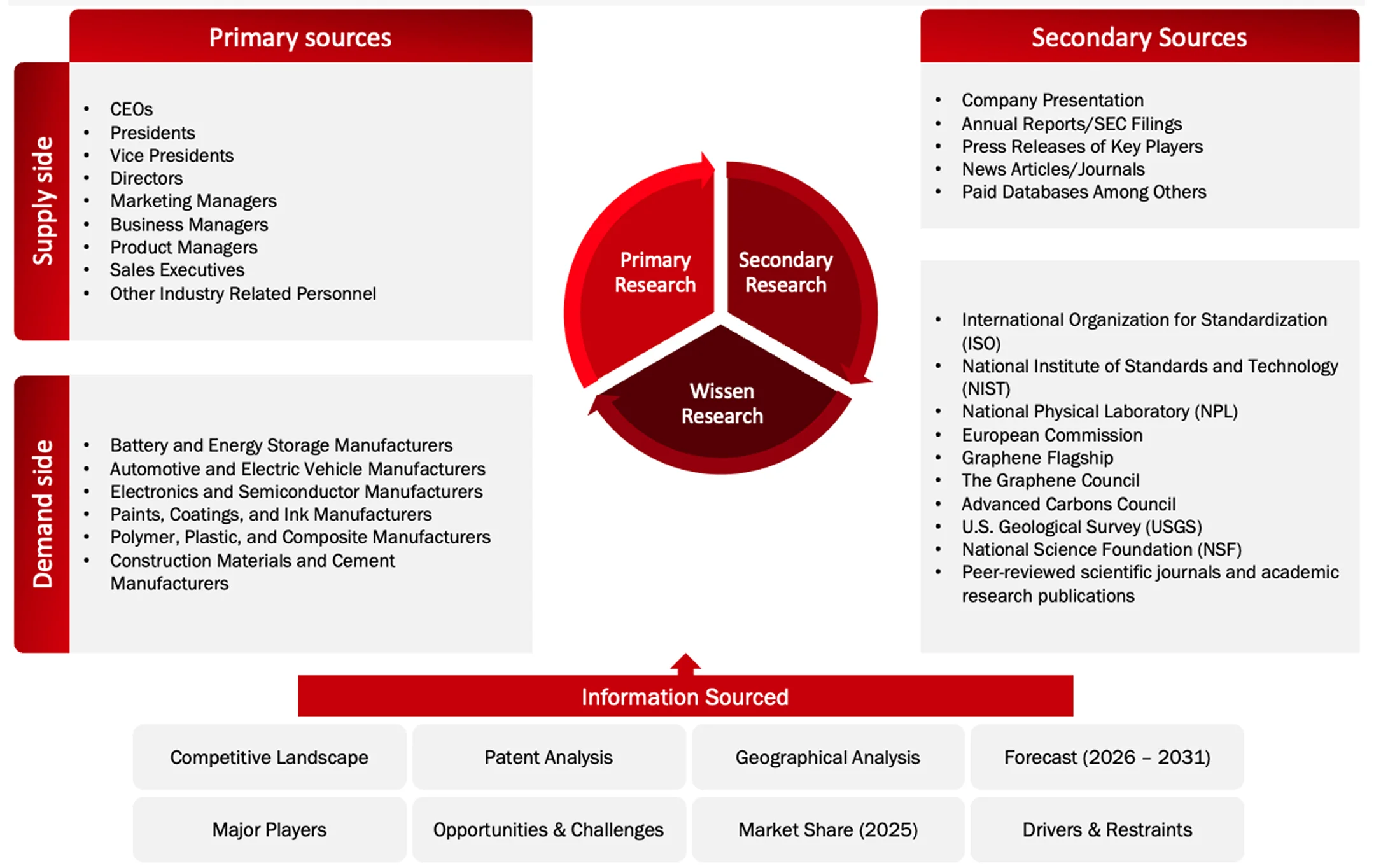
This research employs a systematic approach by using primary research along with secondary research to achieve full coverage and accuracy of information about the graphene sector. Through this approach, the current market trends in terms of consumer behaviour, technological developments, and competitive environment can be analysed thoroughly.
Secondary Research
Secondary research involves the collection of data from reliable sources such as industry databases, company annual reports, investor presentations, and regulatory filings. This process helps in understanding market trends, identifying key players, and gathering technical and commercial insights.
A comprehensive database of leading companies and market participants is developed through secondary research to support further analysis.
Primary Research
Primary research is conducted to validate findings from secondary research and to gain deeper insights into market dynamics. Interviews are carried out with industry stakeholders across both demand and supply sides, including executives such as CXOs, Vice Presidents, and Directors from business development, marketing, and product teams.
Data is collected through structured questionnaires, email interactions, and telephonic interviews across key regions including North America, Europe, Asia-Pacific, and Rest of the World.
Market Size Estimation
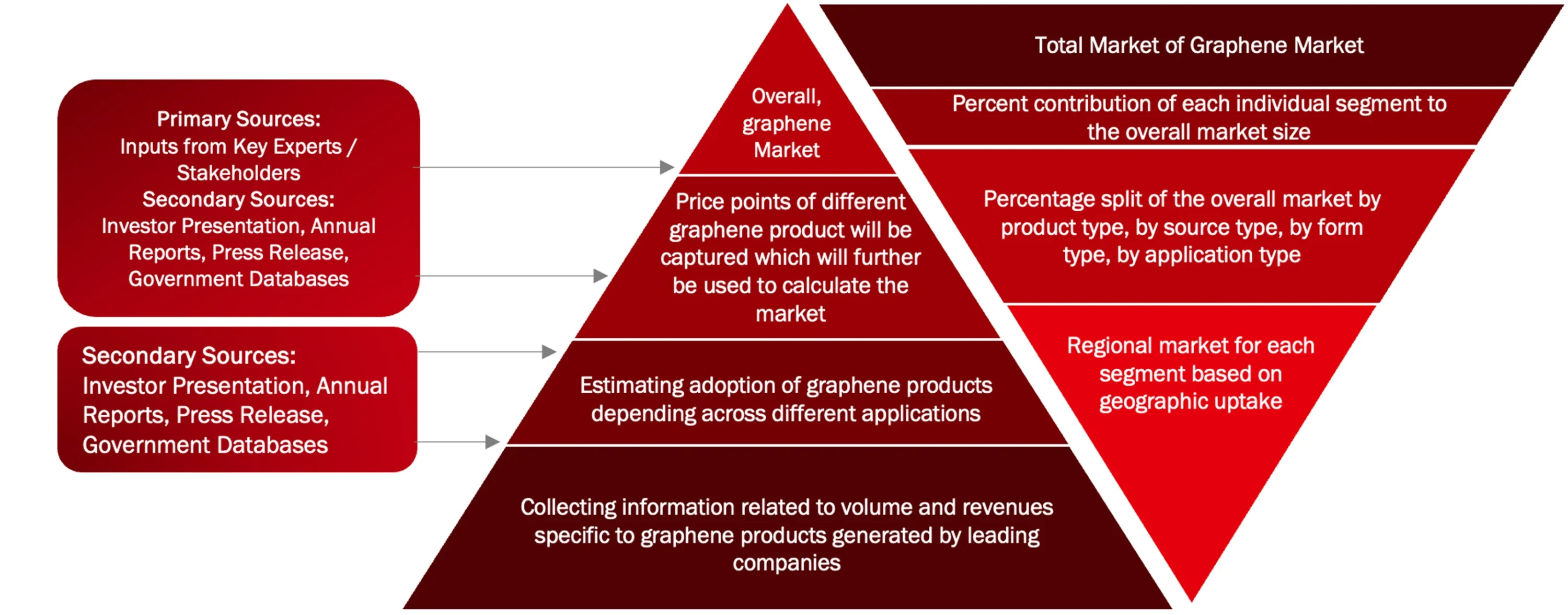
Market size estimation is performed using both top-down and bottom-up approaches. Key market players are identified, and their revenues are analysed to estimate the overall market size.
The market is further segmented based on:
- Product and service mapping across regions
- Adoption patterns across key application segments
- Insights gathered through primary and secondary research
Data Validation and Research Design
After estimating the overall market size, the data is validated using triangulation methods and market breakdown techniques to ensure accuracy and consistency. Both demand-side and supply-side factors are considered to refine the analysis.
The final data is validated through multiple sources to ensure reliability and to provide accurate insights across all market segments and regions.
Assumptions of the Study
The analysis of the graphene market is based on the following key assumptions:
- Trends in the industry are drawn from historical data and current information within the sector
- The future outlook is underpinned by constant economic conditions in the absence of shocks to the market
- The rate of adoption for graphene will rise steadily in all important regions
- The income statement and market share figures are estimated using available information from the industry and publicly available data
- The exchange rate and price trends will not be greatly affected during the forecast period
Scope and Limitations
Scope of the Study
This report offers an exhaustive overview of the international graphene market and includes the following components:
- Summary of market size, growth trends, and projections
- Carefully segmented market based on market by product type, by form type, by source type, by application type.
- Discussion of primary factors influencing the market
- Competitor analysis
- Insights into regional and national market performance
Limitations of the Study
Despite the best efforts being made to keep the results accurate, the study does suffer from some limitations:
- It has been done using both primary and secondary data that come with their own constraints
- Rapid developments in technology might affect the future course of market dynamics
- Some figures are only approximations due to lack of public disclosure
- The report is not an insurance against any disruptions in macroeconomics and geopolitics
- Future forecasts are indicative and subject to change due to altered industry dynamics
Data Triangulation and Market Breakdown
Data triangulation involved the combination of primary research, secondary research, and the Wissen Research analysis. Once the data points were sourced from the secondary market research, we sanitized the data points to make the market sizing and growth forecast more accurate by developing our own assumptions based on the inputs and insights we gather through the primary interviews with the industry experts. Once the data was thoroughly validated through primary interviews from both, demand and supply side of the market, our team of analyst and other team members involved finalized the market sizing and growth forecast.
Data Triangulation Methodology
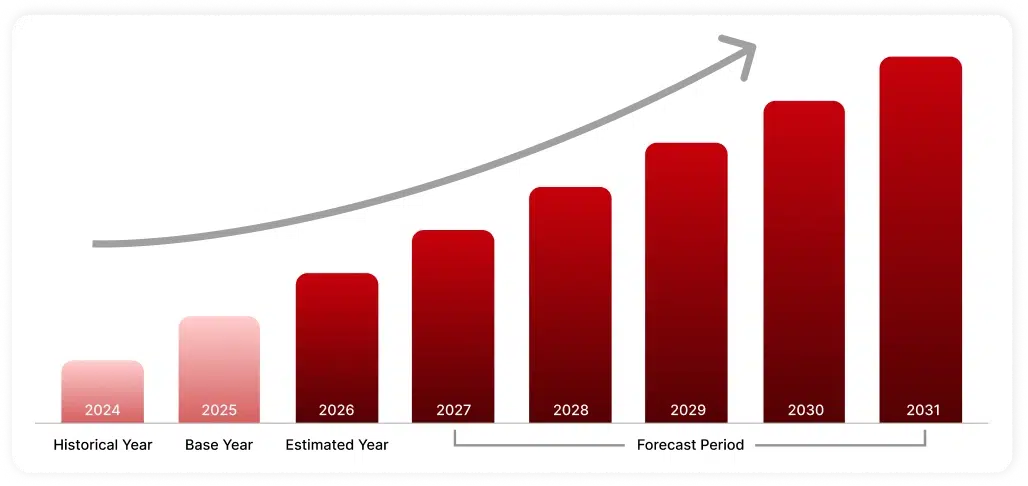
Year Framework
Bottom-Up Approach (Demand Side) And Top-Down Approach (Supply Side)
Bottom-Up Approach (Demand-Side Approach):
Determining the market size through the consolidation of demand among end-users, sectors, and geographic areas, which are calculated according to real-world demand conditions.
Top-Down Approach (Supply-Side Approach):
Calculating the market size through revenue and performance of the industry and its important companies, allocating the market size among various sectors.
Want detailed insights from this report?
Buy this Report
Choose the option that best fits your needs