Patent Invalidation Search: Prismatic Lithium-Ion Battery
Case Study

Could Existing Battery Designs Challenge a Patent on Prismatic Lithium-Ion Cell Architecture?

An evidence-led patent invalidation investigation examined dual-gasket configurations, negative-terminal insulation and positive-polarized cell housings to assess the novelty and inventive step of a claimed battery design.

Case Study Type Invalidation Search
Industry Battery Technology
Publication Date November 19, 2026
Prismatic Lithium-Ion battery image

The Client's Challenge

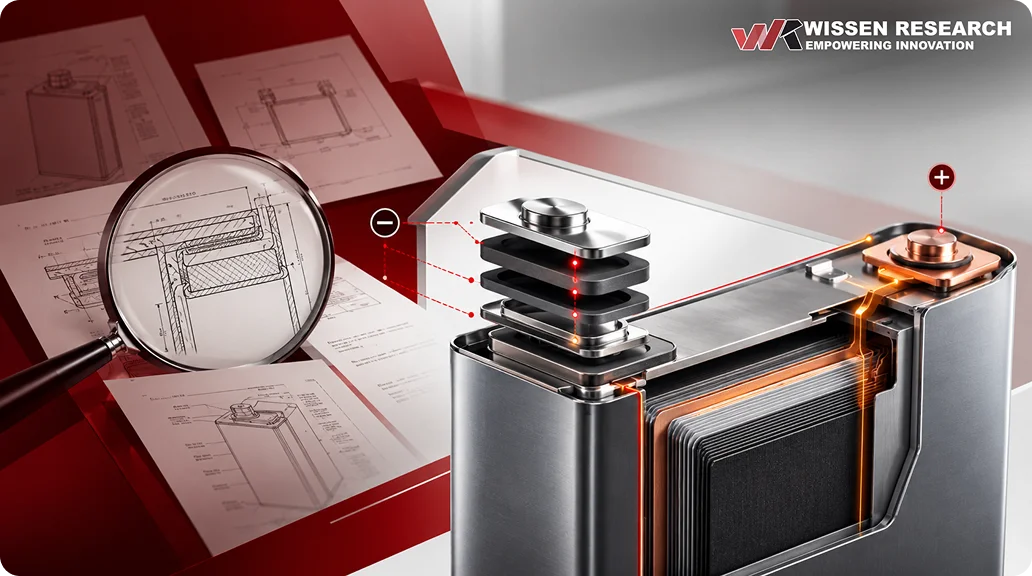
A client sought support in invalidating a patent related to the structural and electrical configuration of prismatic lithium-ion batteries. The subject patent claimed a dual-gasket arrangement at the negative terminal, in which upper and lower gaskets provide insulation, alongside a positively polarized cell body and lid. The patent further described a configuration in which the positive electrode was in conductive contact with the prismatic cell body.

The claimed invention presented this combination of sealing architecture and electrical connectivity as a technical advancement in battery construction. The investigation therefore focused on determining whether these features had already been disclosed in earlier battery designs and whether the claimed combination represented a patentable technical contribution.
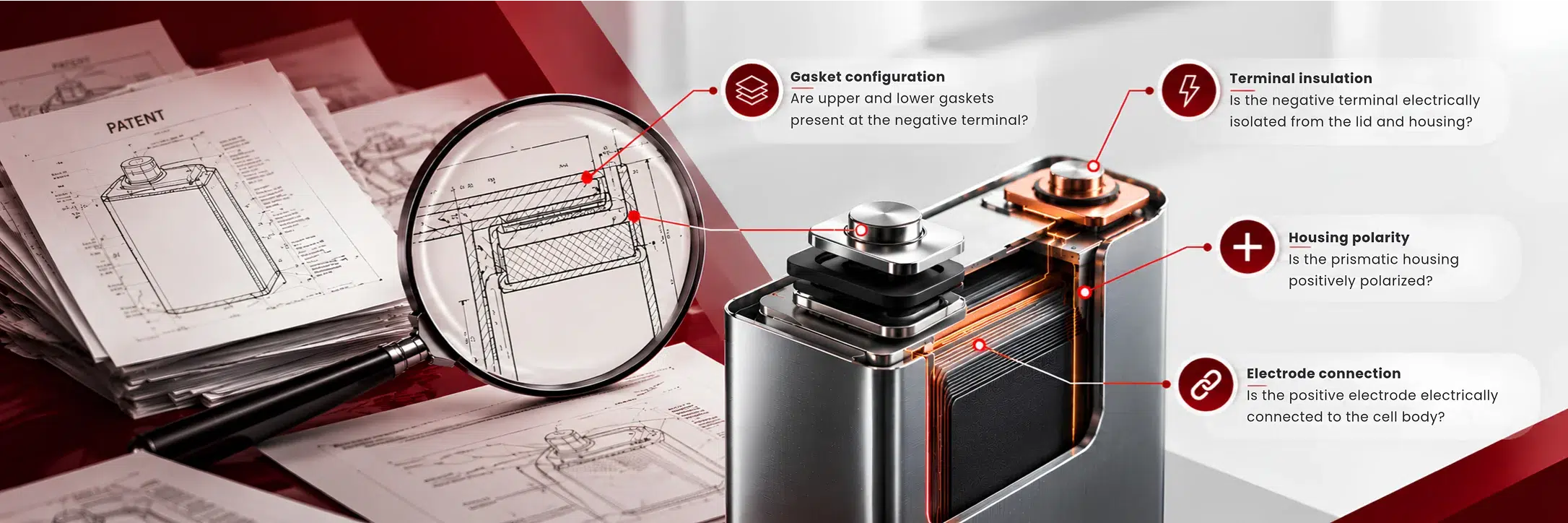
Prismatic Lithium-Ion battery case study

The patent claims primarily covered:

    • An upper and lower gasket arrangement associated with the negative terminal.
    • Electrical insulation of the negative terminal within the prismatic cell assembly.
    • Positive polarization of the prismatic cell body and lid.
    • Conductive contact between the positive electrode and the prismatic cell body.
    • The combination of these structural and electrical features within a single battery configuration.
Objective icon
CLIENT’S OBJECTIVE

Identify prior art challenging the novelty and inventive step of the claimed battery architecture.

The assessment distinguished between novelty, requiring a single reference disclosing all claim limitations and inventive step which may involve multiple references under the applicable legal standard.

Clients come to us for answers.
They leave with opportunities they didn’t know existed.

Our experts help organizations uncover insights, opportunities and strategic directions that traditional approaches often miss.

Wissen’s Out-of-the-Box Approach:

Mechanism-Focused Prior Art Investigation

  • Recognizing the limitations of conventional keyword-based searching, the investigation evolved beyond exact terminology matching to examine earlier battery designs that disclosed individual structural and electrical features of the claimed invention.
  • To establish a broader and more technically grounded assessment of the patent's validity, the investigation expanded its search strategy to include prior-art disclosures relating to:
  • Dual-gasket arrangements in prismatic battery cells.
  • Electrical insulation mechanisms at the negative terminal.
  • Positive polarization of conductive cell housings.

Identifying Relevant Prior Art

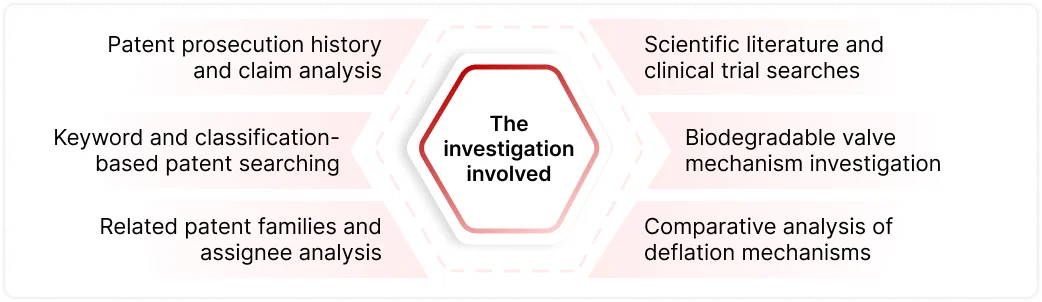
  • A focused investigation was conducted using expanded technical terminology, patent classification codes, international patent publications and assignee and inventor portfolio analysis.

  • The search identified four potentially relevant US patent references describing different aspects of the claimed battery architecture.

  • However, the identified references differed in the specific features they disclosed. Further technical comparison was therefore required to determine whether the claimed configuration was disclosed in a single reference or whether the references could support a challenge based on inventive step.

Our Methodology

Claim Feature Identification
Expanded Keyword Search
Patent Classification Analysis
Global Prior-Art Search
Assignee and Inventor Analysis
Reference-Level Technical Analysis
Claim Mapping and Comparative Assessment
Claim Feature Identification
  • Identify the dual-gasket arrangement at the negative terminal.
  • Isolate the housing polarity and positive-electrode contact limitations.
Expanded Keyword Search
  • Incorporate alternative terms for stacked seals, terminal insulation, and electrode connections.
  • Combine technical synonyms to identify disclosures missed by exact keyword searches.
Patent Classification Analysis
  • Integrate relevant IPC/CPC classifications for battery sealing and insulation.
  • Target patent documents relating to cell casings, terminal assemblies and electrode connections.
Global Prior-Art Search
  • Extend searches across US, Japanese, South Korean and Chinese patent publications.
  • Identify earlier prismatic cell designs with potentially relevant structural and electrical features.
Assignee and Inventor Analysis
  • Examine relevant patent portfolios of major battery manufacturers.
  • Investigate inventor portfolios for additional disclosures relating to sealing and terminal configurations.
Reference-Level Technical Analysis
  • Examine four potentially relevant US patent references for gasket placement and terminal insulation.
  • Evaluate disclosures concerning positive housing polarity and positive-electrode-to-can connections.
Claim Mapping and Comparative Assessment
  • Compare each reference against the patent’s key technical limitations and identify disclosure gaps.
  • Assess potential novelty and inventive-step arguments separately under the applicable legal standards.
Outcome:

Four potentially relevant prior-art references were identified, providing a structured basis for assessing the claimed battery architecture and evaluating potential grounds for a patent validity challenge.

Prior-Art Search and Technical Investigation Methodology

The investigation focused on comparing the disclosed gasket arrangements, terminal insulation mechanisms, housing polarity and electrode-to-housing connections.

Prismatic Lithium-Ion battery investigation methodology

The investigation identified overlapping technical disclosures relating to the claimed battery architecture. These findings provided a basis for further evaluating the patent’s asserted technical contribution, subject to verification of the original patent documents, publication dates and complete claim limitations.

Technical Challenges Addressed Through Prior-Art Analysis

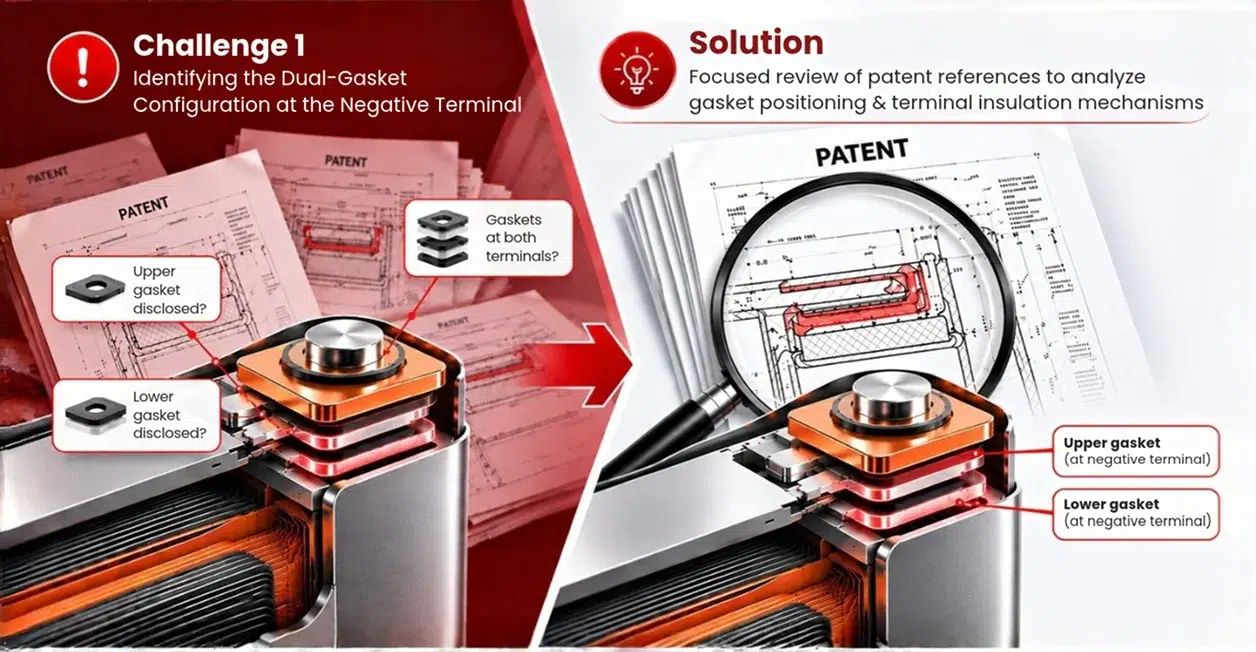
Challenge 1: Identifying the Dual-Gasket Configuration at the Negative Terminal

One of the key challenges involved determining whether earlier prismatic battery designs disclosed both upper and lower gaskets at the negative terminal, as required by the subject patent. Several references described individual sealing elements or multiple gaskets across both terminals, making it necessary to distinguish these arrangements from the specific configuration under investigation.

Solution

A focused review of the identified patent references examined gasket positioning and the associated terminal insulation mechanisms. The analysis identified:

The analysis revealed:
  • Upper and lower gaskets in a prismatic cell to address electrolyte leakage.
  • Upper and lower gaskets specifically at the negative terminal to provide electrical isolation.
  • Differences between the disclosed gasket arrangements and the precise configuration claimed in the subject patent.

These findings established relevant earlier disclosures of dual-gasket arrangements and provided a basis for evaluating the novelty of the claimed terminal architecture, subject to complete claim-level verification.

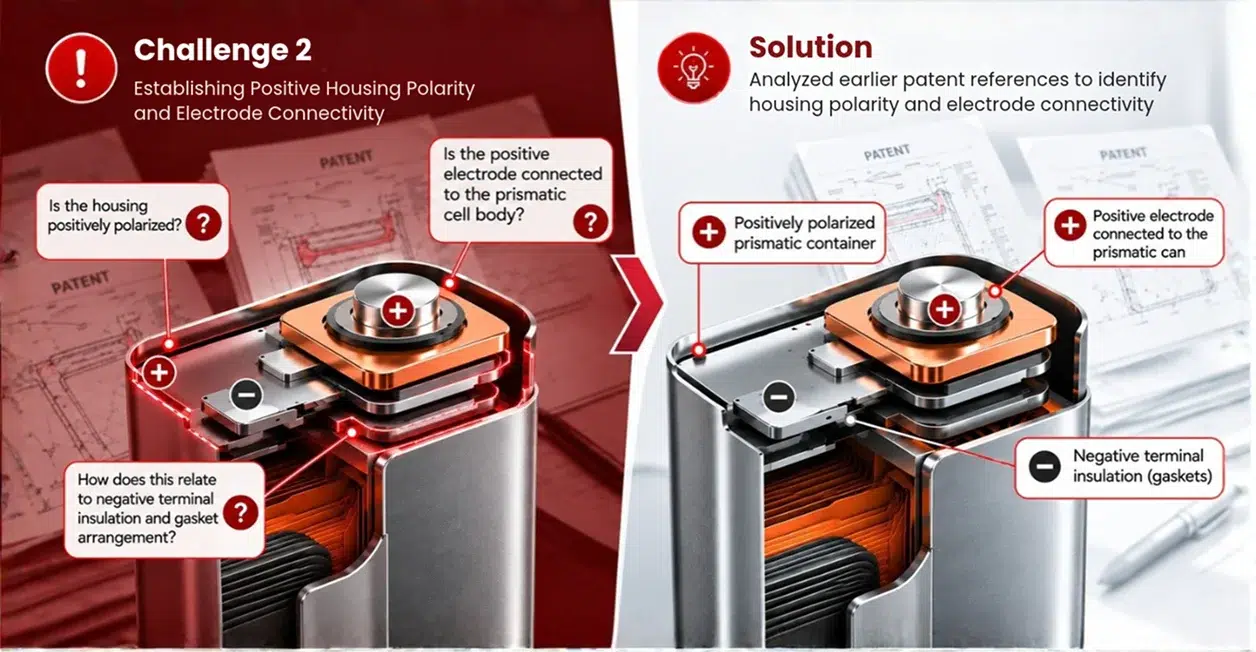
Challenge 2: Establishing Positive Housing Polarity and Electrode Connectivity

Another important challenge involved determining whether positive polarization of the cell housing and conductive contact between the positive electrode and the prismatic cell body had been disclosed in earlier battery designs. These electrical relationships needed to be evaluated separately from the gasket configuration to establish the extent of overlap with the patent claims.

Solution

The investigation examined references describing conductive metal housings, positive-electrode connections, and negative-terminal insulation. The analysis identified:

The analysis revealed:
  • A positively polarized prismatic container.
  • A positively polarized conductive metal case connected to the positive electrode.
  • Electrical connection between the positive electrode and the prismatic can, alongside negative-terminal insulation.

These findings identified earlier disclosures relevant to the claimed electrical architecture. However, the available information did not establish that a single reference disclosed the complete combination of housing and lid polarity, electrode connectivity, and the specified dual-gasket arrangement.

The results therefore provided a technical basis for further evaluating the claimed configuration under the applicable novelty and inventive-step standards.

Results & Business Impact

The investigation identified four potentially relevant prior-art references addressing different aspects of the patented prismatic lithium-ion battery architecture.

Key outcomes

  • Key outcome Icon

    Identification of earlier disclosures relating to upper and lower gasket configurations.

  • Key outcome Icon

    Identification of a reference describing dual gaskets at the negative terminal.

  • Key outcome Icon

    Identification of disclosures concerning positive polarization of a conductive cell housing.

  • Key outcome Icon

    Identification of earlier positive-electrode connections to the prismatic can.

  • Key outcome Icon

    Development of a structured basis for evaluating the claimed combination through claim-level comparison.

Strategic Business Impact

By expanding the search beyond exact keyword matches and examining the underlying battery architecture, the investigation provided a more focused basis for patent-related decision-making. The analysis provided:

  • Identified potentially relevant earlier battery designs.
  • Highlighted patent claim limitations requiring further analysis.
  • Improved understanding of earlier battery sealing and electrical connectivity approaches.
  • Prioritized key references for patent evaluation and licensing decisions.

The case demonstrates how a structured, feature-led prior-art investigation can reveal important overlaps between a claimed battery configuration and earlier technical disclosures, while preserving the distinction between technical similarity and a legally established invalidity conclusion.

Need Support for Complex Battery Patent Investigations?

Our team helps organizations assess patent claims against prior art to evaluate novelty and inventive step in battery architectures.