LED Patent Invalidation Search: Prior Art Case Study

Could an Earlier Liquid-Cooled LED Design Invalidate a Modern Lighting Patent?

A structured prior art investigation revealed that claimed LED thermal and optical innovations had already been explored in earlier technical disclosures.

Case Study Type Invalidation Search
Industry Electrical Technology
Publication Date August 18, 2026
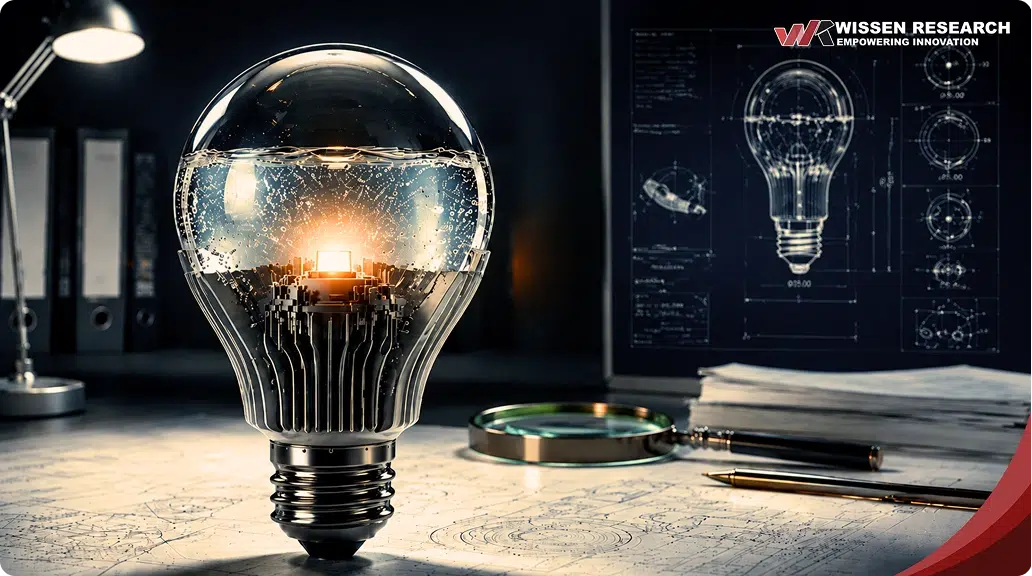
Led bulb technology Image

The Client's Challenge

A client sought support in invalidating a patent directed toward an LED lighting system that combined thermal management and optical enhancement within a single bulb architecture. The patent described an LED bulb incorporating a thermally conductive liquid enclosed inside the bulb shell to dissipate heat generated during operation. Suspended within this liquid was a dispersion material designed not only to modify the emitted light color but also to improve light diffusion throughout the bulb.

The subject patent positioned this integrated approach as a distinguishing feature, making it essential to determine whether comparable concepts had already been disclosed before the patent’s priority date.
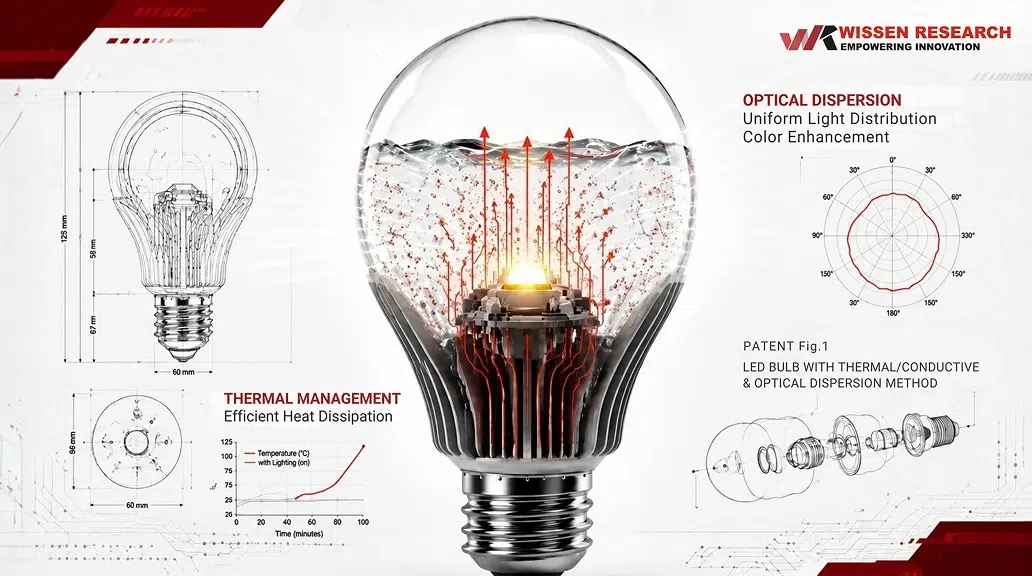
Optical dispersion mechanisms image

The investigation primarily evaluated patent claims with following technical concepts:

    • LED bulb comprising an enclosed shell containing a thermally conductive liquid.
    • Heat transfer from one or more LEDs through the liquid medium.
    • Dispersion material suspended within the liquid.
    • Modification of emitted light characteristics using dispersed particles.
    • Improved light distribution achieved through optical dispersion.
    • Conventional bulb base compatible with standard lighting fixtures.
    • Integrated thermal and optical functionality within a single lighting assembly.
Objective icon
CLIENT’S OBJECTIVE

Identify publicly available prior art and establish technically credible evidence challenging the novelty and inventive step of the claimed LED lighting system.

Clients come to us for answers.
They leave with opportunities they didn’t know existed.

Our experts help organizations uncover insights, opportunities and strategic directions that traditional approaches often miss.

Wissen’s Out-of-the-Box Approach:

Multidisciplinary Prior Art Analysis

  • Recognizing the limitations of conventional document-based searching, the investigation evolved beyond identifying isolated disclosures toward understanding the underlying engineering principles behind the claimed LED architecture.
  • The key challenge was determining whether earlier technologies had already combined thermal management and optical functionality within a single lighting system.
  • To address this challenge, the investigation expanded beyond literal claim searching and focused on identifying technically equivalent solutions that addressed the same engineering objectives. The approach incorporated a broader analysis of:
  • Thermal management mechanisms in LED systems
  • Liquid-based heat transfer technologies
  • Optical dispersion and light scattering materials

Identifying Relevant Prior Art Sources

  • The investigation focused on earlier LED lighting technologies that addressed similar challenges of heat dissipation, optical performance and bulb design efficiency.

  • However, because relevant technical concepts were distributed across multiple sources, additional refinement was required to evaluate whether these disclosures collectively addressed the claimed invention.

Our Methodology

Traditional Search Limitations
Patent Scope & Technical Analysis
Multi-Dimensional Prior Art Search
Technical Literature Investigation
Integrated Technical Analysis
Evidence Validation & Assessment
Prior Art Mapping & Support
Traditional Search Limitations
  • Identified fragmented thermal and optical disclosures
  • Lacked integrated LED architecture references
  • Required broader technical evidence sources
  • Limited effectiveness of keyword-based searching
Patent Scope & Technical Analysis
  • Reviewed claims and prosecution history
  • Identified critical technical limitations
  • Decomposed architecture into functional elements
  • Established engineering-focused search directions
Multi-Dimensional Prior Art Search
  • Expanded technical synonyms and classifications
  • Searched patents and related families
  • Analyzed assignee and citation networks
  • Identified liquid-based LED technologies
Technical Literature Investigation
  • Reviewed scientific and industry publications
  • Examined manufacturer technical disclosures
  • Explored non-patent literature sources
  • Identified additional technical evidence
Integrated Technical Analysis
  • Compared references against claim limitations
  • Evaluated thermal-optical feature combinations
  • Assessed technical similarity and relevance
  • Prioritized strongest prior art disclosures
Evidence Validation & Assessment
  • Verified publication dates and availability
  • Cross-validated independent technical disclosures
  • Documented relevant technical teachings
  • Established reliable evidence foundation
Prior Art Mapping & Support
  • Mapped references to claim elements
  • Evaluated novelty and inventive contribution
  • Identified potential patent validity weaknesses
  • Supported strategic invalidation decisions
Outcome:

A broader prior art investigation identified earlier LED technologies combining liquid-based thermal management and optical enhancement concepts.

Technical Challenges Addressed

Challenge 1: Identifying Prior Art That Combined Thermal Management and Optical Functionality

One of the primary engineering challenges was determining whether prior art existed that disclosed not only the use of a thermally conductive liquid within an LED bulb but also the integration of a dispersed material capable of modifying light characteristics and improving optical distribution.

Solution

Search queries were progressively refined using broader material-science terminology, lighting-specific classifications, and alternative technical expressions describing optical media, phosphor dispersions, light-scattering materials and multifunctional liquid compositions.

The analysis revealed:
  • Liquid thermal medium enclosure
  • Optical particle dispersion system
  • LED-liquid-material integration
  • Prior technical disclosures identified

These findings demonstrated that the claimed combination of thermal and optical functionality had already been explored through earlier publicly available technical disclosures.

Challenge 2: Distinguishing Genuine Technical Novelty from Alternative Engineering Terminology

Lighting technologies frequently describe similar material compositions, optical properties, and thermal mechanisms using terminology that varies across patents, scientific publications and manufacturer documentation. Consequently, a search based solely on literal claim language risked overlooking technically relevant disclosures.

Solution

Each search iteration incorporated newly identified terminology, classification codes, material descriptions and engineering concepts discovered during earlier phases of the investigation. The search scope also expanded beyond patent databases into scientific publications and technical literature from established lighting manufacturers.

The analysis revealed:
  • Alternative thermal terminology identified
  • Optical mechanisms beyond patents
  • Multifunctional liquid media research
  • Cross-source technical disclosures found

This broader investigation substantially improved the completeness of the prior art assessment and reduced the likelihood that technically relevant disclosures would remain undiscovered due to differences in terminology.

Results & Business Impact

The investigation successfully identified prior art relevant to the principal technical concepts underlying the subject patent by combining traditional patent searching with targeted analysis of non-patent technical literature.

Key Outcomes

  • Key outcome Icon

    Reviewed patent specification and prosecution history

  • Key outcome Icon

    Developed refined multi-stage search strategy

  • Key outcome Icon

    Identified liquid-based LED thermal disclosures

  • Key outcome Icon

    Discovered liquid-integrated optical dispersion references

  • Key outcome Icon

    Correlated patents with technical literature

  • Key outcome Icon

    Established novelty and inventive contribution challenges

  • Key outcome Icon

    Supported informed invalidation strategy evaluation

Strategic Business Impact

For organizations involved in patent litigation, licensing, freedom-to-operate assessments or portfolio evaluation, this methodology can:

  • Improve confidence in prior art assessments.
  • Reveal technical disclosures overlooked by conventional searches.
  • Reduce uncertainty during patent enforcement decisions.
  • Strengthen technical support for legal strategy.
  • Broaden evidence collection beyond traditional patent databases.

This case study demonstrates the value of combining structured patent analysis with broader engineering research to achieve a more comprehensive understanding of the prior art landscape.

Need Support for Complex Electrical Patent Investigations?

Our team combines patent intelligence with engineering research to uncover technically relevant prior art supporting high-confidence patent assessments.