
Laser Optics Market
Global Industry analysis, Size, Share, Growth, Trends, and Forecast 2026-2031
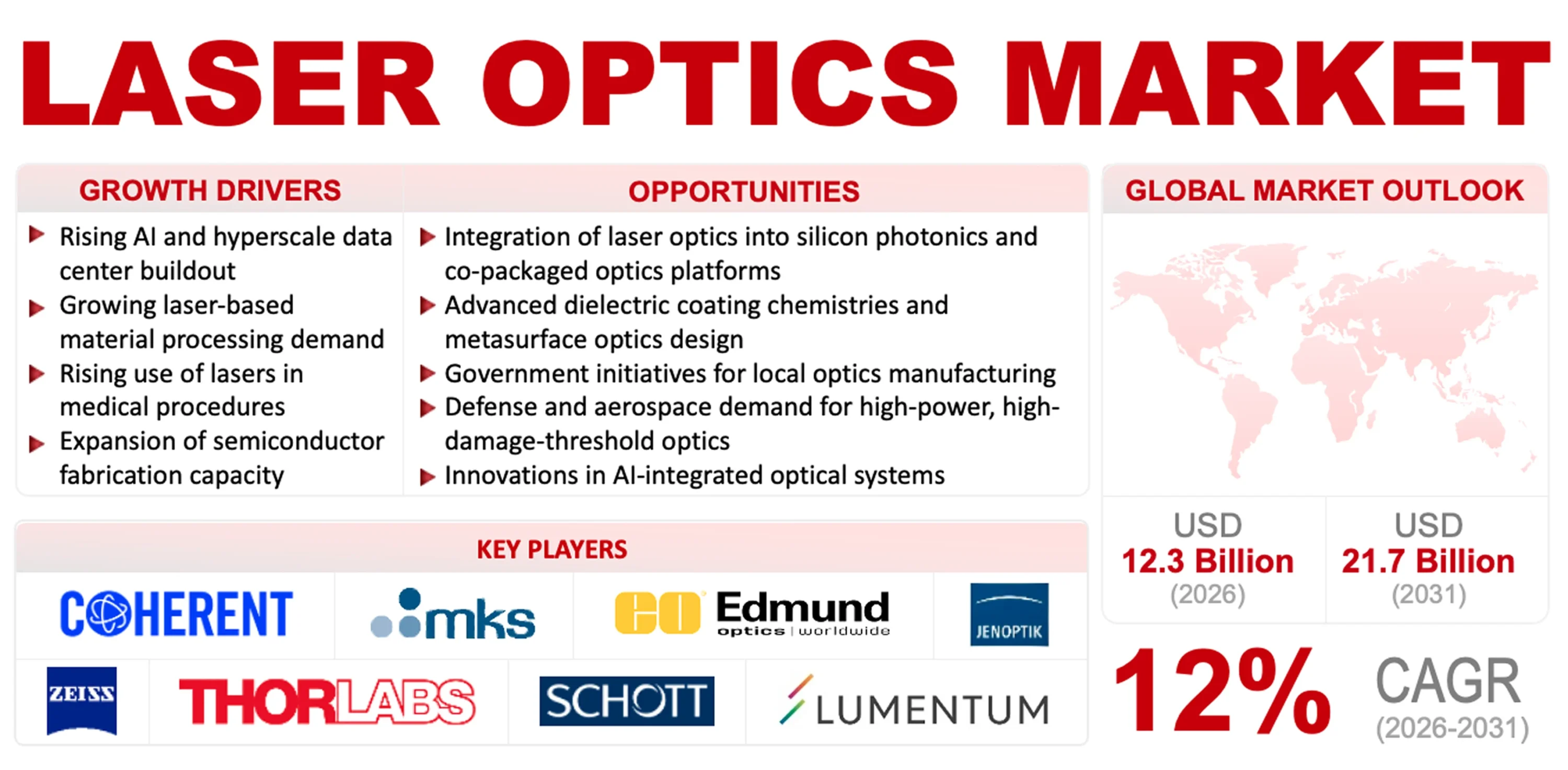
The global laser optics market is projected to reach USD 21.7 billion by 2031, growing at a CAGR of 12% during the forecast period.
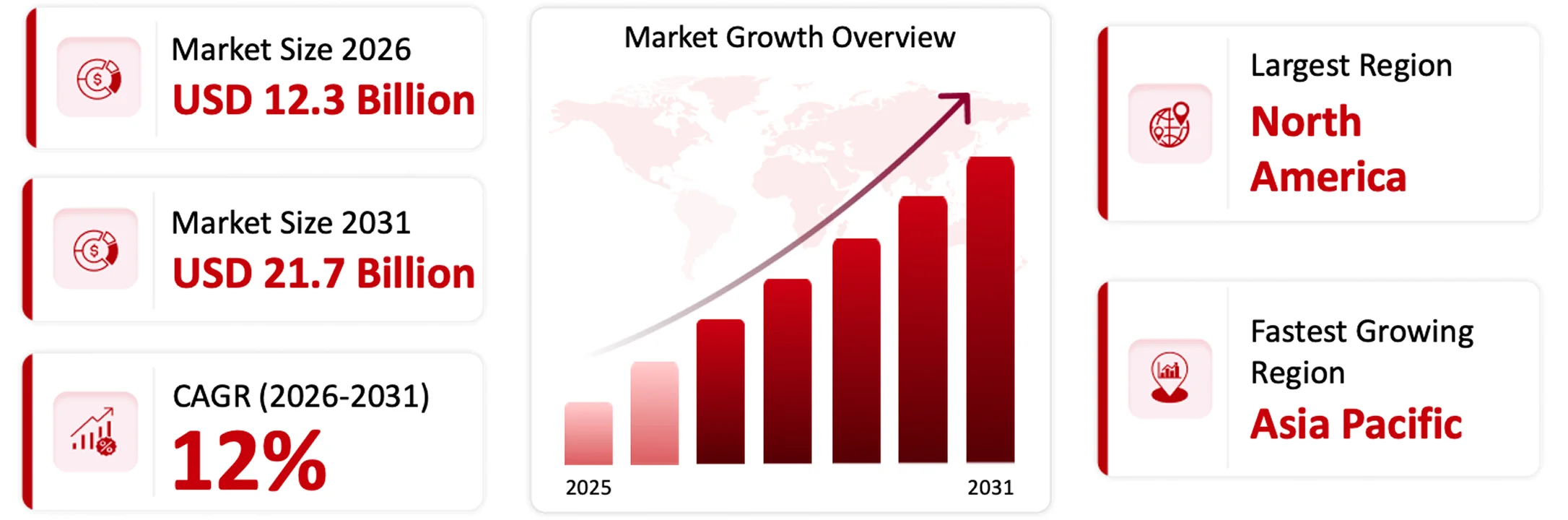
| Market Size (2026): | Forecast (2031): | CAGR (2026–2031): | Leading Region: | Fastest Growing Region: |
|---|---|---|---|---|
| $ 12.3 Billion | $ 21.7 Billion | 12 % | North America | Asia Pacific |
Summarize this report with:



Market Overview
The laser optics market covers the design, manufacturing, and supply of specialized optical components such as lenses, mirrors, beam splitters, filters, optical modulators, and waveplates engineered to control, shape, direct, and condition laser light. These components play a pivotal role between a laser source and its application, with the quality of the surface, coating, and purity of material directly affecting beam quality, damage resistance, and transmission rate. The demand for laser optics is very much dependent on the speed of deployment of laser-based systems in fields such as industrial manufacturing, telecommunications, medical equipment, microelectronics production, defence, and automotive sensing.
The global laser optics components market is estimated at USD 12.3 billion in 2026 and is projected to reach USD 21.7 billion by 2031, expanding at a CAGR of 12% during the forecast period of 2026–2031.
Technology Overview
The performance of laser optics is determined by two interconnected aspects: substrate material and surface coating. The choice of substrate materials such as fused silica grades, calcium fluoride, magnesium fluoride, zinc selenide, sapphire, and specialty glasses (N-BK7 and N-SF11) is determined by the operating wavelength and power density as well as thermal conditions of the application. Excimer laser optics commonly utilize UV-grade fused silica and calcium fluoride, whereas CO₂ laser optics primarily rely on infrared materials such as zinc selenide and germanium.
Coating technology has become an equally decisive differentiator. Anti-reflective, high-reflective, and partial-reflective dielectric coatings are engineered with precise layer designs to maximize damage threshold and minimize losses at specific wavelengths. These coatings are increasingly treated by manufacturers and buyers as a distinct purchasing specification rather than as a secondary attribute of the lens or mirror substrate. Therefore, this report tracks coating type as an independent segmentation dimension alongside material and component type.
On the component side, optical modulators, precision-figured mirrors, and advanced coated optics are among the fastest-evolving categories, propelled by two parallel forces: the expansion of coherent optical communication systems and co-packaged optics infrastructure for AI data centers, and the continued shift of industrial laser processing toward fiber and ultrafast laser platforms that demand tighter surface-figure and damage-threshold specifications than earlier CO2 and lamp-pumped systems.
Key Growth Drivers
- The rapid expansion of AI and hyperscale data center infrastructure is accelerating demand for optical interconnects, co-packaged optics, and silicon photonics, creating new growth opportunities for precision optical modulators, beam-control components, and advanced optical coatings
- Increasing adoption of lasers for material processing (cutting, welding, engraving, microprocessing) in automotive, electronics and other heavy industries, driven by the need for higher precision, throughput, and manufacturing efficiency
- The increasing use of lasers in minimally invasive surgeries, ophthalmology, and dermatology is driving demand for precise and biocompatible medical optics
- The massive growth of semiconductor and electronics fabrication in extremely high-precision applications such as photolithography inspection on wafers
- The increasing adoption of LiDAR and ADAS technologies in the automotive industry that is driving a fast-growing downstream market for compact and cost-effective laser optics.
Laser Optics Market Key Highlights
Need deeper insights on this market?
Get full report access with detailed forecasts, competitive analysis, and segmentation.
Laser Optics Market Trends
The laser optics industry is being reshaped by the convergence of two previously separate demand pools: traditional industrial and medical laser processing, and the optical-interconnect requirements of AI computing infrastructure alongside a steady push toward higher-precision, higher-damage-threshold components as laser sources themselves grow more powerful and more compact.
AI Data Center Buildout Reshaping Optical Interconnect Demand
Hyperscale operators are scaling optical interconnects to overcome the bandwidth and heat limitations of copper wiring inside AI compute clusters, pushing optical links progressively closer to the chip itself through technologies such as co-packaged optics (CPO) and optical I/O architectures as cluster sizes grow. This is lifting demand for high-speed optical modulators, precision beam splitters, and low-loss coated lenses at a pace that is becoming an increasingly important growth segment alongside conventional telecommunications infrastructure. Because these components must meet extremely high reliability standards for continuous data center operation, suppliers with proven high-volume manufacturing quality are capturing an outsized share of this demand.
Precision Requirements Tightening as Fiber and Ultrafast Platforms Displace Legacy Systems
As fiber and ultrafast laser platforms continue to replace older CO₂ and lamp-pumped systems across industrial and medical applications, tolerances for surface figure, wavefront distortion, and coating damage thresholds have tightened materially. Suppliers relying on legacy specifications are increasingly challenged in premium applications requiring advanced precision capabilities, shifting market share toward manufacturers capable of meeting the latest precision requirements at volume. This shift is also accelerating the trend toward treating coating type as its own purchasing specification rather than as a secondary attribute of the substrate.
Key Players in the Laser Optics Market
Leading companies in the laser optics industry are competing on precision manufacturing capability, coating technology, breadth of material and component portfolio, and the ability to co-develop custom optics with laser system integrators. Key strategies include capacity expansion, new product launches in high-power and ultrafast-compatible optics, and partnerships with laser source manufacturers.








Strategic Activities Within the Laser Optics Market
NVIDIA (US), Lumentum (US) and Coherent Corp. (US) have formed strategic partnerships aimed at ramping up the development of advanced optical technologies to support the burgeoning Al data center infrastructure. As part of the agreements, NVIDIA will invest $2B each in Lumentum and Coherent to increase its manufacturing capacity, boost R&D collaboration as well as acquire advanced optical devices such as laser technologies and optical networking services.
Semtech Corporation (US) has acquired HieFo Corporation (US) to strengthen its InP-based optoelectronic component capabilities for high-speed optical communication applications. The acquisition enables integration of HieFo’s indium phosphide laser technologies with Semtech’s optical semiconductor solutions, supporting the development of advanced optical transceivers for AI-driven data center connectivity.
Marvel Fusion (Germany), Carl Zeiss Jena (Germany), and Fraunhofer Institute for Applied Optics and Precision Engineering (Germany) are collaborating under the FusioTile project to develop advanced large-format pulse compression gratings and high-power laser optics for laser fusion applications. The initiative focuses on improving optical components capable of handling extreme laser intensities, enabling advancements in high-energy laser systems and future fusion technologies.
Laser Optics Market Insights
As laser system integrators continue to develop fiber and ultrafast laser platforms for industrial and medical markets, while hyperscale data center operators build out optical interconnects, the global laser optics market is marching steadily along. Growth will also be aided by the growing capacity expansion at optics companies and the wider acceptance of lasers in processing applications in industries such as automotive, electronics, and heavy industries. It is projected that the market will be worth USD 12.3 billion in 2026 and is expected to reach USD 21.7 billion by 2031.
The market for laser processing (cutting, welding, marking, etc.) is the biggest in terms of consumption in various industries (automotive, electronics, heavy industry, etc.). Optical communication is currently the fastest-growing application area, with the build-out of AI data centers driving demand for co-packaged optics and high-performance coherent transceivers, requiring a wide range of precision optical components. The medical laser systems market is increasing consistently in size with their utilization in ophthalmology, dermatology, and minimally invasive surgery and semiconductor and electronic manufacturing including photolithography and wafer inspection although size wise it is smallest but high-value segment requiring the highest tolerances.
The primary driver of demand is the parallel expansion of laser-based systems across both traditional industrial/medical applications and the newer optical-interconnect use case, a combination that gives the market two largely independent sources of momentum rather than dependence on a single end-use cycle. Advances in coating and substrate material continue to allow laser optics to achieve higher damage thresholds and tighter specs, opening up new applications where laser-based alternatives to established solutions can offer value. Another positive aspect for the market is the capacity growth by major market participants, as well as the creation of partnerships between optics providers and laser source/systems integrators.
Key developments include the growing treatment of coating type as an independent purchasing specification rather than a secondary attribute, the acceleration of demand from AI data center optical interconnects, and continued tightening of precision tolerances as fiber and ultrafast laser platforms displace older technologies. However, meaningful friction remains: supply chain concentration and trade-policy exposure are lengthening qualification cycles, the high capital cost of precision coating and fabrication equipment creates a barrier for smaller entrants, and qualification requirements for critical applications (defense, medical, data center) continue to raise the bar for new suppliers seeking to enter premium segments.
The Asia Pacific region is predicted to be the fastest growing region in the global laser optics market over the 2026-2031 forecast period. This is due to increased investment in semiconductor manufacturing capacity, rapid growth of the automotive and electronics sectors, and rising numbers of data center buildouts across China, Japan, South Korea, and Taiwan. The drive by several APAC governments to support local precision-optics manufacturing within their own markets is gaining further traction, with domestic suppliers extending their production capacity to meet growing local demand and reduce their dependence on imported components.
Laser Optics Market Dynamics
Drivers: Rising Demand for AI Infrastructure and Precision Manufacturing
The primary factor affecting laser optics market growth is the dual pull of expanding laser-based industrial and medical processing on one side, and the buildout of optical interconnect infrastructure for AI computing on the other. Both factors ensure sustained demand for components capable of meeting increasingly stringent damage-threshold and precision specifications, with manufacturers investing accordingly in capacity and coating technology to keep pace.
Opportunities: Silicon Photonics Integration and Next-Generation Coating Chemistries
The most promising area appears to be the integration of laser optics into silicon photonics and co-packaged optics platforms, an approach attracting significant new investment in chip-scale-compatible component design, advanced coating chemistries, and metasurface optics. The continued push toward higher damage thresholds and tighter tolerances is also opening new application areas where laser-based approaches were previously not viable, extending the market’s addressable base beyond its traditional industrial and medical core.
Challenges: Supply Chain Concentration, Qualification Barriers, and Capital Intensity
This issue persists in the form of high capital costs associated with precision coating and fabrication equipment, which poses particular difficulty for smaller manufacturers seeking to compete in premium segments. Trade-policy volatility affecting specialty optical materials and coating source inputs is adding further uncertainty, making long-range capacity planning more difficult for suppliers operating across multiple regions.
Technology and Market Insights
The laser optics sector sits at the intersection of materials science, precision optical fabrication, and photonics engineering, with research focused on coating chemistries that push damage thresholds and transmission efficiency higher, substrate materials that extend performance into new wavelength ranges, and manufacturing processes that improve surface-figure precision while reducing per-unit cost at scale. Collaboration between optics manufacturers and laser system integrators is becoming increasingly common as a means of accelerating qualification and reducing time-to-deployment for new component designs, a trend reinforced by the growing number of specialized optics companies that rely on external or partner manufacturing capacity rather than fully integrated in-house production.
Technology Scope and Products
Laser Optics Market Segmentation
Want detailed insights from this report?
Industry Developments and Competitive Landscape
The laser optics competitive landscape is structured in tiers. At the top sit diversified laser and photonics companies, including Coherent Corp., TRUMPF, IPG Photonics, and Han’s Laser Technology, which compete through integrated portfolios spanning laser sources, optics, and system-level assemblies. A mid-tier of specialized optics manufacturers, including Edmund Optics, JENOPTIK, Lumentum, Sumitomo Electric, and SCHOTT, compete primarily on precision coating capability and application-specific component design rather than breadth of portfolio. Below that sits a long tail of smaller regional fabricators, custom coating houses, and niche component suppliers, who compete on turnaround time and tolerance for custom orders but are the segment most exposed to the capital intensity of precision coating equipment and to raw-material supply risk. The industry’s reliance on specialty substrate materials and, in some cases, specialty optical materials and coating inputs leaves smaller players with the least ability to absorb pricing or availability shocks. The market overall remains intensely competitive, with established manufacturers and emerging startups both actively racing to advance coating and fabrication technology rather than competing mainly on scale.
In 2025, custom and application-specific optics components fabricated or coated to a customer’s precise wavelength, damage threshold, and geometry requirements rather than sold as catalog items represented a disproportionately profitable share of supplier revenue relative to their unit volume. Custom components typically carry longer qualification cycles but higher margins and stickier customer relationships, since switching suppliers mid-program requires re-qualification. Growth in AI data center and defense-related demand is reinforcing this trend, as both application areas favor tightly specified, application-matched components over off-the-shelf alternatives, a dynamic that tends to favor the top and mid tiers described above, since qualification for these programs is itself a barrier to entry for smaller suppliers.
In 2025, North America’s largest share can be attributed to the concentration of companies manufacturing laser sources and precision optics, integration with the semiconductor and defense industry of the region, and acting as an early adopter market for AI data center infrastructure which is currently the fastest-growing application field for optical interconnect components. The region’s established base of research and development institutions and experienced fabricators of specialty optics will continue to ensure a strong domestic market for the sector given the interest of aerospace, defense and medical device manufacturers in the region.
What This Report Covers-
This report provides a comprehensive analysis of the laser optics market, offering insights into key trends, growth drivers, challenges, and future opportunities. It is designed to support strategic decision-making through a combination of quantitative data and qualitative analysis.
Specifically, the report covers:

Market Overview & Definition:
Overview of the market scope, structure, and key terminology

Market Size & Forecast:
Historical data and future projections across key segments and regions

Key Market Trends:
Insights into emerging trends, technological advancements, and evolving demand patterns

Drivers, Restraints & Opportunities:
Analysis of key factors influencing laser optics market growth

Competitive Landscape:
Overview of major players, their strategies, and recent developments

Detailed Patent Analysis:
This includes, top assignees, geography focus of top assignees, legal status, technology evolution, key patents and patent trends and innovations

Segmentation Analysis:
Breakdown by product type, material, technology, application, end user, and region

Regional Insights:
Key regional trends and growth opportunities

Future Outlook:
Strategic insights and future market direction
Research Methodology
The analysis of the laser optics market is based on a combination of primary and secondary research approaches, complemented by data validation and analytical assessment to ensure the accuracy, consistency, and reliability of market findings.
Market Definition: Laser Optics Market
The laser optics market consists of the design, production, and supply of specialized optical components such as lenses, mirrors, beam splitters, filters, waveplates, optical isolators, beam expanders, and optical modulators. These optical components, along with their corresponding substrates and coatings, are crucial for controlling, shaping, guiding, and conditioning laser light to achieve required optical performance. These core optical components represent directly attributable market value where laser optics serves as a critical enabling function within the final product. Revenue from laser systems and related optomechanical assemblies where laser optics are only a minor subsystem of a larger product is not included here. Components can be used in many industries like manufacturing, telecommunications and data centers, healthcare, semiconductors and electronics production, defense and aerospace, and automobile sensor solutions.
Key Stakeholders
The laser optics market involves a diverse ecosystem of stakeholders:
- Laser Optics Component & Assembly Manufacturers
- Optical Substrate & Material Suppliers (fused silica, calcium fluoride, sapphire, specialty glass)
- Precision Coating Houses & Fabrication Specialists
- Laser Source & System Integrators
- Data Center & Optical Interconnect Equipment Providers
- Semiconductor & Electronics Manufacturing Equipment Companies
- Medical Device & Surgical Laser System Manufacturers
- Defence & Aerospace Contractors
- Distributors and Value-Added Resellers
- Academic and Research Institutions
- Regulatory and Government Bodies
- Investors and Industry Associations
Key Objectives of the Study
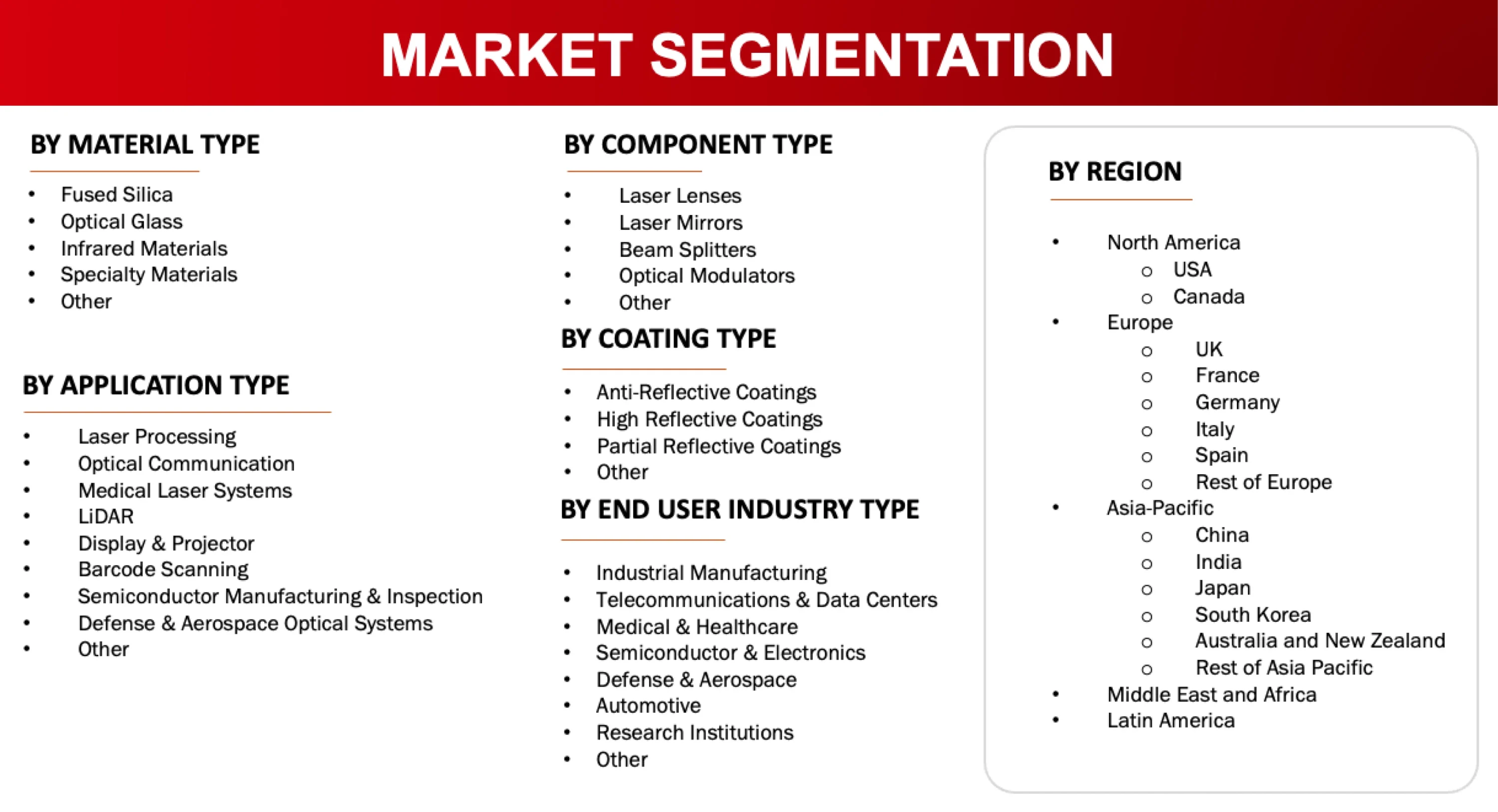
- To define, describe, analyze, segment, and forecast the laser optics market by material type, component type, coating type, application type, end user industry, and region
- To describe and forecast the market for four key regions: North America, Europe, Asia Pacific, and Rest of the World
- To provide detailed information regarding key drivers, restraints, opportunities, and challenges influencing market growth
- To strategically analyze the micro indicators with respect to individual growth trends, prospects, and contributions to the overall market size
- To analyze opportunities for stakeholders in the laser optics industry and emphasize the competitive landscape of the market
- To develop competitive benchmarking of key market players based on technology specifications, product offerings, and end-user applications
- To strategically profile key players and comprehensively analyze their product portfolios, technological capabilities, and core competencies
Need deeper insights on this market?
Get full report access with detailed forecasts, competitive analysis, and segmentation.
Research Approach
This research employs a systematic approach by using primary research along with secondary research to achieve full coverage and accuracy of information about the laser optics sector. Through this approach, the current market trends in terms of consumer behavior, technological developments, and competitive environment can be analyzed thoroughly.
Secondary Research
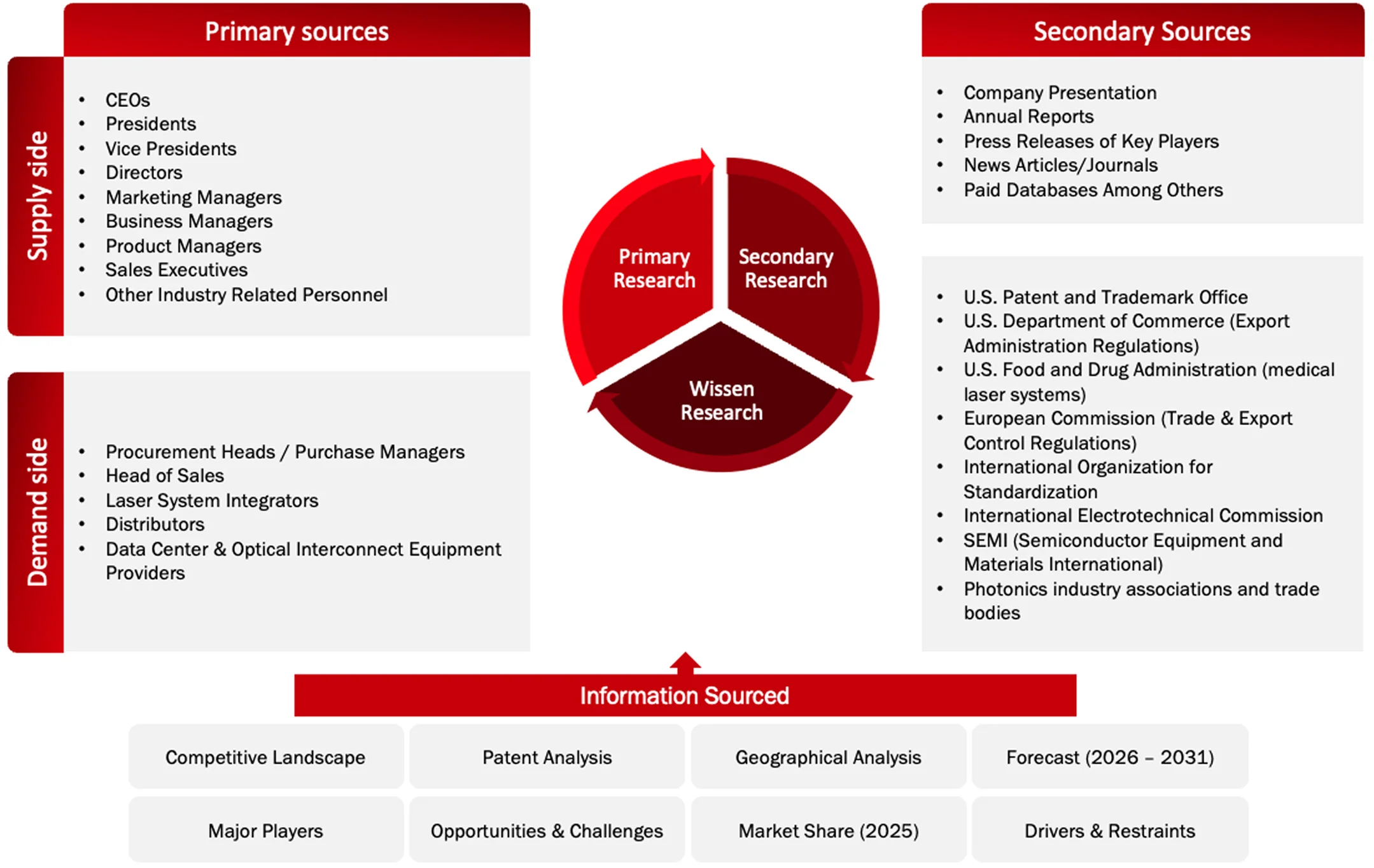
Secondary research involves the collection of data from reliable sources such as industry databases, company annual reports, investor presentations, and regulatory filings. This process helps in understanding market trends, identifying key players, and gathering technical and commercial insights.
A comprehensive database of leading companies and market participants is developed through secondary research to support further analysis.
Primary Research
Primary research is conducted to validate findings from secondary research and to gain deeper insights into market dynamics. Interviews are carried out with industry stakeholders across both demand and supply sides, including R&D leads, commercial leadership at optics and component manufacturers, procurement and technical decision-makers at laser system integrators and data center equipment providers, CXOs, Vice Presidents, and Directors from business development, marketing, and product teams.
Data is collected through structured questionnaires, email interactions, and telephonic interviews across key regions including North America, Europe, Asia-Pacific, and Rest of the World.
Market Size Estimation
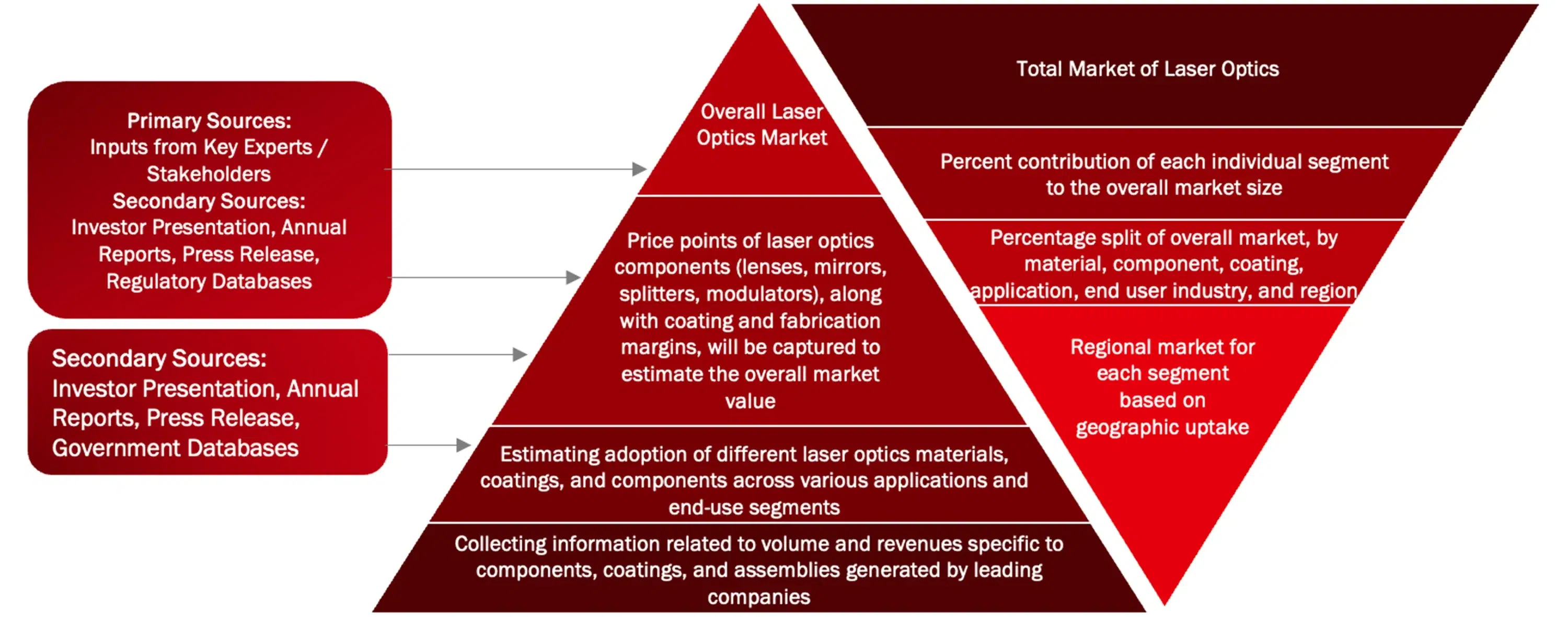
Market size estimation is performed using both top-down and bottom-up approaches. Key market players are identified, and their revenues are analyzed to estimate the overall market size.
The market is further segmented based on:
- Product and service mapping across regions
- Adoption patterns across key application segments
- Insights gathered through primary and secondary research
Data Validation and Research Design
After estimating the overall market size, the data is validated using triangulation methods and market breakdown techniques to ensure accuracy and consistency. Both demand-side and supply-side factors are considered to refine the analysis.
The final data is validated through multiple sources to ensure reliability and to provide accurate insights across all market segments and regions.
Assumptions of the Study
The analysis of the laser optics market is based on the following key assumptions:
- Trends in the industry are drawn from historical data and current information within the laser optics sector
- The future outlook is underpinned by constant economic conditions in the absence of major shocks to the market
- The adoption rate of laser optics technologies will rise steadily across all important regions
- Advancements in coating chemistry, substrate materials, and manufacturing precision will continue to drive growth in the laser optics market
- Market size and market share figures are estimated using available information from the industry and publicly available data
- The regulatory frameworks, R&D spending, and pricing conditions are assumed not to be significantly disrupted during the forecast period
Scope and Limitations
Scope of the Study
This report offers an exhaustive overview of the global laser optics market and includes the following components:
- Summary of market size, growth trends, and projections
- Carefully segmented market based on material type, component type, coating type, application type, end user industry, and geography
- Discussion of primary factors influencing the market
- Competitor analysis
- Insights into regional and national market performance
Limitations of the Study
Despite the best efforts being made to keep the results accurate, the study does suffer from some limitations:
- It has been done using both primary and secondary data that come with their own constraints
- Rapid developments in technology might affect the future course of market dynamics
- Some figures are only approximations due to lack of public disclosure
- The report is not an insurance against any disruptions in macroeconomics and geopolitics
- Future forecasts are indicative and subject to change due to altered industry dynamics
Data Triangulation and Market Breakdown
Data triangulation involved the combination of primary research, secondary research, and the Wissen Research analysis. Once the data points were sourced from the secondary market research, we sanitized the data points to make the market sizing and growth forecast more accurate by developing our own assumptions based on the inputs and insights we gather through the primary interviews with the industry experts. Once the data was thoroughly validated through primary interviews from both, demand and supply side of the market, our team of analyst and other team members involved finalized the market sizing and growth forecast.
Data Triangulation Methodology
Sources: Company annual reports, Investor presentations, SPIE Photonics Industry Reports, Optica publications, Laser Focus World, Photonics Spectra, EPIC reports, SEMI reports, Company press releases, Patent databases, WIPO, USPTO, EPO, Wissen Research Analysis.
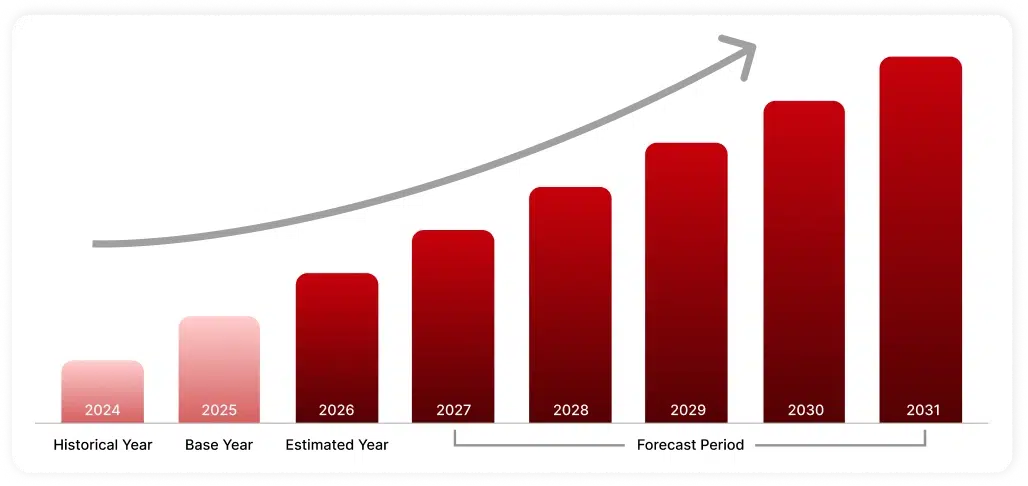
Year Framework
Bottom-Up Approach (Demand Side) And Top-Down Approach (Supply Side)
Bottom-Up Approach (Demand-Side Approach):
Determining the market size through the consolidation of demand among end-users, sectors, and geographic areas, which are calculated according to real-world demand conditions.
Top-Down Approach (Supply-Side Approach):
Calculating the market size through revenue and performance of the industry and its important companies, allocating the market size among various sectors.
Want detailed insights from this report?
Buy this Report
Choose the option that best fits your needs