330x Growth in cortisol monitoring search interest in 11 months
$716.2M Projected hormone monitoring market by 2035
1.2B Women expected to experience menopause
Hormones regulate metabolism, growth, reproduction, mood, and stress response. Even small, short-term fluctuations can signal or cause real problems, from thyroid disorders to hormone-sensitive cancers to burnout-level chronic stress. The trouble is that traditional testing methods, like ELISA, HPLC, and mass spectrometry, are built for accuracy, not accessibility. They require invasive sampling, expensive lab equipment, and centralized infrastructure, and they only ever give you a single snapshot in time. For a hormone like cortisol, which naturally spikes and dips throughout the day, a single blood draw can miss the story entirely.
That gap is exactly what wearable biosensors are trying to close.
The problem with today’s approach
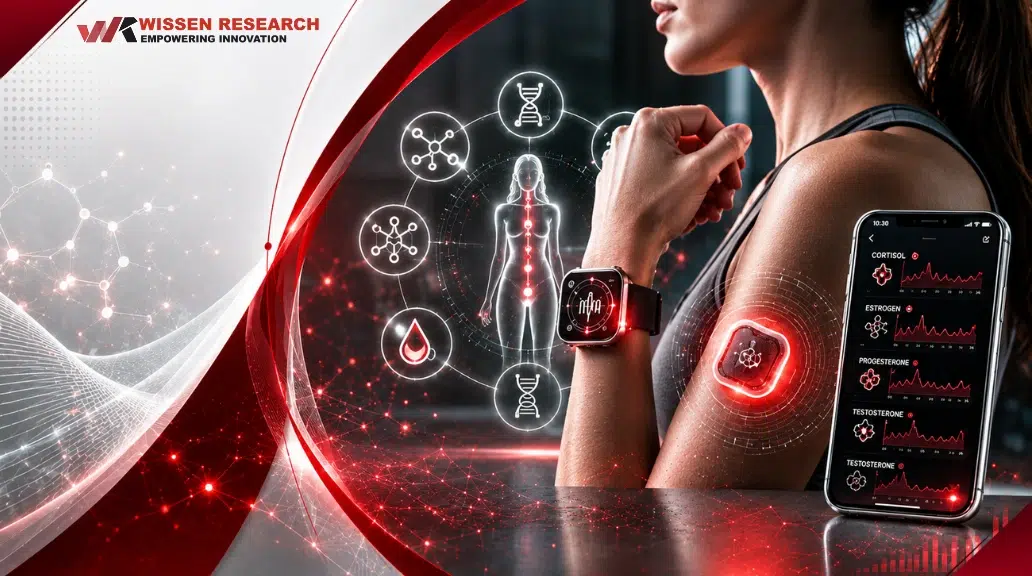
A hormone like cortisol naturally spikes and dips throughout the day. A single blood draw can miss the entire story. Wearable biosensors are designed to close exactly this gap—turning invisible, fluctuating signals into real-time data you can watch on your wrist or skin.
How the Technology Actually Works
At the core of most of these devices is an electrochemical biosensor — a small piece of engineering with three essential jobs. First, a biorecognition element (often an enzyme, antibody, or synthetic aptamer) latches onto the specific hormone it’s designed to detect. Second, a transducer converts that biological event into an electrical signal, usually by measuring changes in current, voltage, or impedance. Third, a signal-processing system amplifies, filters, and translates that raw signal into a number a person can actually read on an app.
The Shift Toward Needle-Free Health Monitoring
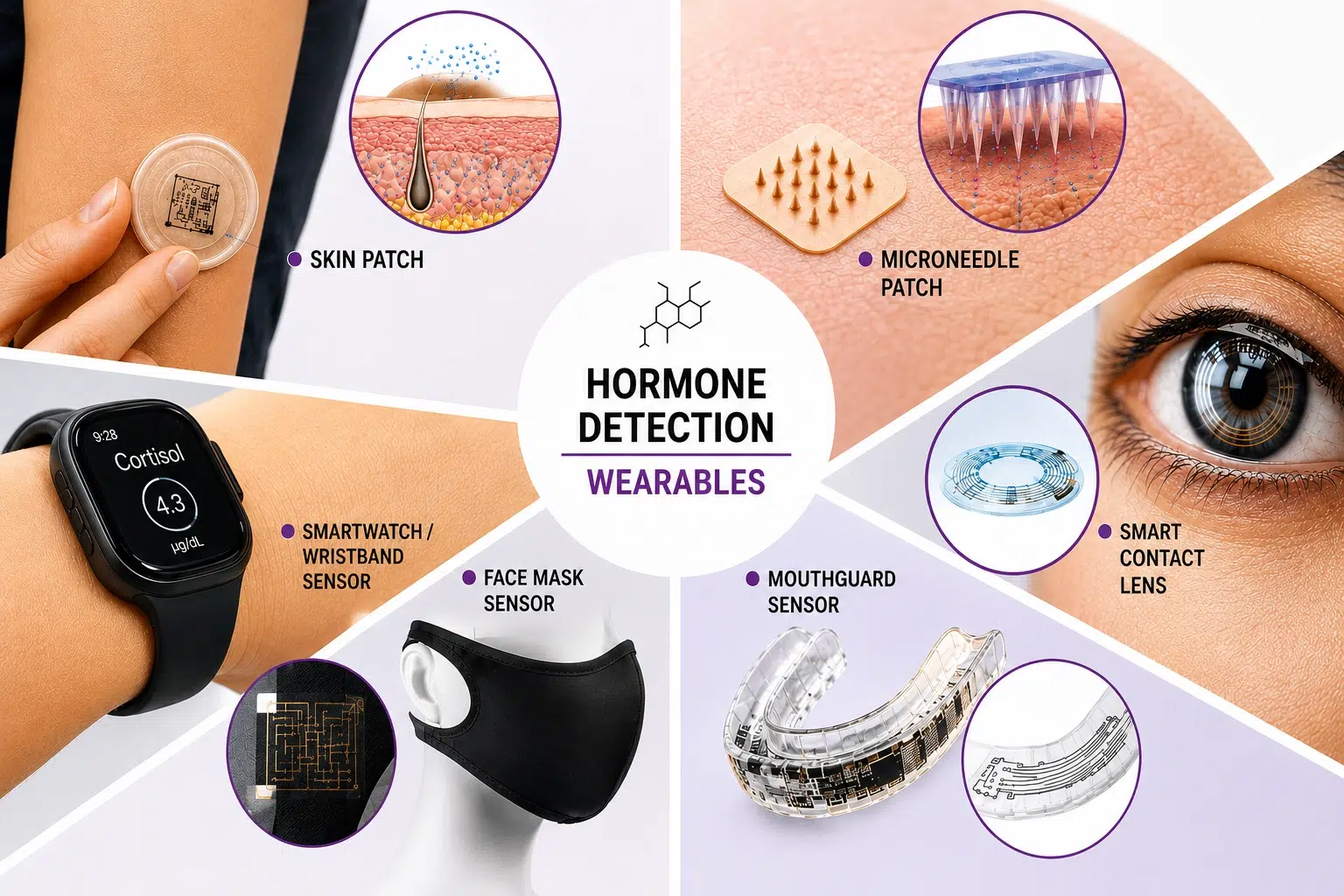
What makes the wearable version of this technology compelling is where it can be deployed. Instead of blood, these sensors are being engineered to work with sweat, interstitial fluid, saliva, and tears — fluids you don’t need a phlebotomist to access. Sweat patches are already commercially deployable, smart contact lenses and textile patches are moving through prototyping and early human testing, and more experimental ideas like sensing face masks and mouthguards remain firmly in the concept stage.
A Breakthrough Year for Cortisol Sensing
If 2026 has a headline moment in this space, it belongs to Adaptyx Biosciences. In June, the company presented the first continuous, multi-day, free-cortisol data ever recorded in humans at the American Diabetes Association’s Scientific Sessions — and walked away with the ADA’s Innovation Challenge award. Crucially, the readings weren’t just novel; they were validated. Adaptyx’s sensor tracked closely with gold-standard LC-MS/MS blood measurements and successfully captured the cortisol awakening response overnight, a physiological pattern that’s notoriously hard to catch outside a sleep lab.
The company backed that up with hard numbers: a limit of detection below 1 nanomolar in artificial interstitial fluid, and more than 400 hours of IRB-approved in-body monitoring data now supporting a path toward FDA Class II clearance.
Adaptyx isn’t alone. Level Zero Health, which closed a $6.9 million pre-seed round in early 2025, is targeting a different niche — intermittent, multi-hormone testing and already has $3 million in signed letters of intent from IVF clinics, plus reported 98% accuracy across four hormones in validation testing. EnLiSense has taken a third path, launching a sweat-based cortisol wearable already sold as a general wellness device, though without the clinical validation of its ISF-based competitors. Meanwhile, Biolinq, best known for its color-coded glucose patch has begun eyeing cortisol as an entry point into multi-analyte monitoring, and Germany’s Pheal is betting on a reusable-reader-plus-disposable-patch model that can track cortisol alongside glucose, lactate, sodium, and troponin on a single platform.
A Market Nobody Has Won Yet
The demand signal is loud. Consumer search interest in cortisol monitoring has grown roughly 330-fold in just eleven months, and the hormone-monitoring device market is projected to more than double from $325.7 million in 2025 to $716.2 million by 2035 , all nested inside a hormonal-health opportunity estimated at $600 billion. Zero FDA-cleared consumer products currently exist to capture that demand.
That vacuum is notable for who hasn’t moved yet. None of the major consumer wearable brands — Whoop, Oura, Garmin, Apple, Samsung currently own validated hormone-sensing hardware of their own. What they do have is massive distribution and increasingly sophisticated software layers (Whoop’s Advanced Labs, Oura’s Cumulative Stress feature) built to eventually sit on top of exactly this kind of data. It’s the classic setup for an acquisition wave: a handful of IP-rich startups with no distribution, and a handful of distribution-rich incumbents with no sensing IP.
There’s also a specific, underserved market hiding in plain sight. McKinsey estimates the menopause market alone will affect 1.2 billion women and reach $600 billion by 2030 , yet only about 7% of femtech startups are currently building for it. For a technology built to track hormonal fluctuation, that’s about as clear a white space as it gets.
What’s Still Standing in the Way
For all the momentum, this is still a pre-commercial category. No wearable hormone sensor has FDA clearance yet, for consumer or clinical use. The correlation between sweat or interstitial fluid readings and actual blood hormone levels hasn’t been validated at scale across diverse populations — a nontrivial problem, since hormone concentrations in these alternative fluids can behave differently from person to person. And unlike continuous glucose monitoring, which converged decades ago on a single dominant sensing chemistry (enzymatic glucose oxidase), hormone sensing remains fragmented across DNA molecular switches, aptamer-based field-effect transistors, and molecularly imprinted polymers, with no clear technical winner yet.
Regulation adds another layer of uncertainty. While the Dexcom/Stelo/Lingo De Novo pathway offers a regulatory precedent that should, in theory, smooth the way for hormone-sensing devices, FDA review timelines could easily run longer than the 6–12 months companies are currently projecting. And there’s a subtler risk worth naming: it’s not yet clear whether the explosive consumer search interest in cortisol tracking reflects durable demand or a temporary cultural spike around “stress optimization.”
What Happens Next
The next 18 months will likely determine whether this becomes the next continuous glucose monitor , a category-defining medical wearable or a slower-burning niche. In the short term, watch for build-vs-buy decisions from major wearable incumbents, and for competitive positioning moves from the current crop of startups as they use early clinical data as leverage in funding and partnership conversations. In the medium term, the clearest signal to track is regulatory: how Adaptyx’s FDA Class II submission progresses, and whether any competitor files close behind it.
If and when a first clearance does land, the CGM( Continuous Glucose Monitoring) precedent suggests what comes next won’t be gradual. Dexcom’s Stelo didn’t just win FDA approval , it triggered a demand inflection that reshaped how millions of people think about a routine health metric. Hormone monitoring, still mostly confined to sporadic lab draws and guesswork, may be next in line for the same transformation.