Radiology Won the Last Decade. Here’s Who Wins the Next One.

If you want to understand where AI in healthcare is actually headed, stop reading the headlines and start reading the FDA’s approval list. It’s not exciting. It’s also not lying to you.In 2019, roughly 1 in every 700 FDA device clearances involved AI. By 2025, it was 1 in 28. That’s not incremental growth, that’s a category taking over the building. And by the first quarter of 2026, the FDA’s AI-Enabled Medical Device List had climbed to roughly 1,524 devices, with 92 new ones cleared in that quarter alone — a 28% jump from the one before it.
We went straight to the primary sources instead of the press releases — FDA filings, clinical trial registries, patent records, and reimbursement decisions buried in CMS bulletins nobody reads unless they have to. Here’s what actually showed up, and why it matters if you’re making an investment, partnership, or product decision in this space over the next 18 months.
The five places this is actually happening
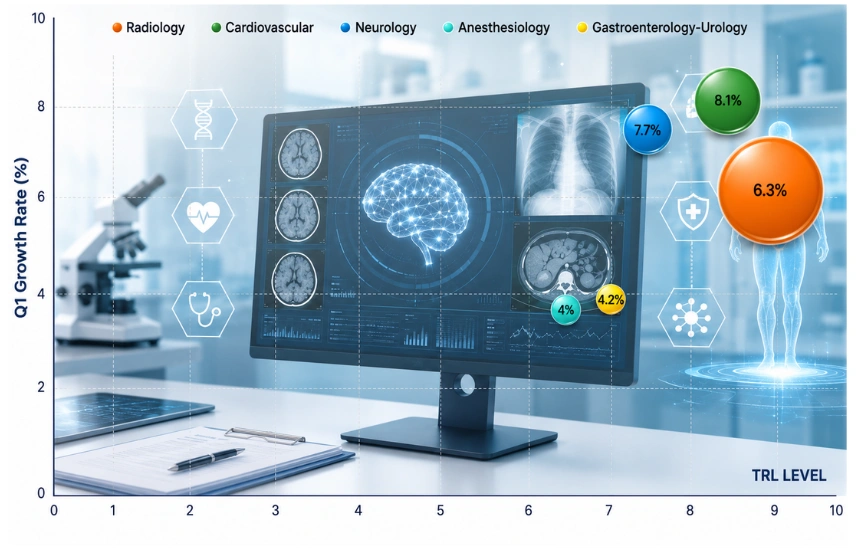
AI diagnostic growth isn’t spread evenly across medicine. It’s concentrated almost entirely in five specialties: radiology (1,164 FDA clearances), cardiovascular (147), neurology (70), anesthesiology (26), and gastroenterology-urology (25). Together, that’s the clearest picture available of where this technology has moved from research promise to clinical reality , and where the next wave is most likely to come from.
Radiology got there first, and it shows. Convolutional neural networks and increasingly transformer-based foundation models now analyze CT, MRI, X-ray, and mammography studies as a matter of course — flagging hemorrhages, embolisms, fractures, before a radiologist even opens the file. GE HealthCare, Siemens Healthineers, Philips, and Canon Medical have all folded this directly into their imaging hardware. If you’re entering radiology today, you’re not entering a frontier. You’re entering a market with the rules already written, and AI-native challengers like Aidoc and Viz.ai have proven those rules can still be beaten, but it takes real deployment scale to do it (Aidoc alone now processes 60 million patient cases a year across roughly 2,000 hospitals).
Cardiology is where it gets more interesting. It’s growing faster than radiology in percentage terms right now, and it just proved something the rest of the industry hasn’t: that reimbursement is winnable.
The part that actually determines who wins: getting paid
Here’s a truth that doesn’t make it into most industry coverage: an FDA-cleared device that nobody gets reimbursed for doesn’t scale. It just sits there.
For years, that was cardiology AI’s exact problem — plenty of clearances, no clean path to payment. That changed in December 2025, when CMS finalized OPPS payment for Eko Health’s SENSORA platform. That single reimbursement decision may end up mattering more than the underlying FDA clearance itself, because it’s the first clean template other AI cardiac platforms can now point to. Reimbursement, not accuracy, is turning out to be the actual commercial unlock, and it’s a lesson every specialty behind cardiology in this race is about to have to learn the hard way.
The rooms nobody’s standing in yet
Here’s the number that should catch your attention if you’re looking for where to compete rather than where everyone already is: anesthesiology and gastroenterology-urology combined added just 2 new AI device clearances last quarter. Compare that to radiology’s 69.
Read that as “these specialties are behind” and you’re missing the point entirely. Read it as “these are the only two rooms in the building nobody’s occupying yet,” and now you’re onto something. Anesthesiology in particular is still almost entirely owned by hardware incumbents — Medtronic, GE Healthcare, Nihon Kohden with barely a single true AI-native challenger in the field. That’s not a weak spot in the market. That’s a door standing open.
The regulatory maze most companies underestimate
If you’re planning to sell outside the US, there’s a structural gap worth knowing about before you build your launch timeline. The FDA runs a centralized system — one clearance, national access. The EU doesn’t work that way. Manufacturers instead need CE marking through an independent Notified Body, and under MDR’s Rule 11, nearly every clinically meaningful AI diagnostic tool lands in Class IIa, IIb, or III — all of which require that Notified Body review. That process typically takes 12 to 24 months and can cost upwards of €300,000, a meaningfully slower and more expensive road than the FDA’s median 510(k) timeline.
And since August 2026, it’s gotten a second layer: the EU AI Act now classifies most diagnostic and therapeutic AI devices as “high-risk,” adding data governance, human oversight, and technical documentation requirements on top of MDR. In May 2026, EU lawmakers confirmed medical devices remain fully subject to both frameworks simultaneously — no exemption, no shortcut. If your go-to-market plan treats “FDA cleared” and “ready for Europe” as roughly the same milestone, it isn’t, and the gap is wider than most teams assume.
Software or hardware that uses machine learning to help detect, diagnose, or monitor medical conditions — e.g., an algorithm flagging a tumor on a scan.
Around 1,451 as of year-end 2025, crossing roughly 1,524 by early 2026 — and still growing
510(k) shows equivalence to an existing device (fastest); De Novo creates a new category for novel low/moderate-risk devices with no predecessor; PMA is full clinical review for the highest-risk devices (slowest, most rigorous).
Unlikely in the near term — AI is largely used to assist and flag findings, with a physician still confirming the diagnosis and making treatment decisions.
Radiology, at roughly 76% of all authorized devices.
Often highly accurate in controlled trials, but real-world performance varies by population and setting, and independent validation remains limited for many devices.
Sometimes — coverage depends on a specific reimbursement/billing code being established, which usually lags well behind FDA clearance.
A large, broadly trained AI model (not built for one narrow task) that can be adapted to multiple diagnostic uses — e.g., one scan flagging many different conditions at once.
No — the EU classifies AI-enabled medical devices as “high-risk” under its AI Act, generally requiring more extensive evidence than the FDA’s faster 510(k) route.
Not yet — as of March 2026, no FDA-authorized device uses generative AI or large language models, though several are in the pipeline