The Hormone That Is Rewriting What “Growth” Means in CPG
| PAST (1999–2025): The Freeze |
For two and a half decades, the food industry ran on one principle, more is more. Bigger packs, more occasions, more calories per dollar. No biological force existed that could make an entire population structurally eat less.
| PRESENT (2025–2026): The Reckoning |
GLP-1-positioned products grew roughly 10x in twelve months, from 38 to 388 unique items in one industry catalog. The badge “GLP-1 Friendly” appears everywhere. Almost none of it is regulated, validated, or built on science tested against the consumer it claims to serve.
| FUTURE (2026–2030+): The Cascade |
Oral GLP-1 pills remove the cold-chain barrier. Patents lapse across markets representing 40% of the world’s population. The user base scales by an order of magnitude — in places no CPG strategy deck has modeled yet.
The End of Bigger Portions, Understanding the GLP-1 Shift
The rise of GLP-1 therapies is not merely a healthcare phenomenon, it is a consumer transformation. Notably, nearly half of all GLP-1 users are taking these therapies primarily for weight loss, underscoring their growing role in shaping consumer health and dietary behaviors. For the past hundred years, the manufacturing economics, distribution infrastructure, marketing strategy, and brand architecture were all built to maximize volume consumed. It worked, reliably, for generations because nothing in the food system itself could push back against it.
That changed with a hormone – GLP-1, or glucagon like peptide-1, is a naturally occurring incretin hormone produced by specialized L-cells in the small intestine in response to food intake. It stimulates glucose-dependent insulin secretion, suppresses glucagon, slows gastric emptying, and signals the hypothalamus to reduce hunger. In its natural form, it lasts two to three minutes in the body before being degraded. Pharmaceutical companies figured out how to make it last for days instead of minutes — and in doing so, they built a molecule that could do something no marketing campaign, regulation, or recession ever had: make a large population structurally eat less, on a sustained basis, for the first time in the history of modern food retail.
This isn’t a trend. It’s a structural rewiring of how much food the world eats.
The numbers describing where the industry stands right now are the kind that make a boardroom go quiet. In the space of twelve months, GLP-1-positioned products went from a handful of niche experiments to hundreds on shelf, a roughly 10x increase that the food industry has rarely, if ever, matched for any single trend. Circana projects that by 2030, GLP-1 households will represent 35% of all US food and beverage sales. That is not a niche segment. That is the mainstream, arriving faster than most category strategy decks have been updated to reflect. Brand responses underscore how quickly GLP-1 has moved from a contrarian idea to a catalyst for widespread industry action.
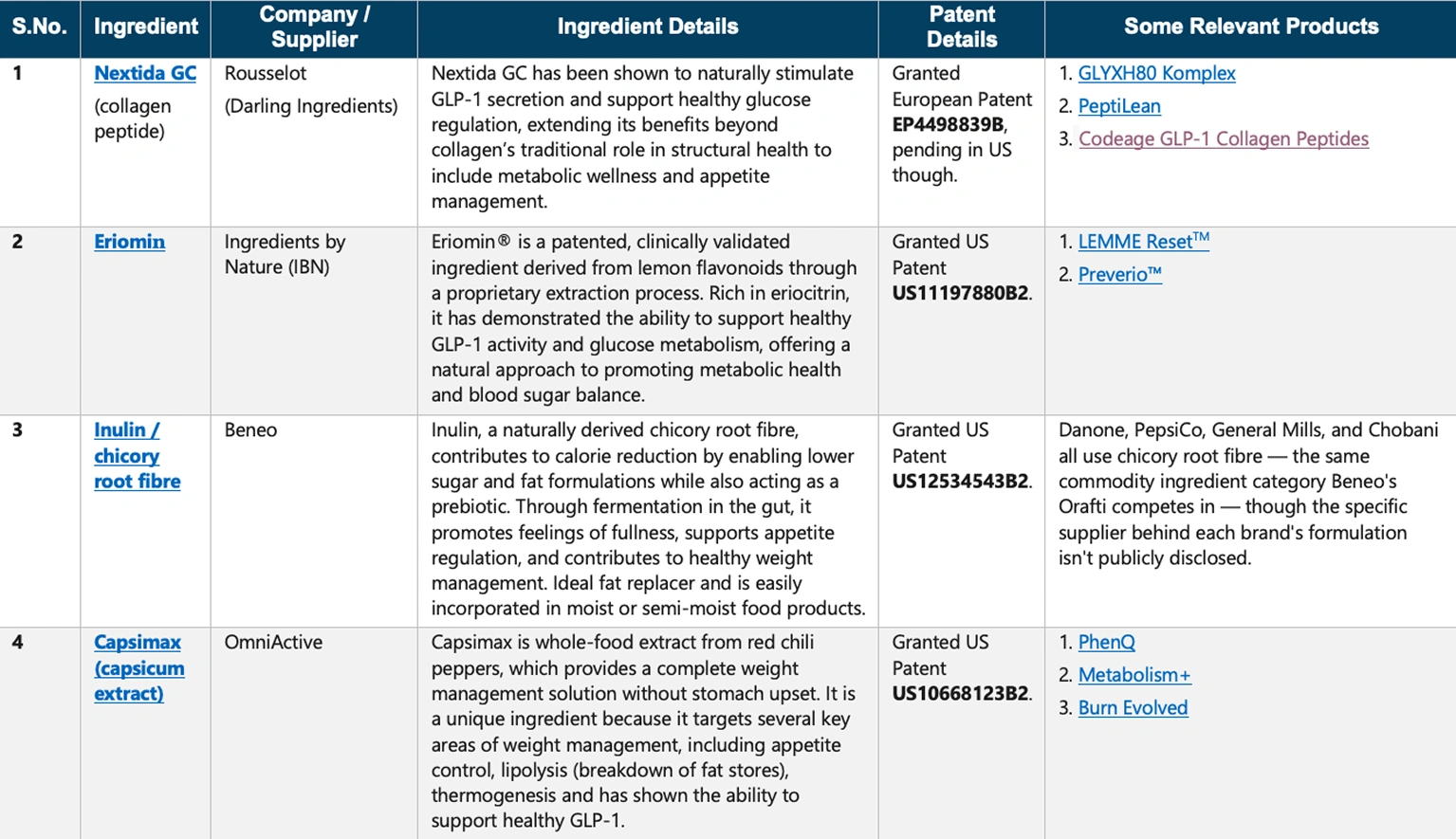
The table below highlights key ingredients being explored for their potential role in supporting satiety, metabolic health, and GLP-1-related benefits. It maps each ingredient to its company/supplier, associated patent activity, technical attributes, and relevant commercial products, providing insights into the innovation landscape shaping the future of GLP-1-oriented food and beverage solutions.
When regulation cannot keep pace with a fast-moving consumer trend, industries tend to find their own workaround. In the GLP-1 food category, that workaround is the label itself. Walk down any supermarket aisle in 2026 and the badge is everywhere: “GLP-1 Friendly.” A reassuring little promise sitting on yogurt cups, frozen meals, protein bars, and snack packs, telling the shopper that this product was made for them. Here is what that badge actually means, in legal terms: NOTHING. There is no FDA definition of “GLP-1 Friendly.” No clinical threshold a product must clear. No minimum protein level, no required fibre content, and no enforcement body checking whether the claim is even true. The closest thing to oversight exists almost by accident — when Conagra and Nestlé began using GLP-1-related labelling, the USDA permitted it only on the condition that the claim be accompanied by a printed statement of protein and fibre content, and that the label not be misleading. Print the numbers, do not lie outright, and the badge is yours.
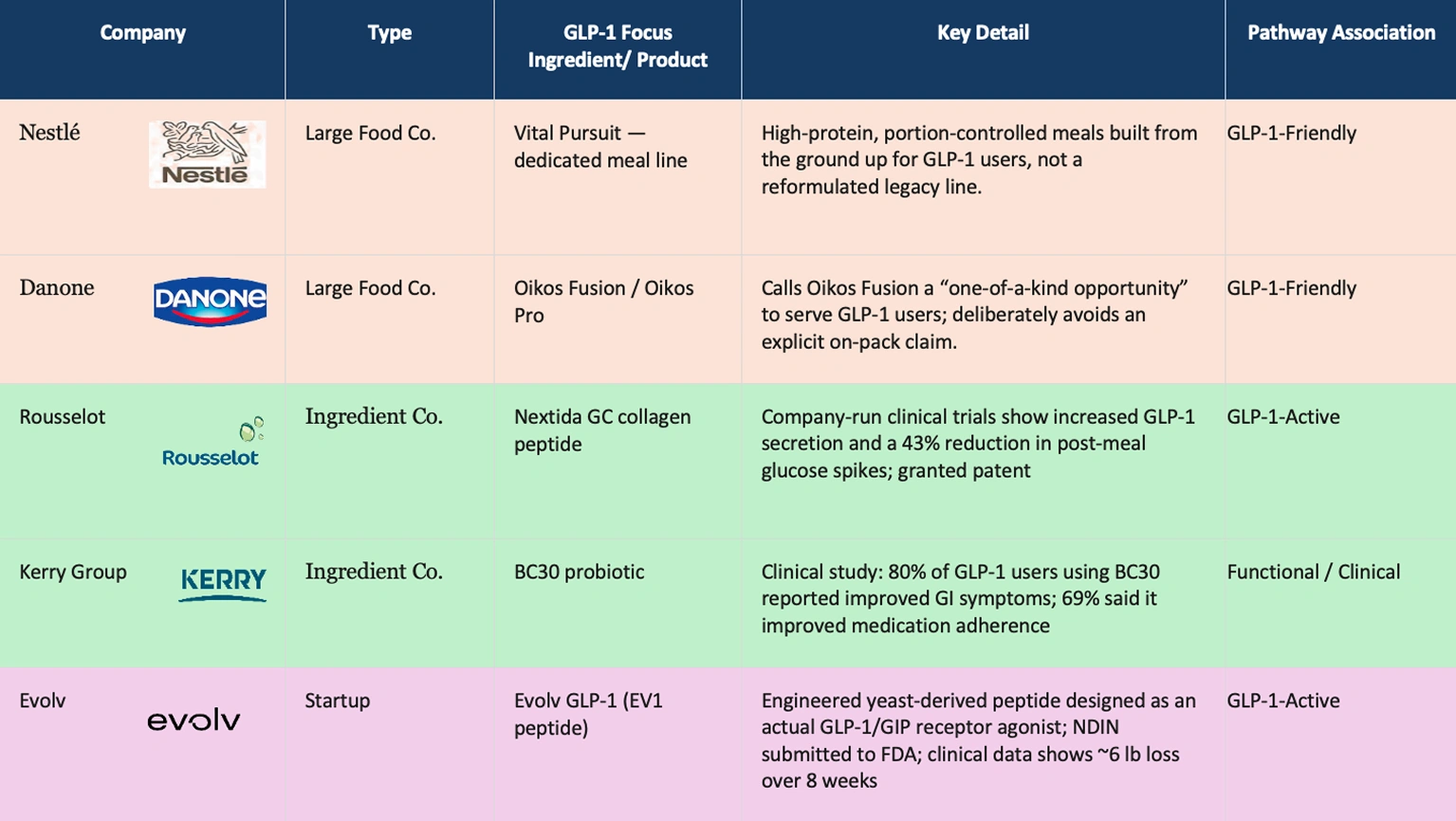
Not every brand is playing the same game, and the differences are not subtle. Some are building dedicated new product lines from the ground up. Others are simply re-badging what they already had on shelf. The table below maps large food manufacturers, ingredient suppliers, and startups — each classified by the strength of its actual scientific association with the GLP-1 pathway, not its marketing language. Three categories define where a company sits: GLP-1-Active, reserved for companies with direct, company-specific evidence that their product stimulates GLP-1 secretion or engages the GLP-1 receptor itself; Functional/Clinical, for companies with real, company-run clinical data showing a validated benefit for GLP-1 users, such as improved digestive comfort, without that benefit operating through the GLP-1 pathway directly; and GLP-1-Friendly, the largest and least exclusive category, covering products positioned for the GLP-1 consumer through macro-nutrient reformulation rather than any verified mechanism. Most large players sit in this last category: real products serving real demand, but without company-specific evidence tying them to the hormone itself. The genuine innovation is happening elsewhere. It is the startups —that are doing the real work of engineering molecules to engage the GLP-1 pathway directly, putting them years ahead of most incumbents on the science even as they remain far behind on distribution. That gap between who has the science and who has the shelf space is the throughline of this table, and the clearest signal of where the next wave of acquisitions and partnerships is likely to happen.
Despite the intensity of attention on this category, the market is still in its early stages relative to its addressable population. Two structural developments are about to expand both supply and demand sharply over the next several years.
The first is convenience. Oral GLP-1 formulations entered the market in January 2026, eliminating the need for the cold-chain refrigeration that injectable versions require — opening a realistic path into regions that could never have economically supported this category before.
The second is price. Semaglutide’s core patents expired in India and China in March 2026, and generics are already entering those markets — two of the largest population centres on earth. Core patents are expected to lapse across ten countries by the end of 2026, including Brazil, South Africa, Turkey, and Canada, representing a combined share of the world’s population and obese adults that dwarfs anything the category has reached to date.
The user base disrupting frozen meals and yogurt aisles in the US and UK today is about to get dramatically larger — in markets most CPG strategy decks haven’t even modeled yet.
Layer onto this the largest unaddressed population in the category today: the roughly half of all prior GLP-1 users who are likely to use the medication again in the future. This “off-ramp” cohort , people who have discontinued treatment, often with appetite returning rapidly, while remaining highly health-motivated has almost no dedicated products built for it. It is, by a wide margin, the clearest white space left standing in the entire category.
Here is the twist that almost no strategy memo says out loud: the better these drugs work, the smaller the market for the food built around them becomes. A drug that successfully makes people eat less is, by definition, shrinking the total addressable market for the very companion snacks and meals racing to serve it. Any brand building a long-term strategy on the active-user moment alone is betting on a target that is mathematically designed to shrink — which is exactly why the durable winners will be built for the full cycle: on the drug, off the drug, and very possibly on it again.
The Badge Means Almost Nothing
“GLP-1 Friendly,” “Booster,” “Activator” — there is no FDA standard behind any of it. First-mover labelling today is regulatory exposure waiting to happen.
Distribution and Science Sit in Different Hands
The brands with the strongest shelf presence are not the ones with the strongest underlying ingredient science — and almost nobody has paired the two yet.
The Market Is About to Get Much Bigger
Oral pills remove the cold-chain barrier. Patent expiry in India and China opens access across roughly 40% of the world’s population. Today’s category is a preview, not the peak.
The Paradox No One Says Out Loud
The better these drugs work, the smaller the addressable market for the food built around them becomes. Long-term winners will be built for the cycle — on, off, and on again — not just the active-user moment.
GLP-1 drugs were developed to treat a metabolic health crisis that the food industry itself played a significant role in creating. The same companies now racing to build “GLP-1 Friendly” companion products are, in many cases, the companies whose earlier products helped generate the demand for the drug in the first place.
The brands that win the next decade will not be the ones that reformulate fastest or print the boldest badge. They will be the ones that make the most credible case that they are genuinely on the consumer’s side — through real transparency, real science, and a genuine understanding of what their customer is going through.
The hormone doesn’t discriminate between brands. The science behind who gets it right will.