
Freedom-to-Operate Analysis for Engineered Bacterial Enzyme

Could an 80% Sequence Match Be the Missing Piece in Assessing Biotech FTO Risk?

A multi-jurisdictional FTO investigation combined biosequence searching, patent analytics and application-level analysis to assess an engineered bacterial peroxidase.

Type FTO Search
Industry Biotechnology
Published September 07, 2026
Bacterial enzyme image

The Client’s Challenge

A client was evaluating a bacterial enzyme with potential antimicrobial applications and needed to understand the patent landscape surrounding its proposed use.

The investigation focused on a particularly narrow technical combination: a bacterial lactoperoxidase meeting a defined sequence-identity threshold relative to CyanoPOX, its encapsulation within a biological container known as an encapsulin, and its potential use in applications including personal care.

The relevant patent landscape had to be examined across the intersection of sequence, function, biological source, encapsulation and application.
bacterial enzyme challenge image

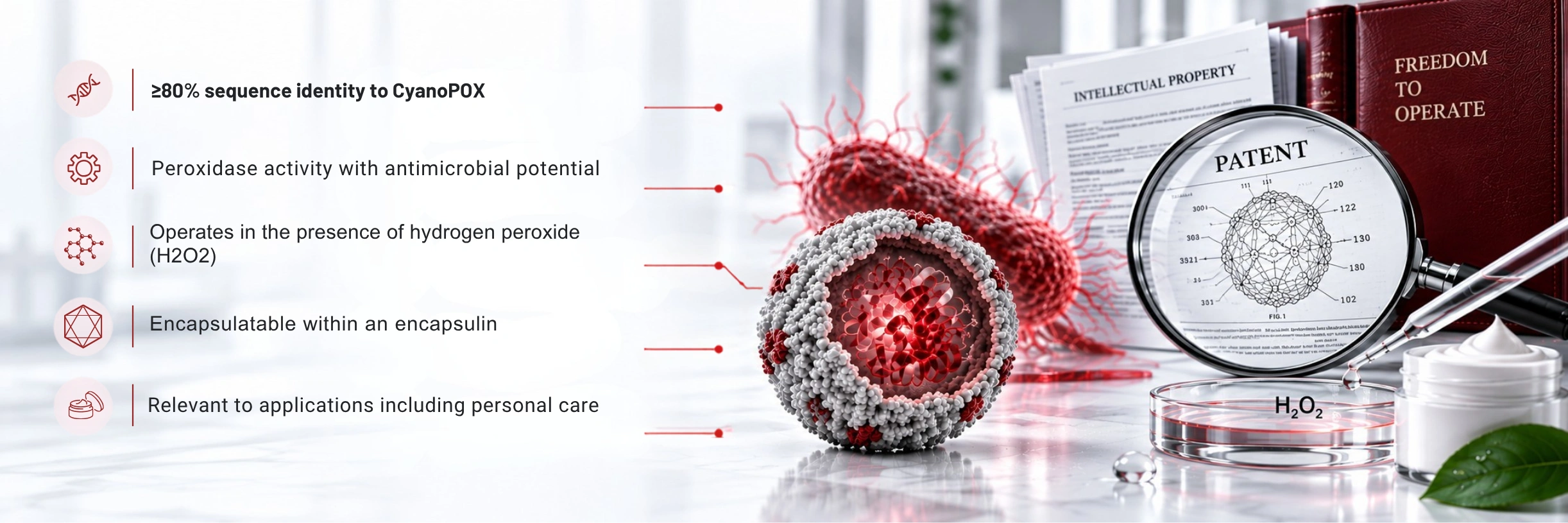
The target enzyme needed to:

    • Demonstrate at least 80% pairwise sequence identity with CyanoPOX.
    • Function as a peroxidase with antimicrobial potential.
    • Operate in the presence of hydrogen peroxide to support the desired oxidative reaction.
    • Be capable of being encapsulated within an encapsulin, a protein-based biological container.
    • Support potential downstream applications including personal-care products.
Objective icon
CLIENT’S OBJECTIVE

Assess the patent landscape surrounding a bacterial enzyme technology across the US, WO, EP and CN jurisdictions

Focus on disclosures combining the required sequence similarity, peroxidase functionality, encapsulation and intended applications.

Clients come to us for answers.
They leave with opportunities they didn’t know existed.

Our experts help organizations uncover insights, opportunities and strategic directions that traditional approaches often miss.

Wissen’s Out-of-the-Box Approach:

From Sequence Matching to Multi-Dimensional FTO Analysis

  • The investigation revealed an important limitation in approaching biotechnology FTO through conventional patent searching alone.
  • The target technology was not defined by a single characteristic. Its potential relevance depended on the intersection of several technical dimensions:
  • The bacterial enzyme and its biological source
  • Sequence identity relative to CyanoPOX
  • Peroxidase functionality
  • Encapsulation within a biological container
  • Antimicrobial activity

Identifying the Relevant Technical Intersection

  • Rather than treating every sequence hit as an equivalent patent risk, the investigation established a series of technical filters.

  • This framework allowed technically related references to be distinguished from references that merely appeared similar at a surface level.

  • For example, a reference discussing a bacterial peroxidase in a detergent formulation could be relevant from an application perspective even if its sequence did not satisfy the client’s 80% threshold.

  • The investigation therefore evaluated technical relationships rather than relying solely on terminology overlap.

Our Methodology

Conventional Search Limitations
Technology Decomposition
Broad Patent Landscape Investigation
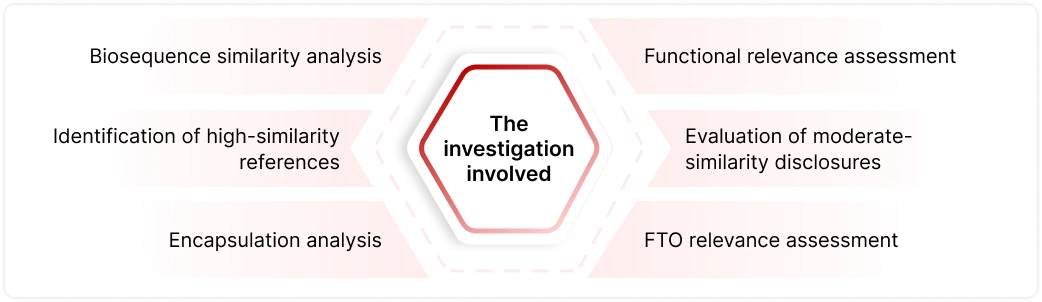
Biosequence Similarity Analysis
Functional Correlation
Encapsulation & Application Mapping
Cross-Validation & Similarity Searching
FTO Risk Assessment
Conventional Search Limitations
  • Keyword searches may miss sequence-level disclosures
  • Enzyme names may vary across technical literature
  • Sequence similarity does not establish functional equivalence
  • Application and encapsulation disclosures may appear in separate technical contexts
Technology Decomposition
  • Establish the 80% sequence-identity threshold relative to CyanoPOX
  • Define relevant biological and commercial use cases
  • Develop search concepts for each technical dimension
Broad Patent Landscape Investigation
  • Search US, WO, EP and CN patent landscapes
  • Use Orbit and PatSnap for structured patent searching
  • Supplement with Lens and Google Patents
  • Investigate classifications, assignees, inventors and patent families
Biosequence Similarity Analysis
  • Compare disclosed biological sequences against CyanoPOX
  • Identify high-, moderate- and lower-similarity candidates
  • Prioritize references meeting or approaching the defined 80% threshold
  • Separate sequence similarity from functional relevance
Functional Correlation
  • Examine whether identified sequences correspond to relevant peroxidase activity
  • Evaluate bacterial source and enzyme characteristics
  • Identify disclosures involving hydrogen peroxide-dependent activity
  • Exclude technically unrelated sequence matches
Encapsulation & Application Mapping
  • Search for biological encapsulation and encapsulin-related disclosures
  • Identify antimicrobial and hygienic applications
  • Evaluate detergent and personal-care disclosures
  • Correlate application-specific disclosures with enzyme and sequence evidence
Cross-Validation & Similarity Searching
  • Conduct citation and similarity searches around relevant references
  • Trace related patent families and technical disclosures
  • Cross-check findings across multiple databases
  • Compare sequence, function and application evidence
FTO Risk Assessment
  • Identify references presenting potential technical overlap
  • Distinguish complete from partial technical matches
  • Prioritize references for detailed claim-level legal assessment
  • Provide a structured view of potential FTO considerations

Biosequence Analysis Methodology

The investigation moved beyond conventional patent searching by treating the 80% sequence-identity threshold as a technical gateway for identifying potentially relevant biological disclosures.

bacterial enzyme methodology image

A US reference demonstrated approximately 82% sequence similarity with the specified CyanoPOX sequence, exceeding the client’s 80% threshold. However, sequence similarity by itself did not establish that the disclosed enzyme addressed every other technical requirement.

A CN reference showed ~75% sequence similarity and disclosed peroxidase use in detergent and personal-care applications, while a WO reference showed ~61.54% alignment with cyanobacterial heme peroxidases. Another CN reference reported 50–60% similarity and addressed bacterial peroxidase encapsulation for hygienic applications.

Technical Challenges Addressed Through Biosequence & FTO Analysis

Challenge 1: Could an 80% Sequence Match Identify a Potentially Relevant Enzyme?

The first technical challenge was determining whether previously disclosed bacterial enzyme sequences could meet the client’s defined 80% pairwise sequence-identity threshold relative to CyanoPOX.

Solution

Biosequence analysis was incorporated into the patent investigation to compare candidate enzyme sequences against the specified CyanoPOX sequence.

The analysis revealed:
  • Approximately 82% sequence similarity in one US reference
  • Approximately 75% similarity in a CN reference
  • Approximately 61.54% alignment in a WO reference
  • Approximately 50–60% similarity in another CN reference

The investigation also demonstrated an important limitation: Sequence similarity alone did not establish that the identified enzyme satisfied the complete technical requirements of the proposed technology. This made sequence analysis a critical FTO screening dimension, rather than a standalone conclusion of patent overlap.

Challenge 2: Could Encapsulation and End-Use Applications Complete the FTO Picture?

A patent discussing bacterial peroxidase might not discuss encapsulation. Another might describe encapsulation without emphasizing the specific enzyme sequence. Yet another might disclose the enzyme in detergent or personal-care applications. The relevant FTO picture could therefore be distributed across different technical disclosures.

Solution

The analysis identified a CN reference reporting approximately 50–60% sequence similarity with the CyanoPOX sequence that also discussed encapsulation of a bacterial peroxidase for use in a hygienic agent.

Separately, the approximately 75% sequence-similarity CN reference discussed bacterial-synthesized peroxidase in detergent and personal-care applications.

Different references provided different pieces of the technical puzzle:
  • One reference provided the strongest sequence correlation.
  • Another combined sequence similarity with peroxidase and personal-care/detergent applications.
  • Another connected bacterial peroxidase with encapsulation.
  • Another provided a lower sequence-similarity disclosure involving cyanobacterial heme peroxidase.

The resulting evidence showed that the 80% sequence threshold, enzyme function, encapsulation and intended application could not be treated as interchangeable search criteria.

Results & Business Impact

The investigation provided the client with a more structured view of the patent landscape surrounding the proposed bacterial enzyme technology.

Key Outcomes

  • Key outcome Icon

    Identification of a US reference reporting approximately 82% sequence similarity with the specified CyanoPOX sequence.

  • Key outcome Icon

    Identification of a CN reference reporting approximately 75% similarity while also addressing bacterial peroxidase use in detergent and personal-care applications.

  • Key outcome Icon

    Identification of a WO reference reporting approximately 61.54% alignment and discussing bacterial heme peroxidases from cyanobacterial sources.

  • Key outcome Icon

    Identification of a CN reference reporting approximately 50–60% similarity and describing encapsulation of bacterial peroxidase for a hygienic application.

  • Key outcome Icon

    Identification of relevant disclosures across US, WO, EP and CN jurisdictions.

  • Key outcome Icon

    Separation of sequence similarity from functional and application relevance.

Strategic Business Impact

For organizations developing engineered enzymes, this approach can help:

  • Identify potentially relevant patent families earlier.
  • Distinguish sequence-related risk from functional overlap.
  • Identify application-specific disclosures that conventional enzyme searches may miss.
  • Reveal encapsulation and formulation-related patent considerations.
  • Prioritize references for detailed claim-level legal review.

Biotechnology patent landscapes often behave differently from conventional technology landscapes. For biological inventions, the identity of the technology may instead be distributed across a sequence, biological function, host organism, formulation, delivery mechanism and commercial application.

Need to Assess Patent Risk Around a Complex Biotech Patent?

Our team combines patent analytics with domain-specific investigation to identify relevant disclosures, technical relationships and potential areas of patent risk.