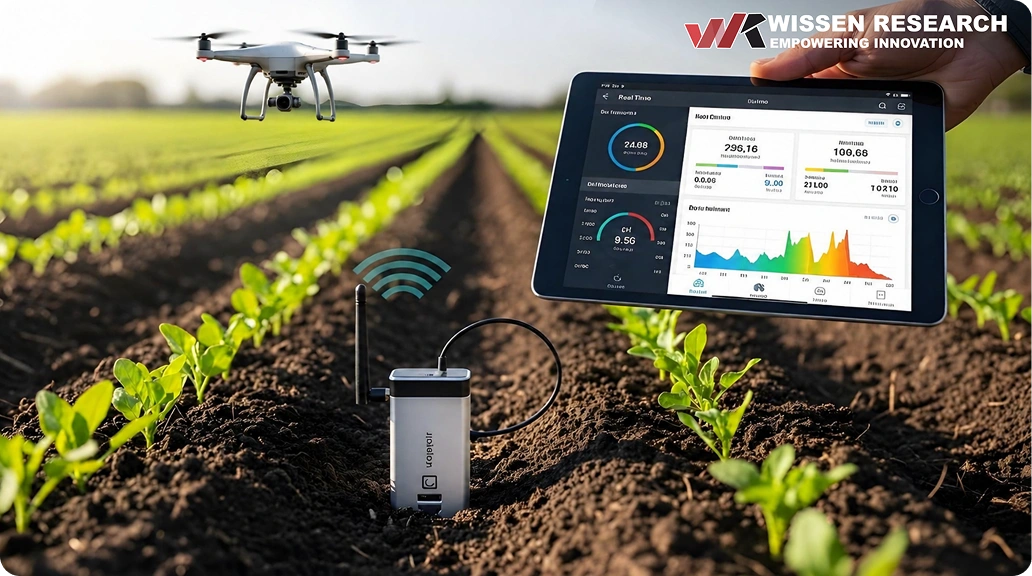
Smart Agriculture FTO Search: Patent Risk Analysis

Can Feature-Based Patent Analysis Uncover Overlooked Risks in Smart Agriculture Systems?

Wissen Research conducted an FTO investigation for an IoT-based smart crop monitoring and irrigation system by combining feature mapping, classification analysis and targeted patent searching.

Type Freedom-to-Operate (FTO) Search
Industry AgriTech
Published September 17, 2026
smart agriculture system

The Client’s Challenge

The adoption of Internet of Things (IoT)-enabled agricultural systems has transformed conventional farming practices by enabling continuous monitoring, data-driven decision-making, and automated resource management.

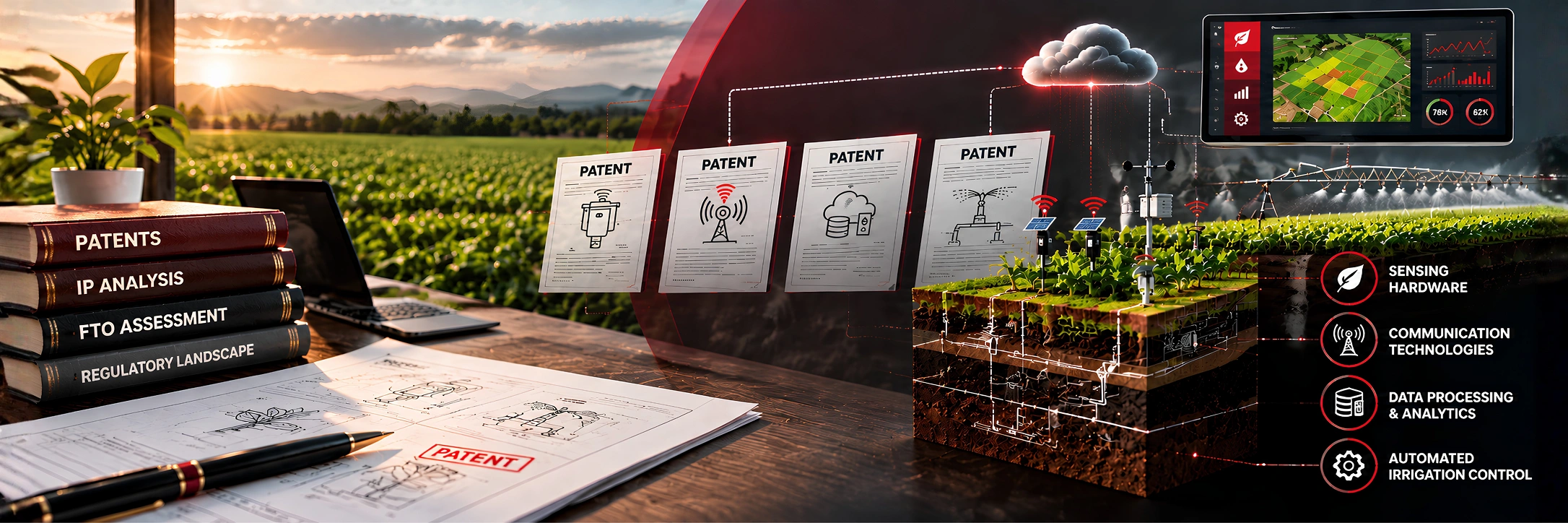
As agricultural technology solutions become increasingly interconnected, understanding the patent landscape surrounding these systems becomes essential before commercialization. Multiple technology layers including sensing hardware, communication mechanisms, data processing workflows and automated irrigation control may overlap with existing patent rights.

A client developing an IoT-based smart crop monitoring and irrigation solution sought a Freedom-to-Operate (FTO) assessment to identify relevant patent risks in the United States and European patent jurisdictions.
Smart agriculture image

The investigation focused on identifying patent references covering key product elements, including:

    • Sensor-based monitoring of crop and environmental conditions.
    • Collection and transmission of field data through communication modules.
    • Remote monitoring and control capabilities.
    • Database-driven analysis of agricultural conditions.
    • Comparison of collected crop parameters with stored agricultural datasets.
    • Generation of recommendations based on identified crop conditions.
    • Automated or assisted irrigation decision workflows.
Objective icon
CLIENT’S OBJECTIVE

Evaluate the freedom-to-operate landscape for an IoT-based smart crop monitoring and irrigation system to identify relevant patent risks before product commercialization.

The primary objective of the FTO investigation was to identify relevant patent rights that could potentially impact commercialization of the smart crop monitoring and irrigation system.

The FTO analysis was conducted for US and EP jurisdictions, with emphasis on uncovering additional relevant patent references.

Clients come to us for answers.
They leave with opportunities they didn’t know existed.

Our experts help organizations uncover insights, opportunities and strategic directions that traditional approaches often miss.

Wissen’s Out-of-the-Box Approach:

Product-Centric FTO Analysis

  • Recognizing the limitations of conventional keyword-based FTO searching, the investigation evolved beyond searching only for directly matching smart agriculture patents.
  • To enable a more comprehensive assessment of potential patent risks, the investigation expanded toward a product-centric FTO analysis approach. The analysis considered patent references that were:
  • Related to IoT-based agricultural monitoring systems.
  • Associated with crop condition monitoring and irrigation management.
  • Developed by organizations in smart farming technologies.

Identifying Relevant Patent Activity

  • A detailed analysis of smart crop monitoring and irrigation-related patents revealed that certain assignees were actively developing technologies associated with agricultural IoT systems.

  • However, simply identifying active assignees was not sufficient to determine product relevance.

  • To improve search accuracy, assignee intelligence was combined with relevant IPC/CPC classifications and technical feature combinations associated with the subject product.

Our Methodology

Traditional FTO Search Limitations
Product Feature Decomposition
Technology and Assignee Intelligence Analysis
Targeted Patent Searching
Claim-Level Feature Mapping
Relevant Reference Identification
Traditional FTO Search Limitations
  • Conventional keyword searches repeatedly identified known patent references
  • Many references disclosed only individual product components
  • Complete product workflows were distributed across multiple technology areas
  • Broad technical similarity did not always indicate product-level claim relevance
Product Feature Decomposition
  • Analyze complete smart crop monitoring and irrigation system architecture
  • Identify key technical features associated with product functionality
  • Extract search elements covering sensing, communication, monitoring and recommendation workflows
Technology and Assignee Intelligence Analysis
  • Identify organizations actively developing smart agriculture technologies
  • Analyze relevant patent portfolios and technology focus areas
  • Combine assignee intelligence with IPC/CPC classification analysis
Targeted Patent Searching
  • Execute focused searches using assignee, classification and feature-based combinations
  • Expand beyond previously identified client references
  • Identify additional patent families with stronger technical alignment
Claim-Level Feature Mapping
  • Analyze independent claims of shortlisted patent references
  • Map patent claim elements against product features
  • Identify references covering complete or substantial product workflows
Relevant Reference Identification
  • Prioritize patent references based on claim alignment
  • Differentiate between complete system coverage and partial technical similarity
  • Generate a focused FTO assessment supported by claim-level analysis
Outcome:

Identified ten relevant patent references where independent claims aligned with major product features, including three references covering all identified elements of the smart crop monitoring and irrigation system

FTO Investigation Methodology

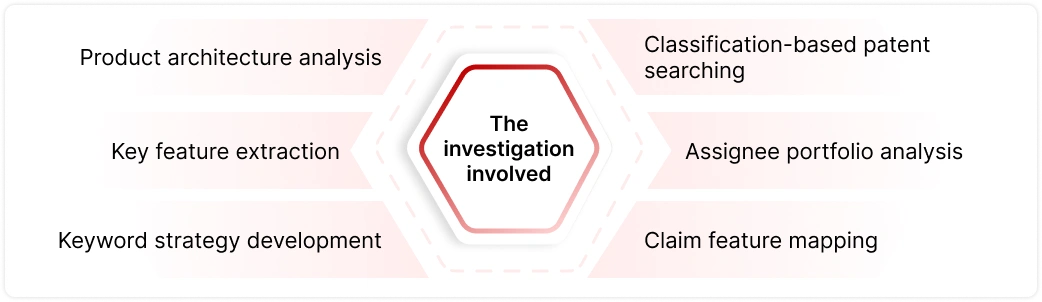
The FTO investigation involved a structured patent analysis methodology designed to identify relevant patent references associated with the smart crop monitoring and irrigation system.

Smart agriculture methadology

The investigation further incorporated targeted assignee and classification-based searches to identify patent references that were not captured through conventional keyword searching.

The final investigation identified ten relevant patent references with independent claims aligned with the major product features, including three references covering all key elements of the subject smart crop monitoring and irrigation system.

Technical Challenges Addressed Through FTO Analysis

Challenge 1: Complete Feature Coverage of Smart Crop Monitoring and Irrigation Architecture

A key challenge involved determining whether existing patent references covered the complete workflow of the smart crop monitoring and irrigation system including sensor-based monitoring, communication of field data, remote access, database comparison and crop condition-based recommendations.

Solution

The product architecture was decomposed into individual technical features and identified patent references were analyzed at the claim level to determine alignment with the complete system workflow. The investigation evaluated whether the claimed inventions covered the interaction between sensing components, communication modules, remote control systems and agricultural decision-support mechanisms.

The analysis revealed:
  • Sensor-based monitoring of crop and soil conditions.
  • Transmission of monitored information through communication modules.
  • Remote monitoring and control functionality.
  • Database-supported comparison of crop conditions.
  • Generation of recommendations based on agricultural data analysis.

These findings enabled identification of patent references with stronger alignment to the complete product architecture rather than individual technical components.

Challenge 2: Identifying Additional Patent References Beyond Client-Known Results

The client had already conducted an initial FTO search and provided a list of known patent references. The primary challenge was identifying additional relevant patent documents beyond the existing reference set when conventional search strategies repeatedly returned known references or incomplete technical matches.

Solution

The investigation expanded beyond conventional keyword searching by analyzing patent activity of organizations actively developing smart crop monitoring and irrigation technologies. A targeted search strategy combining relevant assignees, IPC/CPC classifications, and product-specific technical features was implemented to identify additional patent references.

The analysis revealed:
  • Ten relevant patent references with independent claims aligned with major product features.
  • Three patent references covering all major elements of the subject product.
  • Twenty related patent references with close technical similarity but additional limitations.

The targeted approach provided broader visibility into the patent landscape and strengthened the overall FTO assessment.

Results & Business Impact

The final FTO investigation provided a comprehensive understanding of the patent landscape surrounding the IoT-based smart crop monitoring and irrigation system.

Key Outcomes

  • Key outcome Icon

    Identified 10 relevant patent references with independent claims aligned to major product features.

  • Key outcome Icon

    Discovered 3 patent references covering the complete system architecture, providing deeper FTO risk visibility.

  • Key outcome Icon

    Identified 20 related references with close technical similarity but additional claim limitations.

  • Key outcome Icon

    Developed feature-level claim mapping to evaluate product–patent alignment.

  • Key outcome Icon

    Expanded the client’s known patent reference set with additional relevant findings.

Strategic Business Impact

By combining feature analysis, patent intelligence, classification searching and claim assessment, the investigation enabled a focused understanding of the smart agriculture patent landscape and potential risks.

  • Improved visibility into potential patent considerations associated with the complete product architecture.
  • Identification of relevant patent references beyond the client’s existing search results.
  • Better understanding of how competitors and technology developers are protecting innovations in smart agriculture.
  • Clearer differentiation between broadly similar technologies and patents with closer claim alignment.
  • A stronger foundation for evaluating product development strategies and future commercialization decisions.

By moving beyond conventional keyword-driven searching and incorporating technology-focused patent intelligence, organizations can develop a more comprehensive understanding of potential patent risks before entering competitive markets.

Need Strategic Insights Before Commercializing Your Technology?

Our team helps organizations evaluate patent risks through structured FTO investigations, claim analysis and technology-focused patent intelligence.