
Uncovering Prior Art Behind a Smart Elevator Patent - Wissen Research
Case Study

Could Waiting-Time Forecasts Unlock the Prior Art Behind a Smart Elevator Patent?

A patent investigation combined classification-driven searching, inventor analysis and technical literature to identify a highly relevant reference connecting elevator travel time, passenger-load changes and waiting-time prediction.

Case Study Type Prior Art Search
Industry Smart Infrastructure
Publication Date November 12, 2026
Smart elevator image

The Client's Challenge

A client sought assistance in identifying relevant prior art for a patent concerning intelligent elevator allocation. The invention described a system designed to select an appropriate elevator car by evaluating predicted arrival times, travel-distance changes and variations in passenger load.

Unlike conventional elevator allocation approaches that may prioritize the nearest available car, the subject technology considered how an elevator’s journey and passenger demand could affect its predicted service time. By evaluating these factors, the system aimed to determine the most suitable elevator for responding to destination requests.
smart elevator challenge image

The investigation focused on the following aspects of the subject technology:

    • Calculation of moving distance for individual elevator cars.
    • Prediction of arrival time at each floor.
    • Consideration of floor height, travel speed and acceleration.
    • Measurement of passenger numbers and changes in elevator load.
    • Evaluation of waiting-time forecasts and elevator allocation decisions.
Objective icon
CLIENT’S OBJECTIVE

Identify the most relevant prior art available before the specified cut-off date of July 12, 2007. To identify earlier technical disclosures addressing the key elements of intelligent elevator allocation, particularly the relationship between per-floor arrival-time calculations, changing passenger loads and waiting-time prediction.

Clients come to us for answers.
They leave with opportunities they didn’t know existed.

Our experts help organizations uncover insights, opportunities and strategic directions that traditional approaches often miss.

Wissen’s Out-of-the-Box Approach:

From Elevator Scheduling to Waiting-Time Forecasting

  • Recognizing the limitations of the initial search, the investigation shifted to a more targeted, classification-driven prior-art search.
  • The focus expanded beyond elevator scheduling to technologies for calculating travel time, accounting for passenger-load changes and predicting waiting times across multiple floors.
  • This shift enabled the team to explore additional technical areas and identify more specific search directions relevant to the investigation.

Identification of Relevant Search Directions

  • The investigation examined patent classification codes related to elevator travel-time calculations, passenger counting and destination-call input. It also explored patent portfolios of major manufacturers, including Mitsubishi Electric, KONE, OTIS, Toshiba, Hitachi and Fujitec, to identify relevant technologies.

  • The team further investigated Marja-Liisa Siikonen’s publications and reported association with KONE during 2005–2008, alongside IEEE-related literature using terms such as Elevator Group Control Systems, Round-Trip Time (RTT) and Waiting-Time Forecast (WTF).

Our Methodology

Technical Scope Definition
Initial Patent and Literature Search
Patent Classification Analysis
Assignee and Competitor Analysis
Inventor-Led Investigation
Technical Literature and Concept Correlation
Prior-Art Evaluation and Lead Prioritization
Technical Scope Definition
  • Clarified key claim terms and calculation parameters.
  • Established the July 12, 2007 cut-off date.
Initial Patent and Literature Search
  • Searched smart elevators, travel time, and passenger counting.
  • Reviewed relevant research papers and technical publications.
Patent Classification Analysis
  • Examined relevant B66B classification codes.
  • Identified patents on travel time, passenger counting and destination calls.
Assignee and Competitor Analysis
  • Investigated patents from Mitsubishi Electric, KONE, OTIS and others.
  • Prioritized relevant pre-cut-off-date publications.
Inventor-Led Investigation
  • Identified Marja-Liisa Siikonen as a key research lead.
  • Explored her associated patents and technical publications.
Technical Literature and Concept Correlation
  • Investigated Round-Trip Time (RTT) and Waiting-Time Forecast (WTF).
  • Correlated travel distance, passenger load and arrival-time calculations.
Prior-Art Evaluation and Lead Prioritization
  • Compared promising references against the key technical concepts.
  • Prioritized the reported reference of a US patent for further assessment.
Outcome:

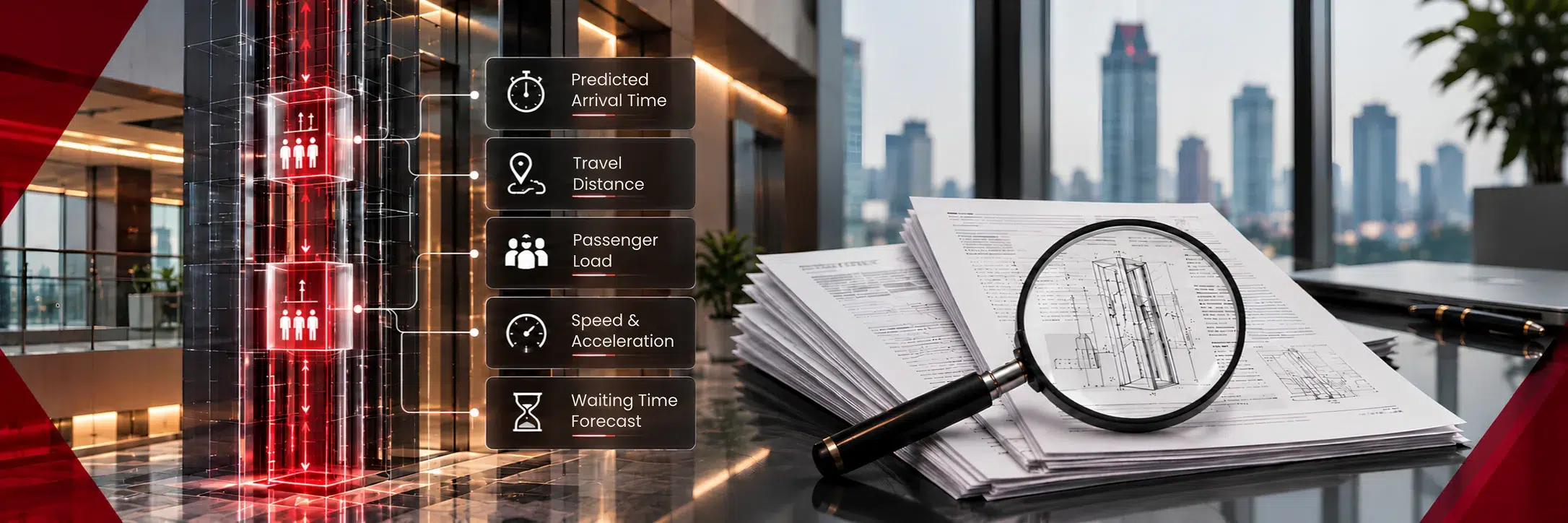
Identified a highly relevant prior-art lead connecting passenger-load changes, travel distance and waiting-time forecasting.

Prior Art Search Methodology

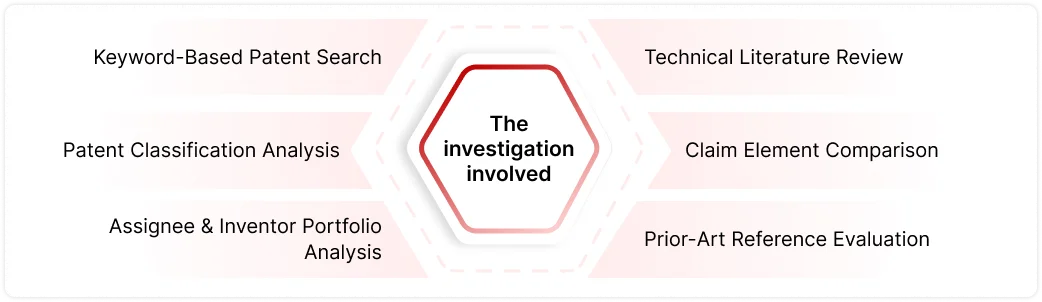
The investigation followed a structured prior-art search methodology, combining keyword-based searching, patent classification analysis, assignee research and technical literature review to identify relevant disclosures.

Smart Elevator system methodology

The investigation initially identified several promising Mitsubishi Electric patents addressing per-floor arrival-time calculations and round-trip time.

The reported breakthrough was the identification of USXXX874, attributed to Marja-Liisa Siikonen, which described waiting-time forecasting in relation to changing passenger load and travel distance.

Technical Challenges Addressed Through Prior Art Analysis

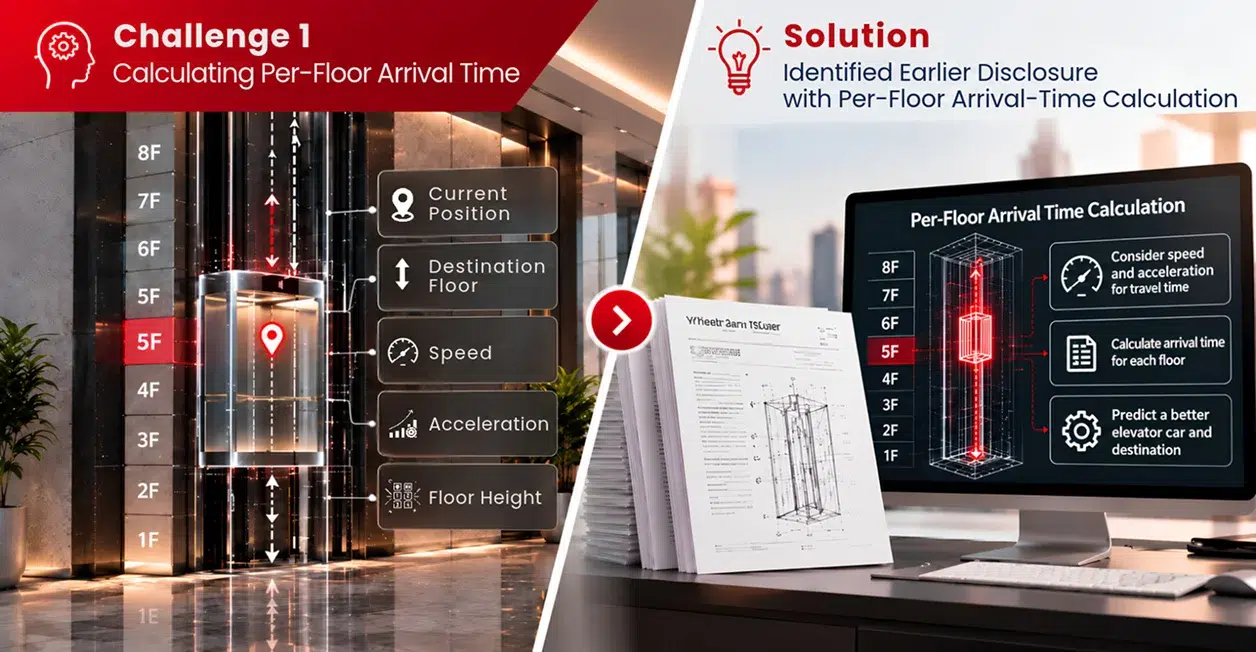
Challenge 1: Calculating Per-Floor Arrival Time

A key challenge was determining how the elevator system calculated moving distance and predicted arrival time for each floor, considering the elevator’s current position, destination, speed, acceleration and floor height.

Solution

The investigation identified a Mitsubishi Electric patent, USXXX050, reportedly describing per-floor arrival-time calculations for multiple elevators.

The analysis highlighted:
  • Floor-by-floor arrival-time calculations.
  • Consideration of speed, acceleration and floor height.
  • Evaluation of elevator movement and travel-time prediction.

These findings provided a relevant basis for comparing the subject patent’s arrival-time calculation concepts with earlier elevator-control disclosures.

elevator calculating time per floor
Challenge 2: Predicting Waiting Time Based on Passenger-Load Changes

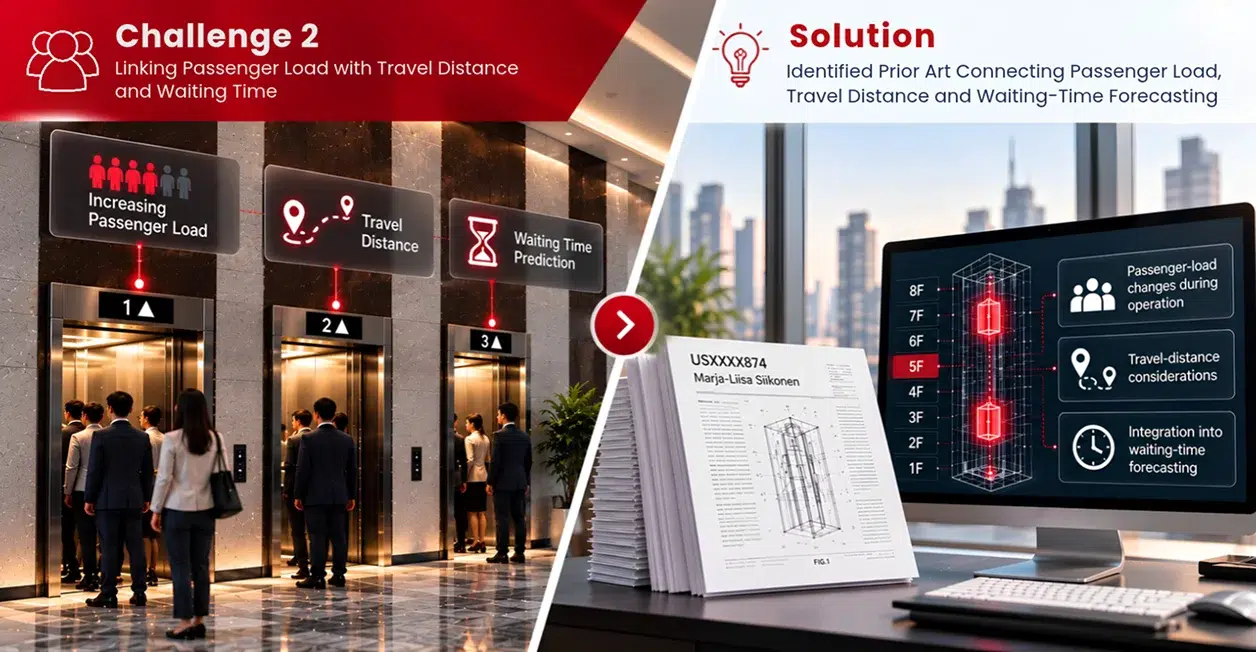
Another challenge was identifying prior art that connected changing passenger loads with travel distance and predicted waiting time. The investigation needed to determine whether earlier systems considered passenger boarding and off-boarding when estimating elevator service times.

Solution

The team expanded its search through patent classifications, inventor-related publications, and technical literature on elevator group control, Round-Trip Time (RTT) and Waiting-Time Forecast (WTF).

The investigation identified USXXX874, attributed to Marja-Liisa Siikonen, as the strongest reported lead. According to the project findings, the reference connected changing passenger load and travel distance with waiting-time forecasting.

The analysis highlighted:
  • Passenger-load changes during elevator operation.
  • Travel-distance considerations in waiting-time prediction.
  • Integration of load and distance factors into elevator scheduling.

These findings established a promising technical connection to the subject patent’s allocation concepts, subject to verification against the complete disclosure and relevant claim limitations.

elevator case study image

Results & Business Impact

The investigation identified a highly relevant prior-art lead addressing key aspects of intelligent elevator allocation, including travel-distance calculations, passenger-load variations and waiting-time forecasting.

Key Outcomes

  • Identification of relevant patent references addressing elevator travel-time calculations.

  • Discovery of classification-based search pathways for passenger counting and destination calls.

  • Identification of technical literature on elevator group control and waiting-time prediction.

  • Prioritization of USXXX874 as the strongest reported prior-art lead.

  • Establishment of a focused basis for further claim-level evaluation.

Strategic Business Impact

By combining keyword searches with classification analysis, assignee research, inventor-led searching, and technical literature review, the investigation expanded beyond conventional search approaches.

  • Improved Search Efficiency
  • Broader Prior-Art Coverage
  • Stronger Technical Assessment:
  • Targeted Claim Evaluation

The investigation demonstrated how a structured, multi-source search strategy can uncover promising prior-art leads under tight timelines. The reference’s legal significance would depend on verification of its publication date, complete disclosure and correspondence with the relevant claim limitations.

Need Support for Complex Patent Investigations?

Our experts uncover relevant prior art through structured patent searches and technical analysis to support informed IP decisions.